The Cowboy Teals
After Dan Osborn's run in 2024, a number of independents in the American West are running for Senate. Can their candidacies succeed, and what does it symbolise for Democratic parties in red states?
About two years ago, on a different blog1, I made a post about an electoral phenomenon I was noticing in British politics, which I gave the somewhat pithy name ‘socialist teal independents’. These were left-of-Labour independent candidates, running either because they had been actually kicked out of Labour or out of dissatisfaction with the party’s position on Gaza. I called them socialist teals because I was reminded both of the way they resembled a handful of disaffected, climate-conscious ex-Liberals who ran at the 2019 election, and because of the way some of their rhetoric mimicked the language Australian teal independents. Namely, a lot of platitudes about being ‘selected by the community’ serving mainly to symbolise a vague commitment to doing politics differently.
I wasn’t sure at the time if any of these ‘socialist teals’ would succeed, but I did say that their performance would likely demonstrate a constituency for their sort of politics, that could be improved on come the next election. In the end, five independent MPs won at the 2024 general election — Jeremy Corbyn in Islington North, and four others campaigning on opposition to Labour’s Gaza policies. Five might seem like a lot, until you remember that the British House of Commons elects 650 MPs.
Subscribe nowMy latter prediction seems to have become half-true. On the one hand, the effort of Corbyn and this ragtag crew of independents to form a party has mainly been a laughing stock. On the other, the English Greens have capitalised off left-wing dissatisfaction from the Labour government of Keir Starmer, and won a by-election in February from Labour. At time of writing, the replacement of Starmer with Andy Burnham seems to have blunted the Greens’ momentum2, but they’re still polling at about 12% nationally, and I would expect them to improve.
Now, looking at the United States of America, I see something similar happening. Not in terms of ideology (if you want a breakdown of the DSA’s rise, look elsewhere — or maybe pester me to write about it), but I see the rise of a group of independent candidates who share a similar strategy, ideology, and general vibe, so I’m here to give them a pithy name.
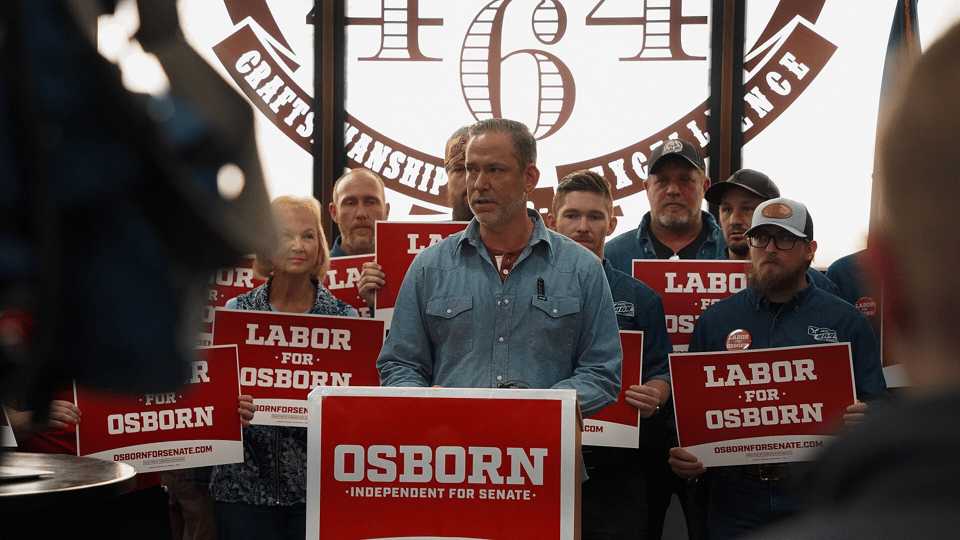
Dan Osborn is a union leader from Nebraska who first ran for Senate in 2024 as an independent candidate. One of the first times I read about him was in The Intercept in late 2023, who were reporting on a poll that showed him ahead of the Republican incumbent, Deb Fischer, by two points. This was impressive by itself, given that Fischer was last re-elected by 19 points against a Democrat, and this was in 2018, a wave year for the party.
But US Democrats have a history of being burned by the polls. This poll, in specific, had a few warning signs about it — he polled 40% to Fischer’s 38%, suggesting a large amount of undecideds who would probably break to Fischer in the end. It was commissioned by a liberal3 firm, Change Research. And most importantly, it just seemed too good to be true. You can run a union leader on a left-wing populist platform and contend in Nebraska so long as you run on an independent ticket?
It seems like wishcasting, and indeed Democrats did have a track record of this sort of thing failing. Greg Orman in 2014 couldn’t win in Kansas, Al Gross and Alyse Galvin in 2020 couldn’t win in Alaska, and Evan McMullin in 2022 couldn’t win in Utah. All probably outperformed what a mainstream Democratic candidate would have, but in the end, polarisation caught up with them all. When push comes to shove, ruby-red Republican states will opt for the devil they know over the independent they don’t.
Except…
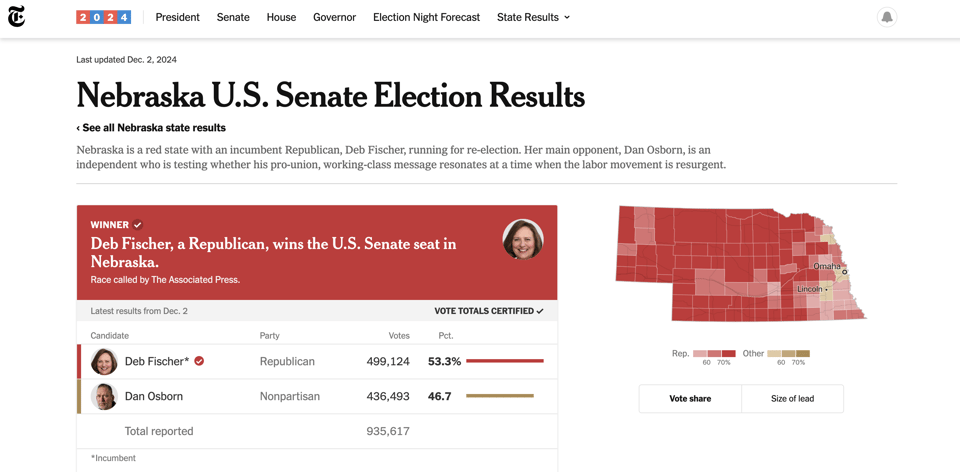
Osborn didn’t end up winning, as you can tell. But he did run a lot closer than partisan polarisation would suggest he might have. Donald Trump carried Nebraska by 20 points, Fischer only managed to win by 6.6.
Dan Osborn had a few things going for him. The most obvious is that there was no Democrat on the ballot, so he had a head-to-head race against Fischer. This was accomplished in part by some stunning duplicity, with Osborn initially seeking the endorsement of both the state Democratic and Libertarian parties, but declaring a day after the primary elections that he would refuse an endorsement from any political party, too late for the Democrats to put a candidate of their own on the ballot.
Although his persona was that of a union man, Osborn also meaningfully shifted to the right in the campaign. In an opinion piece for Fox News, he expressed support for Trump’s border wall and attacked Fischer for falling short of conservative principles. An ad supporting Osborn declared that he was “the only real conservative in the race”.
This strategy has some obvious weaknesses, and I personally didn’t think it would come all that close to working. Dan Osborn did not quite prove me wrong, but he did get closer than I expected. A 6.6 point gap is the sort that can be bridged fairly easily. In the Australian parlance, it’s a marginal seat. In a more left-leaning year, or a year with lower Republican turnout, Dan Osborn might have won.
And that brings us to 2026. As of the time of writing, Democrats lead the generic congressional ballot by 6.4 points (per Nate Silver’s analysis). The President of the United States can’t stop posting about bombing Iran on Truth Social. A guy like Dan Osborn could stand a much better chance of winning.
Osborn is running again for Nebraska’s other Senate seat, currently held by Republican Pete Ricketts. But the 2026 US Senate elections have also seen a number of other independent candidates throw their hats into the ring, with more or less the same implied pitch — the Republican might be able to lose, but a Democrat can’t beat them.
Seth Bodnar, the former president of the University of Montana, has thrown his hat in as an independent for that state’s Senate race, with the tacit support of former Democratic senator Jon Tester. In Idaho, Todd Achilles, a former Democratic state legislator, is running as an independent. And in South Dakota, Brian Bengs, who ran for Senate in 2022 as a Democrat, is trying again as an independent.

It was Bengs’ campaign website that inspired me to nickname this motley crew the cowboy teals. It’s not a perfect nickname — former academic Seth Bodnar seems more James Talarico than old West, and as mentioned earlier, Osborn’s archetype is clearly that of a disgruntled union man more than anything else — but I think it works well enough. “South Dakota’s Independent” reminded me too much of Monique Ryan to pass up on the pun, anyway, and I just didn’t think “Four Random White Guys Running For Senate in The American West” made for as punchy a title.
But in any case, the plan for victory seems clear. Get a clean run against the Republican incumbent who no-one much likes, talk a lot about how both major parties are terrible and all the broadly well-approved things you’ll do if you get elected. Hope you can scoop up all of the left-of-centre vote and disaffected conservatives to sail to victory.
Osborn and Achilles will get a head-to-head race against their states’ Republican incumbents come November. But in Montana and South Dakota, Democratic candidates have so far stayed in the race. Perhaps this doesn’t make as much of a difference in South Dakota, which Trump won by 29 points, but I have seen lots of consternation about Montana around.
Subscribe nowPolling at the moment seems to suggest that Bodnar, in a one-on-one race against Republican Kurt Alme, would likely win. This may be because Montana is a relatively winnable state for Democrats in years that they are doing well. It also might be because Montana Republicans tried a shockingly brazen trick, with incumbent Steve Daines dropping out of a re-election bid minutes before the filing deadline, securing the nomination for Alme, an attorney, who filed to run eight minutes before nominations closed.
But, at time of writing, Democratic candidate Alani Bankhead is still in the race. She believes that it is Bodnar who should drop out, but most tend to view her as the spoiler. Her fundraising has been shockingly poor, raising only $35,000 in the last quarter to Bodnar’s $1.1 million.
G. Elliott Morris, formerly of 538, describes the race in Montana as a question between whether a Democrat should win or a Republican should lose. Polling shared with Morris indicates that, in a head-to-head against Alme, Bodnar would win by 6 points, while Bankhead would lose by 8. If these are accurate, Bankhead is clearly the weaker candidate.
On the face of it, the calculus seems simple. A Democratic candidate is unlikely to win because of how negatively the party is viewed in red states, so Democrats should drop out for independent candidates. It is the position the Nebraska and Idaho Democratic parties have found themselves falling behind, and the stance a whole lot of Democrats want Bankhead to take. (Bankhead most recently said she would only drop out “if a lightning bolt from God struck me”.)
I think this view is intuitive, but also misses something important, and to make this point I’m going to talk a bit about Hungary.
A very important caveat here — I am not Hungarian or indeed a particular expert on Hungarian politics. I have found myself reading about it a decent bit as of late, but mainly due to the rule of law conflicts with the European Union, and not specifically what I’m about to talk about. I may end up saying something laughably incorrect, so I am going to try to speak very broadly.
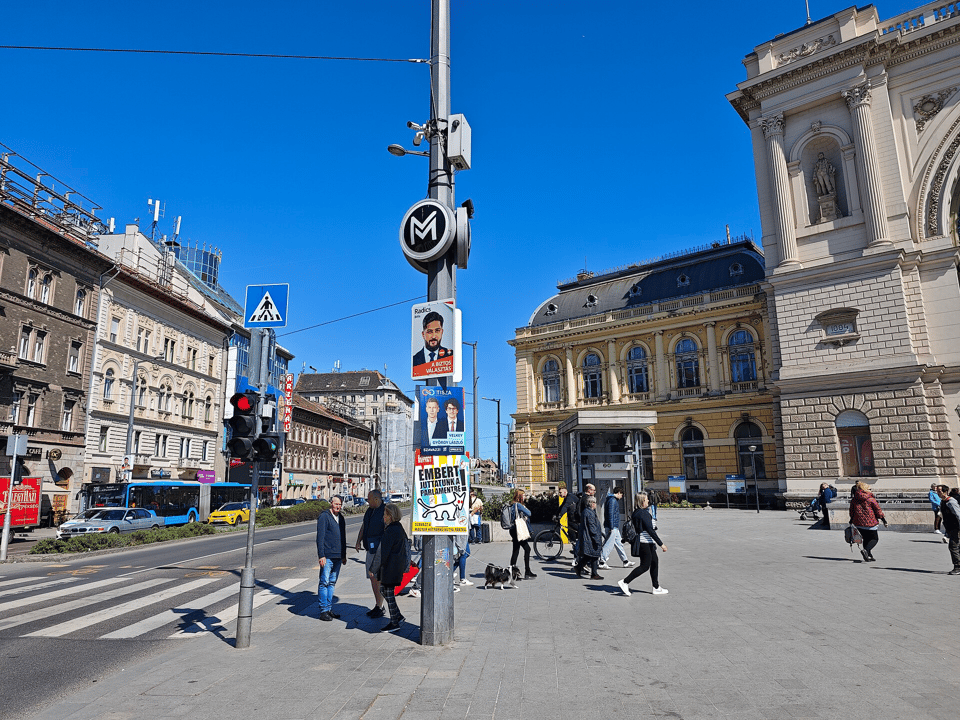
In April of this year, the sixteen-long rule of Viktor Orbán’s Fidesz party ended. They were swept out of power by opposition leader Péter Magyar, who campaigned mainly against corruption in the government. A unity opposition ticket at the previous 2022 elections against Fidesz had failed, and the 2024 European Parliament elections showed that Magyar’s new Tisza Party had largely supplanted the extant opposition parties.
Fidesz had been known for blatant violations of the rule of law, consolidating media and government power under themselves, attacking the European project, and broadly establishing a model of ‘illiberal democracy’ that was the envy of many right-wing populists across the world. To steal a line from a friend, a veritable Fascist Internationale of leaders endorsed Orban at the 2026 election, with US vice president JD Vance even campaigning for Fidesz in Budapest.
Magyar was initially a Fidesz member and functionary. His opposition to the party is recent, and he is generally considered to be a conservative-leaning politician. Tisza refused to work with existing opposition parties. For those opposition parties, a dilemma now existed — do you throw all of your hopes behind Magyar and the Tisza Party, at the expense of any hope of parliamentary representation, or do you stay in the race and perhaps allow Orban to win another term?
Most Hungarian opposition leaders found the answer obvious. I quite rate this report from Politico, which contains a number of interesting quotes from Hungarian opposition politicians, but the one that stuck out from me was this one, from Timea Szabó, who herself stood down for a Tisza candidate: “Hungarians would vote for a goat at this point if it was running against Orbán”.
Subscribe nowAnd this is quite intuitive. When you are facing an entrenched, authoritarian government hellbent on expanding its power at the expense of the average person, you will be willing to make some ideological compromises to kick them out.
I bring up Hungary for a few reasons. One is that I think Orban’s Fidesz is a fairly helpful model to understand where the US Republicans — or at least the smart ones — tend to want to end up. It’s less sending the army in to seize ballots, more controlling the media and opposition to make sure you don’t lose. Illiberal democracy as opposed to a violent coup.
But the other is that I think it’s worth looking at where the opposition outside of Tisza ended up. The Hungarian National Assembly after 2026 contains no representatives to the left of Tisza. The only other parties which won representation were Fidesz, its ally the KDNP, and the far-right Our Homeland party. The opposition parties that had existed beforehand were entirely wiped out, because they had mainly chosen to fall behind Tisza.
You can’t solely credit this to capitulation from the non-Tisza opposition forces. As I mentioned earlier, Tisza trounced the opposition (but not Fidesz) at the 2024 European Parliament elections, and Hungary’s majoritarian electoral system incentivises lining up behind one particular party. After years outside of power, Hungary’s opposition seemed impotent and ineffective at countering Fidesz, paving the way for Tisza to supplant them.
Sound familiar?
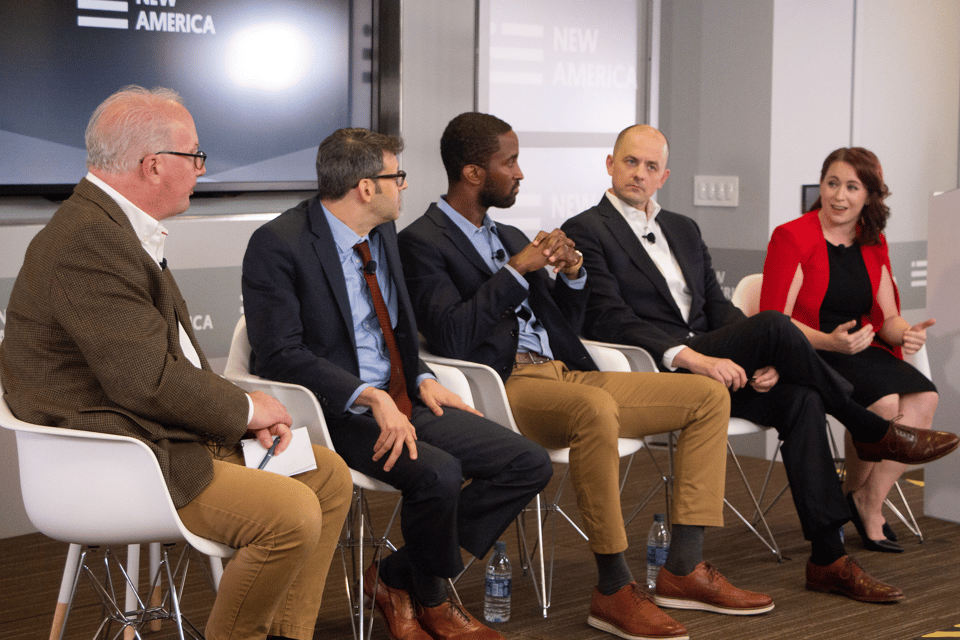
I mentioned Evan McMullin’s failed Senate candidacy earlier. McMullin first gained prominence around the time of the 2016 presidential election, when he was standing as an independent candidate against Hillary Clinton and Donald Trump. Many conservative voters at the time were disgusted by Trump’s acts and rhetoric, and McMullin billed himself as the only conservative running.
In 2022, he ran for Senate as an independent against Republican Mike Lee. He was endorsed by the Utah Democratic Party, who viewed him as the best candidate to defeat Lee. McMullin lost by 10 points.
To be sure, this was an impressive result in a state like Utah. Split Ticket has an interesting analysis of it, and it’s especially remarkable when you consider that Trump would carry Utah in 2024 by 21.6 points.
But McMullin’s candidacy meant that Democrats had no voice at the top of the ticket. It likely harmed Democratic support further down the ballot, specifically in the state legislature. Katie Adams-Anderton, then the chair of the Utah County Democrats, said that the McMullin endorsement harmed party enthusiasm and turnout.
I have neither the time nor the knowledge right now to do an extensive, data-driven into the effects backing independents has on Democratic chances downballot. But the key problem that these cowboy teals cause for state Democratic parties ought to be clear.
It’s a very top-down, single-minded model. Your average Democrat does probably think that it is extremely important to keep Republicans out of the Senate, just as it was extremely important to get Fidesz out of office. If the only price to pay for that was a loss in ego, not getting to vote for an ideologically aligned candidate, most probably would pay it.
But the cowboy teals promise little beyond a Senate seat. In fact, a lot of what they campaign on is actively detrimental to the Democratic Party. If you are sledging both parties as corrupt and as bad as each other, that is likely to help the one that has entrenched itself in power, and harm state Democrats’ chances.
There aren’t cowboy teals running for the state house and flipping seats from Republicans, because part of the model is being a straight talker running in an absurdly Republican state, thus attracting fundraising from national Democrats. Saying “I’ll flip a state district in Sioux Falls” is much less enticing of a prospect than “I’ll flip South Dakota’s Senate seat”.
Even then the trade-off might be worth it. But the problem is that there hasn’t been an outrageously compelling proof-of-concept. Yes, Osborn came close in Nebraska. Yes, there’s a whole bunch of polls that show Bodnar leading in a head-to-head, or Achilles and Bengs trailing by only four points.
But ultimately, a Senate seat is an all-or-nothing game. You can outperform partisanship by astonishing numbers and win counties and precincts that haven’t been won by Democrats in years, but if you still lose to the Republican, what does it matter?
If you’re running with the infrastructure of a political party, a rising tide tends to lift all boats. For example, even though Beto O’Rourke lost to Ted Cruz by three points in Texas’ 2018 Senate election, Democrats still gained downballot, at both the federal and state level. O’Rourke’s political career crashed and burned after a failed presidential and gubernatorial run, but a Democrat might well win Texas’ Senate seat this year.
It seems pretty unlikely that a Democratic Senate candidate could win in Idaho, South Dakota, Nebraska, or Montana. But there are still state races to win on the local level, Republican supermajorities that could be broken. Montana, once a state with a history of political independence, has seen its Republican Party, and thus its governance, take a hard turn to the nationalist right.
Maybe, as in Hungary, it will take a whole different movement or party to unseat Republicans in these states, and the prospect of unseating a federal right-wing Republican senator will simply be too enticing to squander.
But I do wonder what will happen if these cowboy teals are successful. I suspect the Democrats will probably flip the Senate come November, and that all of these candidates we’ve talked about will likely drastically overperform their state’s partisan leanings, just as Osborn did in 2024. Some might even win, though I don’t think I’ll believe it until it happens. What will be left for the state branches of the Democratic Party to win, after they’ve spent months propping up candidates who claim to stand against them? Ultimately, the question I am most interested to answer is: will the gamble pay off?
If you’re keeping track, I have kept two blogs — one on Substack, which you can still read but which I’ll no longer use for a number of reasons (the Nazi thing, but mainly because it is age-gated in Australia now, meaning I’d have to hand over my ID to even keep using it), and one on Ghost, which is unfortunately gone. I had two quite good blog posts on there about One Nation and Australian politics but neglected to archive them, and Ghost wipes your blog the moment your subscription ends. Disappointing! ↩
In a by-election for the Greater Manchester mayoralty, the Greens received 12% to Labour’s 47%. ↩
As an Australian, it makes my teeth itch to use ‘liberal’ to mean ‘broadly progressive’/’left-of-centre’, but I did so anyway as a concession to American readers. ↩