Helen Haines, Creative Commons, and Empathy
About four years ago, I was a nerdy teenager interested in editing Wikipedia. The 2022 federal election had just taken place and one of my little bugbears was how difficult it was to find good photos of Australian politicians.
In the United States and the United Kingdom, the photos that national legislatures take of their politicians are in the public domain. Although there are some professional photographers who make their work available under Creative Commons licenses (such as Gage Skidmore), most national politicians, ranging from the Secretary of Agriculture to the Member of Parliament for Bexleyheath and Crayford, already have good and high-quality photos available for free use.
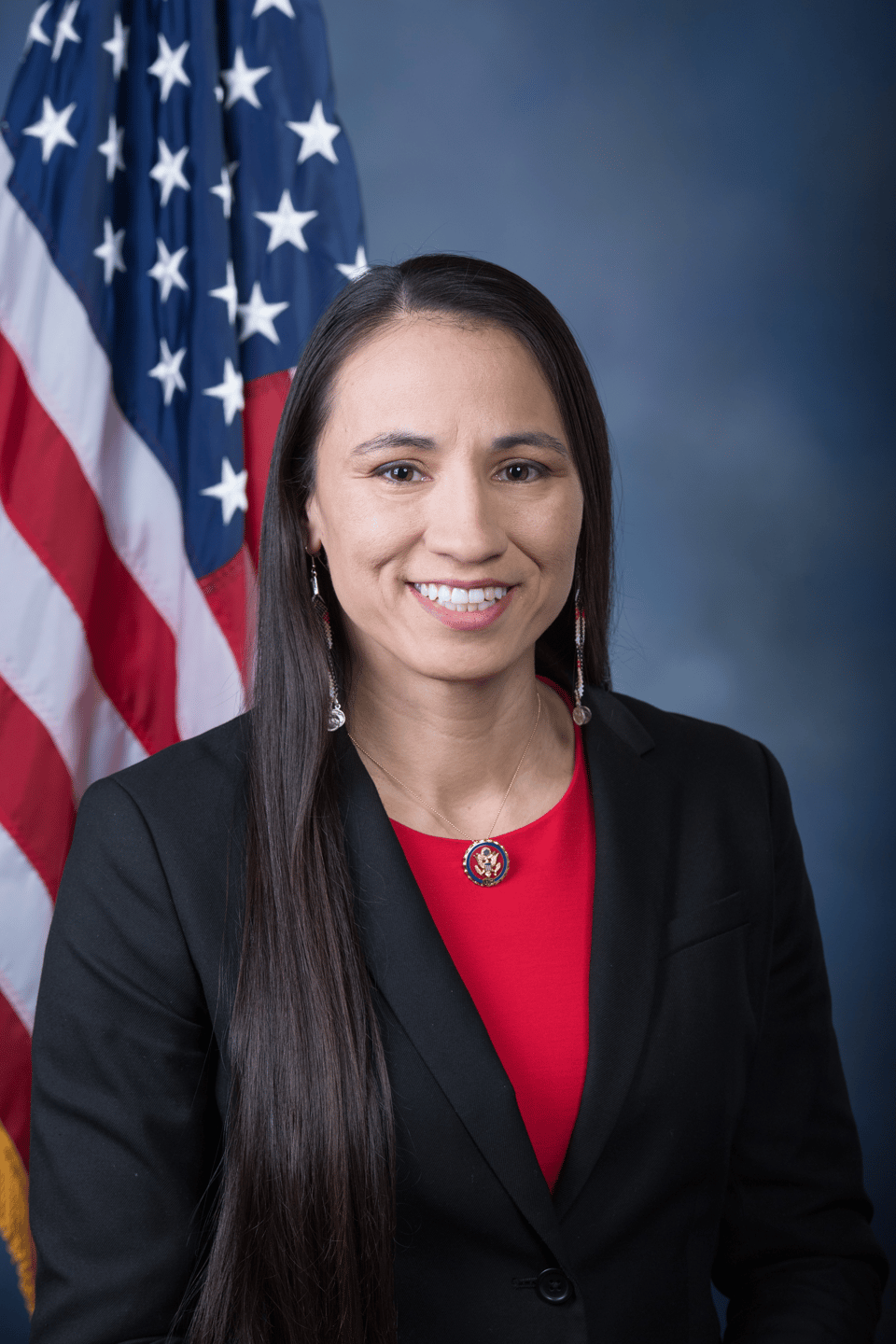
Wikipedia takes the whole ‘free encyclopaedia’ thing very seriously. While it probably wouldn’t be practical to pay for and obtain the rights to a bunch of images of politicians through, say, Getty, or any other stock image provider, it also is against the wiki’s principles. One of Wikipedia’s five pillars is that it is “free content that anyone can use, edit, and distribute”. You can criticise this as idealist, unrealistic, or simply an artifact of a time when the internet was different, but I quite like it, and I think the whole “contributing to the sum of human knowledge” mission (which is broadly why I edit) is incompatible with a paywall, and incompatible with copyright.
Unfortunately, Australia does not make its photos of parliamentary representatives available in such a way. In fact, copyright law in Australia is shockingly restrictive, as epitomised by the fact that the Aboriginal flag was under copyright until a few years ago.1 But this means that photos of Australia’s MPs on Wikipedia can range from the obvious copyright violations, blurry crops from a public domain photo, or low-resolution shots by amateurs on the go.
And now we go back to a slightly younger me, who was looking to be one of those amateurs. I had been keeping my eye on the Australian Electoral Commission’s list of declarations (which newly elected MPs and defeated candidates usually showed up to) and was disappointed as most of them tended to clash with the days I needed to be at school. But there was one that didn’t, though it was a bit of a train ride away for me.
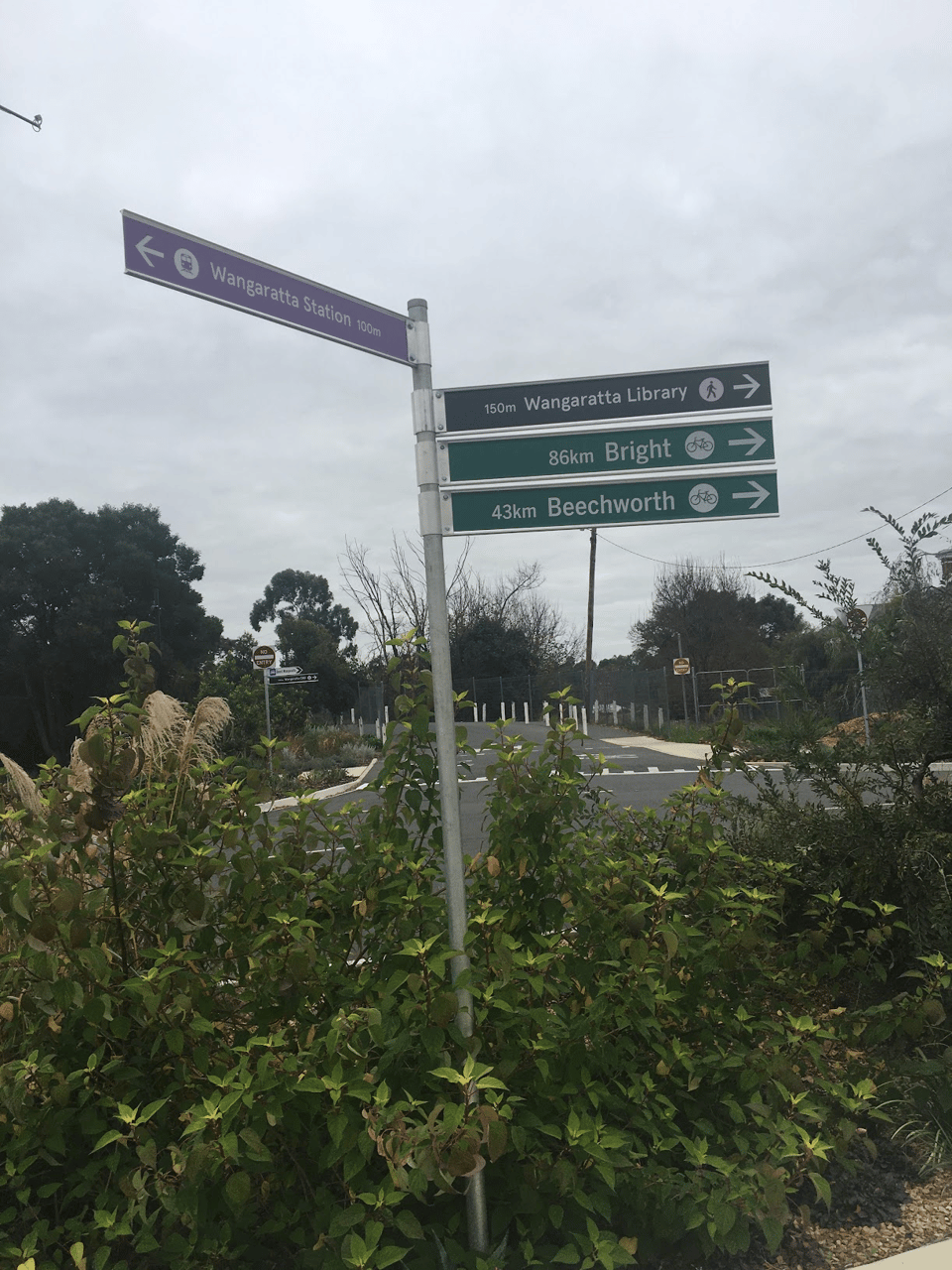
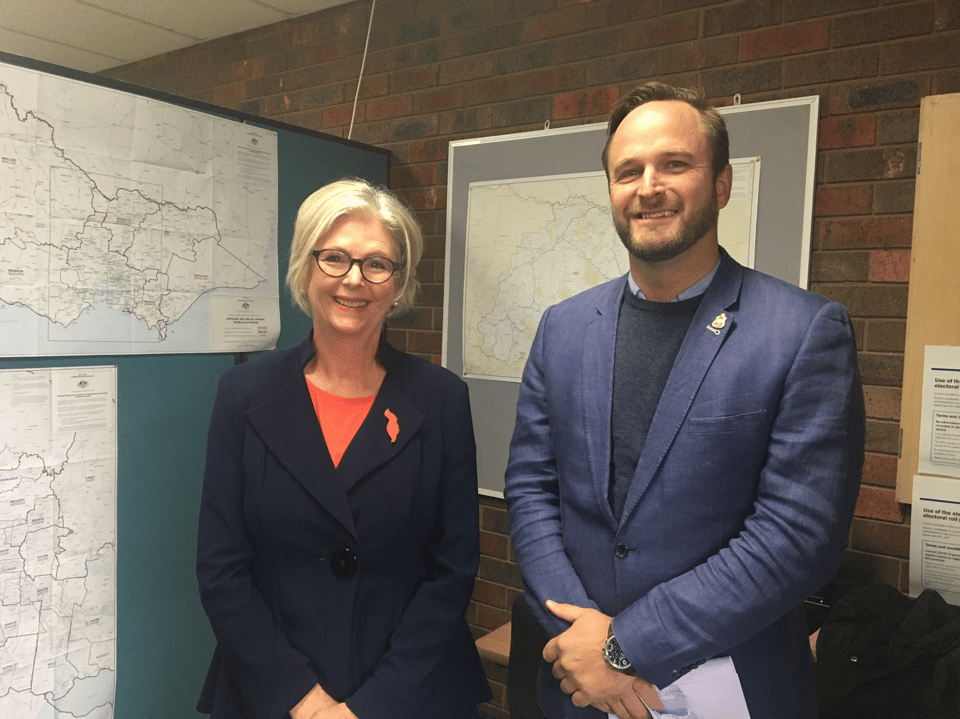
I had wanted to get up to Indi because the re-elected independent MP there, who had been in Parliament for three years, didn’t yet have a photo on Wikipedia, plus I probably was just keen for the train journey. Wangaratta’s a nice enough town and I hadn’t been there before. I had arrived to the site of the declaration a bit early, before anyone else had arrived aside from the AEC people, but the next person to arrive was, as it happened, Dr Helen Haines and her staff. I introduced myself and shook her hand and such. She was very nice to me, I told her I was a student and that I’d come down from Melbourne. I was rather socially awkward (still am) and most of my future interactions with politicians would be similarly respectful and courteous, but I remember thinking she was rather lovely.
Eventually the Liberal candidate, Ross Lyman, showed up, and so did some journalists. The candidates spoke, the result was declared by the AEC officials, and I was part of my first ever press scrum with a couple of regional journalists out Wangaratta way.
The years ahead had more for me than just sitting on my laptop and editing Wikipedia, as it happened. My geeky interest in politics didn’t go away but I wasn’t focused so much on getting photos of politicians, until the 2025 federal election came around. Then I thought it might be a good idea to try what I had done again, first at a ballot draw, then afterwards at some more declarations. In 2022 I had used my iPhone 6, in 2025 I had a slightly more sophisticated digital camera.
Later in the year I decided to sink some money into a proper DSLR. It was second-hand from Cash Converters but it did the job. I started going to more events and taking photos for Wikipedia, some of which I’m properly proud of. Earlier in the year I flew to Adelaide for a few days in the hopes of getting around to election events to photograph candidates. This went quite well, and I was looking forward to doing more of the same in the lead-up to the Victorian state election. After all, I live in Victoria, and a flight is considerably more expensive than a V/Line train and a taxi. Surely I’d be able to cover more than I did in South Australia.
The first forum that I went to was at the start of this month, in a tiny country town about 25 minutes out of Ballarat called Newlyn. It was set up by a group opposing the AusNet transmission lines in the area, so I certainly expected it to be right-of-centre, but I’ll admit to being kind of shocked by the atmosphere in the room.
Doing this photography stuff has often brought me to places where people are more conservative and right-wing than I am. I wasn’t exactly shocked that this room would probably elect a One Nation MP if given the chance. But what I was surprised by was how hostile they could get when faced with views they found highly disagreeable from the candidates. Two representatives from the Greens2 had showed up, and when the first began her speech with an acknowledgement of country, the room booed. Perhaps I am showing my ignorance here, but this is something I have never seen before in my life. And when the second started listing off One Nation policies that he found the most objectionable — putting 10 year olds in prison, making parents liable for their kids’ criminal damage — the room started cheering.
It was something that I don’t think a lot of us in the cities are frequently exposed to (outside of in screaming matches on the internet), and it left me with a lot of thoughts. My bus back to Melbourne took me further out into the country, but via North Northcote, and it was pretty surreal going from that event to seeing placards from the Greens pop up on the same country road.
The second event I went to was earlier in this week, on the Mornington Peninsula. I had been down there already for the Nepean by-election and had more of a sense of what to expect, I wasn’t particularly surprised that no-one at the fancy footy pavillion booed the acknowledgment. It felt like a more normal politics.
At the very beginning of the debate, I saw a friend say that Helen Haines had been hit by a car. I assumed it was a terrible accident and hoped she was alright. At a press conference about an hour later, the Prime Minister stated that Haines had been attacked. The debate ended with a note from the moderator for thoughts and prayers for Helen Haines, which seemed to leave some of the crowd a bit perplexed. Most like as not hadn’t heard of the attack on Haines up until right then.
Over the last 24 or so hours I’ve had a lot of thoughts on this. Hoping for her recovery, obviously, worries about political violence, upset at the rolling coverage live blogs to some degree. But a lot of them have felt weirdly selfish. I hope you’ll indulge me this tangent.
Somewhere in my thoughts as I was heading back from the Mornington Peninsula I remembered that photo I had taken four years ago of Helen Haines. Someone had replaced it, which I was pleased by as my photo was a very amateur piece of work. I’m glad I went out and took it but I’ve done much better, so I must have felt mildly embarrassed about it.
The next day I was keeping an eye on her Wikipedia page. My photo of her wasn’t there, but another one I had took that day was: a photo of her electorate office.
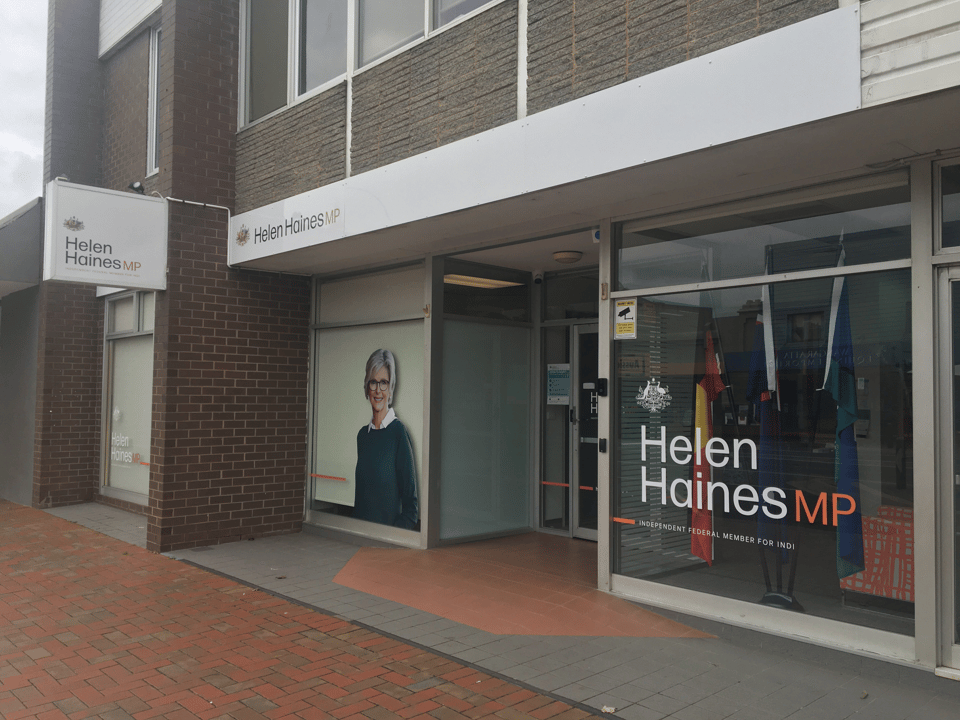
Initially I just assumed this was there as a way to make the article a bit more visual, until I realised that the attack on Haines had taken place right out the front of her electorate office. And Christ, a lot of photos I’ve taken have aged weirdly, but I don’t think I ever expected one would show up as the site of an assassination attempt.3 I looked again at the photos that I’d taken from the day, some of the oldest in my photo gallery.4
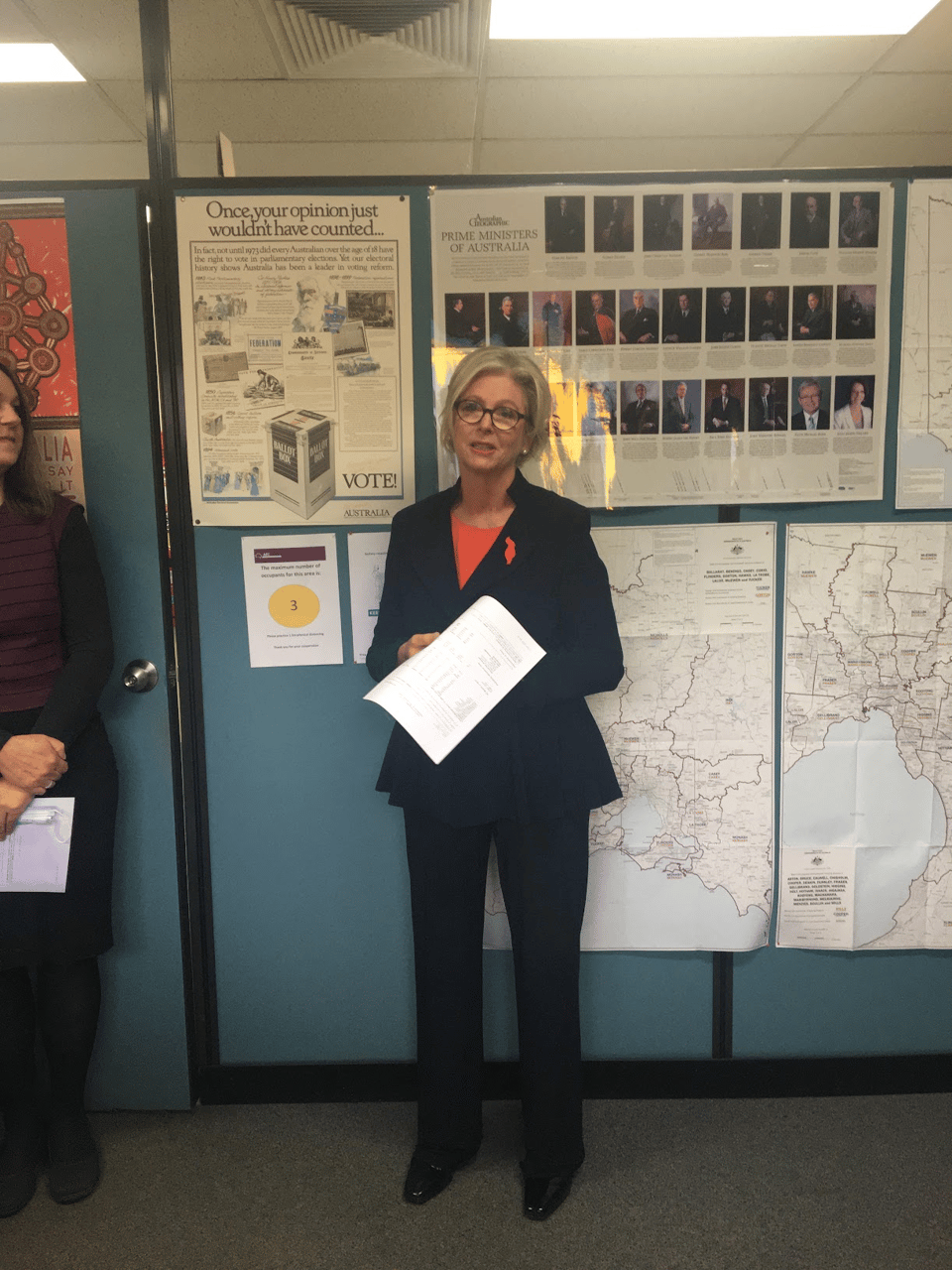
It was deeply weird to look back at these. I mentioned above that I really sort of detest the rolling coverage of the attack on Helen Haines to the point of live updates on which body part of hers the doctors might have to amputate, but in case you didn’t know, Helen Haines has lost one of her legs at the time of writing. Ergo, the image above5 is one of the few Creative Commons images of Helen Haines with two legs.
That feels morbid and voyeuristic to write, especially considering my connection to her is almost entirely incidental. In isolation, I probably wouldn’t be writing this. It gives me the same feeling as when the bride at a wedding I got dragged along to as a kid died a few months later. Terrible, bizarre, and tragic, but who am I to say anything about it?
It might indeed turn out to be that the attack on Helen Haines was, while certainly not random, not motivated by any particular political conviction. But it is unsurprising that the conversation has been less about a freak accident and more about the manifestation of a terrible phenomenon that’s been brewing under the surface for a while.
At the Ripon debate, I was standing next to a man who appeared to have a bizarre grievance against Bev McArthur, a conservative Liberal Party MP, for supporting solar panels, on the basis that her deceased son had run a business for solar panels and she had some on her family farm. Threats to politicians, and specifically female MPs, are disturbingly common.
There is a lot of talk right now about the implications this sort of stuff could have for our democracy, and how already MPs had stopped promoting events online for fear of violence. As I write this, an article in the Guardian has just come out on the same issue, discussing the issue of tightened security for MPs.
I can speak less to the issue of violence and death threats, but I can speak a little bit on the latter. As someone who has spent a good amount of my free time in the last few months trying to meet MPs in public for entirely innocuous (if a bit odd) reasons, it is often difficult to find publicly advertised events that members of parliament will be in attendance at, outside of in the direct lead up to an election. I’m sure some of you might bemoan this as the typical state of things but it really has changed.
The main thing I hope for right now is for Helen Haines’ health and wellbeing. Certainly, if members of parliament were to become more inaccessible to the public, it would be bad for the little project I like to do, but I would gladly accept it if it meant keeping our elected officials safer (notwithstanding the other, greater consequences of tightened security and lessened transparency around MPs).
A lot of people I follow on social media were very quick to say that this was likely an attack from a far-rightist, or a ‘cooker’. An obviously satirical tweet was passed around as evidence that the attacker liked Pauline Hanson. I don’t blame people for thinking this, and it wouldn’t surprise me if it was true, but the indications seem to be that it isn’t.
I think that if you are disturbed by my mentioning of people cheering for 10-year-olds in prison, then you should at least have a little bit of pause at this. I have no doubt it comes from genuine concern and fear, but the risk of these sorts of things becoming screaming matches about what the attacker’s motives were misses the point, to me.
I hope that we can learn to have a bit more empathy about the way that we treat people. Yes, this is obviously true about some on social media leaving vile comments about female MPs, but I’d invite you, the reader, to think about ways you can apply this yourself.
My photography has meant that I’ve often interacted, if briefly, with people who’s views I consider deplorable, or whom I have a very strenuous objection to on one thing or another. Helen Haines was not one of these people, to be sure, but I certainly didn’t agree with all of what Bev McArthur’s voted for and some of the things she said at that debate.
I don’t mean to turn this into a plea for tolerance and agreeableness, of ignoring dissent out of kindness. People have strong views and in a democratic system it’s alright to express those. But I will say that it is worth using a bit more empathy when speaking about politicians, and to politicians. You can address someone’s beliefs without targeting their character or their personhood. If you start thinking of someone as less worthy of respect, or more deserving of ridicule and mockery, solely because of a political disagreement, it can lead to some very stubborn thinking and nasty views.
I’d invite you to reflect upon the things you say online, the things you share, the things you see, and consider whether they’re really fair. Is this harsh but justified invective, or is it gendered abuse? Can I make this point in a way that is kinder to the other person?
I don’t think this is a cure-all but it’s all I have for now. Politics has seemed nastier and more dangerous than it ever has before in my lifetime. It’s been inspiring to see the bravery of bystanders and the strength of local community after the attack on Haines, but I don’t know that it can fix the problem at the root here. I think only a structural, society-wide change can do that. Right now I hope that Helen Haines recovers to good health, and that in four years we’ll look back at this as a horrible aberration.
I’m a bit iffy on this case specifically because I do think the man who designed it, Harold Thomas, does deserve to see a share of the wealth from his creation (this country has taken enough from Indigenous people) but I mention it because the simple design of the Aboriginal flag would lead to a copyright case being laughed out of an American court, and probably most European ones, for not meeting the threshold of originality. ↩
Sarah Mansfield MLC and Tim Drylie, the Greens candidate for Ripon. ↩
The motives of the man who ran over Helen Haines are not yet known. ↩
I got a new phone in May 2022. ↩
I didn’t actually upload this one to Wikipedia but, for the record, the photo above is available under a Creative Commons BY-SA 4.0 license. ↩