A Preliminary Look at the Māori Seats
A look at the results in the Māori electorates at this year's general election, and what it might potentially mean for Te Pāti Māori going forward.
I didn’t think there was going to be an election-changing overhang in last Saturday’s New Zealand election.
I flagged the possibility of it in my August blogpost on which major-party politicians would be re-elected1, and while I was correct to identify that even the highest of positions on National’s party list weren’t a sure thing, I didn’t actually think an overhang was all that likely.
Since I put out that blog post, Te Pāti Māori announced that they would focus only on the electorate vote, explicitly encouraging its supporters to party vote Labour or Green. And right-wing billionaire Harry Mowbray launched a ‘Split Your Vote’ campaign, encouraging people to give their party vote to ACT or New Zealand First, and their electorate vote to National.
Both of these had the goal of explicitly inducing an overhang: if Te Pāti Māori were to win all seven of the Māori seats, but only receive 1% of the party vote (which would proportionally entitle them to one seat), six overhangs would be added to Parliament.
I might discuss my thoughts on the latter at another time, but I didn’t think either were likely to be very successful. Mowbray’s largely for reasons of boring electoral math (and for the fact that voters weren’t abandoning National in large enough numbers for its right-bloc partners), but Te Pāti Māori’s for a bit more controversial of a reason.
I didn’t expect Te Pāti Māori to do all that well in the Māori electorates. I thought the threats of utu, expulsion of MPs, and general instability would work against them. Specifically, I thought that there would be one shock turnover in the Māori seats — and my money was on Rawiri Waititi in Waiariki.
I should preface this by saying that I am not Māori, or even from New Zealand. I am Australian, and while I have a good number of friends from New Zealand, I certainly didn’t have any real sense of how the Māori seats would go outside of guesses and assumptions. Not only do I have no special expertise, I probably have less than the average voter in New Zealand.
But what I am very good at is putting numbers into a spreadsheet, so that will be the focus of my analysis from here on out.
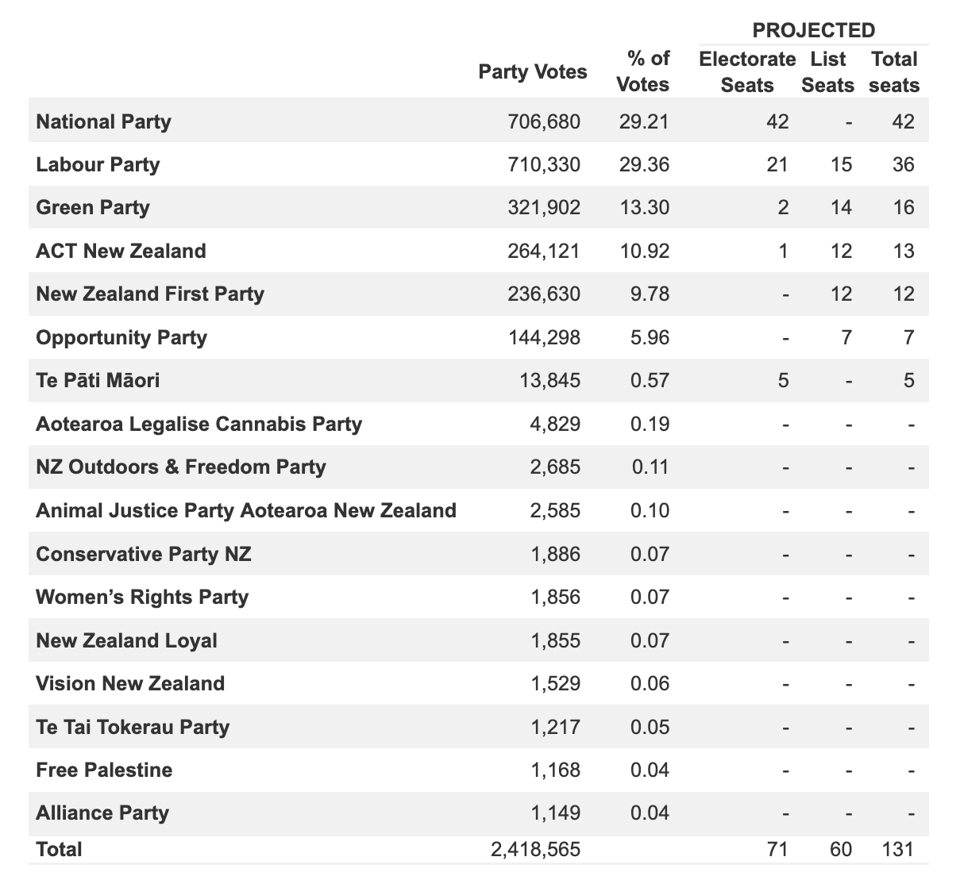
Anyway, you can see the preliminary election results above. These are prior to special votes, which may change a good deal of what you see, but as I saw the results come in on election night, I felt like my theory had been conclusively disproven.
Te Pāti Māori had won a stonking four-seat overhang. Not only had the four incumbents aligned with the party been re-elected, but Te Pāti Māori had also won Te Tai Tokerau, giving them five out of the seven Māori electorates. It seemed like Māori roll voters had decided to act strategically and maximise the overhang, lining up behind Te Pāti Māori to secure more seats in Parliament for the left bloc. My theory of a backlash against them was seemingly dead.
Or was it?
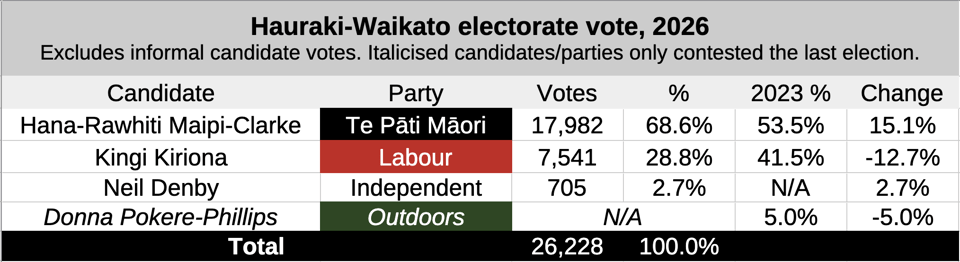
Hauraki-Waikato is one of the clearer cases of voters backing Te Pāti Māori for the overhang. Part of it has to do with the structures of the race itself: Maipi-Clarke is well liked and generally separate from the turmoil that has engulfed Te Pāti Māori throughout the term, and she’s not up against Nanaia Mahuta, an institution in Māori politics who had been in Parliament since MMP was introduced. But still, Maipi-Clarke received a 15% swing in her favour, and won with a 40% majority. It’s hard not to argue that this is a great result for Te Pāti Māori.
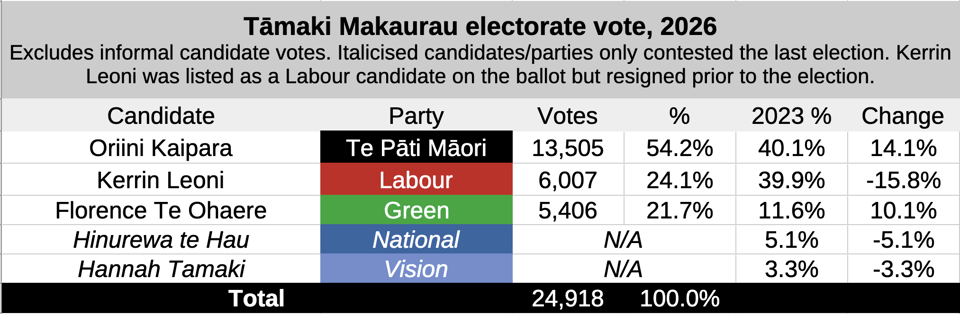
A similar dynamic exists in Tāmaki Makaurau. None of the candidates here had contested the seat in 2023: Te Pāti Māori MP Takutai Tarsh Kemp tragically passed away in 2025, being succeeded by Oriini Kaipara in a by-election. After losing to both Kemp and Kaipara, Peeni Henare announced he would retire from Parliament, having represented Tāmaki Makaurau from 2014 to 2023. And Darleen Tana of the Green Party was forced out of her party and Parliament after an inquiry into migrant exploitation at her husband’s business.
The race appeared to be one largely between Oriini Kaipara and Kerrin Leoni, with the Green Party’s Florence Te Ohaere doing little in the way of active campaigning. But at a debate for the seat, Kaipara accused Leoni of having attended an event at a gang pad (despite Leoni having criticised Kaipara for doing just that). After video of this emerged, Leoni resigned as Labour’s candidate in Tāmaki Makaurau…but then days later announced she would keep standing as an independent, in a situation that confused even me.2
Leoni was still on the ballot as a Labour candidate, so I’ve listed her as such above, but as a result of what happened with her the Tāmaki Makaurau race is a bit of a weird one to analyse. Labour’s vote went down and Te Pāti Māori’s went up, yes…but so did the Green Party’s vote, despite their candidate not seemingly trying all that hard to win. Kaipara did win with a 30% majority, but with divided and disorganised opposition. That being said, like Hauraki-Waikato, this does seem to be a good result for Te Pāti Māori.
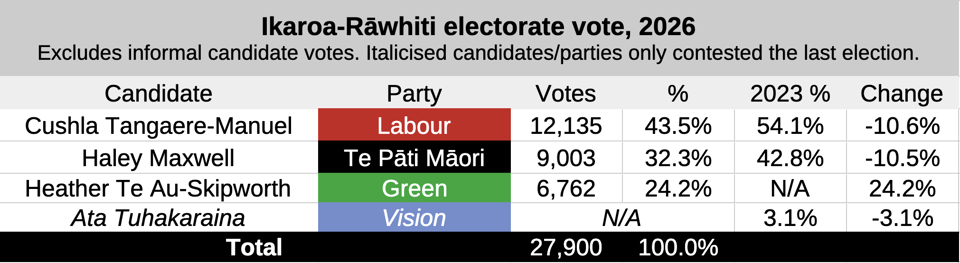
I had always thought that Meka Whaitiri (who had defected from Labour to Te Pāti Māori) was fairly likely to lose Ikaroa-Rāwhiti in 2023, and I was proven right by the final results. Ikaroa-Rāwhiti was the only Māori seat Labour won in 2023, and the smart money was on Cushla Tangaere-Manuel being re-elected easily in 2026.
Whaitiri did not stand again in 2026, with Te Pāti Māori instead putting forward Haley Maxwell. Heather Te Au-Skipworth, who had been Te Pāti Māori’s candidate here in 2020 and briefly the candidate again in 2023 until Whaitiri’s defection, stood for the Green Party.
I’m not really sure how to analyse the result here because it is not straightforwardly good for either Labour or Te Pāti Māori. Tangaere-Manuel’s majority stayed more or less steady, despite the fact you would really expect it to increase, and Te Au-Skipworth seems to have taken almost an equal chunk of vote from both sides. I think on balance this is a decent result for Te Pāti Māori (and suggests that Te Au-Skipworth herself might have been a stronger candidate in 2023), but I suspect in a head-to-head race they likely would have still lost the seat to Labour.
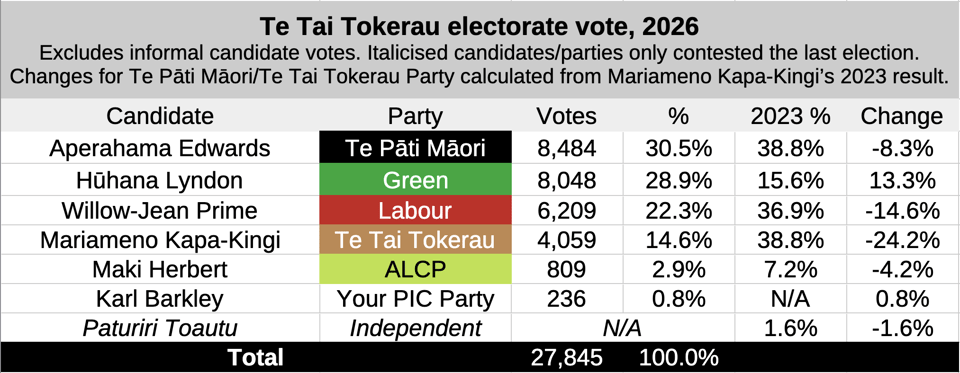
Oh boy.
So, first of all, this is the one Māori electorate where results could be plausibly flipped by special votes. At time of writing, Aperahama Edwards of Te Pāti Māori has won the seat, but it may well be the case that in about two and a half weeks, Hūhana Lyndon will come out ahead.
Secondly, I wasn’t quite sure how best to present changes from the 2023 vote here (and in Te Tai Tonga, where there’s a similar case). Mariameno Kapa-Kingi was the Te Pāti Māori candidate in 2023, but has since left the party to form her own Te Tai Tokerau Party. It would be odd to present Kapa-Kingi as a wholly new candidate, given she stood and won in 2023, but she is likely to lose some of the support she had then simply by having left Te Pāti Māori. So for the tables, I have presented both Te Pāti Māori and Kapa-Kingi’s vote changes in comparison to Kapa-Kingi’s 2023 result, but I’ll expand a bit more on the implications here.
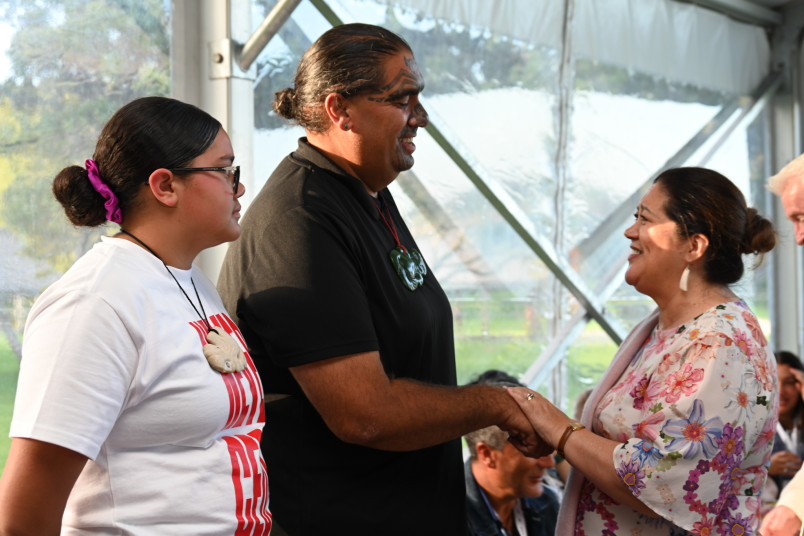
Anyway, as mentioned, Edwards is the new Te Pāti Māori candidate following Kapa-Kingi’s departure. Willow-Jean Prime, who served as the MP for the general seat of Northland from 2020 and 2023, replaces Labour’s 2023 candidate Kelvin Davis, who had represented the seat since 2014, and retired from politics on Waitangi Day, 2024. Lyndon and Herbert both stood in 2023.
The -8.3% swing away from Edwards would seem to suggest a poor result for Te Pāti Māori, but I actually think it’s rather respectable. The combined vote for Edwards and Kapa-Kingi is 45.1% — an increase of 5.8% from 2023. Edwards managing to hold on to the lion’s share of that is quite impressive, and speaks to his high profile in the electorate.
Of course, the performance by Hūhana Lyndon of the Green Party — a near doubling of her 2023 vote — is just as, if not more impressive. Lyndon may well win the seat come special votes, which would be a big achievement both for her and the Green Party.
As for Prime, she had a difficult task in succeeding Kelvin Davis, and at least personally I didn’t expect her to do terribly well. You’d expect Labour’s vote to fall, especially in a larger field of candidates, but a decrease of 14.6% is still rather poor, and suggests that Prime may have lost some of Davis’ vote to Hūhana Lyndon.
As for Kapa-Kingi, she’s obviously done the worst of any of the four main candidates, and she would have been hoping for better, obviously. But I suspect her low share of the vote3 is mainly attributable to her poor showing in Curia and Mata-Horizon polls. It’s a bit of a chicken and egg situation, but I suspect she wouldn’t have done so badly if she hadn’t been a clear fourth in both. (Or perhaps she was always a clear fourth.)
Again, I think this is a fairly good result for Te Pāti Māori, even if they do end up losing the seat, especially given that the strife Te Pāti Māori has been in throughout the term specifically centred on Kapa-Kingi and Tai Tokerau.
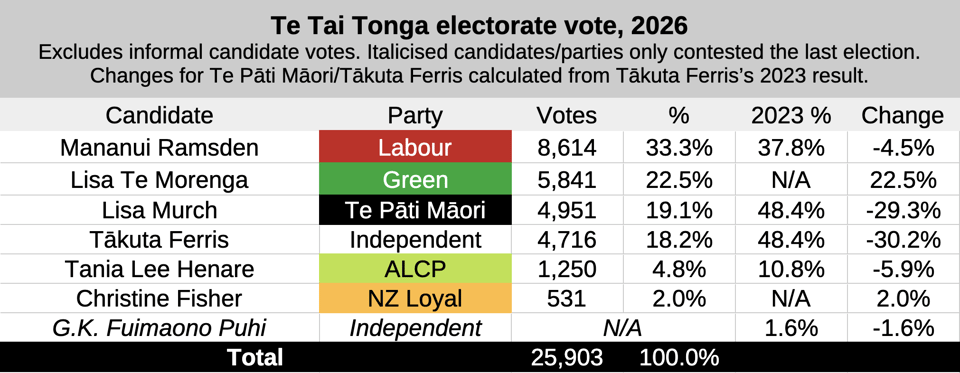
As in Te Tai Tokerau, I’ve compared Te Pāti Māori and Tākuta Ferris’ results this year from Ferris’ 2023 performance.
Except Ferris, all of these candidates did not stand in 2023. After losing, Labour’s Rino Tirikatene retired from politics in 2024, having held the seat since 2011. The Green Party did not stand here in 2023, although they’ve traditionally done rather well in Te Tai Tonga, and Lisa Murch is a political newcomer.
In contrast to Te Tai Tokerau, I do think that this is a fairly poor result for Te Pāti Māori. The combined Murch and Ferris result is 37.3%, a decrease of 11.1% from 2023. You can attribute part of this to the presence of Green candidate Lisa Te Morenga, but even so Te Pāti Māori seems to have disproportionately fallen. Labour only lost 4.5% from 2023 (and you can surely attribute some of this to the loss of Tirikatene), and the Aotearoa Legalise Cannabis Party vote fell by 5.9%. That seems to suggest that the lion’s share of the 22.5% Te Morenga polled came from Ferris supporters in 2023.
And unlike in Te Tai Tokerau, Te Pāti Māori’s support split straight down the middle. If you’d seen a similar split as there, Murch might have polled something around 25% — not enough to win, but enough to cut Ramsden’s margin down and place in second.
As it happened, Ramsden won fairly easily in a divided field. A more unified opposition might have toppled him, but Te Pāti Māori likely would have still fallen back from their results in 2023.
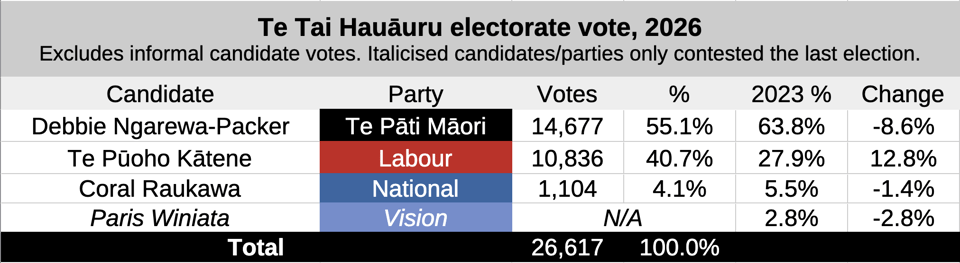
In comparison to the last two electorates, Te Tai Hauāuru is rather straightforward. Debbie Ngarewa-Packer won the seat in 2023 on her second attempt, defeating Labour’s Soraya Peke-Mason. National’s candidate in 2023 was Harete Hipango-Brownlie, but she has since left the party for New Zealand First, with Coral Raukawa standing instead.
So with all this taken into account, I think it is rather interesting that Ngarewa-Packer’s vote has fallen quite a bit. Perhaps this is a function of her being considered rather safe, given her 35.9% majority in 2023, and voters feeling free to register displeasure with Te Pāti Māori without costing them an overhang. But it is still a rather drastic drop-off, and the first unambiguously bad result for Te Pāti Māori that can’t simply be explained by new candidates or different voting patterns.
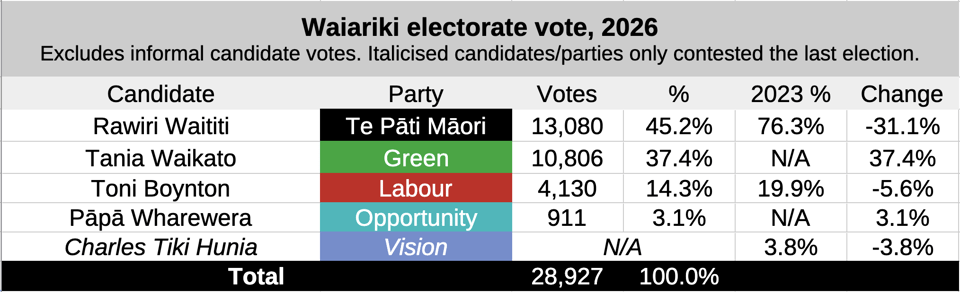
When I saw the first results coming in from Waiariki and Tania Waikato was outright leading, I felt very smug. As you can tell by the table above, that didn’t hold, but my prediction that Waititi would lose Waiariki was vindicated in a sense.
Against Labour’s Toni Boynton in 2023, Rawiri Waititi had won the largest majority in any of the Māori seats. This time around, the Green Party stood a candidate in Tania Waikato, and the Opportunity Party also stood their first Māori seat candidate, but otherwise it was a rematch between Waititi and Boynton.

Now, Tania Waikato was also a very prominent candidate herself. Although she had no parliamentary or electoral background, she was very prominent on social media and was a lawyer for the Toitū Te Tiriti Movement, and was explicitly campaigning for the Waiariki seat. This is otherwise not relevant, but I am also obligated to tell you that she posted “bikini baddies and buff bros” on social media to spread awareness on voter enrolment and the window to change between the general and Māori rolls. Smarter people than me have said that Waikato, who will enter Parliament via the Green list, will likely make a very impressive MP.
And it is also true that, given how well Waititi did in 2023, he sort of had nowhere to go but down. Which is to say, by virtue of receiving over three-quarters of the vote, any new candidate likely would have taken more from Waititi than Boynton.
But Rawiri Waititi’s vote crashed. He lost over a third of his vote from 2023, to the point that Waiariki was the closest Māori electorate in 2023 by percentage and raw votes aside from Te Tai Tokerau. Boynton proportionally lost less of her vote4, which leads me to think that you can’t credit the Waiariki result solely to Waikato’s background and profile.
While Te Pāti Māori did better in the election than I thought, I think the Waiariki vote specifically is a sign of trouble under the hood for them. By and large, Māori roll voters united behind Te Pāti Māori to secure a four-seat overhang, that might keep the left competitive even as National produces a seven-seat overhang of their own.
But it would be a mistake to read the results solely as an endorsement of Te Pāti Māori. Some of Te Pāti Māori’s MPs performed well, but others, specifically their co-leaders, underperformed from what you might expect. Was the stake of the election not so high for Māoridom, they might have lost their seats entirely.
Special votes could make the story quite a bit different, but I wanted to get this out now because I think the contours of the vote patterns will largely hold up. Even if Rawiri Waititi’s majority expands in Waiariki, if Hūhana Lyndon gains Te Tai Tokerau, the patterns are still likely to hold. The state of the next government is still up in the air, but Te Pāti Māori should avoid interpreting these results as a vindication of their performance over the last three years: elsewise they might end up losing some seats in 2029.
Correction: An earlier version of this post incorrectly stated that, on preliminary figures, Te Pāti Māori had won a five-seat overhang, and National a six-seat one. This was incorrect: Te Pāti Māori was proportionally entitled to one seat based off the percentage of their party vote, meaning their overhang was four seats and National’s seven.5 The post was updated accordingly on 11 November 2026.
When final results are released I’ll likely do a blog post on how these stood up. ↩
Kerrin Leoni remained on the Labour list and on the ballot as a Labour candidate, so if she were elected to Parliament she would be aligned with Labour. If she had been elected, Leoni could sit as an independent, but Labour could also invoke Parliament’s waka-jumping laws agaisnt her, which would remove her from Parliament and require her to face a by-election if he had won Tāmaki Makaurau. It was probably unlikely that they would do this but they would have had the option to do it at any time. ↩
I am shamelessly stealing this analysis from a friend of mine whom I disagreed with at the time. ↩
Rawiri Waititi’s vote fell by 31.1%, which as a proportion of his 2023 vote was 40.8%. Toni Boynton’s loss of 5.6% was 28.1% as a proportion of her 2023 vote. ↩
These do not necessarily go hand-in-hand but I, the author, had assumed that because there were eleven overhangs and Te Pāti Māori had won five seats, that National must have thusly won six overhang seats. ↩