Why The New York Times (and Others) Changes Headlines So Often
Something to keep in mind as you read social media.

Something to keep in mind as you read social media.
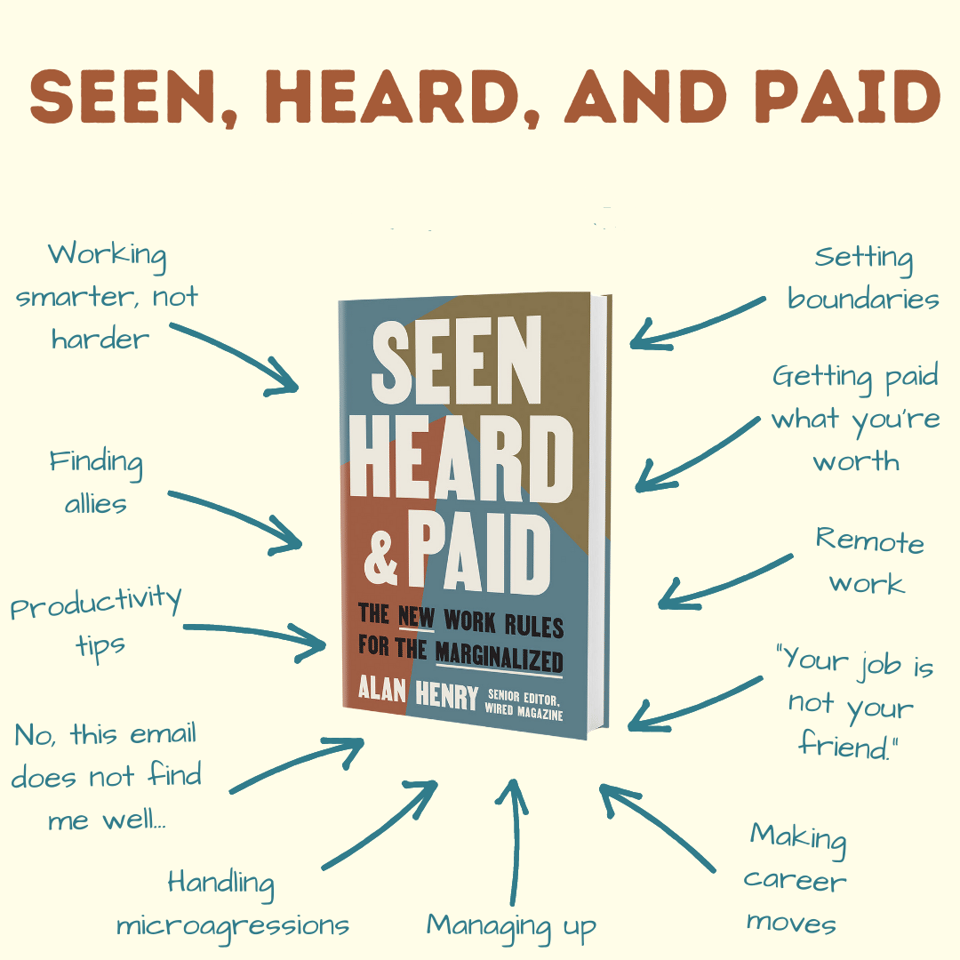
Welcome back to Productivity, Without Privilege friends. I'm your erstwhile host, Alan Henry, and that book up there, Seen, Heard, and Paid: The New Work Rules for the Marginalized, was written entirely by me, with my own two hands, the help of some amazing people, and absolutely no assistance from AI. That's something I can happily say that apparently other authors really can't, these days. Ah well.
This edition is inspired by a Bluesky post: my friend and former colleague Eric Ravenscraft posted a particularly egregious headline change in The New York Times. The change was captured by nytdiff, which posts whenever The Times changes story headlines, URLs, or decks/deks (the teaser text that's usually right below the headline).
Quick reality check here: there's nothing wrong with changing a headline or deck (which the account refers to as the abstract) to get more eyes on a story, or to change the framing to reflect updates to the story. It's also a common SEO strategy to change URLs or republish updated articles to capture the attention of search engines' news aggregators, such as Google Discover. I don't love it as an editorial strategy, of course. I think regurgitating old stories over and over can be good now and again, but if that's your primary approach to getting people to read your work, you should consider doing more, better work.
But virtually every publication I've worked at or with over the course of my journalism career does this, mostly because, unlike print newspapers or magazines, where headlines are essentially fixed elements that never change, online, you have the ability to update stories, repromote them, and try to get new eyeballs on old articles. But Eric poses a good question here:
serious, unrelated question: does the NYT just not brainstorm their headlines internally? i feel like by the time i hit publish on any story, i have a pretty good sense of what the headline is gonna be at worst, it definitely wouldn't be a total rewrite like they seem to do constantly
— Eric Ravenscraft (@lordravenscraft.bsky.social) May 05, 2026
When he asks if The Times brainstorms headlines internally, I can confidently say that they do! Of course, it's been a long time since I've been in that newsroom, but I used to share a manager with the team that handled those headlines and decks for the paper's homepage, so I got a front-row seat to a lot of their work. In fact, there's a team that often discusses those changes, and some great journalists on that team. So why do so many of the headline and deck changes seem like they're completely reframing the story? Why do some of them feel like they're entirely disconnected from the article itself, or the writer's own intention for how they wanted the story to be received by readers?
Well, there are two big answers for that:
Because the writer - and sometimes the story editor themselves - aren't involved in that conversation. In fact, the writer usually isn't involved in the headline decision at all, beyond proposing one when they file the story or work with the story's direct editor. From there, the editor and their desk editor (usually their manager) settle on something they think will both communicate the story's point in an interesting way and grab eyeballs.
Because we really only notice the worst examples, where the headline is changed to something more bombastic to attract attention, or where focus keywords or language are used to pull in news aggregators or specific audiences on social media. (That's what I think happened in this specific case.)
To the first point, it's important to remember that The Times is a massive publication, with multiple avenues for sharing its stories. Sure, there's the article page itself, but there are also other "story forms," as it's referred to in the newsroom: the social headline, the SEO headline, the homepage, and even in the app. Each of these can be customized independently, and nytdiff (and similar accounts) usually monitor the homepage and/or article pages. Trust me, people in the newsroom are acutely aware that the account (among others!) exists.
This isn't a bad thing, actually: it means you can customize the same story for different types of audiences, and again, lots of publications do the same thing. But it does mean that sometimes a story gets a headline on the homepage or on social media that the writer hates, or the editor hates, and a difficult internal conversation has to happen about whether it's bad enough to change back. That part sucks, and I've been there before, on both sides of the conversation.
But to the second point, I've noticed that nytdiff does its job very well, which also means that for every one bad headline change that seems like it completely reframes the story, there are dozens of small changes that clarify a story, reflect a normal update or reframing to try to repromote a story, or even a change intended to reflect new information in the piece.
Additionally, The Times specifically makes heavy use of live blogs for ongoing news events, which means the story is getting constantly updated as new reporting comes in, which means the headline to the live blog will evolve with that reporting, sometimes changing massively to reflect something new that someone said, or some major shift in the ongoing story. You'll find this on tech sites, too, when they run live blogs to cover events like conferences and conventions or company announcements (like Apple or Google events).
So, bottom line, what we often perceive as a bug because we see terrible examples that make people angry, is actually a feature that plays out quietly every single day, and we usually don't notice because the changes are largely harmless. Until, of course, it's not harmless at all and completely changes or misrepresents the actual piece, or feels like it's designed to say something specific in a way the article may not, or didn't, with its previous framing.
I don't mean this to be a specific defense of The New York Times here, even though I understand how you might think it is; it's just one newsroom I've worked in where this was so integral to the strategy, and I got to see it up close every day. Even in other newsrooms, like at Lifehacker, we knew that if we repromoted a specific story on Facebook with specific language, it would pop off. At WIRED, changing headlines was a little less of a big deal because the magazine-style approach to journalism ruled the day, and we were pretty rigorous about our headlines before we published.
But even at PCMag, where I work now, we often do what The Times does: update old stories to reference current news events, reframe pieces to reach new readers we may not have reached the first time, and so on. The team is much smaller here, so the story's editor (and often the writer) gets a say in how their work is framed, something that's more difficult (but in my opinion, still important) to do in a large newsroom like the one at The Times. So think of this more as a defense of the strategy in general, with the caveat that I think the story editor, and definitely the story writer, should be involved or at least notified in the change in framing, so they can speak up if they hate it. Of course, I'm sure some of my old colleagues would counter this (and with good reason, to be fair) that the writer should own their work, pay attention to any changes, and then speak up if they're uncomfortable, so I can see both sides of this.
That said, this is just something I think more people, especially anyone interested in journalism or wider media, should take into account. As you write a story, or even as you consider pitching a story to a new outlet, think deeply about what you would headline your story. Not only does that help you set the stage for your idea, but it also proves (to yourself, and to a potential editor) that you've thought deeply enough about your idea that you know, in a single line, how you would communicate it to someone else and encourage them to read it.
As an editor who takes freelance pitches, I love seeing that. It tells me the person writing the story has a laser focus on their idea, and they're less likely to submit a disorganized piece that tries to do too much, or moves in too many different directions.
And that's the real advice here, if there's any advice for me to give. Your headline (and to a lesser extent, your deck) is your best opportunity to grab the people you want to read your story and say, "Hey, this is what I'm talking about, and it's important." Which is also why it's a task most often reserved for the people at the publication who deal with their audience and its demands every day.

A Day for Gaza, by Rayan El Amine, Jack Mirkinson, and Lizzy Ratner: One thing is absolutely true: media coverage of Gaza and what’s still going on there has plummeted as the news cycle moves on to other things, especially ones closer to home. But that doesn’t mean it’s not deserving of space in the news, and The Nation dedicated a whole day of coverage to Gaza, featuring stories written by Palestinians reporting on what’s happening in their homes and communities. This post is the top-level explainer of the whole project, but it’s worth reading, and it includes a sidebar linking to all the features from the day, each of which is worth reading in its own right.
'A Directive From Above': Former NYT Editor Lays Out How The Paper Pushes Anti-Trans Bigotry, by David Forbes: This piece was published at the beginning of the year, and I remember reading it and nodding my head at my former employer. I offer no additional context beyond what you already know about my position on the matter and some of the reasons I left The Times, which were not directly related to this, but not necessarily unrelated either, in the broader context of what it’s like to be a marginalized person working in legacy media. But I do think this is worth a read, and it’s worth considering as you renew your subscription.
After ICE Killed a Woman, Too Many Newsrooms Chose Government PR Over Actual Journalism, by Nora Biette-Timmons: I could spend a whole newsletter writing a love letter to Jezebel, but this piece is exceptional, and beautifully dovetails the connection between how major media outlets handled the murder of Renee Good with the way that major media outlets handle the story anytime law enforcement or state power guns someone down in the streets. In America, anyway. In other countries, there’d be no newsroom anxiety at calling a spade a spade, but for some reason when it happens in our own backyards, we’re more inclined to treat statements by law enforcement as objectively true, when all of our collective coverage reveals that we should treat them as an involved party with its own interests, the same way we do with corporate spokespeople and company statements. But we don’t, and this excellent piece examines why that’s the case, who’s responsible for it, and what we should do instead.


Ever since smartphones and other battery-powered electronic devices of all shapes and sizes became commodities, I’ve been concerned that our waste systems simply never adapted to handle them. After all, back in the days before LCD displays, if you needed to toss out a big old CRT monitor, you couldn’t drop it off with the trash, and rightfully so: cathode ray tubes are dangerous when mishandled. Now that lithium-ion batteries are in everything, and they have a reputation for being volatile (one that’s appropriately earned), our waste disposal streams still haven’t learned, and by “learned,” I mean there’s no political will or interest in funding improvements to them so consumers can separate them for easy disposal, or so waste companies and sanitation departments can sort them and dispose of them appropriately.
So the onus falls back on you and me, the consumers with the batteries in our pockets and in our homes, to make sure they’re healthy, not a fire risk, and when we’re finished with them, that they don’t catch fire in the back of a garbage truck. One tool that can help us do that is BatterySafetyNow.org, a project of the National Waste & Recycling Foundation (NWRF). The site couldn’t be simpler to use, and gives you three simple steps to dispose of your batteries: tape the terminals, enter your zip code so the safe disposal locator can find a place to drop off your battery, and… then … take the battery there. After all, I’m willing to bet most people would dispose of their batteries safely if they knew how to. And while the hurdle of actually having to take your batteries to a specific place to dispose of them will still be an obstacle for some people, it’ll hopefully help a lot of others.
Now, the NWRF is itself an industry group that represents private waste management and recycling companies, so they’re not doing this out of the goodness of their own hearts. They’re doing it because, while it’s a good idea to engage in some consumer advocacy, battery fires are a growing problem that costs them a lot of money. But putting that aside, the tool is pretty useful and worth bookmarking for the next time you have a device that needs proper disposal.


