Little Rituals Have So Much Power
A small way to find some peace in very turbulent times.
Hi friends, welcome back to Productivity, Without Privilege. I’m Alan Henry, and I wrote Seen, Heard, and Paid: The New Work Rules for the Marginalized. Boy, it’s rough out there, isn’t it? I don’t even really want to go into everything that’s happening right now, because odds are you’re more than aware of all of it, and if anything, I share your existential fatigue about all of it. Instead, this time I want to talk about one way that I try to keep The Voices at bay. You know, the ones that shout at me that my work is unimportant, given the state of the world, that no one cares, and no one’s listening, that I have no right to talk about my work or my personal projects when the world is burning.
You’re probably familiar with those voices, and I don’t envy you any more than I enjoy hearing them, but I will say this: Those voices aren’t you. They’re not reflective of who you are, of your worth, or even of reality. Let them pass without answering them, and, if you’re like me, go make a cup of tea. Or light some incense. Or just get up and stand in the sunlight for a little bit. Do whatever works for you to give yourself that little reset, but whatever you do, make it special.
***
I’m a journalist, so I can’t very well turn my eyes away from what’s happening in the world if I want to be able to do my job well, and to me, that includes watching events unfold that don’t necessarily have to do strictly with the things that I cover and edit at work. But I've noticed, especially very recently, that it’s been taking a toll on me. I mentioned some of this in a previous newsletter, where I suggested the 30-second test to make sure that reading social media isn’t hurting you more than it’s helping, and I still stand by that suggestion. But I also found that sometimes I need a reset, something more than just closing the app and, unfortunately, switching to a different social media app, or worse, refreshing the same three websites I read all the time, even when there’s nothing new to see.
My mind went back to an article I wrote for Lifehacker in 2013, about how personal rituals can actually improve your health, and similarly, to an article my friend and former colleague (he’s now at the Electronic Frontier Foundation), Thorin Klosowski, wrote about how personal rituals can help process grief. In both of our pieces, we highlighted that those rituals can help shake you out of habits you may want to change, and that, in a world that feels completely out of control, small daily rituals can help us reclaim our agency in a life that feels bigger than ourselves. So I decided recently to go back to performing a little tea ceremony in the afternoons. Here’s how I described it back then:
“Every day, usually in the mid-afternoon, I have a little tea ceremony at my desk. I get my four-cup tea press, put on a kettle to boil, and meticulously add the leaves and put the press, my tea cup, a little sweetener (usually honey), and a spoon on a bamboo tray that fits nicely on my desk while I work. When the water boils, I take its temperature, pour the water over the leaves, set a timer on my phone, stir, and bring the whole tray to my desk. I relax while it steeps - usually just watching the steam rising off of it. When the timer goes off, I press the tea, pour my first cup, and go back to work. It's elaborate, but it's one of my little rituals that helps me disengage for a bit—something meditative that helps me get through the afternoon.”
How elaborate my new, 2026 edition of this little ceremony is depends entirely on what kind of tea I’m making (listen, a bag of Yorkshire Gold doesn’t require measuring out leaves; I just need to warm some milk and turn on the kettle). Some days I break out the good loose-leaf stuff, and other days I’m either so tired or so busy that the most I can do is steal a few minutes away from my desk to pop a bag into a cup. But the point is to do it, not because I want to make it a habit, but because the habit helps me reset my nervous system. It lowers my overall stress level a bit, and watching the steam waft off a freshly poured cup relaxes me in a way that few other things do. And that helps a lot.
Your ritual doesn’t have to be the same as mine, though! Maybe you get that same mental and emotional reset by hitting the treadmill or exercise bike. Maybe you get it by going for a walk around the office, or better yet, outside. (After all, touching grass is actually good for your mental health!) But whatever you choose to do, here’s how to get started:
Identify what and when triggers your need to reset. I used to refer to this step as mood tracking, which is helpful if you do want to go that far, but you don’t have to. If you know that waking up to a DM from your boss stresses you out and sets you up for a bad day, that’s enough. If you know that you really start dragging in the early afternoon (like I do), that’s also enough.
Pick your ritual, and when you want to do it. This one’s all about finding that thing that works for you. There’s no reason it has to be a single thing, or even a big thing. Just something that’s meaningful to you. Get that DM first thing in the morning before you can settle into your day? Light an incense to offset it. Feel yourself slipping into the post-lunch doldrums? Time to stretch and take a little walk, or refresh your water bottle, even if it’s not necessarily empty.
Keep it up, this is what self-care looks like. Self-care has been co-opted by corporate interests to promote wellness products that make other people money while you continue to struggle. Real self-care involves doing good things for yourself because they address pain points or issues in your life, feel good, reduce your stress, or just generally make you happy. You don’t have to buy things in order to do that. As long as you keep making your cup of tea, or lighting your desk candle, or brushing your teeth after lunch, or whatever it is that gives you and your brain and body a chance to reset a little, that’s self-care.
Good luck with yours. Hey, once you pick something that works for you, let me know what you decided on. Just hit reply and let me know what you did.

Journalism Is Increasingly Pushing Reporters of Color Out of the Industry, by Xintian Tina Wang: If there's anything that I understand, it's working in an industry that you love that also doesn't love you back. And now, in an industry where every media organization has conducted layoffs and is likely planning more, we continually find that journalists of color and marginalized journalists are the ones let go first, despite the performance of their work or the necessity of their journalism.
Those journalists then line up for the few full-time jobs available in the industry, fighting each other for slim pickings, or going freelance and doing things like starting newsletters (hey, that sounds familiar) and taking on all of the things that this industry employs thousands of people to do, like social media, audience development, and monetization. I've watched how even some of my former employers shuttered entire desks and teams, only to relaunch them a year later by making flashy hires of all of the new editor's friends from their previous publications, leaving the exceptionally talented journalists of color with experience and skill in the unemployment line, while mediocre, less experienced journalists get their staff jobs for little more than "I worked with them and they're good," as an excuse. It's heartbreaking, but I fear it won't change soon.
A Newspaper Fired Her for Making up Quotes. She Changed Her Name, Got Back in the Game — And Now Is Facing Prison, by Sam Tabachnik: This story is a little old, but it still takes me for a loop, and I particularly love stories like this because they reveal exactly how much someone can actually get away with when they're both well-liked and in a position of privilege. Again, the headline is so good that I don't want to spoil too much here, but make sure you're seated for it, and then ask yourself: "At which stage here would I have gotten fired for even a fraction of what this person did?"
Compulsive Curiosity, Or, How I Built an Infinite Idea Machine, by Ryan Farley: I just wrote a newsletter that was all about dealing with creative blocks, and it's funny to me that this landed in my inbox not too long after (although I can't remember how, sadly). One thing I think that Farley gets right here is the nature of brainstorming, something I used to cover a lot when I was at Lifehacker - there are plenty of tools and apps designed to help you brainstorm, but the best brainstorming never happens when you sit down and open one of those tools; those ideas come to you when you have the mental freedom to let your mind wander, to bounce thoughts off of other people, and to allow yourself the mental breathing room to come up with new ideas—or even better, identify those great ideas and capture them when they come to mind.

I speak to a lot of freelance writers and other journalists who often have a great idea or are interested in a specific topic, but they're looking for a great way to turn it into a story.
And don't underestimate how difficult that can be: I'm willing to bet you can identify a lot of things that are important to you, or important to the world at large, but you might stumble a bit more when it comes to finding a way to communicate those things in a way that's particularly interesting to other people. So when it comes to turning a topic into something engaging, we can take a lesson from our friends who work in communications, and are tasked daily with finding ways to make even the smallest, driest business announcements into something that reads like it's important enough to put your world on pause for a moment. (And I truly mean that with the utmost respect!)
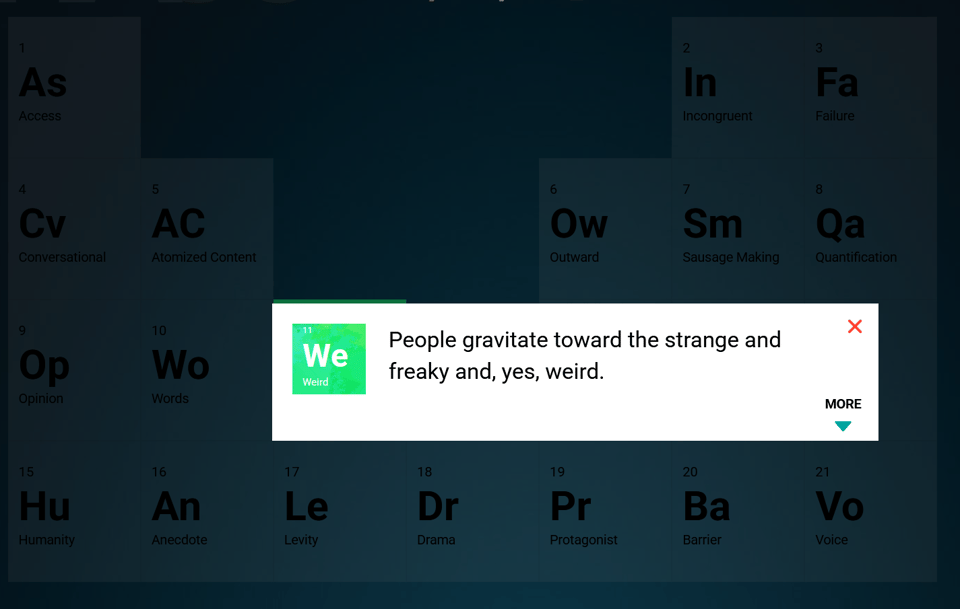
Storytelling Techniques is aimed at folks writing "business stories," like corporate comms and public relations, but it's also a really useful little tool for finding the most engaging elements of any story you want to write or communicate. Built like a periodic table, you can click each "element" to see what part of a good story it is, and how you should think about that specific element if you want to incorporate it into what you're trying to cover.
For example, "Weird" reminds you to consider what about your topic might be freaky or eyebrow-raising, and to include that in your storytelling; after all, people do gravitate to the unusual and strange. "Sausage making" embodies the idea that sometimes the backstory on how something happens, or what's going on behind the scenes, can be more interesting than the thing itself; something journalists know pretty well. Again, a lot of the elements here are definitely written for people looking to get their PR pitches read and used in media coverage, but the bottom line is that whatever you want to discuss, there's always a story there; you just have to find a good way to tell it.
***
That's all for this edition of Productivity, Without Privilege. If you enjoyed the newsletter, consider supporting me by dropping me a tip here or by subscribing to my Patreon for early access to the newsletter and my other projects. I promise, your support makes it all possible. I’ll see you back here soon.


