Creativity Doesn't Wait: How to Deal with Writer's Block
It's okay, it happens to all of us.
It's okay, it happens to all of us.
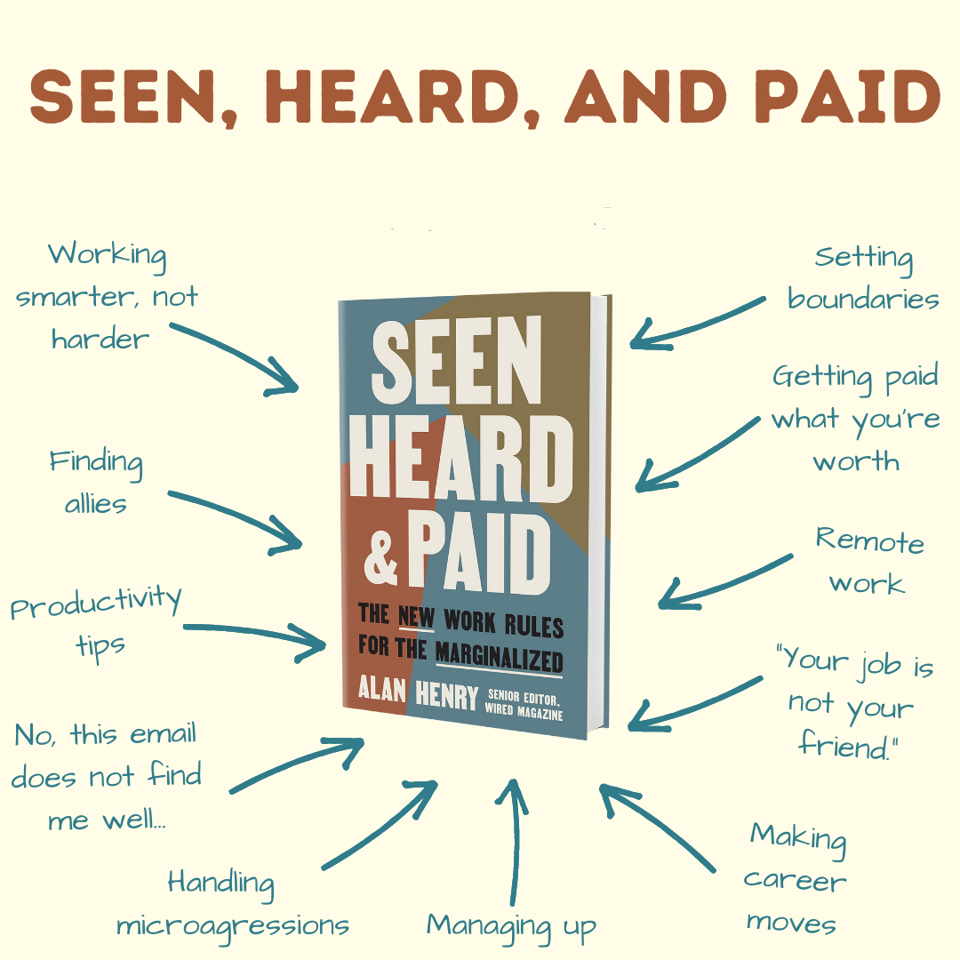
Greetings, guys, gals, and non-binary pals, and welcome back to Productivity, Without Privilege. I’m Alan Henry, and I wrote Seen, Heard, and Paid: The New Work Rules for the Marginalized. Do you have a copy? Of course you do. If you ever catch me and want me to sign it, don't hesitate to ask; I crave attention. Anyway, consider supporting me by sending me a tip or subscribing to my Patreon. Remember, you get early access to the newsletter on Patreon, and the ability to comment directly on them (as well as all of the other goodies I post there). I try to keep things interesting over there.
In this edition, I want to break my own writer's block by talking about writer's block. Yeah, it might be an easy way out, but hey, that's one of my tips for dealing with it: if you can turn your own struggle to create into a creation, that still counts as having made something worth reading. Besides, what's more relatable than the struggle to produce in a world that values productivity above everything else?
If you've followed my work for this long, you know that the value I place on productivity is a bit different from most people's. To me, being productive and efficient is a means to an end: more time to live your life, be with your loved ones, and achieve your dreams. Not as a means to just process more work, more of the deluge of responsibilities that hustle culture and our up-and-to-the-right obsessed society forces on all of us. But that doesn't mean that being unable to produce hurts any less. So when you're feeling stuck or lost, it still sucks, even if you know how pointless some of it might actually be.
"But Alan," I hear you saying, "you write a column every week! You manage a team, keep up with social media, and you even write a newsletter, you never seem to shut up - how could you possibly get stuck?" And honestly, I get stuck way more often than you might think. The well runs dry for me just as easily as it does for anyone else, and despite my reputation for always having something to say, or something to write about, a lot of that comes from my origins in the 2010s blog mines, where I had post quotas to meet, and low quality simply wasn't going to cut it.
***
So the first tip I have to offer is one you've probably heard before: Show up anyway. It's cliché advice for a reason: it works. Sometimes you can break through creative blocks just by forcing yourself to create. It's messy, it may not end up being your best work, but at least you'll have created something. And that counts for a lot. Even if you create something under duress, like a deadline or just the understanding that the world goes on despite the fact that you're having a hard time, that really counts, and you've still managed to create something.
One thing I encourage all writers to do, and maybe I'm speaking to myself here, is to stop comparing the value or worth of your work to the other forms of artistic expression you see every day. So much of our culture celebrates other forms of expression, like visual art, audio, video, and performance. It can feel like the written word doesn't have the impact that you would hope that it does. I certainly know that I wake up some mornings thinking the work I've done doesn't matter as much as the work of some of my favorite visual artists or entertainers.
And then, out of the blue, someone comes along and reminds me that they worked with me on a story ten years ago and hopes I'm doing well. Or they repost a quote from my book that really resonated with them. Remember, your work extends far beyond your reach or even your vision. Take refuge in that when things get difficult.
***
Next, and this one can be difficult, but it doesn't have to be: Change your perspective. You're reading that and you're probably thinking of something like a writer's retreat, or a fancy vacation where you can live, laugh, love yourself into creation again, like a Hollywood rom-com. I mean, if that sounds appealing to you and you have the privilege to do it, don't let me stop you. But I'm talking about small perspective changes that can make a huge difference in how you feel.
If you have a playlist or a type of music that you listen to while you write, try something new that makes you feel differently. If you work from the same place all the time, try switching locations. I've found that when I feel like I just can't sit at my desk and stare at my monitors anymore, sometimes it helps to spend the day on the couch with my laptop instead. If that's not your jam, try a local coffee shop. I know working at the coffee shop may sound played out, but my favorite local spot has tons of outdoor seating for the nice days, and indoor booths for the bad ones, and the coffee is delicious. It's worth a block or so walk just to clear my head, see some faces I don't recognize, and not be forced into the same old same old, especially if that same old is an office you hate surrounded by people who don't like you. Ask me how I know about that one.
You really don't have to go around the world for a shift in perspective. I've even found that taking my laptop to a quiet corner of my local library is a huge boon, because you never know who'll show up there. It's a public space, probably one of the last truly public, all-comers-are-welcome spaces in American life, and a few hours inside will remind you who you're writing for, why you're writing, and what made you passionate about writing in the first place. I spent an afternoon at my closest one a few months back, and I saw a microcosm of the world in front of my eyes, and it reminded me how much closer I am to my neighbors than I ever will be to a prize award committee, or the fancy ties and suits at my industry's receptions and galas.
***
Here's my favorite, and the one I'll leave you with here: Just begin. Don't stay, but start. This tip is a banger from my old editor, Adam Pash, who wrote that getting started is everything many, many years ago, and it remains my most powerful advice for any writer of any type.
You'll see this advice repeated in many forms around the web; people will tell you to just freewrite, write in a stream-of-consciousness style, get something on the page, and refine it later, etc., etc. All of that is also good advice, but it really boils down to what Adam distilled all those years ago: having something on the page is much better than having nothing. And even if you wind up going back and erasing everything and starting over, at least you'll still have started. You'll have something to work with, and that's better than being stuck with nothing.
Adam used to say that what you should do is just sit down and say, "I'm going to work on this project for five minutes," and set yourself a timer. And while that clock is ticking, you do your best to put something on the page. Maybe it's some vague ideas, maybe it's something barely legible, or maybe something clicks and the words start flowing. Whatever it is, you give yourself five minutes. And when the timer goes off, you have a choice to make: you can either keep going if you feel the juices flowing—maybe restart the timer and give yourself another five minutes, or you can say, "You know what, I'm glad I started, and now I have something to work with," and go do something else. In either case, you're light-years ahead of where you were.
***
Of course, this isn't a definitive list of any kind. Lots of productivity blogs and experts will tell you to embrace practices like the Pomodoro Technique, which is a lot like the method I just described: you set a timer, commit to working while it runs, and then take a break to reset. Others will suggest mind mapping, which has never really worked for me personally, but I know some people who swear by it. Regardless of the method or structure you choose to experiment with, they all boil down to the same basic principles: Do something. Anything. Just get going, and worry about the details later. Honestly, that's the best advice any of us can really offer.

The Death of a Superman, by Paul Collins: This story broke my heart and exposed me to an issue I didn't even know was a problem, let alone as widespread as it is. I almost don't want to talk about it because it's one of those reads that makes you miss your subway stop because you're glued to your phone, or makes you forget it's time to pack up and go home because you're reading it at work. TL;DR, though, it's about those big clothing donation boxes you see on street corners and in parking lots, and the fact that they're not what you think they are. They're disingenuous and dangerous. Extremely dangerous, and while our neighbors in Canada have done something about them, here in the United States, the land of personal responsibility above all else, we haven't seen fit to even approach the problem.
I Had a Dream Journalism Job. Here's Why I Quit. by Ryan Haas: Perhaps the thing that resonates the most for me with this story is how often so many of us in media, especially those of us from marginalized groups, have wonderful jobs in journalism doing great work that our audiences appreciate, and how all of it is so often casually ripped from us by one bad leader, one egotistic up-failure, or someone whose commitment is less to their work as it is in sabotaging others.
And usually, it's all for no other reason than that they've made their own judgment about whether they deserve the role they have, which never has anything to do with skill, performance, or ability. And in this case, Haas recounts how it took only one bad executive at his workplace to tear down the editorial firewall between the people doing journalism and the people counting the money, encouraging the latter to push the former around. I've seen this relationship work really well in many places, where the money people have input, but not direction, when it comes to doing good journalism. But when those people get direction, you end up with hollowed-out journalism that pretends to care about its audiences when in reality it only cares about CPCs and revenue.
‘Apartheid Newsroom’: Minority Ethnic Journalists Still Locked Out of Top Jobs, Report Finds, by Michael Savage: In a way, I would hope that you've read this one already. It's a good reminder that when you're a member of a marginalized group, privileged people will always, regardless of your capabilities or skills, see your role as less than their own priorities, and tokenize you as a diversity hire, regardless of the quality of work that you do, or how passionate you are about your job. This story focuses on UK television news networks (so you can dismiss any thoughts that problems like these are purely American issues). It's a systemic issue in media in general, one that won't change without this field taking accountability seriously. And as long as journalism operates as a money-making venture while trying to talk the talk of a public service, I don't think it will.

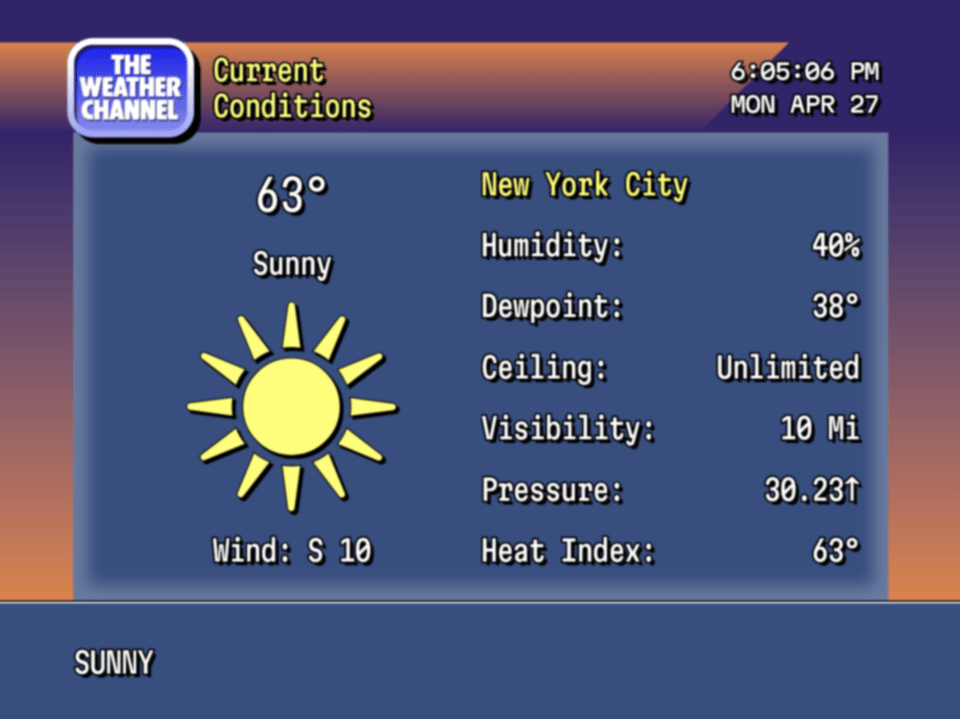
On a lighter note, I remember the days when The Weather Channel didn't really have programming, aside from, well, the weather. I remember getting regular loops of weather information for my location with some background music, interspersed with a little studio reporting or maybe a once-in-a-while on-location shoot somewhere in the country experiencing a severe weather event, long before doing so made Jim Cantore the legend that he is.
If you also remember those days, or maybe just long for those repetitive moments, especially late nights, where you just had some jazzy tunes and a loop of your current weather conditions and the near-term forecast, RetroCast, by The Weather Channel itself, is perfect for you.
Hit the link and unmute, and you'll get a brief forecast for wherever you are, complete with current conditions, nearby major cities, sunrise/sunset, moon phases, and more, all accompanied by the kind of music that I would happily fall asleep to on the couch when I was younger.
Maybe the thing that delights me the most about it is that this is a project by The Weather Channel itself, and it captures everything that made the network so lovable and necessary in the first place. Oh, and it doesn't just loop, which is nice: you get the forecast, and then it goes quiet, only to repeat itself after a few minutes if you're still on the page. It's perfect, and worth bookmarking. Heck, maybe make it your browser start page: it's definitely better than whatever algorithmic slop you're probably being served right now.
***
That's all for this edition of Productivity, Without Privilege. If you enjoyed the newsletter, consider supporting me by dropping me a tip here or by subscribing to my Patreon for early access to the newsletter and my other projects. I promise, your support makes it all possible. I’ll see you back here soon.


