
The Electric Palace, and other news (18 May 2026)
Reflecting on the evolution of Art Deco as a term and exploring several news stories of modernist buildings around the west country.
I’m still thinking about how Art Deco as a term has changed since it was first created in the 1960s by shortening “Arts Decoratifs”. Until then, many buildings and designs we’d now call Deco were simply called jazz modern.
I now see it used as a synonym in a couple of different ways. I think for some people it has collapsed into simply meaning “built in the 1920s or 1930s”. Others see it as only the glamourous moderne, evoked as far back as 1989 by the delightful Poirot title sequence. Perhaps some decorative Egyptomania details like the much loved Carreras Cigarette Factory (Collins, Collins and Porri, 1926) in London. But, as Elain Harwood’s excellent Art Deco Britain book shows, the decoratif was a lot more than just geometric lines and motifs.
We’re now further from the coining of the “Art Deco” shorthand than that was from the heyday of “arts decoratif” as a fashionable style. This week, I’m rounding up some news including the sale of an Art Deco gem.
Last week I published the first part of my field notes about Taunton. It’s free to read and highlights some of my favourite buildings in the town centre and southern suburbs.
If you’re a paying subscriber, my deep dive into Mervyn Seal’s holiday lodges at Sladnor Park in Torbay is available. You may need to log into the site to access it (or check your spam folders).
Bridport’s Electric Palace
The Electric Palace (Frederick Cooper & Sons, 1926) in Bridport is described in Pevsner as an Art Deco gem. It’s now for sale, with the owner saying he will only sell to someone committed to caring for the building as much as he has for the last twelve years.
The Electric opened in June 1926, having been built for the town by the Palmers brewing family.1 The head of Palmers wanted an opera house in the town. Knowing there was going to be a limited audience, he commissioned it to be both a theatre and a cinema.
There was one slight detail: the town didn’t have mains electricity yet. So the Palace was built with its own generator room in the basement. It’s hard to imagine how it must have felt when it first lit up the town. Unlike many cinemas of its age, it has remained in use as a cinema for a century rather than undergoing painful conversions.
As with the former Gaumont in Taunton last week, the auditorium is rather more exuberant and colourful than we think of when someone says ‘Deco’. It has the same duckshell blue and gold ceiling, with plenty of detailing. It has some great glass.
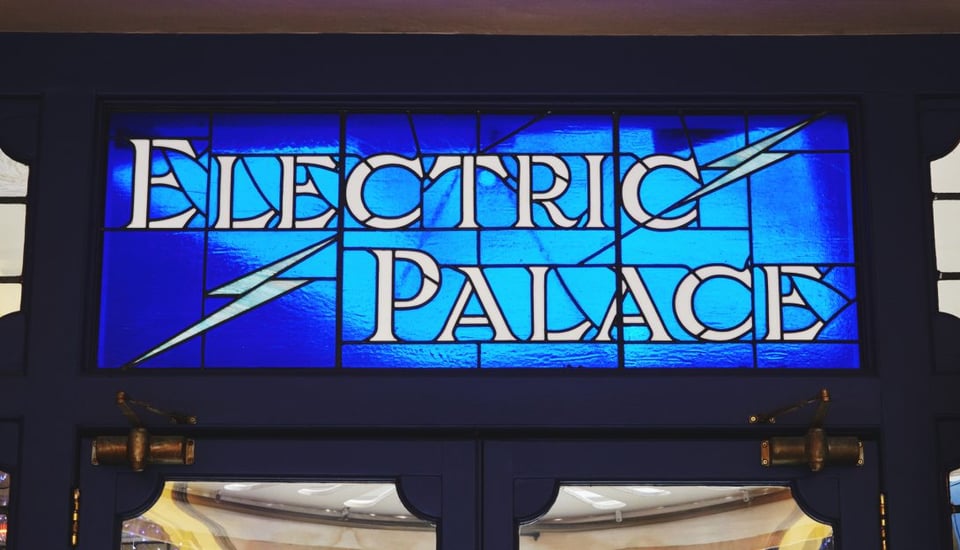
It also has murals. A lot of murals. Those in the auditorium are modern, but the ones in the foyer are from 1936. These are by local signpainter and artist George ‘the Professor’ Biles. Biles produced scores of pub signs for the Palmers brewery, and was clearly asked to do something on the Electric. Palmers have loaded an old TV news item about Biles’ work on their Facebook.
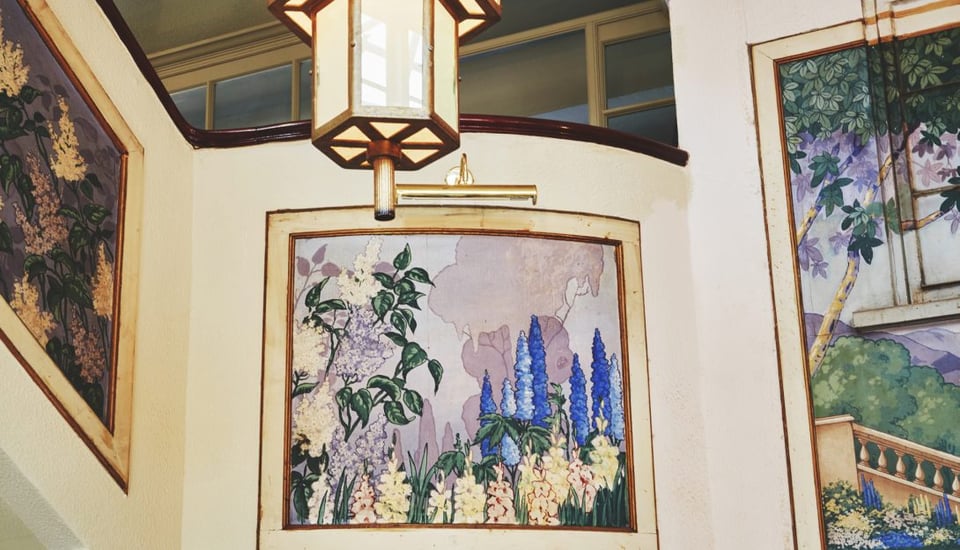
These are delightful, and remind me of colour illustrations and fashion plates from magazines of the time. As seen in the image above, lots of original Deco light fittings also survive.
Unsurprisingly, the building is Grade II listed.
The sale includes the two shops flanking the passageway entrance, and the two flats above. These also have lots of Deco detailing, though I’m unclear if these are original or reproduction. You can have a look at the full details on the Symonds and Sampson listing.
The Grand Central Hotel
This Grand Hotel is not in Budapest but in Weston-Super-Mare. And it’s to be converted into a combination of flats and an HMO.
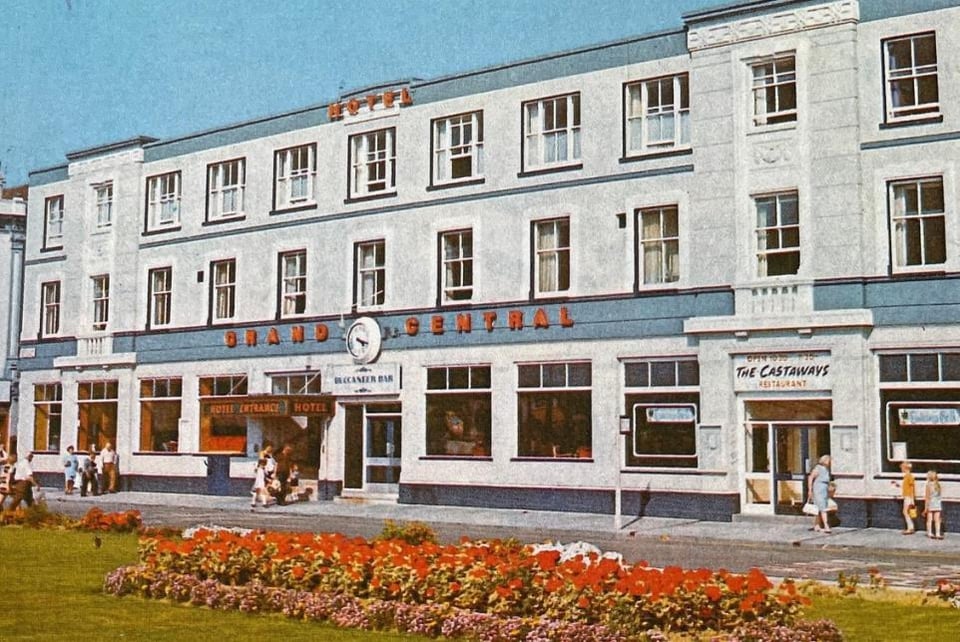
The Grand Central Hotel (Sir Henry Tanner, 1925) was designed for Macfarlane and Sons. It smooshes together neo-classical and moderne details on its facade. The design and access statement for the redevelopment2 provides an illustration of the original 1925 design by Tanner, and two photographs of its phased construction.
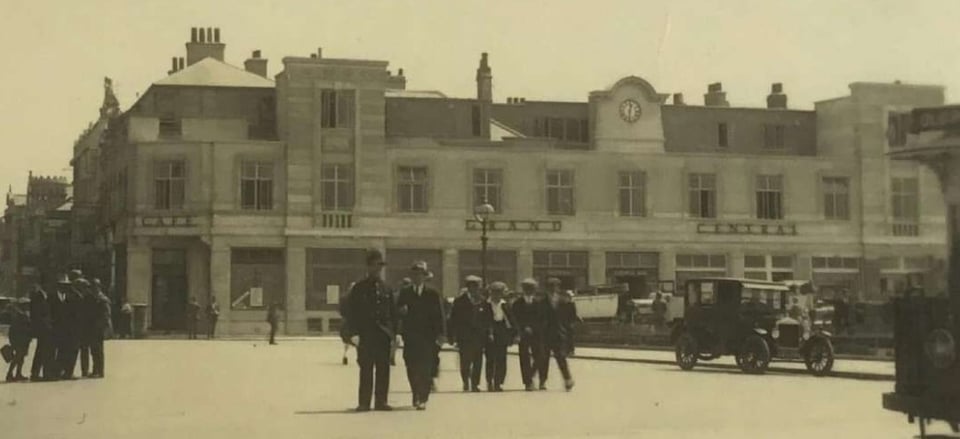
Tanner had chaired the RIBA committee on the idea of using reinforced concrete in buildings, back in 1904, and is known for both his post offices and the Dickens and Jones (1922) department store on Regent Street.
With the days of grand hotels fading, and Weston’s holiday makers heading elsewhere, the hotel has been derelict for thirty years. I took a photo of its non-descript frontage when I was in Weston, but thought it too scrappy to include in my field notes for it. In fact, I noted it as a parade of shops, not a hotel as so few signs of its history are left.
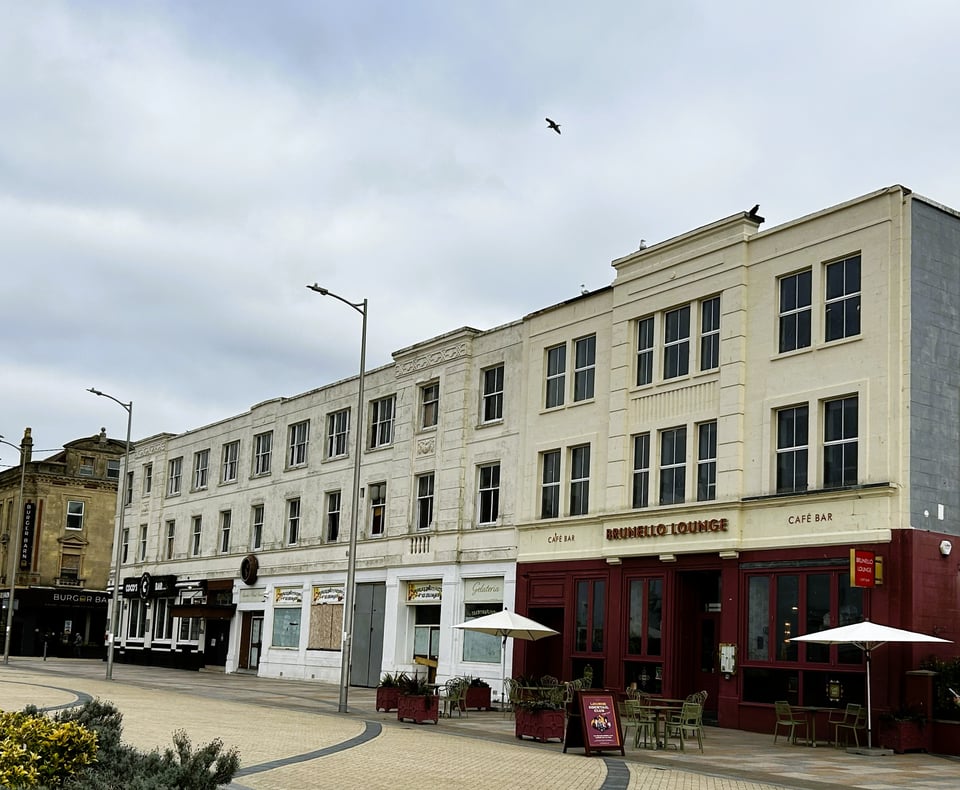
Flats seem like the best use of the building, certainly better than letting it continue to decay.
In brief
Peoples of the universe, please attend carefully3
In 1962, the first open parabolic antenna was built in the UK. Antenna One, known as Arthur, picked up signals from Telstar on 11 July 1962. Arthur also transmitted the moon landings of 1969 around the world. It’s now a Grade II listed structure.
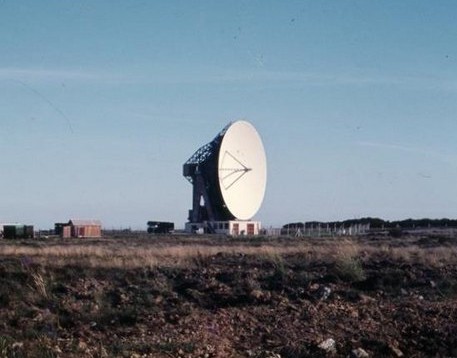
Goonhilly Earth Station was commissioned by the General Post Office and was the centre of satellite communications for decades. At one point it had perhaps 60 antenna. When the British Telecom, which replaced the GPO, decided to sell it in 2006, it was turned into a commercial enterprise. Now, after over sixty years supporting space exploration, it is being sold to US aerospace company Intuitive Machine.
Seawater pool centenary fundraiser
The Shoalstone Seawater Pool in Brixham took on its current form, complete with a simple building, in 1926. Before then, two Victorian walls had held some of the seawater in place. At high tide, the sea covers the walls and rocks, filling the pool. The tide retreats but the pool holds onto the seawater.
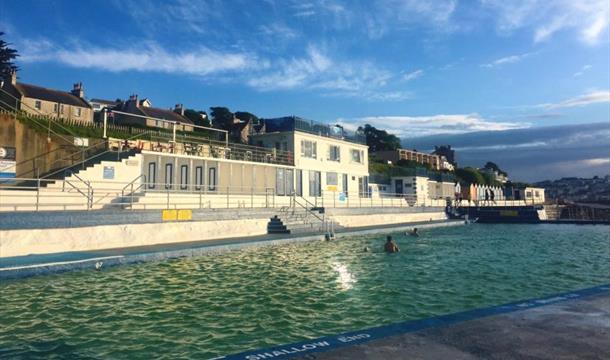
I’ve written about why the 1920s and 1930s were obsessed with lidos when I wrote about Tinside in Plymouth. Shoalstone is both older than Tinside, and free to use. The pool was due to open for the season around about now, but is closed for critical repairs. They are fundraising to try to finish the work, and are 95% of the way there.
The Old Kiln, Port Navas
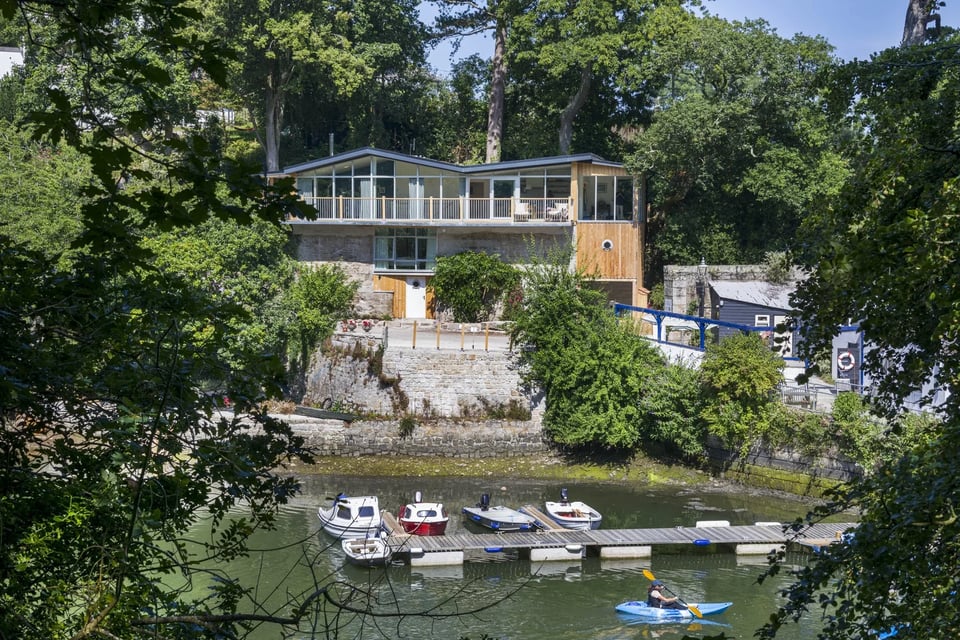
This holiday let, currently for sale, was originally created in 1968 for Ida Hilary Shaw (1923ish to 2013), a former missionary turned Cornish teacher and bard. The building used the granite old kiln structures as a base, supporting a wooden modernist building with a zigzag roof. One element that intrigues me is she is said to have employed a woman as the architect. I’ve not been able to find out more on an initial search.
Right up until her death in 2013, aged 90, Miss Shaw would access her property by using a ladder.
The upper storey was completely rebuilt in 2017-2019 by architect Michael Hormann, keeping much of the shape but increasing the ridgeline and improving the safety. Apparently prospective guests didn’t want to use a ladder to reach their holiday let. The timing of opening it, for the 2019 summer season, may provide a clue why the owners are now selling up. Within a year, the pandemic was keeping everyone at home and tourism took a serious economic blow.
The sales listing does not include a council tax band, due to it having been set up for business rates. So if you have the £1.35 million asking price, do check what the CT band would be as Cornwall charges 200% CT on second homes.
Modernist Bristol
Andrew Eberlin has published a new 102 page book, Modernist Bristol. Andrew’s photography is always a delight as he takes the time to find the angle that makes a building snag at your imagination. Learn more about the book on his website.
Everyday modernism in East Dorset
The Museum of East Dorset has put a call out for everyday items that tell stories. The photo illustrating the story suggests a lot of C20 items are likely to appear in the subsequent exhibition.
From the BBC Archive
I’ve just watched the 2011 documentary about the Festival of Britain which has been put on the iPlayer to mark the Festival’s 75th anniversary. The Festival of Britain: A Brave New World is available until April next year.
Also available in the Archive until the end of 2026 is Travels With Pevsner from 1997. This includes an episode on Dorset by Patrick Wright which doesn’t touch on modernism at all, but does talk about how Pevsner guides miss the human stories of the buildings. This lack is what I try to tackle with the deep dives.
I’ve started an interim contract, which means I now have some time constraints. I’ll be publishing the newsletter on Mondays as it means I can write it on Sundays. As you can imagine, I disappear down rabbit holes even just roughly researching these news stories!
Mags
If you’re enjoying this newsletter, feel free to share it with others.
If someone has sent you this, you can subscribe below.
A free sub will get you the weekly field notes and notice that a deep dive has been published.
A paid sub will unlock the deep dives early, plus occasional bonus content and the warm knowledge that you’re supporting the project.
Not the first time a local brewing family has invested in an entertainment building for its town: see my free deep dive into the Amulet (Terry Hopegood, 1975) built by the Showerings for Shepton Mallet. ↩
As planning regulations change, I strongly hope the need for heritage statements, design access statements or both, is kept. They are very useful secondary sources for research. ↩
This is a Doctor Who reference. Sorry. ↩
