
Field Notes: Taunton part 1 (8 May 2026)
A tour of half of Taunton, Somerset, taking in "one of the few good buildings employing New Brutalist architecture in the south west".
I’d never really got my head around Taunton until last week. I’ve mostly seen it from the railway, or from National Express coaches to That London. When I’ve stopped in the county town itself, it’s been for the Somerset Archives out on an industrial estate or the County Hall. So my knowledge was mostly of the roads leading to those places.
I prepped by drawing up a list from Orbach and Pevsner’s 2014 Somerset: South and West. That revealed a cluster in the town centre and some satellite buildings in the suburbs. Following my notes and my nose, I finally worked out how Taunton fits together and it involves the huge stadium floodlights that peek over rooflines.
Bridge Street, which provides the first impression as you walk up from the railway, is a long row of takeaways with a single, rather nice, gentleman’s outfitters tucked within them. That’s the key I’d never found before: the space between the station and the city centre is all focused around the cricket crowds coming to the County Ground. The city centre sits beyond this and its main shopping drag is not the short High Street as I’d previously thought but East Street. Within an hour of starting my wander, I also realized I’d need to split this into two parts. So here’s Taunton part 1: southwest suburbs and town centre.
Highlands, off Sherford Road (1930s and 1960s)
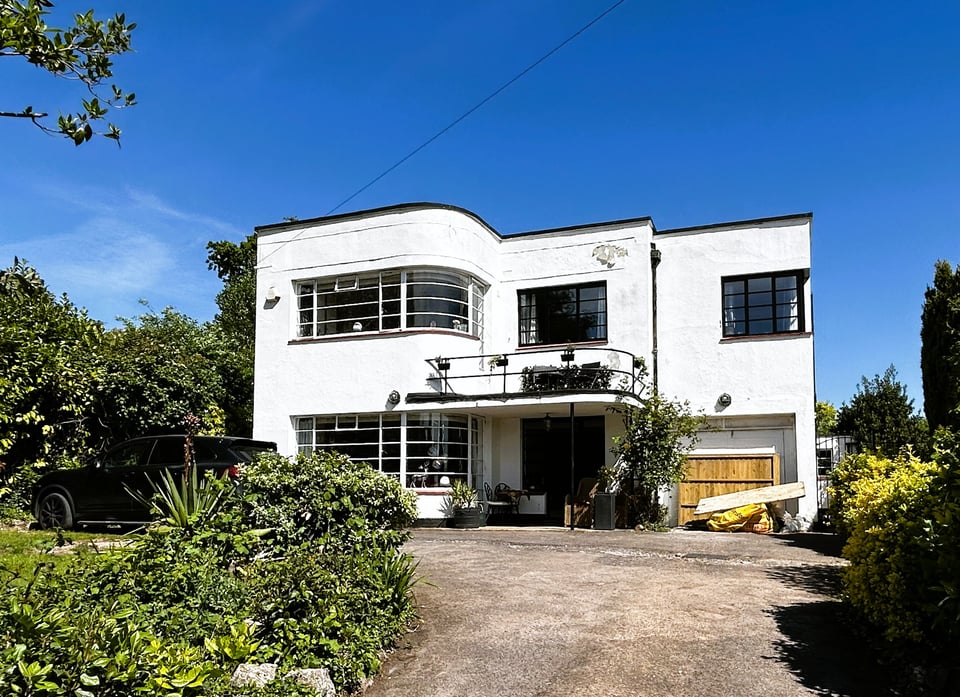
Back in 1933, local building firm Moggridge and Sons bought the old Highlands House and its grounds to develop into a T-shaped cul-de-sac. At the top of the left arm are the first houses developed by Moggridge, in 1934. Numbers 1 through to 3 (Fairmile, Danesclose and Two Ways) are very much in the Moderne of the time.
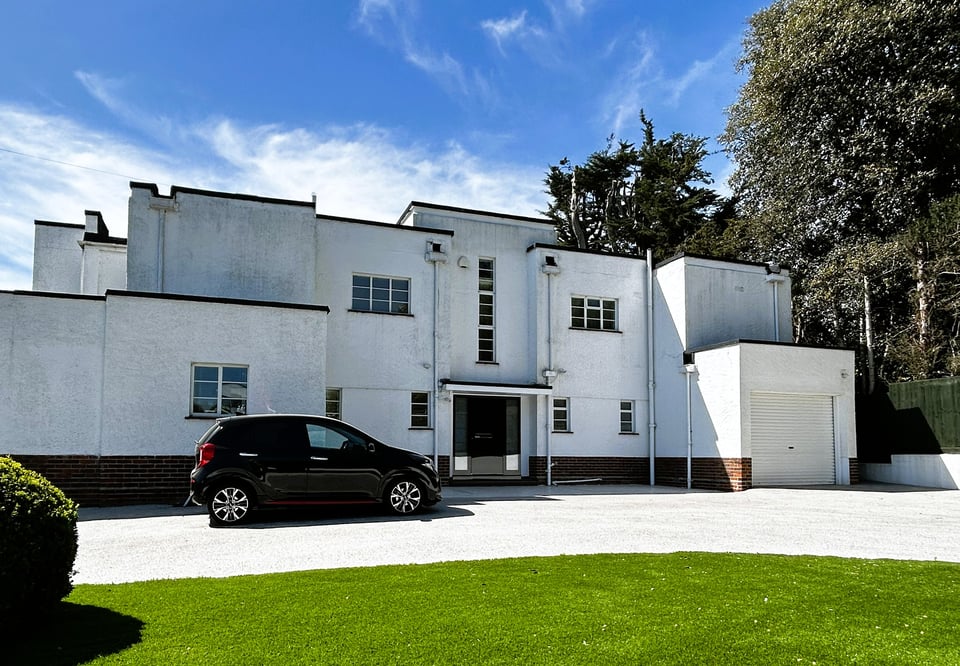
These are thought to be the work of Henry Stone, a local architect, then practising with Eric Francis. (Source: Haines Hill Conservation Area appraisal)
What surprised me, though, was number 4, since it had not been in Pevsner. This was built in the late 1960s by local builders Noyese and Marks, and won a Borough Design Award. As it was for Mr Noyese, it doubtless doubled as a showcase of their work. When the area’s conservation report was written, the upper floor of the house was still clad in wood. This was replaced with vertically crimped metal as part of the 2016 renovation designed by Exeter-based architect Eduardo Hoyos.1
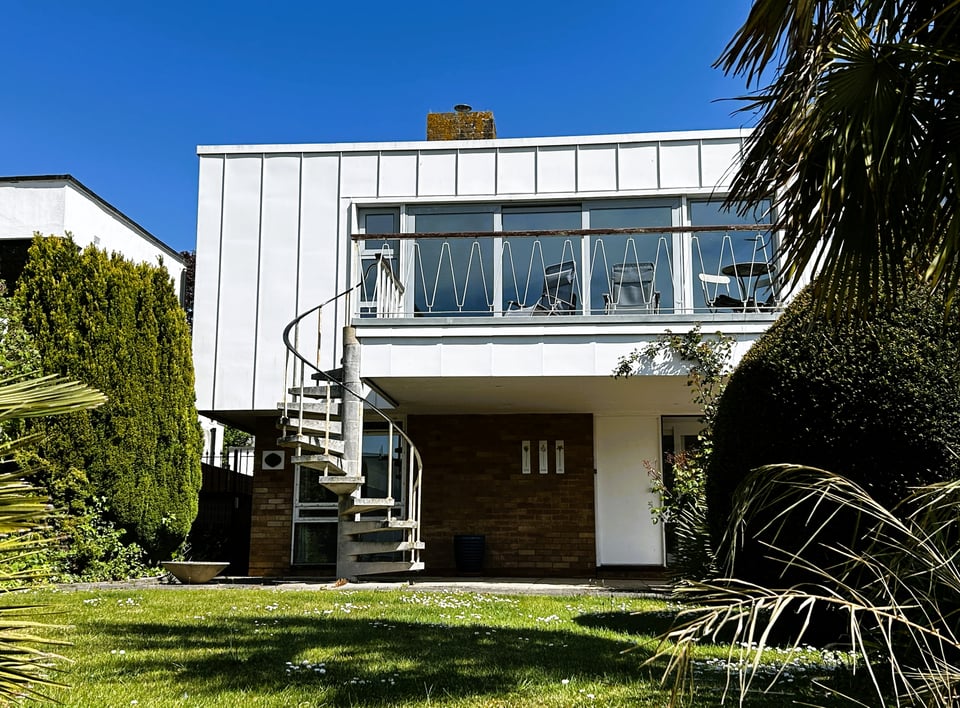
I really like this house’s front elevation. The approved renovation included replacing the original metal and wood balcony rails with frameless glass but I’m delighted that hasn’t been done, and a lovely bit of its original 1960s fittings are still on show. This is one reason I treat Pevsner as a starting point: following their footsteps can lead to surprises.
Somerset Art School (1972)
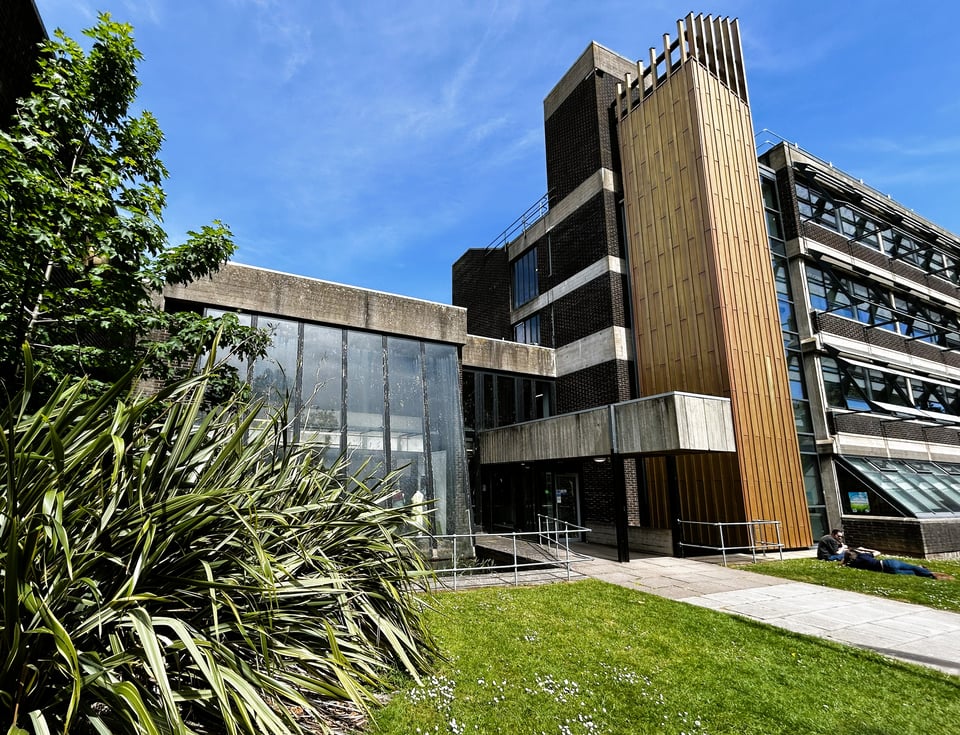
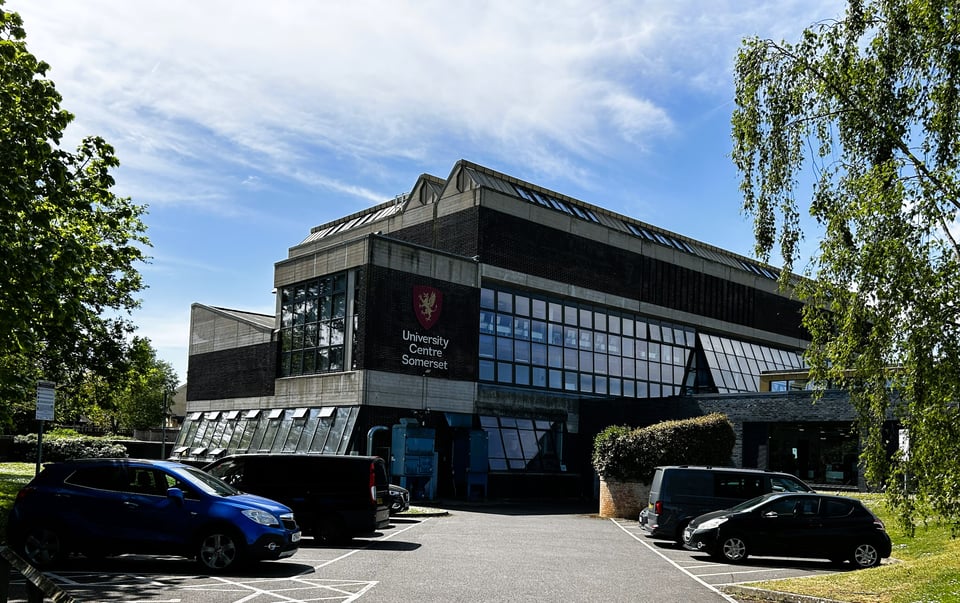
This was designed by Peter Hirst and Derek Rutherford under Bernard C Adams’ tenure at Somerset County Council Architects Department.2 What a good art school building needs is lots of natural light. Hirst and Rutherford delivered this. Hirst had studied at the Architectural Association, where Brutalism was the preferred style.(Source: Somerset HER 42639) An Historic England report, which decided against listing the building, described it as “without doubt one of the few good buildings employing New Brutalist architecture in the south west.” (Source: HE 1517214)
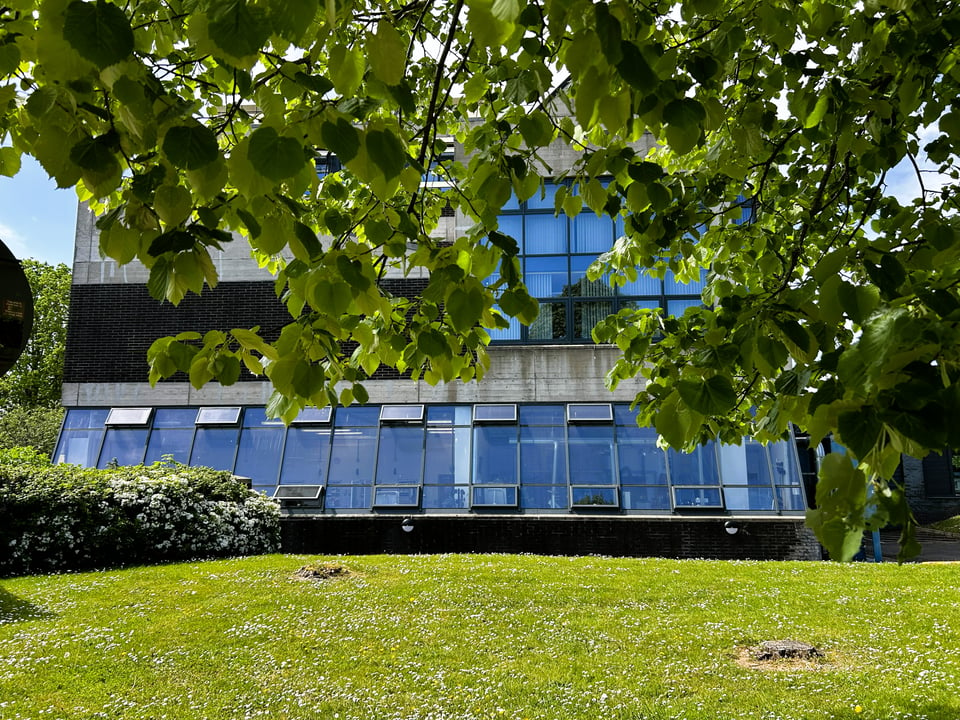
The dark brick and shuttered concrete walls are lightened on the southern and eastern elevations by the ribbon windows tilted at angles to catch the sky. The rooftop hints of many skylights and ribbons of transverse glazing. The main entrance way is a single storey glass atrium reached by a covered walkway over shallow pools one of which goes under the glass wall so the fish swim in and out. The northern elevation of the main block is glass, allowing a steady natural light into the studios. I like to imagine the architects knew exactly what needs they were designing for here.
The Moxom (1960, formerly Bedford House)
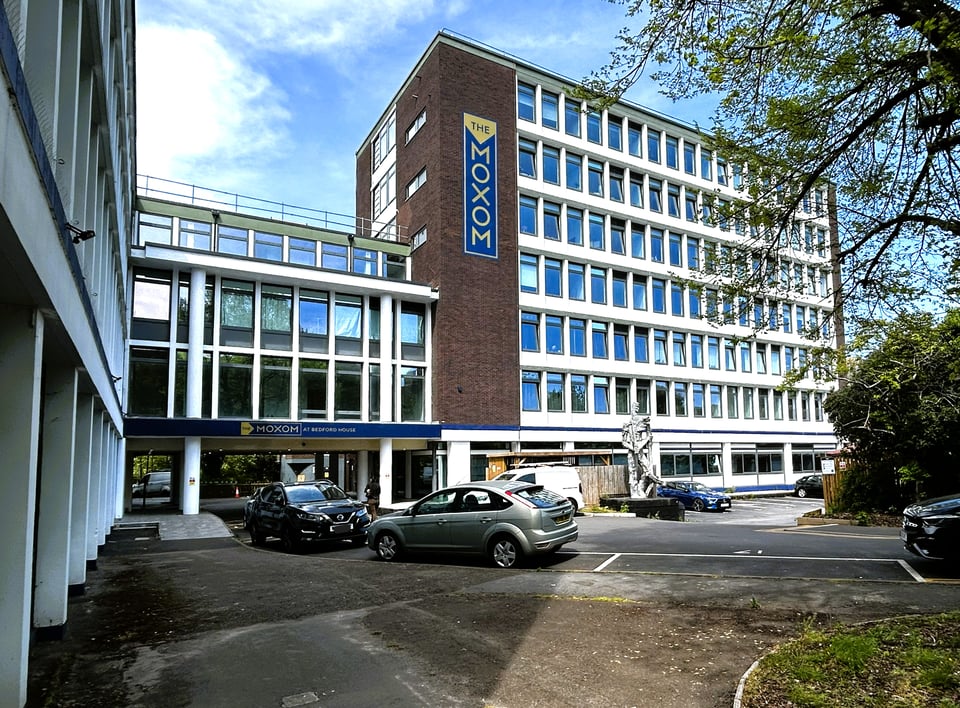
These two six-storey office blocks, by Reginald Gallanaugh, connected by a smaller glass link building, were originally intended to be the headquarters of the National Farmers’ Union (NFU). They’ve now been converted to apartments. The blocks are frames and panels, with the white of the panels standing out against the dark brick façade hiding the stairwells.
Outside is a sculpture, which is locally listed. This is lacking an information panel but is Agriculture by Joxé Manuel Alberdi Elorza (1922-2008).
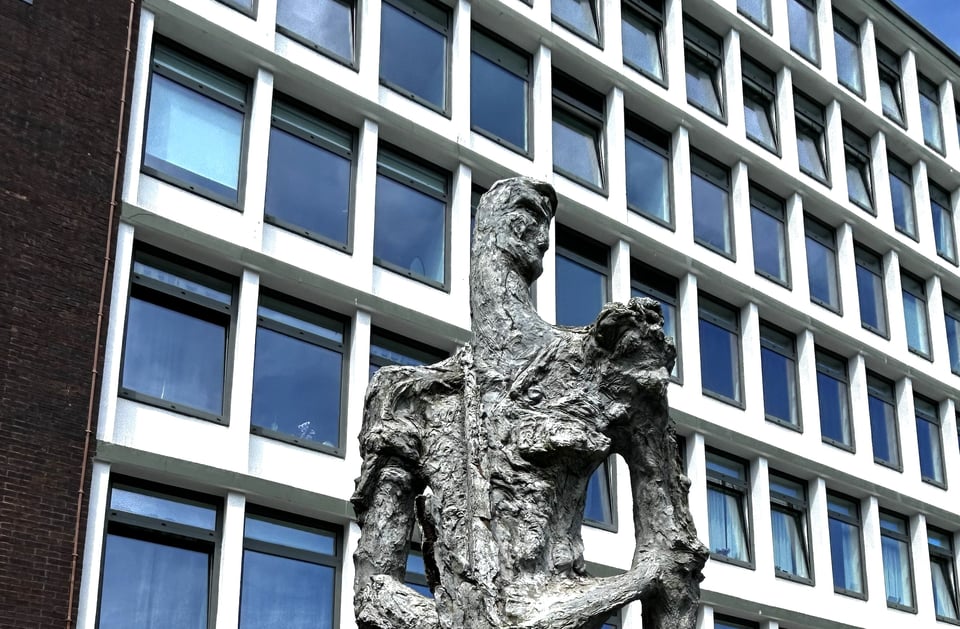
Alberdi was born in the Basque, and arrived in the UK as a child refugee from the Spanish Civil War. Initially working to become a civil engineer, he switched to sculpture, eventually becoming Professor of Sculpture at Saint Martins in London. Agriculture had to be craned into place, as seen in this British Pathé newsreel.
The NFU never moved in. For a while, as their new blocks were being built, it was occupied by staff from County Hall across the road. It then became the offices of Debenhams backroom services. (Source: Somerset HER 47045)
Gaumont Palace cinema (1932, now Mecca Bingo)
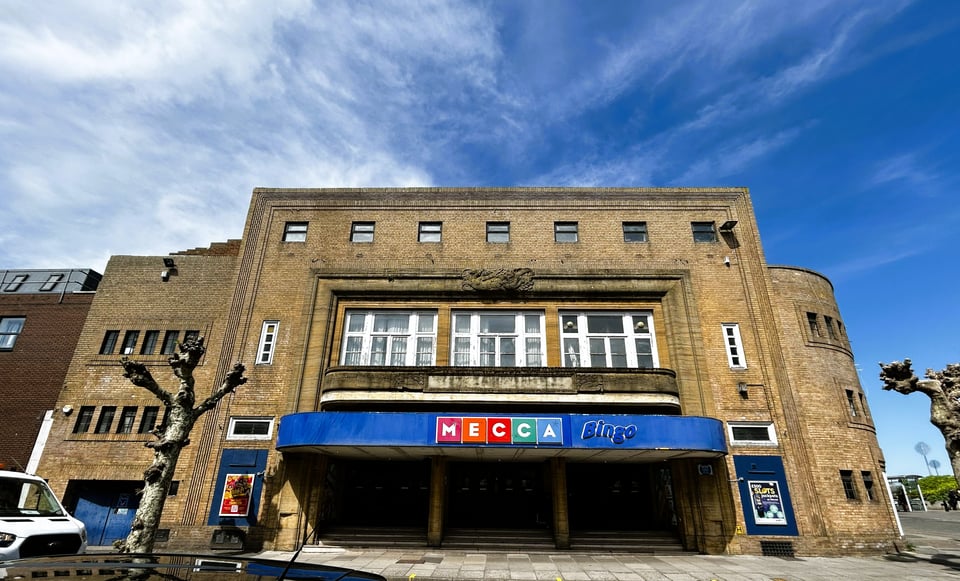
Designed by William Benslyn for the Gaumont chain, this is a solid, large brick building with typical 1930s stylings. I had assumed the Mecca bingo canopy had been rather crudely inserted across the top of the doors and below the stone balcony. In fact an early photograph of the building shows this is a boxing of an original canopy.
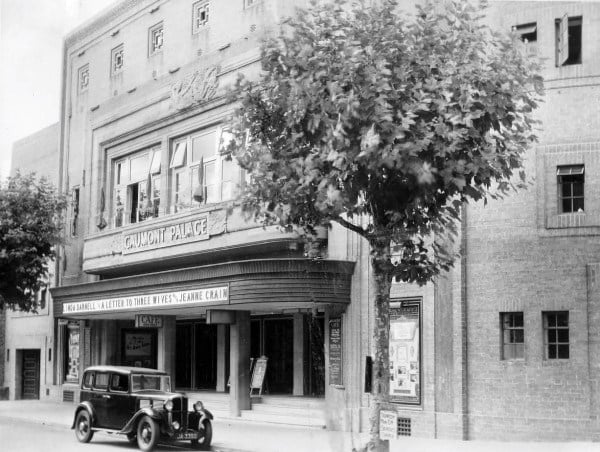
As the doors were open, I went inside and a member of staff showed me the interior of the auditorium.
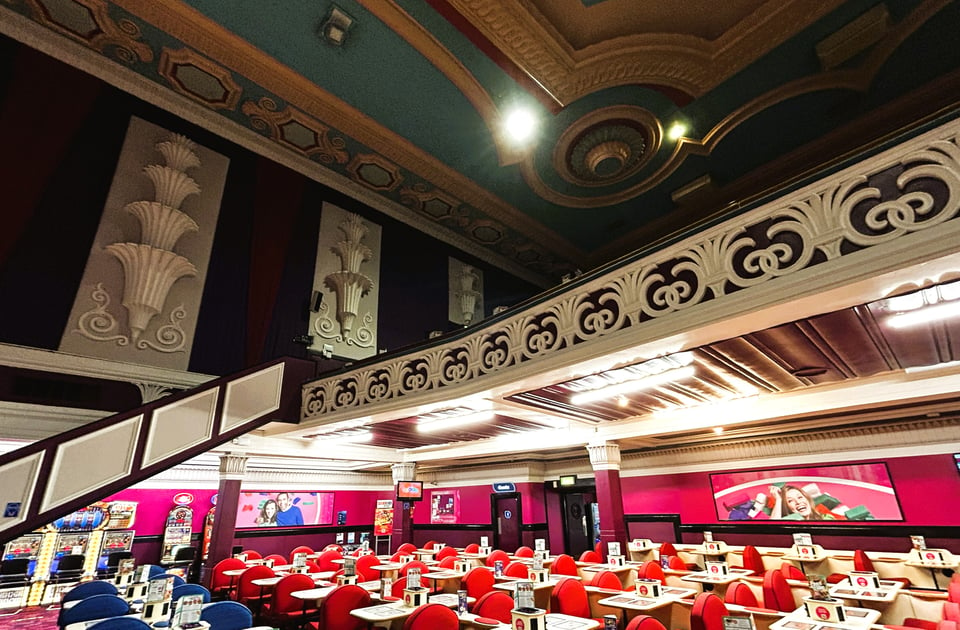
There are so many original details retained, from grilles and doors through to the ceiling. This is an example of how the definition of Deco has been reduced to the streamlined Moderne since the 1970s. Orbach and Pevsner call this interior Deco: the exuberant colours and tiered fountain wall motifs seem almost too wild. It did make me catch my breath and laugh though.
Unsurprisingly, the building is Grade II listed. Cinema Treasures has some much better photographs on their page about it.
Bridgwater House (c 1960)
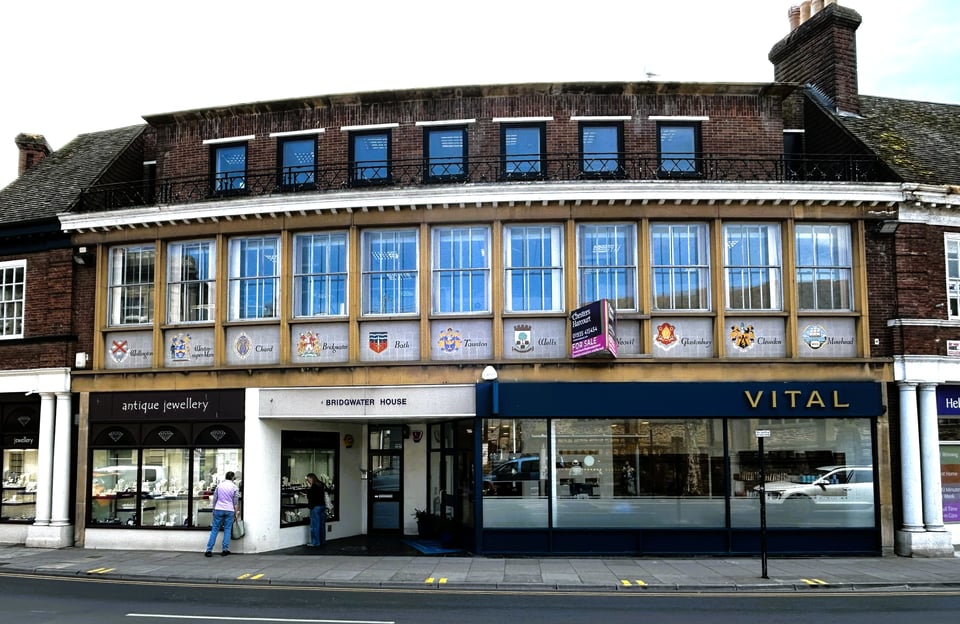
This building was designed by Robin Shirley-Smith for the Bridgwater Building Society. Although it’s listed as 1960 by Pevsner, the Somerset HER makes me think it may have been more like 1957 or 1959. The offset doorway in the otherwise symmetrical design was because one side was a car showroom for Somerset Motors.
The overall building is rather generically post-war, a blend of modernist simplicity with traditional materials and detailing. The bit that made me pay attention was the delightful tiles for all the towns where, I assume, the Bridgwater Building Society had branches.
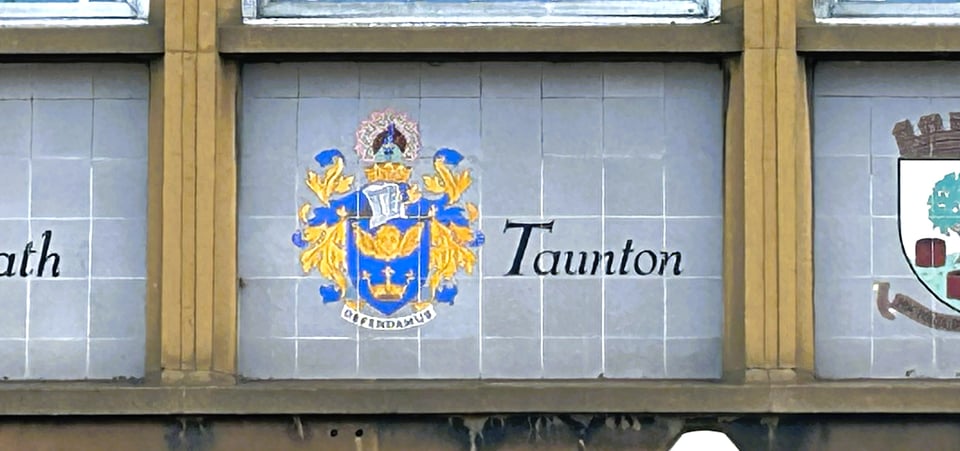
The property is for sale, so there are more details on the estate agent’s site.
If you’re enjoying these wanders around west country towns, did you know you can support them with a monthly or annual subscription. It’s less than a super fancy coffee a month!
Upgrade now1 High Street (1977-79)
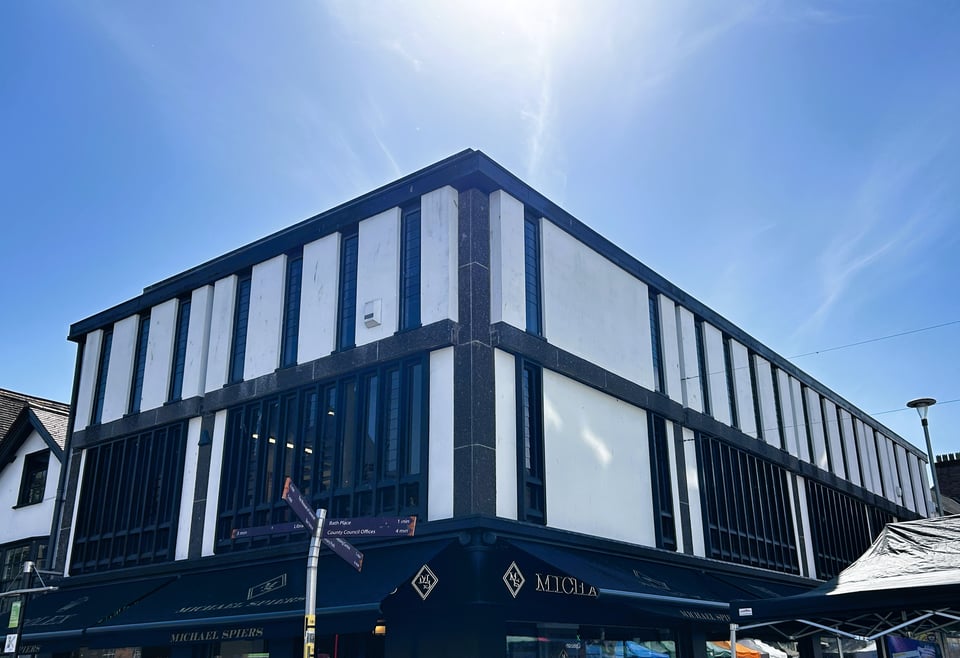
This building by Whicheloe Macfarlane, the practice that did so much to shape modern Bristol, makes me smile every time I see it. It’s a 1970s take on the half-timber building it replaced. The white panels are concrete, with stylized Elizabethan gallery windows set into the concrete frame. At street level, the playfulness is less obvious, due to the need for plate glass shop windows.
Library and Paul St car park (1973)
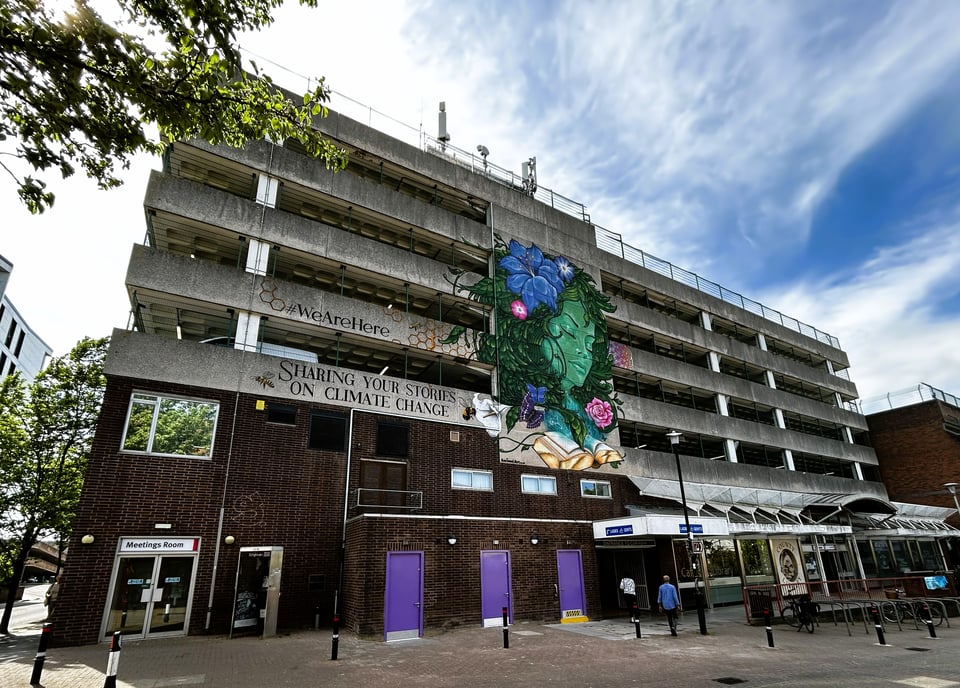
The library is reusing a supermarket space under a car park and the interior is very 1990s.3 Outside, using the blank concrete wall of the carpark’s lift shaft, is a simply wonderful mural about stories and climate change. Around the back, I also rather liked the drum ramp spiraling up to each level of the parking.
Cheapside House (unknown)
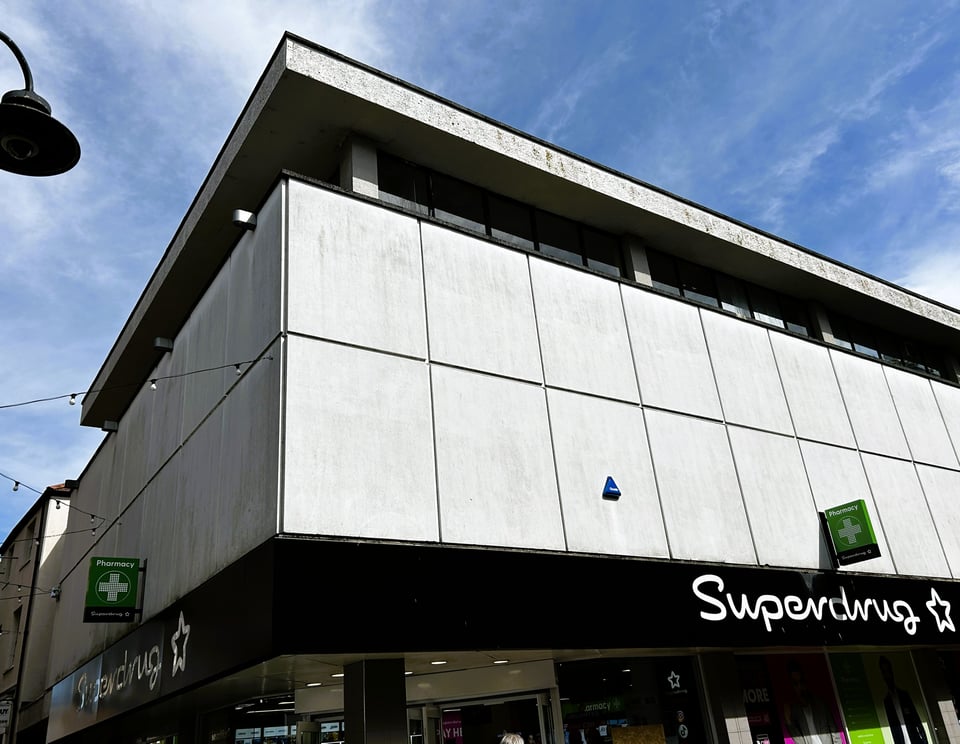
I found out very little about this building, which had struck me for its monolithic appearance. It’s not listed in Orbach and Pevsner, nor on the Somerset HER. The solid slabs and simple roofline makes me think it would be 1970s, as does the fact it’s close to the Paul Street car park (see above).
Digging into the Taunton Deane planning portal revealed its name, and that it has prior approval to convert the upper floor office space to 10 one-bed flats. This would be where the ribbon of windows is visible.
Lloyd’s Bank (1960)
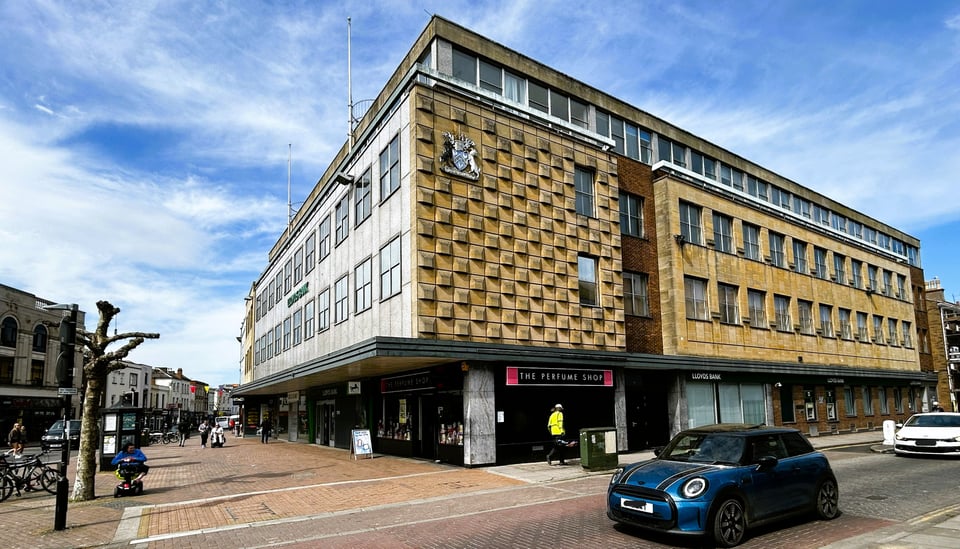
Very much in the house style of Lloyds, with the customary pale green Ashburton marble street-level cladding, but with a rather more interesting relief wall on one side. This was designed by Trehearne and Norman, Preston and Partners to integrate with the existing buildings that neighbour it, hence the use of brick. A classic of the “always look up” building where there’s something interesting above the retail floor.
Burtons (1930)
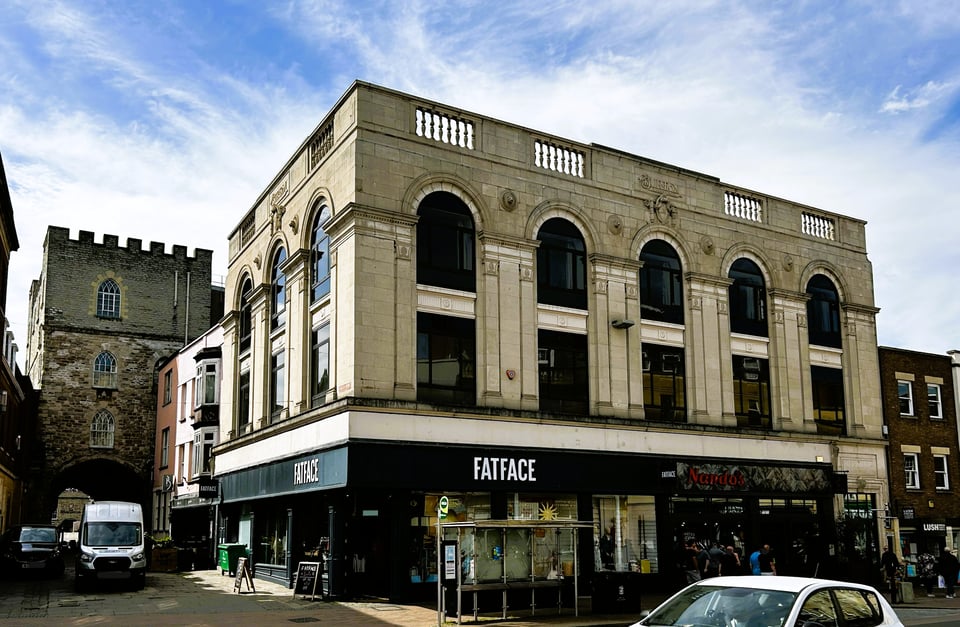
This is nothing like as wild as Weston-Super-Mare’s elephantine branch.4 Although it’s dressed in some classical motifs, and the Edwardian nouveau logo, the underlying structure is clearly built on a steel frame that is then hidden beneath the classical elements.
The building originally included a billiards hall on an upper floor as a form of loss-leading attraction. The theory was the young men who would come to the hall might over time become Burtons customers. For more about the surviving Burtons buildings, you can explore Laid By Monty.
Debenhams (1930s and 1960s)
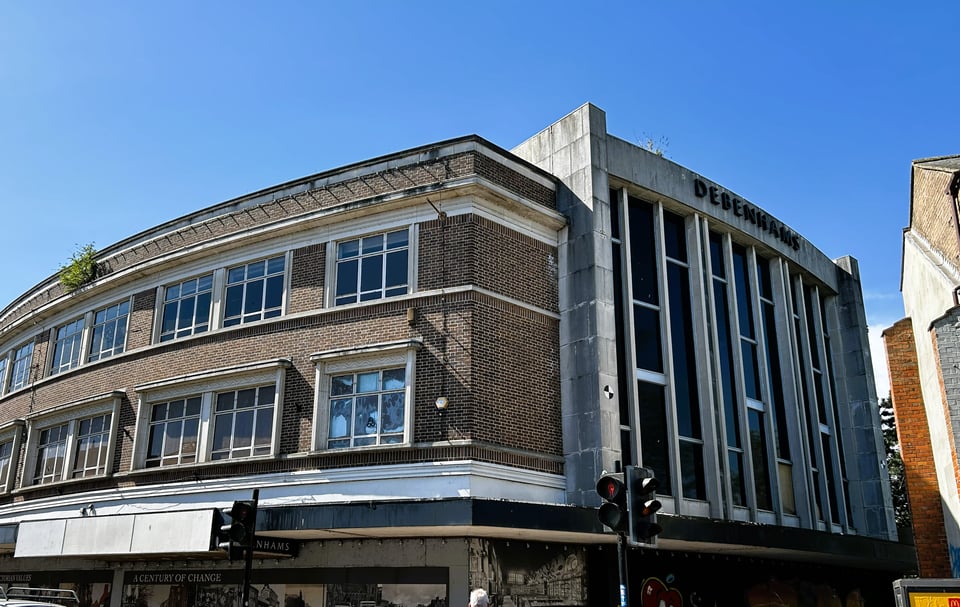
I’ve written about this building’s future a fair bit.5 The original frontage was designed by George Baines and Sons for local retailer Chapmans in 1938. When it was taken over by Debenhams in 1959, they extended its footprint and used George Baines again. Around the back it is middling and practical 1960s brick but the additional frontage maintained the lightly Deco/Moderne style. I rather like the juxtaposition of the 1960s concrete block on the northern elevation with the curve of the front.
Walking around it, I was struck by how compact it is and what a view it has over the river. It is easy to see how some thoughtful renovations would enable some premium riverside apartments and ground floor social spaces. It’s locally listed, and the proposals for adapting it seem sympathetic.
Brewhouse Theatre (1977)
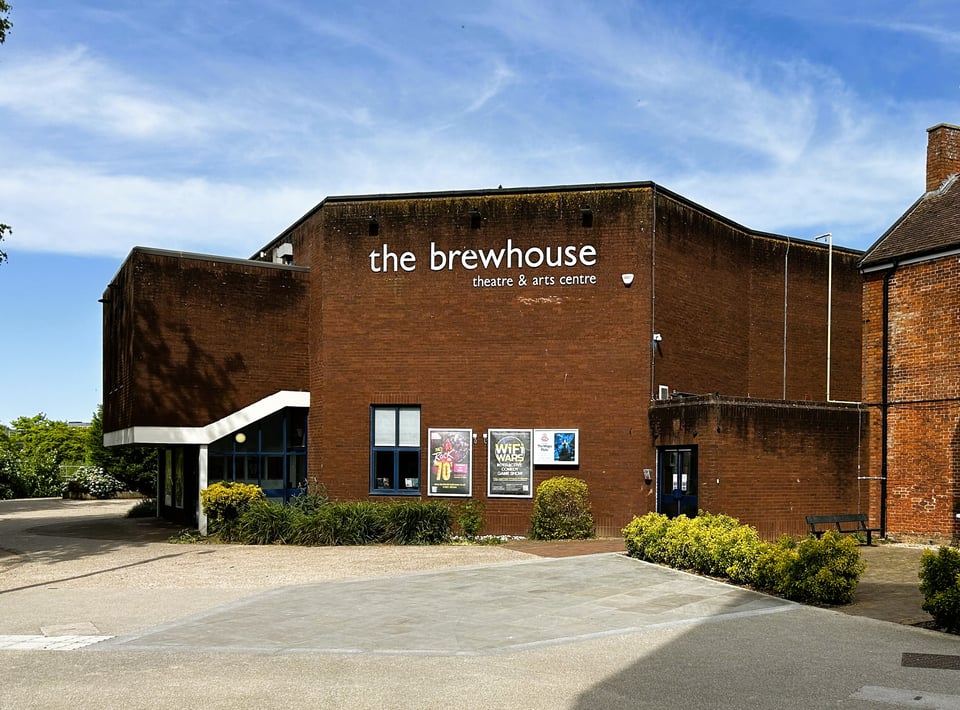
The Brewhouse Theatre was designed by Norman Branson in collaboration with Adams’ Somerset County Architects department. Branson designed several mid-century theatres, including Questors (1964) in Ealing and Rugby School Theatre (1974).
Externally, I found it a bit smaller and darker than I anticipated.
The Coal Orchard (1937)
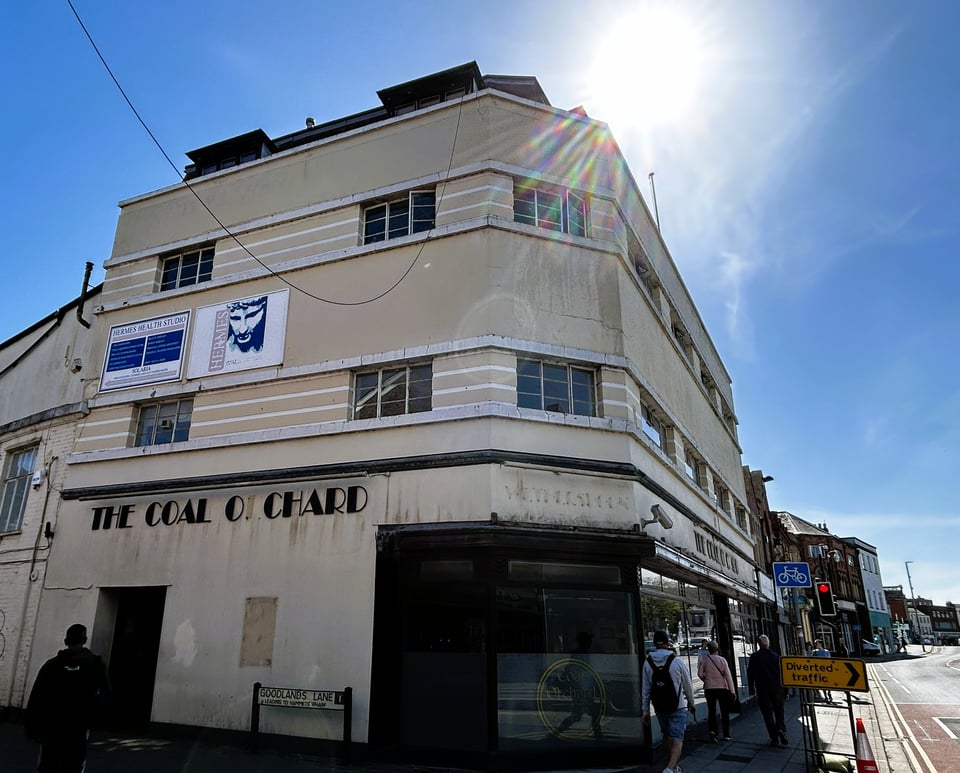
This lovely, if battered, building was designed as offices and a salesroom for a builders’ merchants Webber and Spiller. It is streamlined modern, with some original elements still in place such as these chevron details.
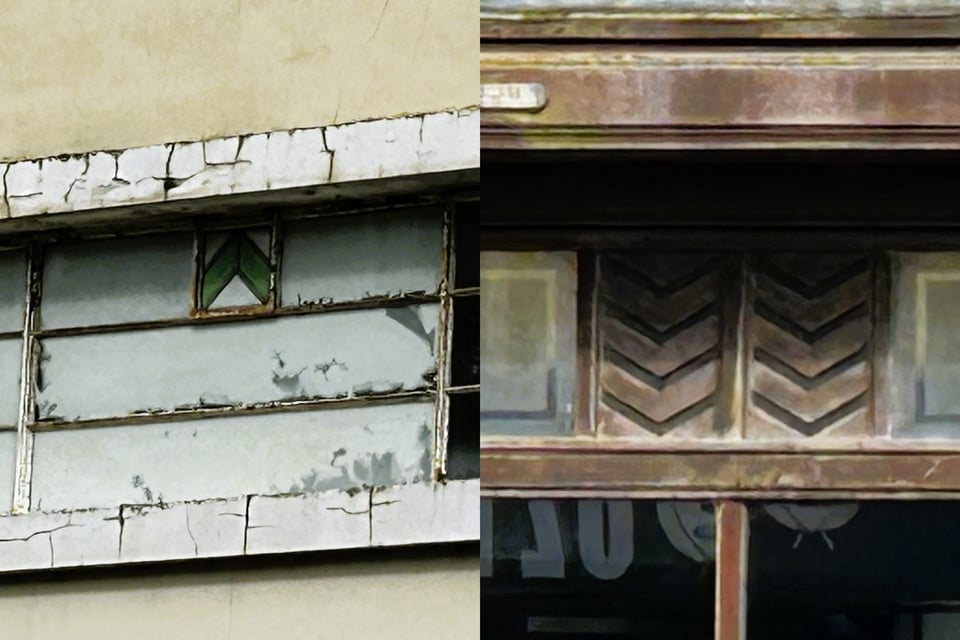
It was built by Moggridge and Sons, the same developers who had created the Highlands estate I started these field notes with. I’ve yet to uncover an architect, but there’s a temptation to suggest it might be Henry Stone.
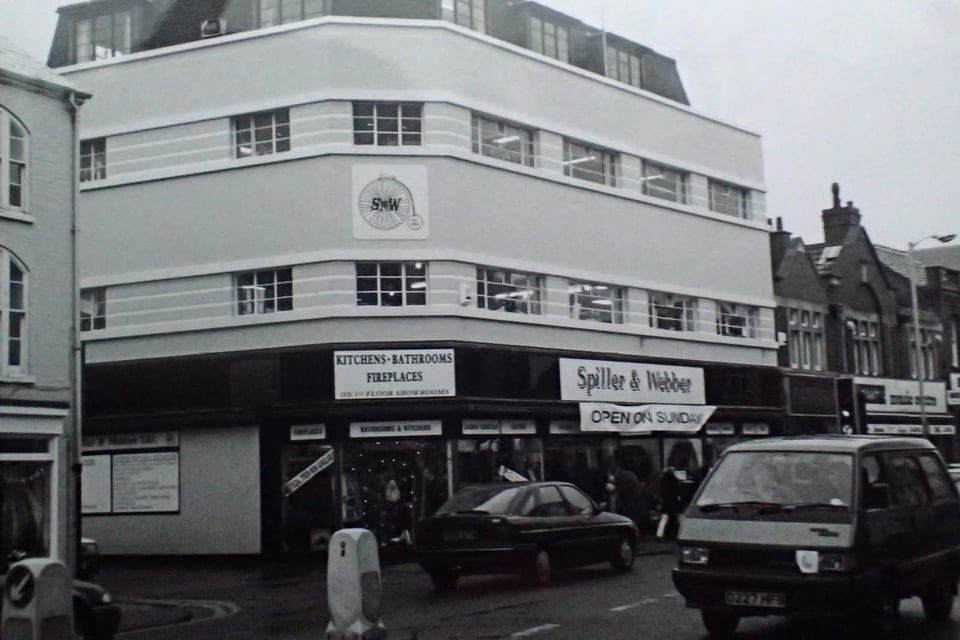
It was taken over by Wetherspoons in 2001, and renamed the Coal Orchard, but the chain pulled out in 2022. An attempt to run it as an independent pub failed, with the landlord evicting the tenant in March this year for non-payment of rent. (Source: Somerset County Gazette)
Not only is the building not listed, but it is not locally listed with nothing on the Somerset HER.
There are still several buildings I want to visit to the north and east of the railway. And I must admit I was mostly thinking about lunch and a nice sit down when I got to County Hall so didn’t stop to photograph the whole campus. So look out for part 2 of Taunton later in the year.
I’m off to carry on breaking in my new DM shoes, and to book my next visit to an archive for the deep dive I’m working on.
Mags
If you’ve got a favourite modernist building in Taunton, or the wider west country, do let me know. You can either reply to this email or reach me on Bluesky.
Hoyos’s Discovering Exeter: Twentieth Century Architecture (2001) was one of the prompts for me finally starting this project. ↩
See my former Nailsea Library deep dive for more about Adam’s ‘Method’ system). ↩
The design elements left over from the supermarket makes me suspect it was a Sainsburys. ↩
See my field notes on Weston-Super-Mare. ↩
See https://buttondown.com/WestCountryModernism/archive/news-23-apr-2026/ ↩
