
Nailsea Library (former), Nailsea (1971)
Exploring the history of Nailsea's old library, a brutalist gem that now serves up lattes.
This contains two firsts for me: the first focus on a piece of west country modernism that has been repurposed, and the first to have been suggested by a reader.
Nailsea sits on the Nailsea coal basin, within the North Somerset Levels. It was the coal seam that the village was exploiting by the 1600s, with scores of pits. That drew glass manufacturers in the late 1700s, reducing their transport costs for cheap glass by being close to the coal for their furnaces. But by the end of the 1800s, both the glassworks and the mining were gone.
What was left was an 1841 railway station, around twenty minutes’ walk away at Backwell, and transport links to the port of Bristol. Walking up from the station, I passed comfortable Victorian villas, then some interwar houses and a 1950s estate. And then, suddenly, a 1970s town centre appeared, parked on and by the old village High Street. And at its heart was a spaceship.
This is the story of Somerset’s town planners, and the ambitious architect leading the county council into the 1960s. It’s also the story of a building that has been repurposed: a building made to tell stories.
In the 1950s, the postwar baby boom was hitting Somerset. As places grew haphazardly, the local planning officers submitted comprehensive plans for specific areas. This included a focusing development in a set of ‘new towns’. These were not official new towns, like those created by the 1946 New Town Act, but villages where the planners expected the population to increase.
Comprehensive Development Area No 4 (Nailsea)
The 1962 report on developing Nailsea, drawn up by planning officers, outlined the expectation the ‘village’ of Nailsea would grow from a population of 6,800 in 1960 to 20,500 by 1981. It also stated that “the existing village centre at Nailsea cannot develop into a satisfactory Town Centre by piecemeal development and redevelopment.” (Source: SHC C/PL/2/12)
The plans drawn up are zoned, with retail, residential and industrial areas alongside some public buildings. One lozenge-shaped site is marked C/L for “Council – library”. These 1962 plans also suggest that C/L would be in the first phase of redevelopment, due to be delivered between 1963 and 1967.
Nailsea needed a larger library to support its growing population. In 1954, Nailsea library had been a single room in Church House. In 1964, as the council took over the service, Nailsea’s library moved to its new premises. This was a prefab hut in the playground of Four Oaks Primary School in Nailsea.
“We used the library in (1961) the Green Room at Church House, Silver Street, before it moved into the Portakabin in the playground of Four Oaks school.” (JM, Facebook)
The ambition was for a permanent new library within the new shopping precinct. The library would have rear access that could garage the mobile library vans. (Source: SHC C/PL/2/12) This is similar to the hub model being developed in Cornwall as outlined in my piece on Saltash’s 1963 Library.
In fact, the only way to deliver the scale of development needed across the county was to use “the Method”.
The ‘Method’
Bernard Charles Adams (1915 to 2001) had been appointed as Chief Architect to Somerset County Council in March 1960 (Source: Somerset County Herald 1960). He’d previously been the deputy chief architect at Hertford, where Charles Aslin had been working with Donald Gibson to develop the Consortium of Local Authorities Special Programme (CLASP). CLASP was a prefabrication system that could build schools quickly by using a selection of parts.
Adams was also a proponent of councils working together to gain economies of scale. In 1962, he chaired a working party of the Chief Architects of Berkshire, Cornwall, Devon, Somerset and Wiltshire County Councils, along with Bristol City and County Council. Somerset would pilot a southwest consortium model with three new buildings.
“Mr Adams visualizes method building as being applied to practically the whole range of county council buildings. Existing methods of prefabrication tended to produce stereotyped results. One object would be to produce greater freedom of expression so that they could readily adapt external design to local conditions.” (Cheddar Valley Gazette, 1963)
By 1968, his ‘Method’ system was reported to be a £10 million success story, with Adams claiming the southwest consortium was the first to apply it across a range of structures and materials.
“We were the first to do this,” said Mr Adams, “Since we started it the national trend has swung around and is following our policy.”” (Somerset Guardian, 1968)
In 1971, the Herald Express reported that
“In Somerset, 26 buildings costing nearly £2,500,000 are due to be Method built next year, adding to 130 earlier schemes worth nearly £11,500,000.
“Completed Method buildings in Somerset include Wells public library, which won a Civic Trust award; the police training centre at Canonsgrove, which won a RIBA architecture award; Worle Comprehensive School; and the divisional police headquarters at Weston-Super-Mare and Burnham-on-Sea.”1
Adams had been joined by M H Kenchington as his deputy. Kenchington came from the LCC, where Alison and Peter Smithson had recently been fermenting brutalism. The job architect on Nailsea Library was R D Samuel, who I’ve not found details of yet. As with Cornwall under Hicklin in the early 1960s, we get the sense of a County Architect’s office that has a vision, and a plan to deliver at scale and on budget.
Adams retired at the end of June 1980. A editorial suggested he’d been responsible for over 200 new buildings across the county. He’d also been President of the Society of chief Architects of Local Authorities, and vice-President of RIBA.
The design
The design was drawn up by R D Samuel and Bernard Adams in association with architects Gallanaugh and Partners from Weston-Super-Mare. Gallanaugh and Partners were the architects to Copthall Holdings (Somerset) Ltd) who were delivering phase 1 of Nailsea’s new Town Centre. This local network of suppliers was part of Adams’ ‘Method’.
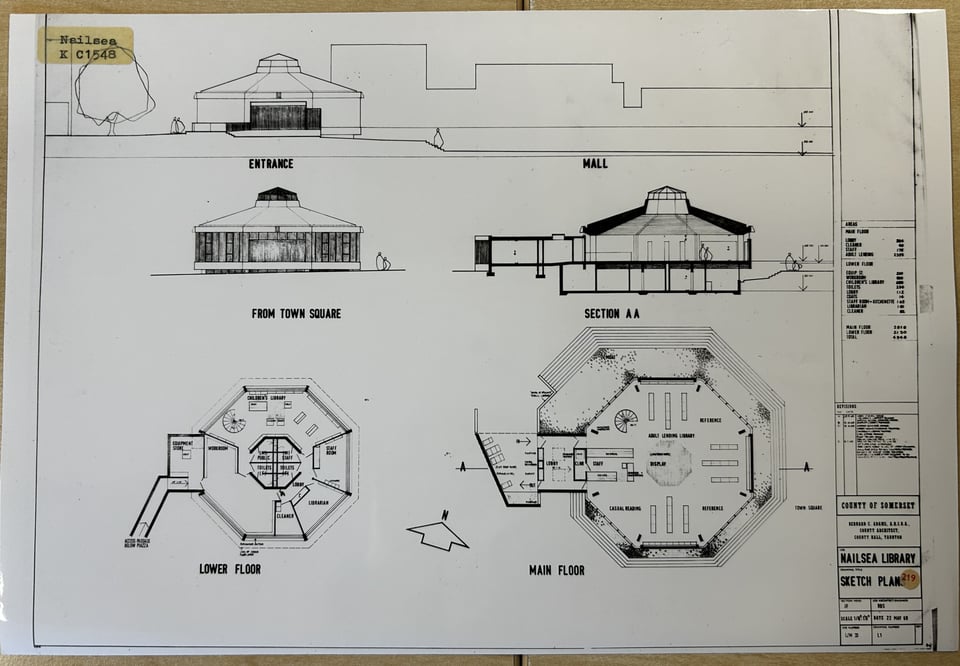
The 1960s development plan specified that all buildings should be no higher than three storeys, in case of subsidence from the coal seams.
The two-storey octagonal library building is set into a matching stepped well so that it has an upper and lower ground floor. The upper ground floor is jettied over the well. It’s walls alternate between ribbed concrete panels with strip glazing above and metal framed full length windows set between narrow concrete mullions. The hidden guttering channels water down not through pipes but over rain chains.
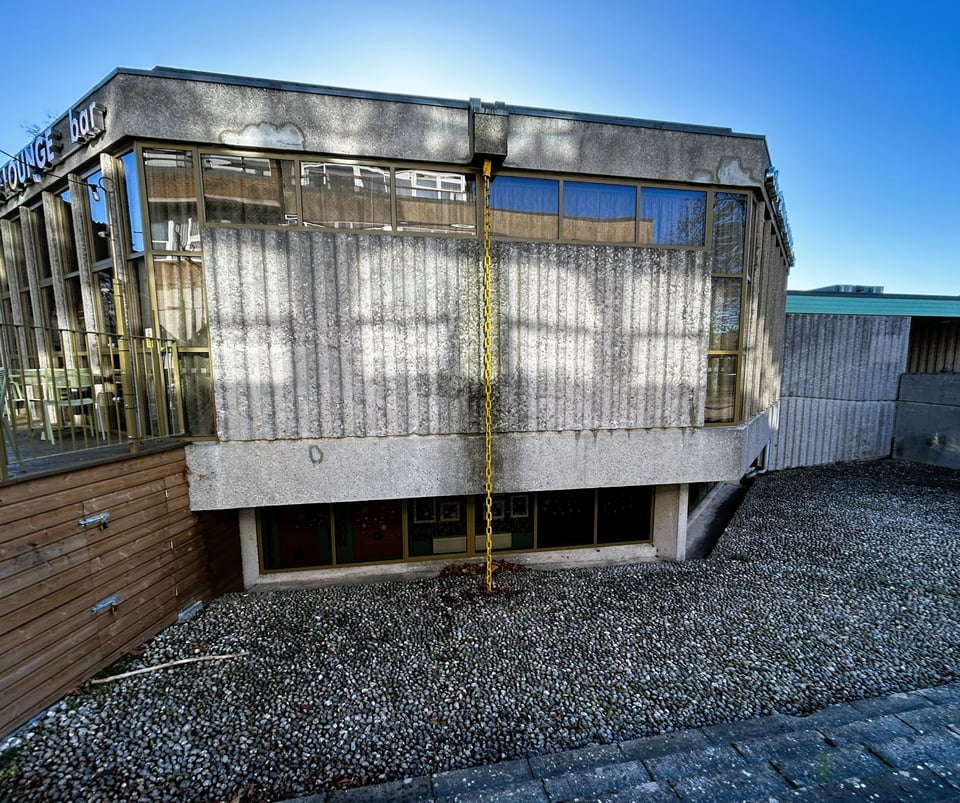
“It's a alien space craft and they had to chain it to the ground.” (IS, Facebook)
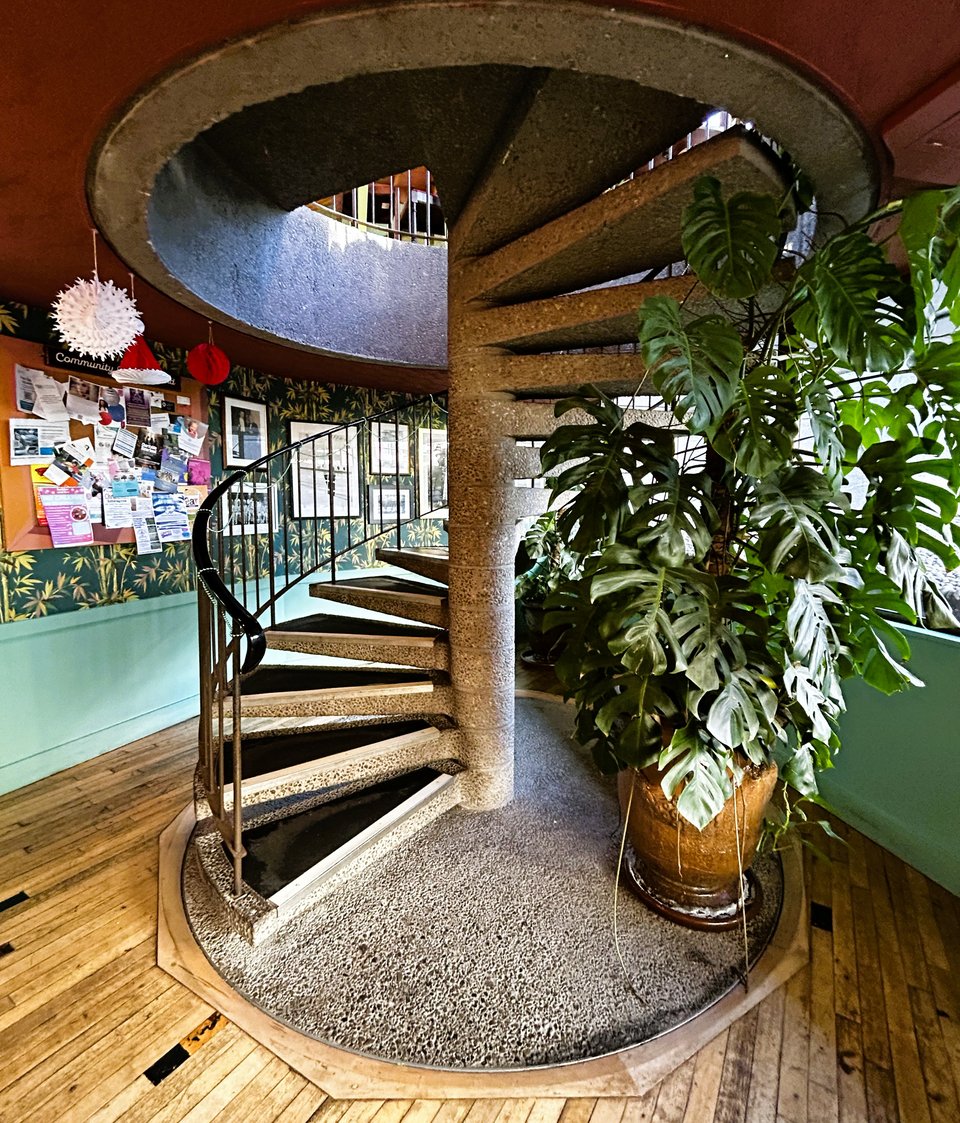
Inside the single huge public space has a wood-clad ceiling that rises to an octagonal lantern light. A spiral concrete staircase to one side leads into the lower ground floor level, which has ribbons of glass windows running high along the walls, letting in light from the pebble-clad well.
On the western side an entrance lobby emerges, crossing the moat of the well. It has a deep canopy over it, which is marked “perambulators” on the plans. The plans also reveal what else is on that side: an underground tunnel. The existence of this tunnel – and the unusual chains – gave rise to urban myths.2
“I was once told (not sure by whom) that the chains on the outside were there to pull the building down in case of fire! No one has mentioned the tunnel to the health centre…” (EM, Facebook)
Ah, yes. The tunnel.
“The story about the tunnel to the health centre was a war secret.” (NB, Facebook)
In fact, it connected the dramatic public part of the library to the rather more prosaic behind-the-scenes loading bay in a neighbouring building where the mobile library vans parked up.
The whole complex was situated right next to a health centre, at one end of the new shopping precinct. This placed it at the heart of the new town centre. A place to bring your kids to story time in between visiting the GP and picking up food.
Construction
Objections to the development of Nailsea meant the library was not built before 1967 as hoped. Instead, the developers and their contractors, C M (Beazer) Mortimer Ltd of Bath, only broke ground in 1970.
“Growing up in Nailsea, I remember this building under construction in 1970. Contemporary with the moon landings, it seemed to a young boy as space-age.” (MR, Facebook)
The building was opened on 18 October 1971.
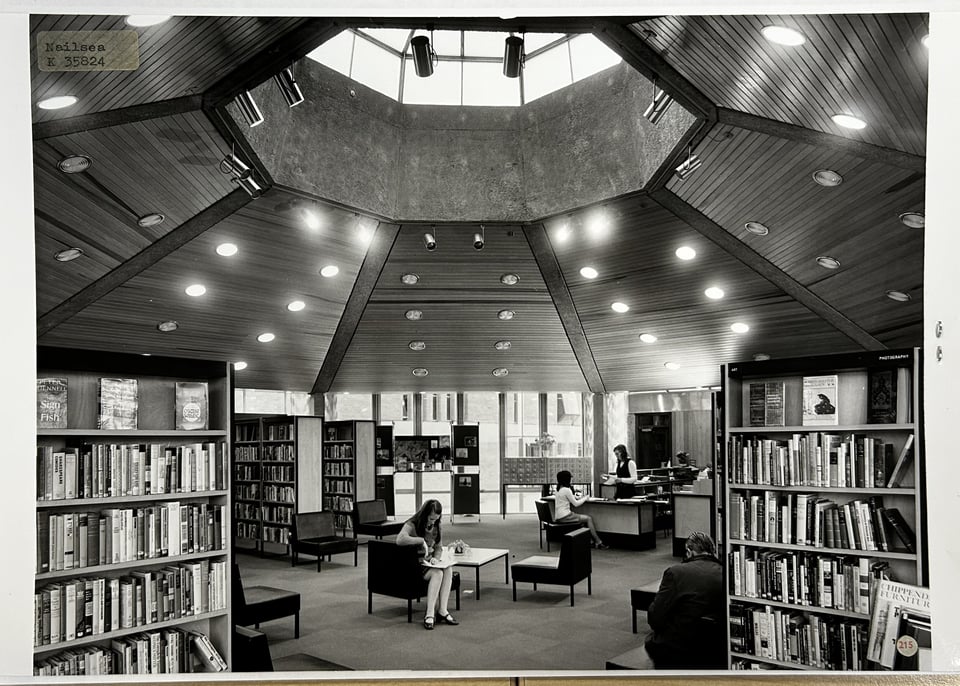
Yes, I would like to see a TARDIS interior design based on it.
Early use
When Nailsea Library opened, it had 12,500 books in the general lending department and a further 2,500 books downstairs in the children’s department. Over that first winter, the number of books issued increased compared to the old prefab library.
“My Mother worked at the library from around 1974 until around 1989. I did some work experience there when I was in the sixth form of Nailsea School. I always loved the design and it had a great selection of books.” (GM, Facebook)
The library also offered all the usual things to encourage children to use it, such as story times held in the children’s library downstairs. Down those narrow spiral stairs.
“We moved to Nailsea in 1977 when it was fairly new. It looked very exciting and modern. I remember struggling to get a 3 year old and a 1 year old down the spiral staircase to the children’s section. Whoever planned that?” (PD, Facebook)
What comes over when asking people about it is that it was well-loved (apart from that staircase) and well-used.
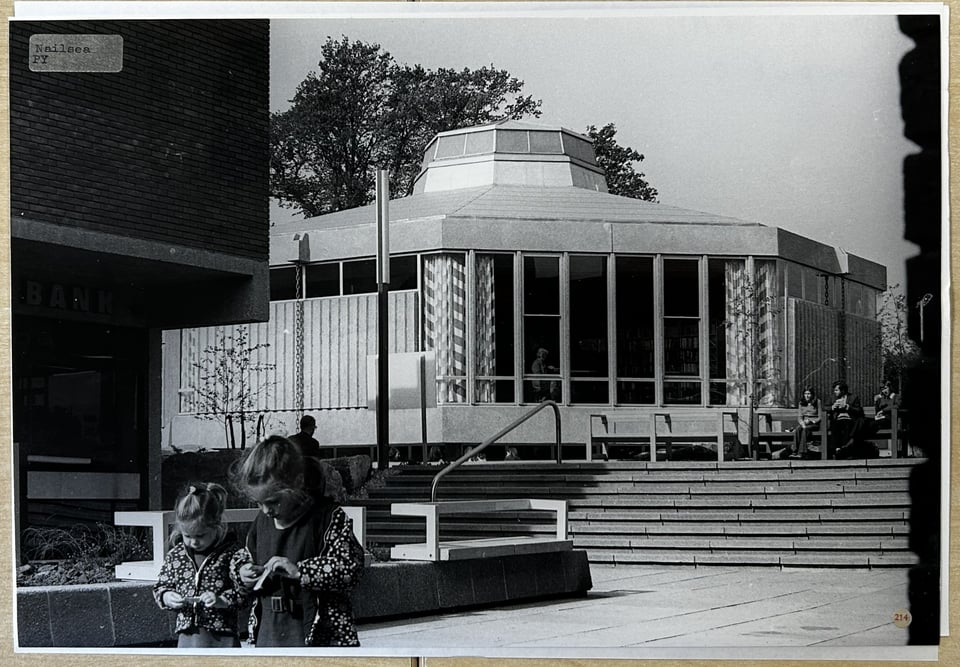
“My family moved to Nailsea in the early 1970s. I loved the centre of Nailsea, it seemed so modern to me. The shape of the library was wonderful, for a teenager it held such possibilities, places and people don't have to all look the same.” (SB, Facebook)
Nailsea, however, did not grow as projected. The 1962 expectation was that the population would reach 13,500 by 1967 and 20,500 by 1981. The 1981 Census shows the population had only reached 14,186 by 1981.
Current and future use
In 1996, Nailsea came under the control of the unitary North Somerset Council. The building overheated, as reported in 2006, so opening hours had to be cut. Then it was rumoured to be up for sale in 2007. Since 2010 the former health centre sat - and sits - derelict. At some point before 2012, the library’s original aluminium windows were replaced with double-glazed units to a matching style. These were initially red.
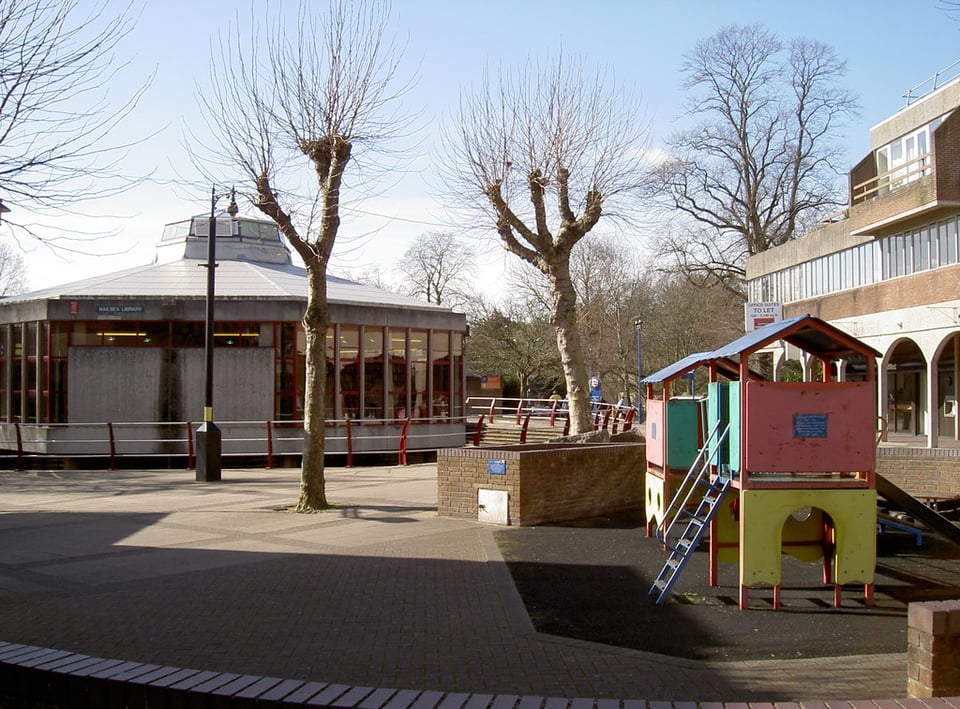
An attempt to list the building in 2015 failed. In 2018, a spokesman for the council said: “We have no plans to close or vacate the current Nailsea Library building and we will continue to run the library service from the building.” (Source: North Somerset Times, 2018)
So obviously five years later, the council moved the library service. It’s new home is still in the new Town Centre, in one of the buildings created in the 1960s and 1970s.
“I remember [the 1970s library] being built. I've taken my children, grandchildren and now great grandchildren over the years, the new library is grand we are so lucky to still have this facility.” (AA, Facebook)
The council put the empty octagonal building up for sale in 2023, leaving it a magnet for vandalism for a brief time. In 2023, the building was bought by Media Developments (Nailsea) Ltd, and by the end of the year it was confirmed it would become a restaurant.
“We are so glad it wasn’t demolished. We enjoy going to Livro Lounge. They’ve given it a new lease of life.” (P, Facebook user)
Loungers is a chain that started in nearby Bristol and now has over 300 sites in England and Wales. I tend to think of their chains as posher Wetherspoons: the menu will be identical wherever you go but the interiors will be different. So I knew what to expect when I visited the Livro Lounge in Nailsea this month.
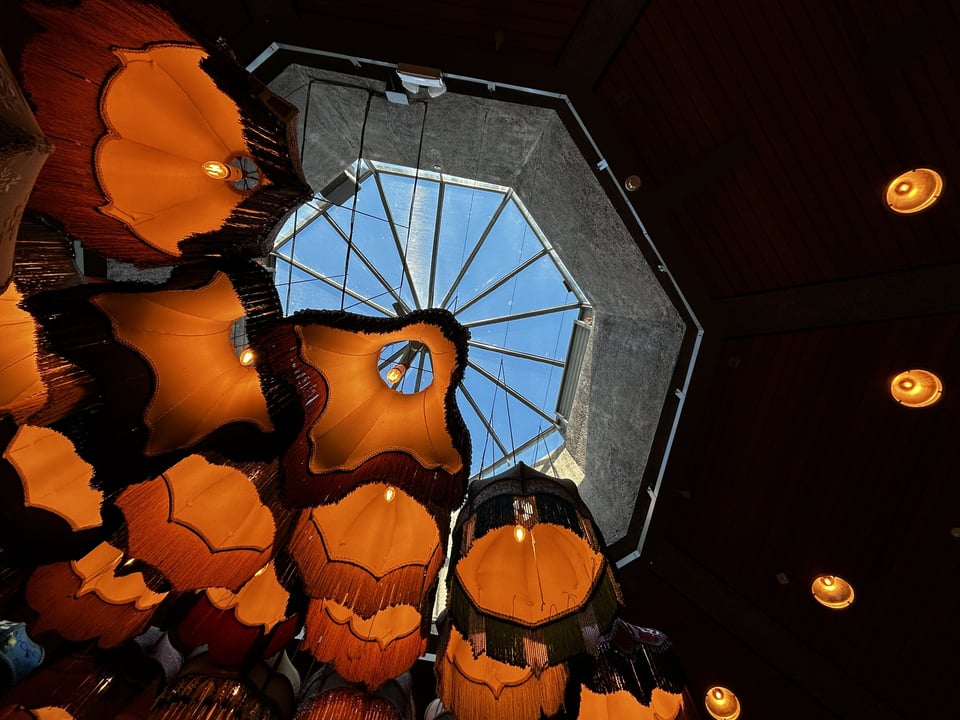
The Loungers’ way of converting a building follows the same method Adams was pursuing. Each lounge uses the same visual language - slightly worn walls and floors, lots of artfully mismatched art and furnishings – but customizes it to suit the location. In Nailsea, the wallpaper and furnishings are from the late 1960s through to the 1970s.
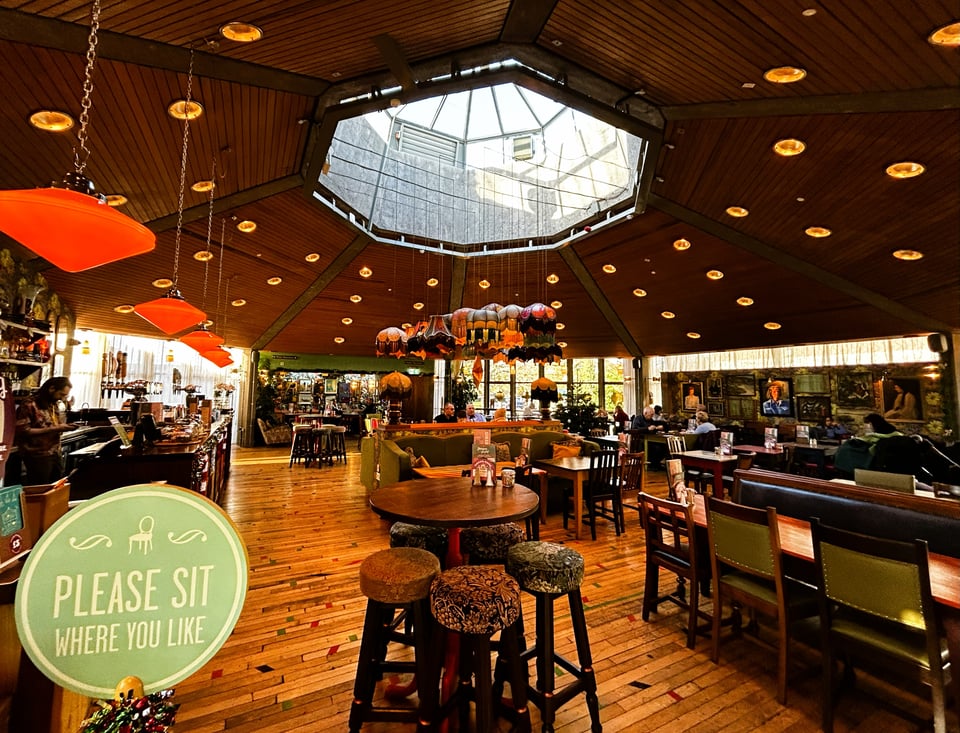
They have also drenched the building in plants: they seem particularly fond of cheese plants, which provides a certain 1970s vibe. The curtains are not cheesecloth but have a pleasing zigzag pattern that echoes the ones visible in the 1973 photos. And the metal window frames are now a greeny-bronze colour rather than red.
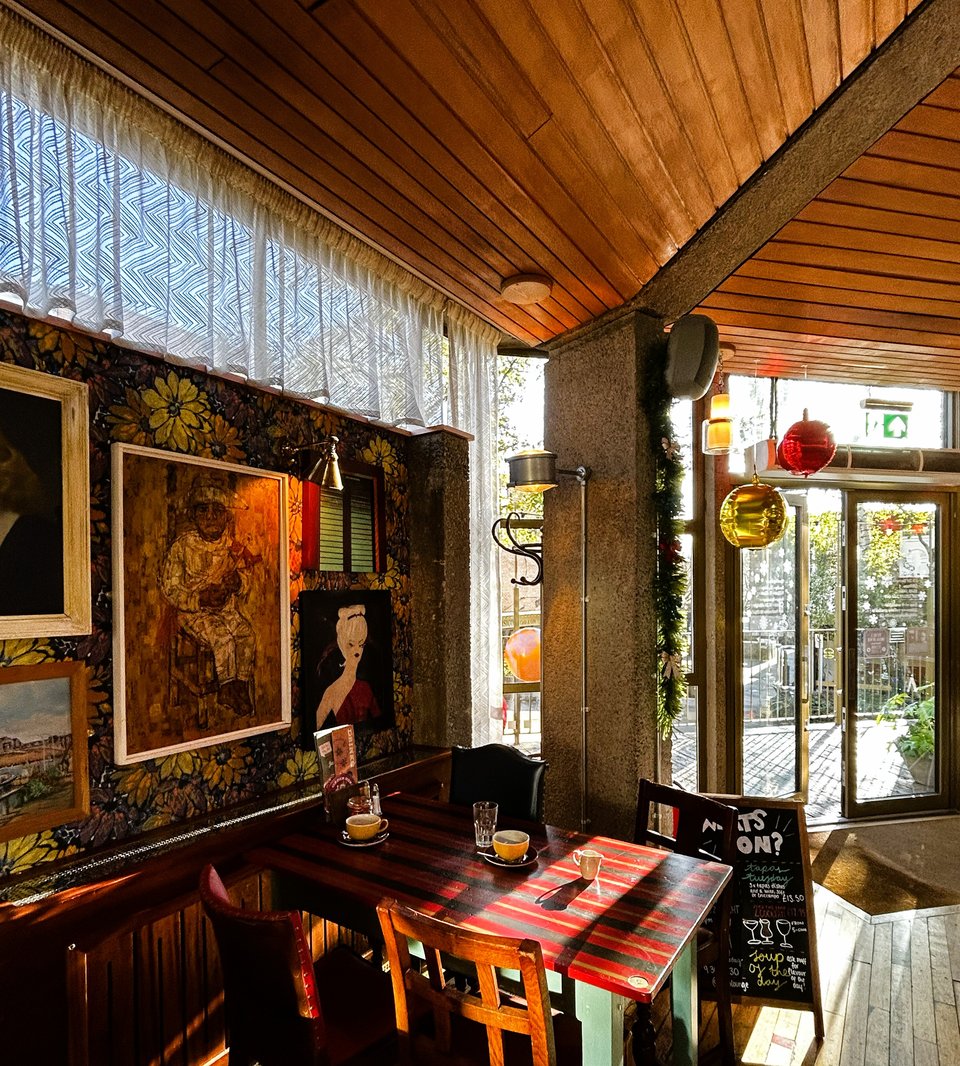
The biggest material change, however, is outside. When it was built, seven sides of the building were separated from the shopping precinct by the well. The 2023 change of use planning application (23/P/2691/FUL) said, “There are no landscape proposals or proposals to make any external alterations”. But six months later a new planning application (24/P/0971/FUL) did request external alterations, and was granted.
Four of the seven sides are now boxed in with a wooden terrace structure to allow outside dining, leaving just 3 sides of the well visible. One of the four glazed sides has had a new entrance punched into it to provide access.
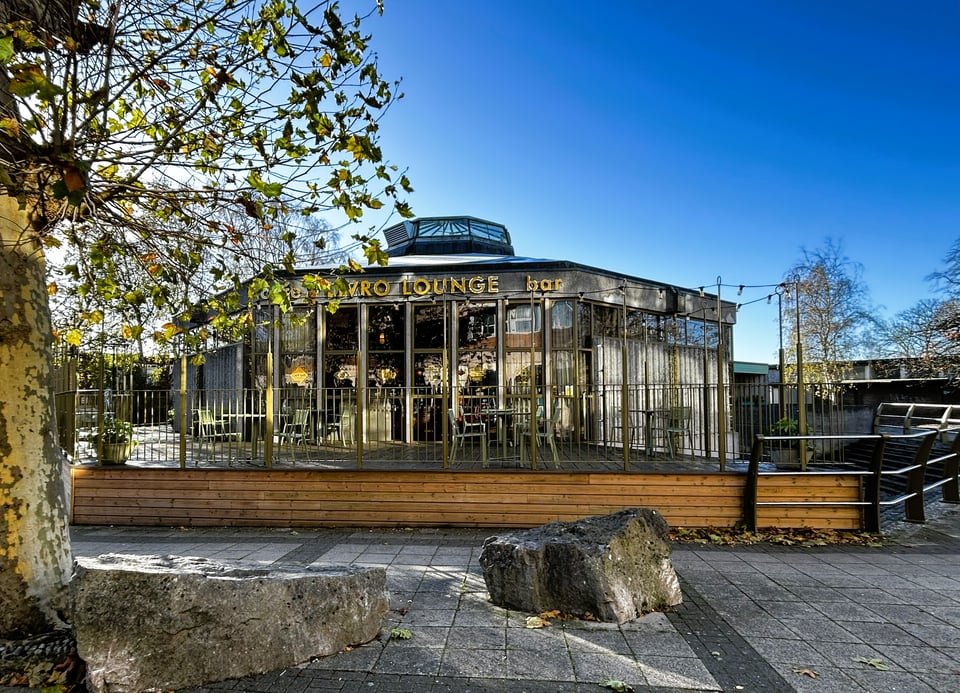
This is obviously a practical intervention: outdoor tables increase how many people can eat there in good weather. And having an entrance on the shopping centre side rather than around the back makes sense. But the decking also subtracts some of the uniqueness of the building, anchoring it more firmly to the ground.
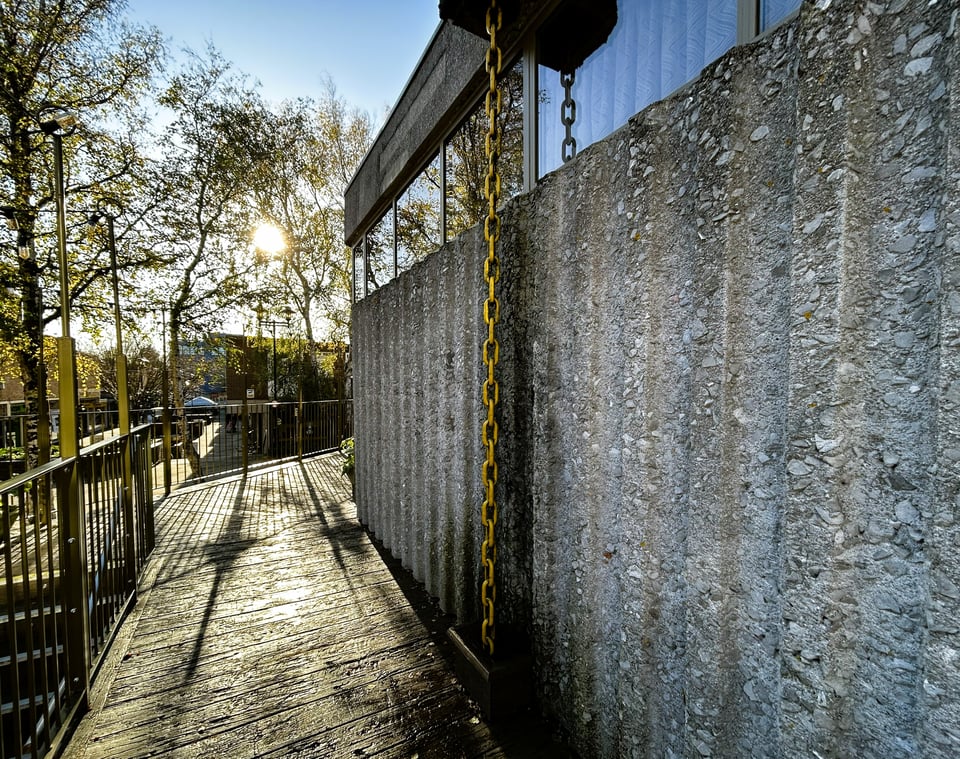
This is, I think, where pragmatism comes into a desire to admire C20 modernism: if the alternative is dereliction, decay and eventually destruction then a wooden platform is preferable.3
When I was looking around, one of the staff told me how they had many memories of taking the spiral stairs to the children’s library. So the change of use is clearly delivering on the local jobs side. There were also several groups of retirees having leisurely brunches and, in one corner, a cluster of babies and toddlers playing as their parents had coffee. It was hard not to notice the parallel with the main users of a library.
The 2022 report on housing need in Nailsea suggests the population of Nailsea is once more expanding. It was 20,572 in 2020 and is expected to rise to 21,605 by 2027. The North Somerset Local Plan 2041 Pre-submission Plan is currently out for consultation, including a section on Nailsea. Reading it straight after reading the 1962 Comprehensive Development Area No 4 (Nailsea) report, it’s hard not to also notice the parallels though the language has changed.
“As a main town in North Somerset, Nailsea will be expanded with the provision of a mix of new homes, business development and supporting infrastructure.
“The Nailsea Placemaking Strategy recognises as a priority regenerating the Town Centre through renewal, retrofitting, improving townscape and generating mixed use and outward facing active frontages and by bringing new homes into the town centre.”
The 1960s New Town Centre is expected to rise again, in other words, and the Livro Lounge building is well placed to support it, just as it did when it was the library.
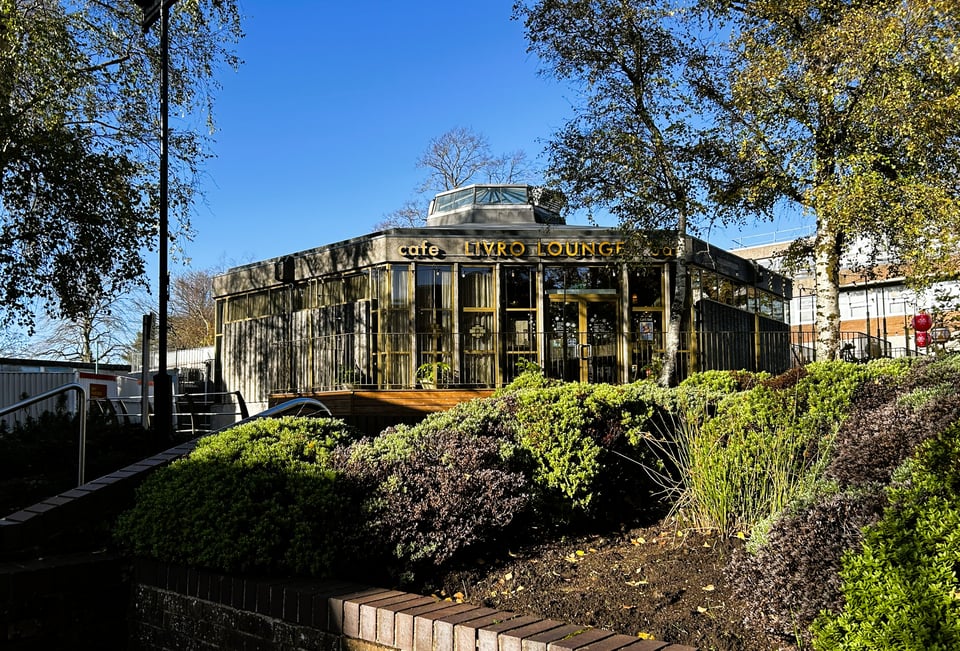
Former Nailsea Library details
Livro Lounge, Somerset Square, Nailsea, BS48 1RQ
Architect(s): Bernard C Adams and R D Samuel of Somerset County Council, in association with Gallanaugh & Partners
Builders: C M (Beazer) Mortimer Ltd
Date: 1971
Acknowledgements
Firstly, thanks to subscriber James who lives in Nailsea and mentioned the library to me. You hoped it would be of interest, and I hope this deep dive has interesting.
Thanks to the staff at Livro Lounge who didn’t mind me taking photos. And staff at the Somerset Heritage Centre in Taunton for support finding the plans and photos, and granting permission to reproduce some here.
As ever, a local history group on Facebook has provided many leads and memories. This time it was Nailsea History Group. I’m sorry the tunnel turned out to be boring.
Sources
This contains sources not already linked to in the main piece.
Foyle, Andrew and Pevsner, Nikolaus. Buildings of England: Somerset North and Bristol. (Yale University Press, 2011)
Thomas, Margaret. Nailsea. (self-published, 1991)
English Heritage Listed Building Decision Summary report: Nailsea Library, 2015.
Somerset County Council, Comprehensive Development Area No 4 (Nailsea), held at Somerset Heritage Centre, ref C/PL/2/12.
Photographs of Nailsea library, Somerset Heritage Centre, ref C/LIB/34/6/36
File of photographs Somerset buildings, Somerset Heritage Centre, ref C/ENDC/6
New Officials Appointed, Somerset County Herald. 19 Mar 1960.
County to Pioneer Projects in New Building Methods, Cheddar Valley Gazette. 8 Feb 1963.
Nailsea library in new premises, Evening Post, 20 March 1964.
‘Method’ is a £10m story of success, Somerset Guardian/Standard, 6 Dec 1968.
‘Less teaching space in new schools’, Herald Express. 19 Nov 1971.
Library biggest of its kind in Somerset, Evening Post. 31 May 1972.
Bernard hangs up his T-square, Evening Post. 2 Jun 1980.
Adams. Bernard Charles, FRIBA, FRSA. Daily Telegraph, 13 Sep 2001.
Library Books Too Hot to Read, Weston Mercury. 2 Aug 2006.
New chapter for library?, Weston Mercury. 24 Jan 2007.
Nailsea library saved from closure, North Somerset Times. 10 Oct 2018.
Empty Somerset library targeted by vandals, Somerset Live. 1 Aug 2023.
Census data from the Office of National Statistics.
Endnotes
The police HQ at Weston has now been demolished, I’ve not checked the others yet. Adams’ 1970 Weston College survives. ↩
I’m not sure ‘urban myth’ is right for a small rural town, but let’s go with it. ↩
The clearly unloved derelict health centre next door shows what happens when a building isn’t cared for or cared about. ↩
