Patrick Henry: Champion of Liberty by Jon Kukla
Jon Kukla’s definitive biography restores Patrick Henry to his proper place among the Founding Fathers while confronting the contradictions behind his legacy.
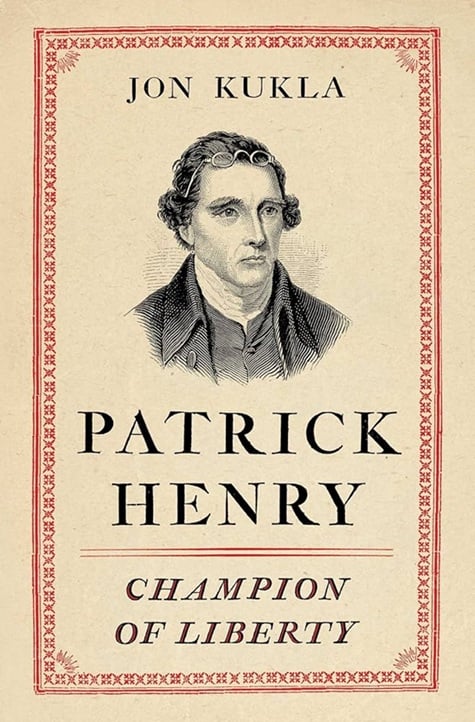
Jon Kukla’s Patrick Henry: Champion of Liberty was first released in 2017 by Simon & Schuster, with a paperback edition following in 2018. It has taken me considerably longer to get around to reading it, finally deciding to do so with the celebration of America 250. In retrospect, that delay feels particularly fitting for a biography about a Founding Father whose own contributions have spent far too long in the shadow of a single famous speech.
Upgrade nowBest known for his fiery “Give me liberty, or give me death!” speech, Patrick Henry was far more than the orator behind one of the American Revolution’s most famous lines. In Patrick Henry, Jon Kukla seeks to restore the Virginia patriot to his proper place among the leading figures of the independence movement, challenging the myths and misconceptions that have obscured his broader contributions. An early opponent of British taxation, Henry served in the Continental Congress, led Virginia’s militia against the royal governor, and became the first governor of independent Virginia, winning reelection several times.
Henry later opposed the Constitution because he feared the federal government would become too powerful, and his resistance helped spur the adoption of the Bill of Rights. Though he retired from public life rather than join George Washington’s administration, he remained highly regarded by his contemporaries and was considered one of the country’s finest orators. At the same time, his belief in liberty had a glaring limitation: despite denouncing slavery as evil, Henry continued to own enslaved people and never extended his conception of freedom to them.
Drawing on newly discovered sources and extensive research, including time spent living at one of Henry’s former estates, Kukla offers a portrait of a complicated and influential Founding Father whose role in the Revolution and early Republic deserves greater recognition.
There are a few challenges to writing a biography of Patrick Henry. The first is that all of the Hanover County records were destroyed following their removal to Richmond for safekeeping during the Civil War in 1865. The second is that most of his personal and family papers were destroyed when a fire broke out at Red Hill in 1919. As for the Virginia Gazette published between 1747 and 1765, no more than 142 of 998 weekly issues survive. And this is before we take William Wirt’s biography into account. Wirt’s biography was written decades after the 1775 speech, and there are no surviving records of the actual text of the speech, so he created it based on first-hand accounts and the spirit of what Henry said. More on this shortly.
Patrick Henry believed in five ideas that drove him toward resistance and then independence:
The Virginia legislative assembly spoke for the people of Virginia.
He acknowledged allegiance to the British crown based on the compact, enshrined in the coronation oath, by which kings promised to protect their subjects in exchange for their allegiance.
Protection of American liberty demanded unanimity between the people of Virginia and the other colonies.
He recognized the necessity of invoking sanctions against enemies of the community in defense of liberty and the common good.
He respected the will of the people when expressed fairly through democratic institutions.
Knowing how Henry felt about these ideas helps us better understand him more than two centuries after his death.
Henry was an orator, and as far as I can tell, he didn’t depend on the written word while delivering his orations. He committed what he wanted to say to memory. Because of this, “some of the most powerful speeches with which he made history were lost forever.” Unless someone knew where to find the information, they wouldn’t know about Henry’s role in the Parsons’ Cause of 1763 and how it would pave the way for Virginia’s reaction following the Stamp Act.
Upgrade nowOf the books published in the decades and centuries before Kukla’s book, he gets straight to the point early on:
“Henry’s proper place in American history has been obscured by the popular myths concocted by his first biographer, William Wirt, in 1817. Readers who are familiar with modern scholarship about the American Revolution, or specialized studies of Virginia, or the biographies of Henry’s famous contemporaries, will likely be surprised (as I often was while laboring to get it right) by the accuracy of Thomas Jefferson’s grudging admission, ten years before his own death, that ‘Mr. Henry’s transcendent prominence as an Orator and Statesman, and especially unquestioned primacy in bringing on the revolution, give him a mass of fame sufficient to satisfy any ambition.’”
Kukla writes plenty about Henry’s views toward slavery throughout the book. He viewed slavery as detrimental, as did others in Virginia at the time. He let his views be known in a January 18, 1773, letter to Robert Pleasants. And yet, it’s not lost on me that he didn’t free his slaves during his lifetime.
The Parsons’ Cause of 1763 put Henry on the map. Henry’s uncle, Rev. Patrick Henry, was a rector of Hanover’s largest Anglican parish. When he arrived at the courthouse, the younger Henry told him not to enter because it could prevent him from bringing justice to his cause. The elder Henry turned around, and the younger Henry won his case. It was a sign of things to come, not only in the cause for American liberty, but also as Louisa County elected him to the House of Burgesses in what would be the first of many successful elections.
As a member of the House of Burgesses, Henry drafted seven resolutions against the Stamp Act. His oratory was shocking for the day, as he went so far as to implicate King George III as a tyrant. This was the very speech in which he brought up Caesar and Charles I having their Brutus and Cromwell, respectively. It resulted in cries of “treason!”
Henry earned the respect of Virginia Quakers because he disdained slavery and offered sympathy for religious dissenters. In 1766, the General Assembly voted to double the import duty on slaves and then doubled it again three years later. The hope was that it would impede the slave trade.
In 1768, Virginians mobilized by sending petitions to the House of Burgesses in protest of the Townshend Acts. Virginia, like Massachusetts, did its part. The creation of nonimportation committees paved the way for the Virginia Association, which led to the Continental Association as the colonies were operating on the same wavelength.
Chapter 10 is devoted to the movement to end slavery in Virginia. While we know how it ultimately went, Henry and Thomas Jefferson both supported Richard Bland’s proposal to ease restrictions on private manumissions. Unfortunately, the proposal was met with ferocious opposition. As Kukla notes, “few contradictions in American history are more stark than the existence of slavery in a nation ostensibly committed to liberty—and Patrick Henry was acutely aware of this dissonance.”
It’s easy to dismiss the Founders as hypocrites since they knew slavery was morally wrong but went along with the practice anyway. Treating slaves with decency doesn’t make up for enslaving them in the first place. Even though Virginia terminated its role in the Atlantic slave trade, the slave population doubled in the 25 years after the American Revolution, leading to an internal slave trade in the South. This resulted in a half million slaves being forced from Virginia and the Chesapeake to the Mississippi River Valley. Henry could hope for slavery’s end, but the reality is that it needed leaders to lead, something that wouldn’t happen until the 1850s and 1860s.
Henry was elected to both the First and Second Continental Congresses. While in Philadelphia in 1774, he bought Thomas Leland’s book on Demosthenes. He used this book to improve his own public speaking. The book now sits in the Library of Congress, where one page has “a dog-eared corner,” presumably because of a passage from 354 BCE: “When we take up arms against the Barbarian, we take them up for our country, for our lives, for our customs, for our liberty, and all such sacred rights.” It’s very easy to see why this phrase had such an impact on Henry. It’s very much aligned with his own ideals as a champion of liberty.
Upgrade nowAnd then we get to Chapter 14, the headlining chapter for anyone familiar with Patrick Henry’s career. But for what it’s worth, any recreation of the speech was drawn from Wirt’s biography, written a few decades after it happened. There’s no transcript that survives, and anything we know today is in the spirit of the speech rather than the actual speech itself. Inasmuch as the chapter is about the speech, it’s also about the preceding debate and the fallout. Henry was right to move for Virginia to arm itself as the American Revolution was weeks away in both Boston and Williamsburg.
I’ve long been curious why Patrick Henry wasn’t a signer of the Declaration of Independence. When we think of the Founding Fathers, he’s one of the most famous orators of the era. Henry was in the room when Congress voted to name George Washington as captain of the Continental Army in June 1775. Henry was on the way back from Philadelphia when delegates attending the Third Virginia Convention elected him as “commander in chief” of the Virginia army. This decision—to elect him—was a controversial one. It wasn’t until after delegates shifted votes in the runoff that Henry got the support. Washington thought it was “a Capitol mistake when they took Henry out of the Senate to place him in the Field.” He wasn’t wrong.
He resigned from his military role in early 1776 because he didn’t want to be outranked by a former subordinate. Troops threatened to resign, but Henry exhorted them to continue their service. No longer in the military, Hanover County elected Henry to the Fifth Virginia Convention, where he played a crucial role in the weeks leading up to July 4. There were three decisions announced by the Convention:
They directed the Virginia delegation in Philadelphia to propose independence from Great Britain.
They wanted Congress to establish “foreign alliances and a confederation of the colonies.” This came with a provision that “the regulations and internal concerns of each colony be left to the respective colonial legislatures.”
Henry and 27 other prominent members were tasked with writing Virginia’s Declaration of Rights and a state constitution.
When the Declaration of Rights was written, it endorsed religious liberty but didn’t go as far as the religious freedom that we know today. Full religious freedom wouldn’t come until 1786.
George Rogers Clark visited Henry in August 1776. Henry assured him that the Virginia legislature would welcome Kentucky as a county during the autumn session. Meanwhile, Virginia didn’t just claim Kentucky, but also enforced its claims to the Old Northwest—what we know today as Ohio, Indiana, Illinois, Michigan, and Wisconsin. But even as Virginia enforced its claims, they knew that these new counties would eventually become their own states. It was too much land for a single state.
While Virginia drew three lessons from the Collier invasion in 1779, the relationship between Jefferson and Henry started to fall apart. One, they moved the capital from Williamsburg to Richmond. This one wasn’t as harmful as the other two—confidence in the militia’s responsive capacity and the anticipation of Portsmouth remaining a British target.
Many American history classes will talk a lot about the Articles of Confederation failing and jump into the Constitutional Convention of 1787. What they never talk about—at least in my own experience—is the Jay-Gardoqui negotiations. The Spanish treaty was dead on arrival, but the attitudes that were revealed would play a substantial role in shaping the decades to come: “hostility from New England, competitive neglect from the middle states, expansive hopes from the south, and impatient frustration in Kentucky and the Ohio Country.”
In his role as governor, Patrick Henry had signed Virginia’s circular letter inviting the other states to meet in Annapolis. The meeting called for the aforementioned convention in Philadelphia. But despite being elected, Henry refused to attend the Constitutional Convention. When it came time to ratify it, he was opposed. What led to his decision not to attend? Most likely, it was the contents of the August 1786 letter that he received from James Monroe. It opened a sectional rift that would only worsen with time.
Even though Henry detested slavery and felt it was abhorrent, he also believed that ratifying the Constitution would put the matter of slavery into the hands of people who were not in a similar situation as states located in the South. Henry’s generation couldn’t foresee any thought of a peaceful multiracial society. If anything, they thought freeing slaves would lead to “the most dreadful and ruinous consequences.”
Chapter 25 is about the amendments and abolition. Suffice it to say, no amount of my thoughts will be able to do full justice to the chapter. There is plenty more here about Henry and slavery, and rightfully so. Kukla has really done the work.
As for the Bill of Rights, Virginia completed its ratification process when the state senate approved them on December 15, 1791, and clinched their adoption. Shamefully, neither Connecticut, Georgia, nor Massachusetts would ratify the Bill of Rights until its 150th anniversary in 1941. And here I thought the northern states were supposed to be progressive.
Late in life, Henry had a desire to retire. His health really wasn’t getting any better. President Washington had offered to appoint Henry as America’s ambassador to Spain, but he declined. He later offered to appoint him as Secretary of State. He assured Washington that he supported both him and the administration, but turned it down due to both family needs and personal circumstances.
Washington thought about appointing him to the Supreme Court after Thomas Johnson resigned in 1794. However, Virginia was already represented, and Washington felt an appointment would cause “unpleasant sensations in other States.” The second time came following the resignations of Chief Justice John Jay, Associate Justice John Blair, and the Senate’s rejection of John Rutledge over his criticisms of the Jay Treaty. Washington approached Henry by way of Light-Horse Harry Lee, but Henry once again turned it down.
If this weren’t enough, Washington once again thought about Henry as a replacement for James Monroe as America’s ambassador to France, but he knew better by this point. Similarly, Henry was elected governor for a sixth term in 1796, but he chose to decline.
Despite only serving two years in the Continental Congress and not taking on any national offices during the Confederation Congress or the U.S. government established by the ratification of the Constitution, Patrick Henry is considered a Founding Father for what he did in Virginia as a champion of liberty. As Kukla shows throughout the book, Henry ought to be known for more than just his speech. And yes, he did have his flaws, and we should recognize those as well.
With its exhaustive research and wealth of new material, Jon Kukla’s Patrick Henry: Champion of Liberty makes a compelling case as the definitive biography of a Founding Father whose contributions to American independence have long been overshadowed by one famous speech.
Upgrade now