
Spring Song Medley
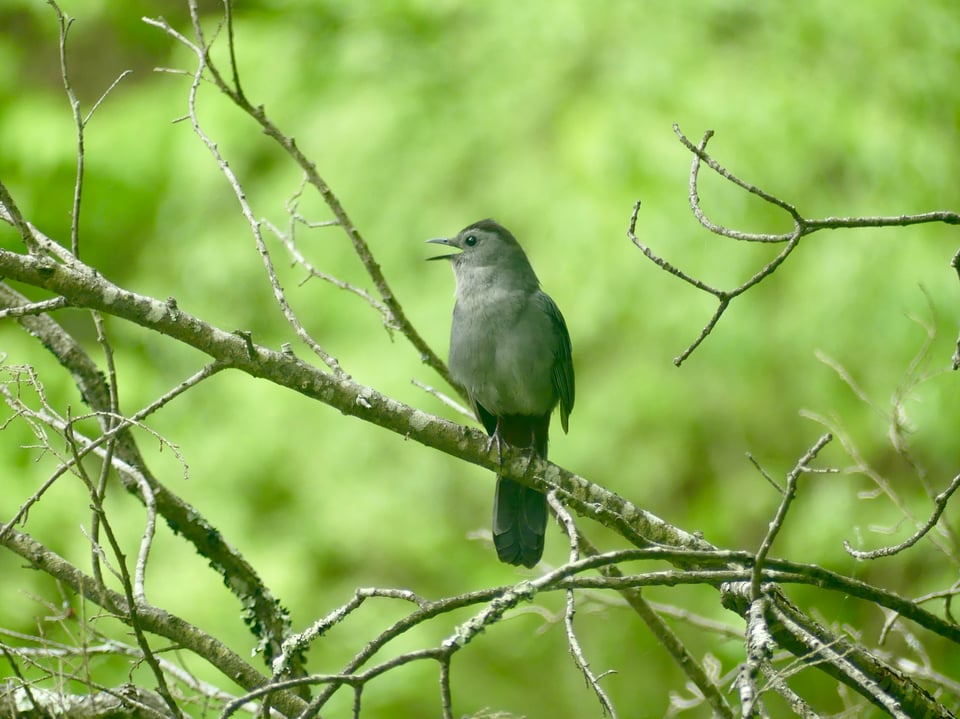
Hello again! It’s been a little while, but there’s a reason I didn’t set a specific schedule for this newsletter right off the bat; I knew this spring was going to be pretty hectic. But I am back, and I have an issue for you that is a bit of a grab-bag of thoughts that came to me over the past couple of months. None of them quite rose to the level of a full essay, but I hope the combination of them gives you some idea of where my mind has been lately. And I’ll be sprinkling in a few extra photos (and if you listen to the podcast version, you’ll get some audio treats instead), to give you an idea of how these woods have been looking lately.
First up, I want to tell you about some fallen trees, because they’ve been catching my eye lately.
The subject of fallen trees has came up in conversation a few times during the “Rewilding the Soul” ecospirituality program I am pursuing at Cherry Hill Seminary. (I’ll come back and tell you more about that later.) In a couple of our small-group discussions last month, we were talking about the sorrow that can accompany the loss of a beloved tree, due to disease, storm damage, or other people’s decisions around land management. But then we also reflected on how fallen trees are also a rich source of nutrients for other plants as well as insects, fungi and other creatures. They can also provide shelter, building materials (and not just for humans), and transportation networks. So it’s no wonder that while I was out in the woods, I found myself particularly drawn to fallen trees in various stages of returning to the land.
There are lots of them in these woods; the combination of wet soil criss-crossed by streams along with sloped ridges makes it common to see roots that have lost their hold after heavy rains. When a tree falls in a suburban yard it demands notice and attention. But in the forested hills, fallen trees become part of the landscape—in fact, they feed the landscape, and eventually become the landscape. It’s easy to kind of take them for granted, actually, or maybe just see them as obstacles when they’ve fallen across a path. But when you stop to look at them, no two are the same.
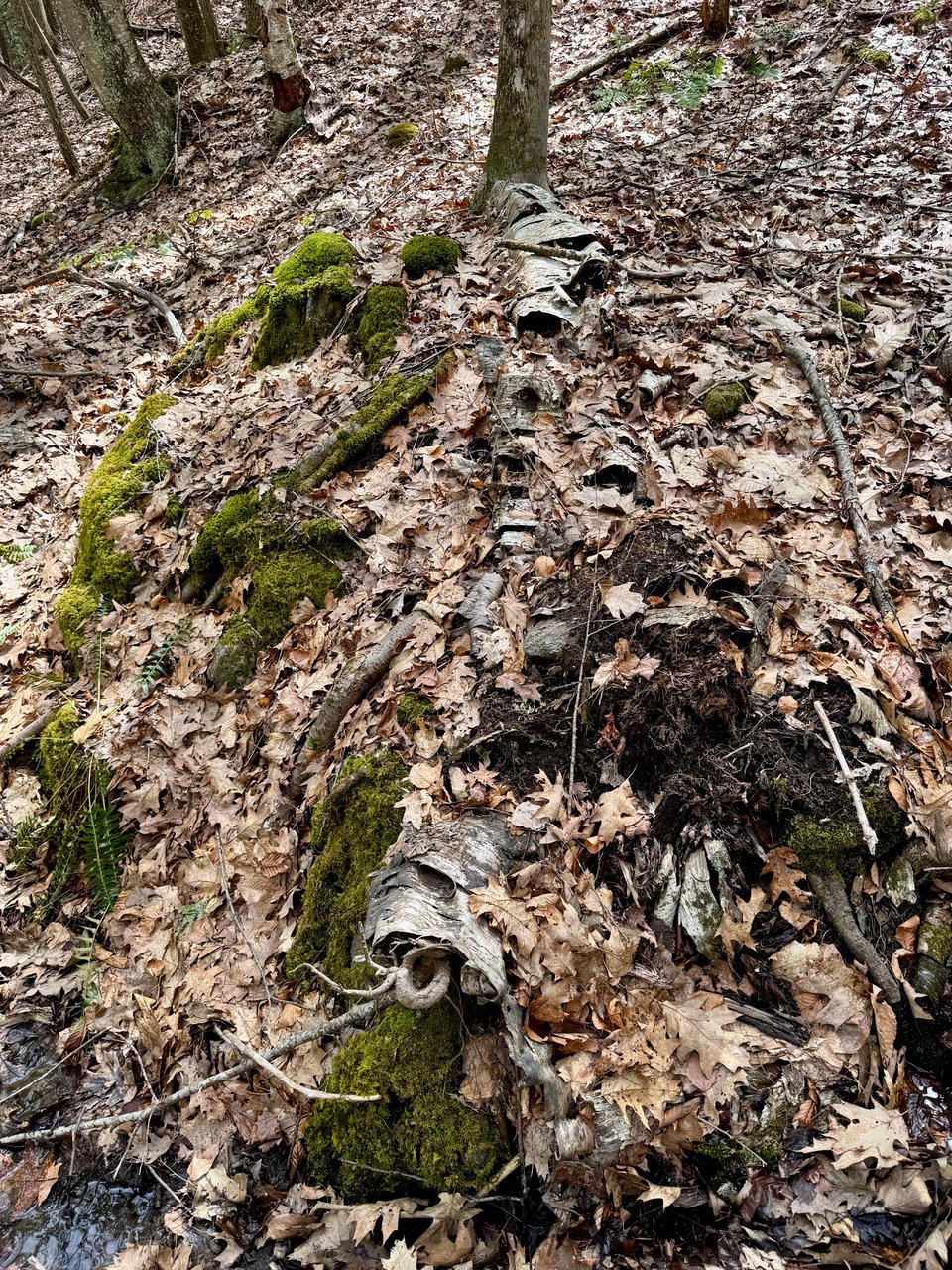
On one outing, there was a large tree trunk half-covered in moss, with hollowed-out places that were likely escape hatches for chipmunks. Elsewhere there was a pair of narrow birches, lying side-by-side, with one covered in moss and small white mushrooms, while the other remained mostly untouched. Another tree was a fresher fall, the trunk still intact, but the root ball pulled up from the sloping ground and creating a hollow with its roots. But there was one in particular that really caught my eye, because the tree itself was nearly gone, absorbed into the earth. All that remained was the skeletal outline of a slender birch, that had nearly disappeared into the landscape. Curls of still-waterproof bark remained, sketching the outline of where it used to lie, while soil and fallen leaves rose up around it, pulling it under.
All of these trees in varying states of…let’s call it transformation…are miniature ecosystems in themselves, and they are also a vital part of the larger woodland ecosystem. They aren’t the living trees they used to be, but they are still part of the web of life. And as it happened, after I started jotting some of these observations down, I happened across a quote from Ursula K. Le Guin, offered up by the internet in the way that sometimes feels random and sometimes feels meaningful. It’s from her book Tales From Earthsea (though I’m not sure which story), and it says, “What goes too long unchanged destroys itself. The forest is forever because it dies and dies and so lives.” Life and death and change are intertwined.
And now, before I go on to another topic, here is a picture of that birch being absorbed into the landscape.
The next reflection I want to share also came out of one of my wanders in the woods, and this one has to do with attention. I stopped at one point next to a small stream running through the trees, my eye caught by an interesting pattern in the water. There was a small birch tree that had fallen across the stream some time ago (see, I’m still coming back to fallen trees, too!) and the way its bark snagged the flowing water created a “woven” effect in the stream where it diverted around the tree. So while the body of the stream ultimately continued on past the birch, the surface of the water just next to it looked like there were two streams criss-crossing each other and weaving together.
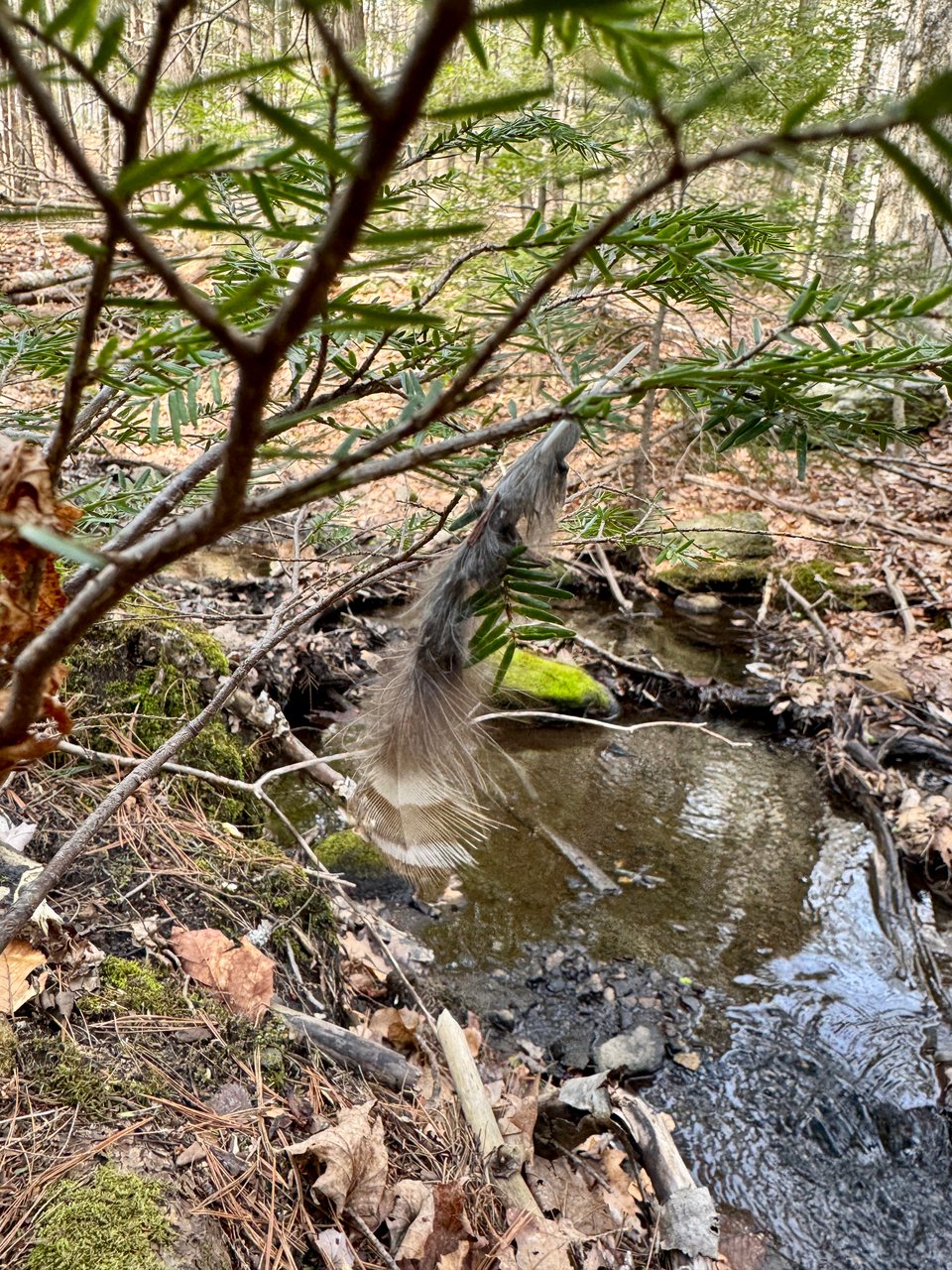
This, as you might expect, was pretty mesmerizing to watch! So I crouched there next to the stream, my back against a tree, for a while watching it. Then I happened to glance a little to my left and noticed a barred owl feather suspended above the water, tangled in the needles of a small hemlock sapling. The feather suggested to me a story of an owl swooping down on an unsuspecting frog by the water’s edge, perhaps gaining a meal and leaving a feather behind in trade. It also made me appreciate the importance of slowing down, of taking the time to stop and notice things. I find that it’s when I stop to pay attention to one thing that I notice some other beautiful thing—and once that cascade starts, there’s no telling when it might stop!
Of course, there is always the risk that taking the time to pay attention will also bring to light less beautiful things, like the trash someone threw out of their car. In the broader scheme of things, it might mean finding out that the climate has grown too hot for some native species, and that others are struggling in the face of habitat loss. And in the human world, of course, there is both joy and pain to be encountered when we pay attention, and unfortunately sometimes the pain is much more evident than the joy.
Perhaps that’s one reason it can be easier to keep busy, to keep our eyes and thoughts elsewhere, because there are too many terrible things in the world. The fear that we might encounter them can encourage us not to look too closely. But knowing the full scope of what we might see can also be a reason to sharpen our attention, and make a commitment to nurture the beautiful things we want to see, which will not survive if we don’t pay attention to both the ugliness and the beauty around us.
For this last little bit, I wanted to share a thought that came to me as I was reflecting on the process of establishing a regular practice of getting outside every day, with longer experiences every week. Having started in the early spring, when the winter here in the northeast really wanted to hang on, it was hard at first just due to cold and occasionally icy conditions. Then it got easier, and very pleasant, as the weather warmed and the land began waking up. But then that warmth and waking brought hazards both small and large—first in the form of ticks, which have exploded in population this year, then in the form of black bears, whose wanderings in the woods sometimes curtail my own.
Sometimes other difficulties surface that have more to do with my own sensory sensitivities and other aspects of neurodivergence. I love the sensory richness of nature, but some things, like spiderwebs or insects on my skin, trigger very negative reactions just from how they feel. Similarly, there is something beautiful about being outside in a warm rain, but because I wear glasses rain also interferes with my vision in unpleasant ways. And sensations around being wet, especially in wet clothes, can cause me anxiety.
So one thing I have appreciated in the ecospirituality program I mentioned is the gentleness and flexibility with which the advice to “get outside” is given. I think sometimes just telling people to get outside more, and especially suggestions to spend more time in wild areas, glosses over the many sources of friction that can arise with that. I know I have criticized myself in the past for finding it difficult to go camping, to garden, or do other things to “get my hands dirty,” so to speak. And that’s just not necessary.
Do what you can do—and also remember that your relationship with the land is a relationship, and relationships involve multiple actors. The external difficulties I encountered—the cold, the bears, the ticks—made things harder because I was getting out there and engaging with the natural world. Thinking of the bears in particular, part of being in relationship means being sensitive to how the other inhabitants and I might affect each other, and not just feeling entitled to do whatever, whenever I want to. And the internal difficulties, like sensory sensitivities or feeling overwhelmed by demands on my time, are also a call to set boundaries in that relationship, and to approach it in ways that honor my needs as well. If you also sometimes struggle with the physical realities of connecting with nature, I hope some of those thoughts are helpful.
So that’s what I’ve got for today! Thank you for coming back for a listen after this last little break, and I hope to establish a more regular schedule over the summer. If you are interested in learning more about the “Rewilding the Soul” ecospirituality certificate I mentioned, you can visit the Cherry Hill Seminary website linked above, or the instructor, Jeffrey Keefer, also has a Substack newsletter at whereinsightmeetsearth.com, where he has some posts describing the program in more detail; this one is a good place to start!
May you enjoy the blessings of Earth wherever you are, and I’ll talk to you again soon.