Naturally Queer
Hello again! Well, the heat has finally hit us in the northeast, and I for one do not like it. I’m not fond of extremes in either direction (and, after all, both extreme heat and extreme cold can be deadly) but I’m much better equipped to deal with prolonged cold than prolonged heat. But at least the woods are shady, the brook is still keeping all the wildlife cool and watered, and the birds are busily singing.
I’ve had a lot of wildlife sightings recently, both directly and through my trail cameras in the woods. Just in the past few weeks I’ve seen deer, bears, coyotes, raccoons, a beaver, and a bobcat, some of them pretty close! (If you visit my Woodland Spirituality channel on YouTube, you can see videos of quite a few of these, and I’m putting up more all the time.) A friend observed just the other day that I see a lot of animals, and asked whether that had to do with my nature spirituality, or if it was just a function of where I live. I said a lot of it was just where I live—I don't go out on expeditions looking for wildlife, it just comes into view. I live where they live. But I added that it is related to my nature spirituality in a cyclical way: I see as many animals as I do because I am paying attention to nature on a regular basis, and because I see as much as I do, I respond to it in a spiritual way. I also do think you can develop a spiritual connection with the land that encourages these kinds of encounters, and makes you the kind of presence that is recognized as part of the neighborhood.
In my neighborhood, the foliage is pretty lush around the waterways this time of year, and the spring flowers have given way to summer ones. We have some pink yarrow coming up in places, and the day lilies are attracting the attention of pollinators and deer alike. The little elder tree is blooming as well, with flat clusters of white blossoms. Fireflies light the night, and frogs sing in a chorus. The loud, short trills of grey tree frogs have been most prominent, joined by the twanging “gunk” sound of green frogs at intervals, and sometimes the much longer trill of an American toad. (The podcast version of this essay has an audio clip, if you’d like to check that out! You can find the podcast link at the bottom of this email.)

Wild Kin: Dragonfly
The wooded wetlands that provide a home for so many amphibians are also an excellent habitat for dragonflies. And the dragonfly is the first featured star of a new segment I’m debuting in this issue, called “Wild Kin,” where I’ll profile one of my wild neighbors, most likely one that’s been showing up prominently at the time of recording. Lately, I’ve been spending time with dragonflies.
Dragonflies, along with damselflies, belong to the order Odonata, which includes thousands of species. Insects of order Odonata have existed on earth for over 250 million years, and before that there were similar dragonfly-like insects that were enormous, with wingspans 25 to 30 inches across. Today’s dragonflies are a bit smaller than that, but they do exhibit a wide range of sizes, colors, and body shapes.
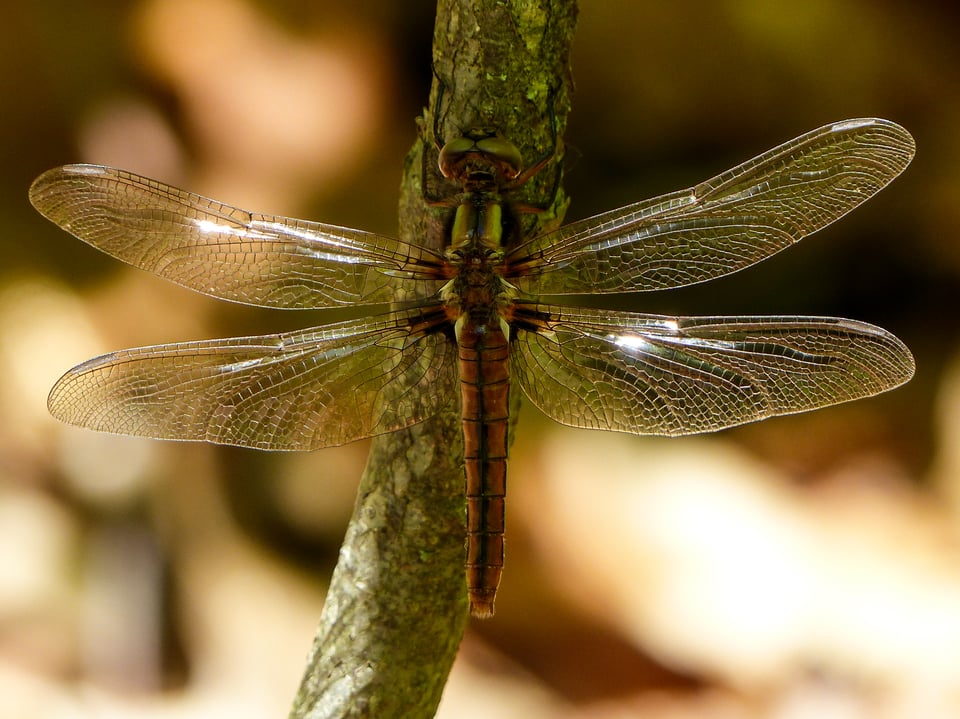
I’m going to focus on dragonflies today, but I wanted to make a quick note about damselflies. Damselflies and dragonflies are very similar, and often inhabit the same habitats. But you can tell them apart in a couple of easy ways. First, damselflies tend to be much thinner and more delicate in build; their bodies are very long and slender, while those of dragonflies tend to be thicker. And second, while both damselflies and dragonflies have two sets of wings—for four total—those wings are held quite differently when they are at rest. Damselflies hold their wings folded back and pressed together (or just slightly open) along the back of their bodies. Dragonflies rest with their wings open to the sides, whether they are perched vertically while hanging onto a branch or leaf, or resting horizontally on the ground or other flat surface. There are some other differences, but I find those two to be the most obvious when I catch sight of one or the other.
Dragonflies begin their lives in water, with eggs laid either in the water or attached to water plants just above the surface. The larvae, also called nymphs, that hatch from those eggs live in the water for months or even years, eating aquatic insects and other invertebrates. Some of the nymphs can grow to be over two inches long, so some of these larger ones can even feed on tadpoles or tiny fish! Over time, they grow by shedding their outer shells and growing a new one, until finally they leave the last one behind and emerge as an adult dragonfly. Now it’s time to take to the skies!
Adult dragonflies only live for a matter of weeks, but during that time they make an impression. With a wide variety of colorful bodies, and powerful iridescent wings, they primarily prey on other insects, especially other flying insects like flies and mosquitoes. Generally speaking, it’s the males who are most visible, since they often have brighter colors and are out and about more, looking for mates and chasing other males away from their territories. They can be seen patrolling the skies above ponds and wetlands in particular, hovering in place and darting after prey in an impressive aerial display of precision and speed. Even at rest, they are eye-catching, with their large size, frequently bright-colored bodies, and iridescent wings glinting in the sunlight.
Their dramatic metamorphosis from aquatic nymph stage to flying jewels makes the dragonfly a powerful symbol of transformation. But what I have also learned from them is awareness. Dragonflies are dynamic flyers, able to move each wing independently for precise control, and it’s impressive to watch them chase and catch other insects in an aerial ballet. Whether pursuing prey or circling on patrol, they seem intently focused on what they are doing. At the same time, their large compound eyes allow them to see in every direction at once, a full 360 degrees, and they see more colors than humans do. They also see faster than we do, processing more each second to the point that the world seems to be moving in slow-motion to them. So I consider dragonflies to be excellent teachers of awareness and perception as well as transformation.
And doesn’t expanded awareness often lead to transformation? And vice versa? So maybe it all fits together perfectly.
So keep an eye out for dragonflies if you find yourself in their habitat. And know that they are definitely keeping an eye on you!
Naturally Queer
I wanted to get this newsletter out before June was over, because June is Pride month - happy Pride! And I realize that I didn’t quite make it within the month of June, in part because I attended a Pride celebration on a weekend when I might otherwise have had time to work on my writing. But that's fine, because every month is Pride month here!
Unfortunately, Pride month also often prompts a lot of unnecessary discourse about what is “natural” and what is “unnatural” in human behavior and relationships. There are, of course, lots of other areas where this kind of language crops up, including health, wellness, and diet, so there is a lot to unpack around ideas of what is natural, and what “natural” even means. But for now, inspired by Pride month, I want to focus in on those claims about what is “natural” in terms of human behavior around gender and sexuality. And I find myself primarily focused on gender identity and claims about the “naturalness” of a strict gender binary, in part because trans identities have been so under fire lately. And as a non-binary person myself, with trans friends of various identities, I’m pretty sick of it.
I think sometimes those of us who are drawn to nature and nature spirituality are particularly susceptible to value judgments about what is “natural” and what is not. I could go down a very long rabbit hole (and believe me, I started to!) discussing various ways of defining “natural,” and the assumptions that go into those definitions regarding the place of humanity within “nature.” There is a lot of value in questioning our definitions and the divisions we make when we define one thing as natural and another as not, but for now I just want to focus on this one area and what people mean when they try to categorize a narrow subset of behaviors as “natural” and anything else as “unnatural.”
People opposed to queerness, transness, and anything outside of a simplistic binary of cisheteronormativity will often state that these things go against the natural order. In their minds, humans come in two and only two genders, those two genders are completely aligned with physical sex (which is also a clear and obvious binary) and those two genders are “naturally” attracted to each other. This, they argue, is the case everywhere in nature, because of procreation. If male and female didn’t come together to make babies, life wouldn’t exist. (Let’s put an asterisk on that assertion for now and come back to it later.) So if we look to nature, they say, mating has a single natural purpose, and that purpose is only achieved by a single combination of genitals.
They will sometimes also go further, and say that if we look at the vast sweep of human history and society, we will see this same “natural” order play out. According to this view, again, binary gender has always mapped onto binary sex, and those sexes had hetero intercourse of one and only one variety to make babies. This was the case up until very recently, when these newfangled ideas about gender and sexuality were imposed on us by…I don’t know, communists or something. But in any case, we need to return to the natural order of things or civilization itself will crumble.
I want to make two things very clear in my response to these kinds of statements. The first is that they are completely, factually, biologically and historically wrong. Let’s start with the fact that among non-human species, there are many forms of procreation that don’t involve sexual reproduction at all, so the requirement of a sperm-and-egg binary just isn’t necessary. There are fish, snakes, lizards and insects that can reproduce without sexual contact, where the offspring is essentially a clone of the mother. Then there are species where individuals can change sex if necessary; some frogs do this, as well as some fish. The clownfish is one stunning example in this regard, because they can start out as male and then become female as adults when their social organization requires it. Even among animals with a roughly binary division of sexes, there are intersex individuals who blend attributes of both, blurring the binary; for example, there are lionesses who have full manes like the males do. Some individuals of many species are what’s called gynandromorphs, where they blend male and female biology and attributes. And then there are fungi, which show dramatic variety in how they reproduce and how many different mating types (which are kind of like sexes) they have.
In addition to these gender-bending species, there are numerous examples of same-sex mating and partnerships in the non-human animal world, as well as non-procreative sex in general. So it is simply not the case that “nature” shows us a simple binary in terms of either sex characteristics or heterosexual mating.
As for humans, people often draw a distinction between sex and gender, with sex referring to biological characteristics and gender reflecting the socially-constructed categories and roles that different cultures create. There are numerous examples of cultures that recognize more than two genders, and people who move between gender categories; PBS offers an interactive map of cultures around the world with more than two genders. So the idea of people who do not fit into binary gender categories of “man” and “woman” is not a new one, nor a specifically “Western” one. And even when it comes to so-called “biological sex,” the actual biology of sex categories is not as clear-cut as some people want to make it. No matter how you try to slice it—based on genitals, chromosomes, the ability to produce sperm or egg cells, or anything else—there will always be exceptions. Many people don’t even know they are exceptions to some of these definitions, because differences in chromosomes or the ability to produce eggs or sperm are not necessarily visible and may only turn up in a specific medical exam. An article in Science News indicates that intersex people make up about 1.7 percent of the population, which is about the same prevalence as redheads.
All in all, it is only in a very simplistic view of history and biology that humans can be said to have two completely separate, non-overlapping sexes, much less gender identities. And it’s even more simplistic to believe that humans have historically limited themselves to heterosexual relationships, or have only had sex for procreation; I really doubt I need to provide examples here. Personally, I think it’s hard to argue that something is “unnatural” when it is so ubiquitous across cultures and throughout history. Not to mention, if cisgender heterosexuality truly were the natural order of things, it wouldn’t have to be enforced so damned rigidly. This is something feminist scholars have studied at length.
As an example, look at the notion of “the opposite sex.” This obviously rests on an assumed binary, but let’s go with that part for a moment. Yes, there is sexual dimorphism in humans, in which men are generally bigger than women, but the overlap between them is greater than the differences in averages. In other words, you can accurately say that men are on average bigger than women, but you cannot say that any individual man will be bigger than any individual woman; instead, there are large women and small men, because there is wide variety across sexes. But our gender norms emphasize smallness for women and bigness for men, whether you’re looking at diet and fitness regimens that shape bodies into thinness or muscularity, clothing styles that emphasize bulk or slenderness, or the way women are encouraged to cross their legs and make themselves small while men are encouraged to take up space. Similarly, men generally have more body hair than women, but culturally we emphasize this through norms that require women to remove most of their body hair and ridicule men who do the same. And yet, each of these things will be held up by some as “natural” differences between sexes, despite all the work we put into them, and the criticism offered those whose bodies or behavior doesn’t conform.
But many people aren’t aware of the variety in sex characteristics, and within human biology only seem familiar with the basic dualism of sperm and egg, penis and vagina, and maybe XY and XX chromosomes as distinguishing two sexes. Intersex conditions are rarely discussed in U.S. culture, with physical presentations that don’t map easily onto “male” or “female” often made the butt of jokes. Also, things don’t fit into nice tidy boxes! Categorization is always a social process; things don’t turn up with nice little labels on them so you know where they fit. Humans create categories, and rules for what goes in them, but then we collectively forget that we made them and act like these are just “natural” divisions. The categories we create ideally should reflect something of reality, but they also reflect our human assumptions and beliefs, so it’s important to remember that our categories and labels for things are not the same as reality.
And that brings me to the second thing I want to make clear in my response to arguments that being queer or trans is “unnatural” and therefore wrong, which is that, while it’s true that the bigoted statements about “natural” or “unnatural” sex and gender are wrong, it is equally true that the lives and experiences of queer and trans people do not need to meet any standard of “naturalness” to be valued. Because what is being said here? That there is some pure, original “natural” state in which humans once existed, some core “human nature” that we should return to if we wish to avoid disaster.
As a bit of an aside, I don’t personally like statements about “human nature,” but if I had to make one, I would say that human nature is to adapt and change, so ultimately there are many human natures. To put it another way, whatever human nature may be, human history demonstrates that one of the unmistakeable hallmarks of human existence—like all the rest of existence—is diversity. So to speak of "human nature" as if it were singular is foolish.
But what these kinds of statements ultimately rest on is religion, not biology or history. And the game is given away by the fact that many of the most prominent purveyors of anti-queer and anti-trans bigotry (or opposition to any deviation from so-called traditional gender roles) ultimately fall back on invoking the Christian god as the one who dictated human sexuality and gender roles, and as the reason we all need to get in line lest we make him mad. This is what they are really arguing when they talk about “unnatural” behavior—because calling it “sinful” would make their positions too transparently religious.
So most of the time, these references to binary sex and gender, or sex strictly for procreation, as biological necessities (or historical realities) are not good faith arguments. I do think there is a lot of value in breaking through the enforced ignorance about gender and sexual diversity in human history and in the animal world, because we shouldn’t let information be suppressed because of narrow conceptions of what is “natural.” This is why it matters that they're wrong: because reality simply includes these things, and people should be aware of that. But at the same time, it’s very likely that better information will not convince a lot of the people making these arguments, because their arguments are not about information. They’re about belief. And when one particular argument is proven wrong, they’ll just switch to something else, because at the bottom of their objection is simply a rejection of other people's freedom to be who they are.
So while it’s good to know about historical and cultural diversity among humans, or diversity among other animals—after all, it’s fascinating and affirming!—knowledge of these facts is not required in order to defend the existence of diversity as it is now. You don’t need to prove your right to exist with biological or historical citations and examples; you are a glorious example of human diversity just as you are.
So, happy Pride! Whichever month it happens to be.
And that will do it for this newsletter; thank you so much for reading, and I hope you enjoyed the new “Wild Kin” segment. May you enjoy the blessings of Earth wherever you are, and I will talk to you again soon.