
Future Visions: e-commerce with Xenia Dobonyi
An interview with Xenia Dobonyi, Director of Digital Experience at GIVENCHY. We talk about the future of e-commerce for leading brands.
You are reading Future Visions, a newsletter by Uncommon Practice. This edition looks at the future of luxury e-commerce. I spoke with Xenia Dobonyi, Director of Digital Experience at GIVENCHY. We talked about AI agents, identity-driven shopping, disappearing interfaces, and the idea of patient innovation inside a global luxury house.

The future is not about screens
You’ve said that the future of e-commerce won’t look like e-commerce. What do you mean by that?
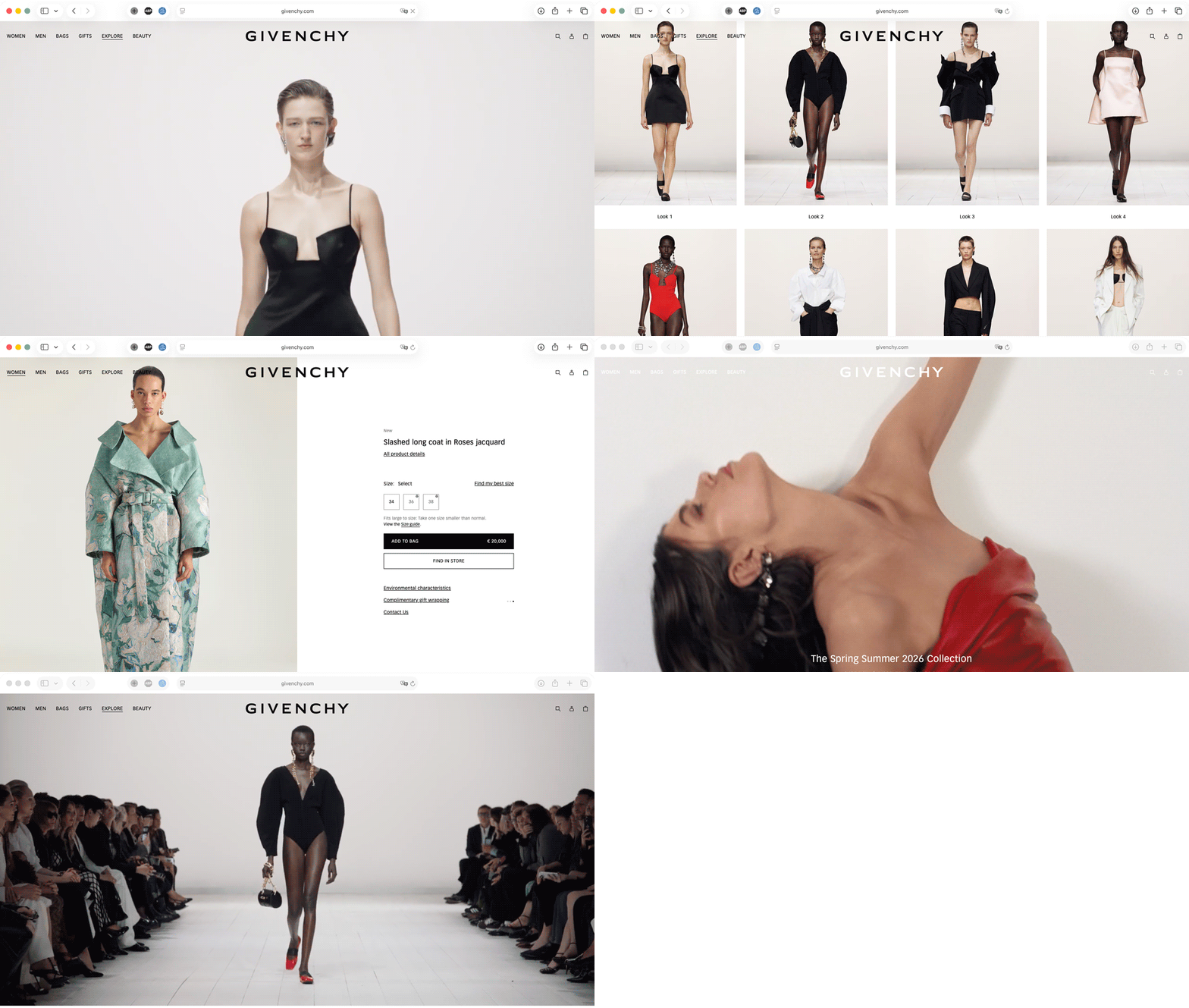
Xenia Dobonyi: When you go to any website of the leading luxury brands, they all look the same. You have a navigation bar, a product grid, filters by color and size. It’s essentially a digital catalog from the 90s, just with better photography and better art direction.
Shopping behavior is changing much faster than websites are adapting. When I tried devices like Apple Vision Pro, one thing became clear: the future isn’t about screens anymore. We’re shifting from screens to spatial, to conversational, multi-modal experiences. Voice, gesture and image search working together.
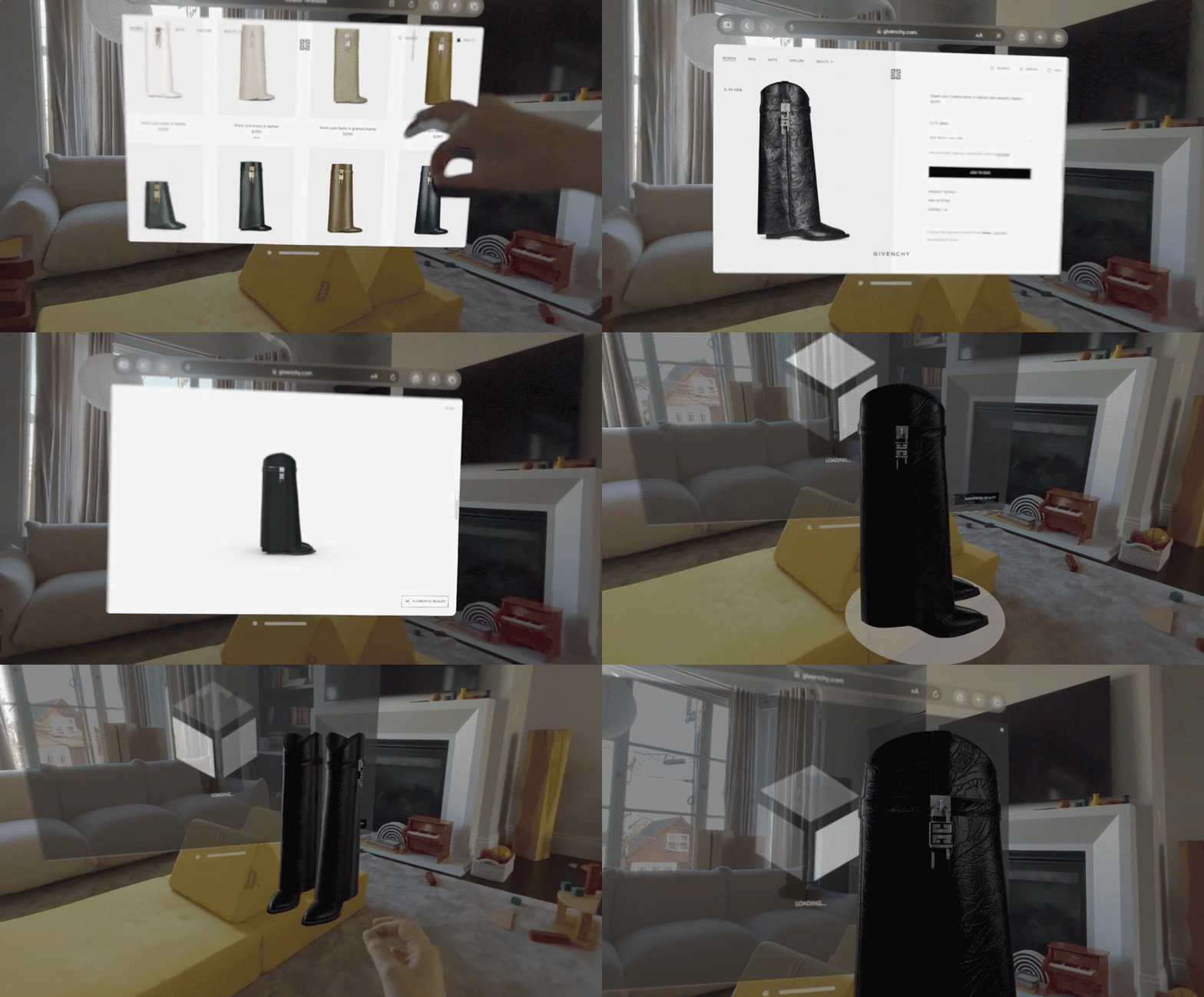
The signals are already here. When you open an LLM like ChatGPT and describe what you’re looking for, that’s the future. Instead of browsing through 50 pages, you talk to AI. It understands your intent, gives personalized suggestions, and eventually, it could complete the transaction.
All of this happens without feeling like you’re on a website at all.
If discovery shifts to AI agents, does that mean brands risk giving up an important layer of personality and control?
Xenia Dobonyi: I don’t think so. I believe every brand will have its own AI agent. One that represents the brand the way the brand wants to be represented. What we’re seeing now are generic assistants. But as the technology evolves, brands will bring their identity into those agents, just like they do in a physical store.
From status signaling to personal identity
You also said that shopping will be more about personal identity expression than social status. What do you mean by that, and how does this change the role of e-commerce for luxury brands?
Xenia Dobonyi: There’s been a fundamental shift. If you look at the old luxury playbook, it was very logo-driven. Bags with visible branding, logo T-shirts... all products that clearly communicated: ‘Look at me, I can afford this.’ The status signaling was very explicit.
My favorite example is the Gucci belt around 2017. It was about being seen.
But if you look at what consumers care about now, it’s changing. There have been recent studies showing that people want to understand the craftsmanship behind the product, the creative vision, the brand’s values. They care less about celebrity collaborations or how visible the logo is.
Luxury today is more about expressing who you are, which group you belong to, what you stand for. It’s less about signaling position in society and more about personal identity.
For e-commerce, this changes everything. We can’t just show product and price anymore. We have to tell the story of how something is made, why it matters, what it represents.
At Givenchy, for example, we introduced 3D models that you can view in AR. It’s not just a cool feature. It lets you understand the construction of the bag, the details, the craftsmanship, in a way that a flat photo never could.
So e-commerce becomes less transactional and more editorial?
Xenia Dobonyi: Yes. It’s about helping people understand the brand’s personality and values, so they can decide whether they feel connected to it. When that connection exists, they stay.
Digital craftsmanship
You mentioned craftsmanship. It has always been central to luxury. But it is traditionally associated with the physical: hands, materials, time, know-how. Digital, on the other hand, is often perceived as instant, scalable, even immaterial. They almost feel like opposite forces. So how do you see craftsmanship showing up in the future of e-commerce?
Xenia Dobonyi: It might appear instant, but it definitely isn’t. And I love this question because people often think craftsmanship only applies to physical products, like a bag made over ten hours by someone trained their whole life. And that’s beautiful.
But digital experiences can be crafted with the same obsessive attention to detail. And truly understanding digital design also requires years of training.
Craftsmanship in digital shows up in places like micro-interactions, the way a menu transitions, how a product image responds when you hover over it, the subtle animation when you add something to cart. It’s about obsessing over pixels.
And over milliseconds. Because it also shows up in performance. That might sound technical, but it’s craftsmanship to care about every kilobyte, every image optimization, every line of code. When a website loads instantly, you don’t consciously notice it, but it feels luxurious. It communicates that the brand respects your time.
The brands that will win are the ones who apply the same craftsmanship standards in digital as they do in their products. Not by imitating physical luxury, but by creating digital luxury with the same level of care.
Digital is as much a flagship as is a physical store. CEOs of brands who understand that, will win.
When technology disappears
You’ve said that future experiences will let technology and design disappear. From a user’s point of view, what will that actually feel like?
Xenia Dobonyi: It might sound abstract, but I think the best analogy is a great luxury store. You walk in, and the staff already knows your size. The lighting feels right. The music is right. Everything works. You do not think about the technology behind it. You are simply enjoying the experience.
That is what disappearing means in digital as well.
Instead of being bombarded with pop-ups, cookie banners, newsletter prompts and sales messages, the website simply shows what is relevant to you. If you are interested in menswear, you see menswear. If you are looking for a specific item, the site understands that immediately.
Instead of clicking through multiple pages to find your size, the site already knows. Or even better, you just ask: do you have this in blue? And it answers.
The opposite of this is what we often see today. Too many clicks. Too many forms. Too many interruptions. The experience feels loud.
The future should feel calm. It should anticipate what you need without creating cognitive load. You are not shopping on a website. You are discovering and buying things you love with zero friction.
Vision meets reality
These are compelling ideas about the future. But in your role as Director of Digital Experience at Givenchy, how do you translate that vision into day-to-day decisions? Where do you feel the tension between what is possible tomorrow and what can actually be shipped today?
Xenia Dobonyi: That is where theory meets reality, and honestly it is the most interesting part.
There is always a gap between what you can imagine and what you can ship, especially inside a large organization like Givenchy. Of course, I cannot disclose any personal processes, but I can share some examples of how this plays out.
A few years ago we implemented 3D and AR for key products. You can view certain items in your own space through your phone. That was a direct step toward spatial commerce. But we did not apply it to everything at once. We focused on the pieces where it had the most impact.
Last year, for our new creative director’s debut collection, we refreshed the entire website in three months with a very lean team. Instead of rebuilding everything, we concentrated on the highest impact customer journeys.
That is where the tension lies. You have to balance innovation with brand consistency, technical constraints, timelines, and global markets. If you see an emerging technology, you have to ask: is it ready? Will it work everywhere? Will it still be relevant in three years?
Sometimes the most strategic move is incremental innovation rather than radical reinvention. I like to think of it as patient innovation.
Patient innovation. I love that idea.
Xenia Dobonyi: Yes, instead of waiting for the perfect moment to launch something transformative, we ship smaller improvements consistently. It is less risky, but it moves the brand forward.
Large luxury houses move deliberately for good reasons. They protect heritage. They value consistency. But the brands that will succeed are the ones with people inside who continue pushing toward the future, even if it happens in small steps.
Before we go
Last time we talked to Olivier Flaviano, head of the Dior Museum in Paris about brand museums and what’s next.
In a previous interview, we looked at the future of hospitality with Koen Malfait, creative director at Airbnb.
We teamed up with Artem Lyustik to create something special: send your friends a message they can only reveal by blinking their eyes. See how it works or try it out yourself here.
Until next time,
Thomas Byttebier
Uncommon Practice