The Cosmic Chronicle #11
Get ready for the red lunar eclipse, and catch up on the latest from the cosmic neighborhood!
Hi ,
Hope you’re excited for the total lunar eclipse on September 7. This week’s newsletter is all about the eclipse.
A total lunar eclipse occurs when the Earth moves directly between the Sun and the Moon, casting its shadow across our celestial neighbour. Because the moon’s orbit is slightly tilted, this alignment doesn’t happen every full moon. Instead, the geometry lines up roughly three times a year, creating the conditions for this dramatic phenomenon.
When the moon enters Earth’s darkest shadow — the umbra — it takes on a reddish tint. This occurs because of Rayleigh scattering: Earth’s atmosphere filters sunlight, scattering shorter blue wavelengths while allowing longer red wavelengths to pass through and bend toward the moon. As a result, during totality, the moon glows a deep crimson, often referred to as a “blood moon.”
The total phase will last an impressive 82 minutes before Earth’s shadow gradually retreats from the lunar surface. Here’s the complete timetable of the event:
Phase | UTC Time | IST Time |
|---|---|---|
Penumbral eclipse starts | 15:42 | 21:12 |
Partial eclipse starts | 16:39 | 22:09 |
Total eclipse starts | 17:31 | 23:01 |
Maximum eclipse | 18:11 | 23:41 |
Total eclipse ends | 18:52 | 00:22 (Sep 8th) |
Partial eclipse ends | 19:44 | 1:14 |
Penumbral eclipse ends | 20:41 | 2:11 |
Although the eclipse’s phases occur simultaneously worldwide, visibility depends on whether the moon is above the horizon in your location. Majority of Australia, Asia, Africa and eastern Europe will be able to witness the eclipse. Regions such as the U.K., Spain, and Brazil will catch portions of the event but miss some or all of totality. Unfortunately, viewers across the Americas won’t see the eclipse at all, as the moon will be below the horizon.
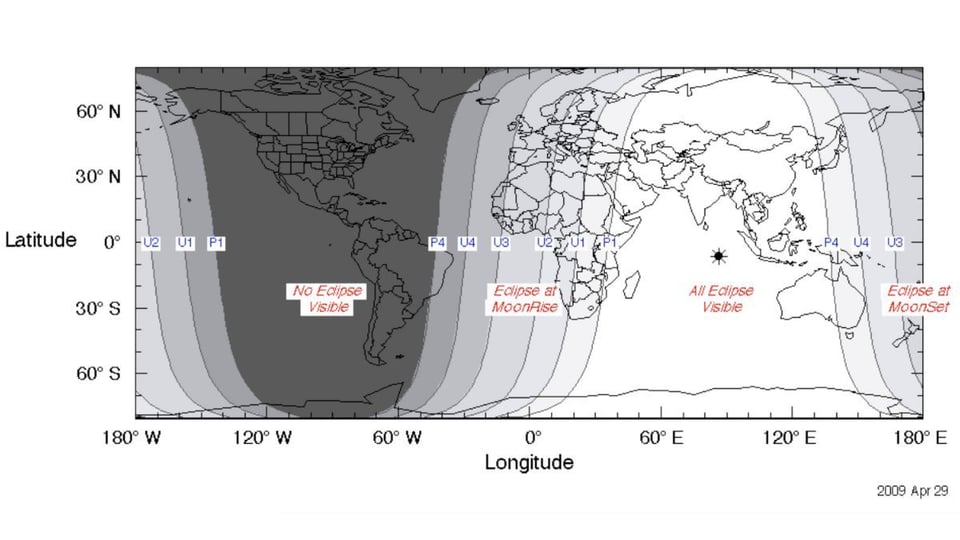
Unlike a solar eclipse, a lunar eclipse poses no danger to your eyes. You can safely enjoy it with binoculars, a telescope, or simply with the naked eye. But don’t worry if you’re in a region where it’s not visible. As mentioned before, I’ll be live-streaming the event on my YouTube channel, provided I get good weather here.
What’s Happening in Astronomy
Unusual CO₂-rich disk detected around young star challenges planet formation models
Recent discoveries from the James Webb Space Telescope (JWST) have identified a planet-forming disk around the young star XUE 10 in the star-forming region NGC 6357, characterised by a high abundance of carbon dioxide (CO₂) and minimal water vapour. This unusual composition challenges existing planet formation models, suggesting that intense ultraviolet radiation may be altering the disk's chemistry and influencing the conditions required for the development of Earth-like planets. Notably, the presence of isotopic variants of CO₂ could offer new insights into the origins of meteorites and comets, highlighting the diverse chemical environments in which planetary atmospheres might evolve and their potential habitability. These findings underscore the importance of understanding extreme radiation effects in the study of planetary formation and evolution.
Asteroid Bennu is like a time capsule from the early solar system
Asteroid Bennu has emerged as a pivotal focus of scientific research, serving as a time capsule that offers deep insights into the early solar system. NASA's OSIRIS-REx mission has successfully collected samples revealing Bennu's complex composition, which includes both solar system materials and ancient stardust from beyond, indicative of its formation history and the processes it has undergone over billions of years. Key findings emphasize the presence of organic materials likely formed in interstellar space and minerals altered by hydrothermal activity, along with significant evidence of space weathering due to micrometeorite impacts. These discoveries not only enhance our understanding of asteroids and planetary processes but also reinforce Bennu's importance in unraveling the origins and evolution of our solar system.
International collaboration doubles detection of cosmic collisions
An international collaboration, primarily through the LIGO-Virgo-KAGRA project, has made significant strides in gravitational-wave astronomy by releasing a new catalogue that includes 128 newly detected events, effectively doubling the known occurrences of cosmic collisions such as black hole and neutron star mergers. This advancement is pivotal for enhancing our understanding of the universe, enabling more precise measurements of the universe's expansion rate and validating Einstein's theory of gravity. Additionally, the improved sensitivity of detection methods broadens observational capabilities, contributing to ongoing research into cosmic phenomena and the fundamental nature of the universe.


Add a comment: