the 2026 grammy looks that stole the show
hiya everyone!! it’s isabella!! I hope everyone is well and is getting ready for spring and some warmer days ahead. As we know, the Grammys just wrapped up last week and we decided to create a piece on some looks chosen at random or by popularity from media outlets!
This piece comes from one of our new writers, Neptune! I cannot wait for you guys to read it!
╰┈➤ˎˊ˗ The Grammy Awards may be music’s biggest night, a ceremony built to honor the voices, lyrics, and performances that defined the year, but the red carpet tells its own story, a story stitched in silk, sequins, and style. While the trophies celebrate sound, the arrivals celebrate statements. This is the one stage where celebrities don’t simply dress for photographs; they dress for impact, for narrative, for a moment that lingers long after the final encore.
This year, risk was the prevailing dress code. Silhouettes pushed proportion, textures clashed and harmonized, and glamour came with an edge sharp enough to cut through predictability. As designer Hayley Paige observed, “The night’s strongest looks weren’t chasing trends, they were composing, building rhythm through proportion, using fabric like instrumentation.” That sense of intention pulsed through the carpet, proving once again that Grammy fashion thrives in the space between daring and discipline.
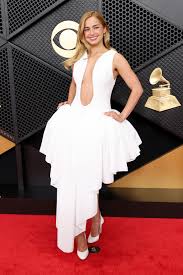
Addison Rae’s appearance on the 2026 Grammy red carpet wasn’t just an entrance, but a declaration of revolutionary change from social media starlet to music and fashion icon. For her first major Grammy nomination, Best New Artist, Addison Rae opted for a custom white Alaïa, a design made by the keys of Pieter Mulier, a celebrated creative chief before his exit at the end of the same year. The dipping cleavage acted assertively toward the navel, an adventurous design that enabled body jewels to serve as extras rather than afterthoughts, a celebration of the interaction of fashion and personality at music’s most dramatic awards ceremony.
“The silhouette was playing a game of tension and payoff, working crisp white fabric, minimalist surfaces, and high-low skirt in a way that felt at once classical and cutting-edge. It captured the essence of old-school ‘Hollywood glamour’ while, in reality, subverting the look for ‘controlled audacity.’ Critics argued that it was an homage to early 2000s ‘pin-up style,’ re-imagined for the 2026 awards show, for which an outfit must announce itself as personality or ‘style.’”
Feedback from the fashion world was divided: some thought the design was sleek and effectively framed the body, while others wondered where the gems should be. Not many people can argue with the effect, however. It was one of the moments when fashion wasn’t an accessory but a part of the story, and she’s here to perform, to take up space, and to be taken seriously.
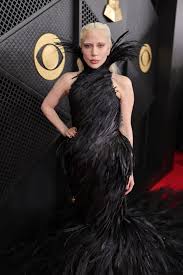
Lady Gaga’s carpet arrival at the 2026 Grammys wasn’t an outfit; it was a thesis on transformation. Gaga went with a couture piece by Parisian brand Matières Fécales, a design brand that excels at the intersection of avant-garde and craft. The look, a black feathered mermaid dress, enveloped her like a contained storm, each feather dyed and arranged to emphasize an hourglass-shaped sculpture that was at turns predatory and regal.
This wasn’t fashion for fashion’s sake; this was myth-building. The train, the stately collar, the slightly gothic quality of the dark plumage and feathers all appeared to be the stuff of Gaga’s own emblem, something that was all-encompassing, untainted, and full of story. Fashion critics referred to her wear as “like an avian shape in action, as if the very rug itself had risen to deliver the goddess of ravens …” They noted that it recalled the look of her Mayhem-era work, combining chaos and performance-art discipline.
Critics celebrated this gown as one of the night's most deeply considered statements. It wasn't about pretty; it was about presence, a deliberate architectural fashion moment that resisted easy description and instead invited interpretation. And in true Gaga fashion, it set up a thematic continuation, re-engaging her performance later in the evening with dramatic cage-like headpieces that amplified the original sartorial metaphor.
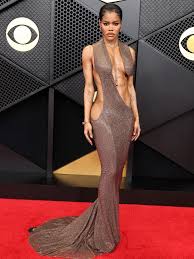
Teyana Taylor didn’t just walk the red carpet; she owned it in a custom-made Tom Ford gown that was a celebration of controlled bravura. Created in conjunction with Haider Ackermann, the gown had asymmetrical cut-outs and a lustrous bronze mesh that was at once a reference to classic glamour but not to hold the wearer hostage. It was a chiseled articulation of restraint and revelation, where lustrous fabric met bravura structuralist drama.
Taylor complemented the look with strong Tiffany & Co. HardWear accessories, as the brand’s delicate style also held a strong, industrial vibe, lending further credence to the image as purposeful accessorizing, not noise, including the fashion moment itself, where strength and calm confrontation existed side by side.
Feedback from fashion critics understood this as not just a dress for the red carpet but a statement of arrival. It avoided the dramatics of some of the other, more theatrical dresses of the night. Instead, it opted to let the architecture of the frock and the accoutrements shine through. Taylor’s dress seemed to be a lesson on how much of oneself to show and why, a rarity of danger and discipline on a night of risks.
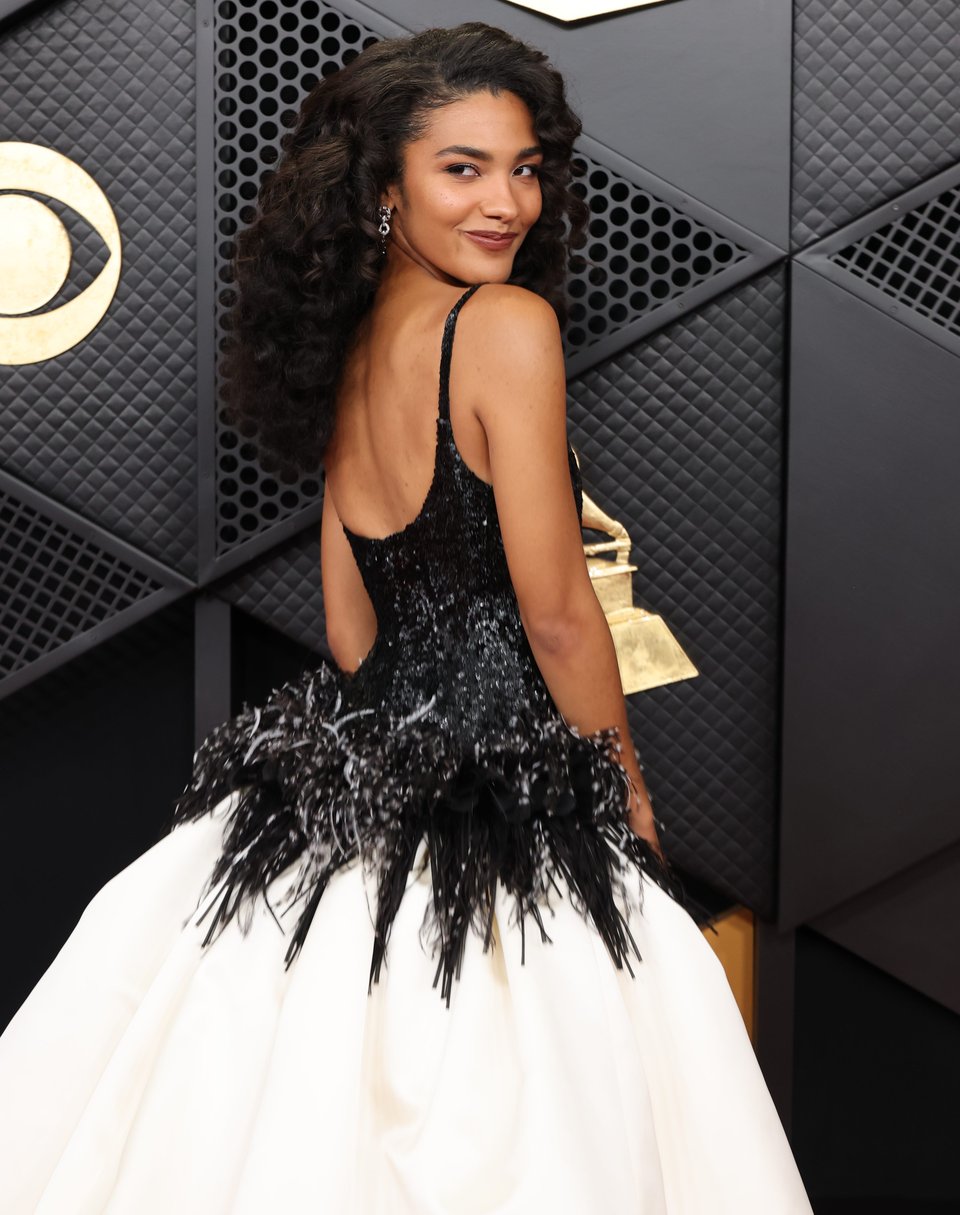
Olivia Dean’s look for the 2026 Grammys was an exercise in the art of narrative elegance. The ‘Best New Artist’ started with a look in a customized Chanel dress boasting both timelessness and the outlandish – a high-low hem with black-and-white sequins that revived a trend from the early 2010s without ever feeling like it had been through a nostalgic crisis.
In the gown, the bodice made of a field of black sequins transitioned smoothly into the dramatically floating skirt, which was in white, with the delineation brought about by the black and white feathers. Far from being frivolous, this was actually the play of composition and rhythm, which, to me, resembled music in textile form. The full look had the vintage glamour, and the high-low had the forward momentum.
Critics pointed out that Dean's style was not just about the aesthetic appeal, “but also about how it fits with her artistic persona, which was poised yet playful, elegant yet unpredictable.” Complete with coordinated heels and elegant diamond pieces of jewelry, “the outfit conveyed a purposeful and sculpted kind of confidence reminiscent of that breakthrough night”.
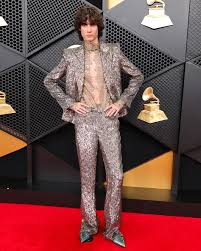
Sombr's 2026 Grammy red carpet appearance crystallized the defiant quality of disco through couture. Born in New York, the singer-songwriter and Best New Artist nominee emerged in a custom Valentino suit engineered by creative director Alessandro Michele, whose work pays homage to rock aristocracy and the storytelling impulse of high fashion.
Embellished with iridescent silver sequins and threading an intricate embroidery, the suit read like a wardrobe-scale homage to the mirror ball-fractal light caught in fabric, anchored by a lace shirt in vintage inflection that softened and complicated the broader spectacle. This was not designed to whisper but to flood every angle of the camera's eye with reflected intention.
Sombr spoke candidly of his thanks and shock to be at the Grammys at all, stating in interviews how much his fans and his fast rise shaped this moment — and how the choice of Valentino felt like a tribute to the late Valentino Garavani’s legacy of grandeur.
Those in the audience appreciated the look, which understood context and character. It wasn’t just sparkling, it was communicating. In an overcrowded field of dramatic drapery and sculptural gowns, Sombr’s suit became a pivot point, fashion as autobiography and disco shimmer as personal mythology.
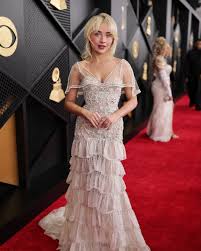
While other stars went for dramatic silhouettes and rock-inspired glamour, Carpenter opted for what can only be described as refined romanticism and couture intricacy. Carpenter walked the 68th Grammy Awards red carpet in a custom Valentino gown, which combined the skill of couture with the storytelling vibe to match this Grammys, where, in fact, both she and her fashion were nominated.
The gown was grounded with the sheer white base that served as a backdrop for different forms of intricate beadwork, pearls, and crystals without ever overwhelming the design itself. Floral designs seemed to float across the bodice before shifting to layers of ruffles and skirt work that seemed to flow like verses from a ballad rather than anything overly designed. A sheer cape design seemed to add to the silhouette without taking away from the architectural elements of the gown itself.
Valentino's legacy as a house of refined glamour, especially under the long shadow of founder Valentino Garavani, provided historical context to Carpenter's look. In the days before the ceremony, word of the house's enduring influence and craftsmanship was on everyone's lips; this gown felt like a tribute to that tradition, its intricate couture beading and layered movement reinterpreted through Carpenter's own artistic rhythm.
Critics and fashion editors alike echoed the praise that this was not just an outfit, but a fashion statement calibrated to theme and person. The mix of delicate beadwork and structural ruffles created a tension between weightless and intentional design; reviewers noted how sheer cape and crystal accents lent the ensemble a poetic texture that read modern "soft couture."
There was a definite trend in both public and critical response that praised the design as a successful blend of timeless elegance and individuality. Several fashion writers were noting that the design was representative of a distinctive interpretation of Old Hollywood glamour, referencing films and awards shows, but giving it a new sort of freshness that was very Carpenters-esque.
On a night when she was nominated for a record six major awards and was scheduled to perform, the red carpet appearance of the singer was enlisted in the narrative of the evening. Her look was not just glamorous, but it conveyed a message of confidence, sophistication, and sensitivity towards how fashion could complement her music.
Taking a step back, the red carpet at the 2026 Grammys less resembles a procession of celebrities and more resembles a sociological exercise in composition. The glamour of Doechii’s high-and-low, colorful look reinforced the notion of contrast as a form of choreography, not just visually but in the dynamic balance of shape and movement. Similarly, Miley Cyrus ensured spectacle lacked substance by embracing attitude within rock-inspired elements of her ensemble, the bold accessories serving not just to enhance the look itself, but to establish a persona or to incorporate cool through construction.
Jon Batiste’s decorated jacket provided celebratory glamour without ornamentation through the use of texture to create volume and detail instead of theatrics. EJAE, Audrey Nuna, and Rei Ami also demonstrated how individualism can create harmony and how individualism works together to create a collective rhythm.
These moments combined to confirm the night's dominant theme: the most striking looks were not seeking to draw the eye, but defining the narrative. In the world's highest stage, fashion made its own statement of performance, where proportion, texture, and intention formed the rhyme.