stitched with power: how clothing became one of humanity's loudest languages
hello hello everyone!! I hope everything is well and you had an amazing february!!
This piece was written by one of our other newest writers pao! I am so excited to show you their work because it is truly phenomenal. enjoy!! :))
╰┈➤ˎˊ˗ Fashion has never been a neutral choice, no matter how often society tries to frame it as shallow, decorative, or disconnected from “real” issues. Long before social media hashtags and protest signs, people used their bodies as moving billboards for belief. We sit in resistance, stand in defiance, march in solidarity – and we dress for all of it. From suffragettes wearing coordinated whites and purples to symbolize unity and dignity, to the Black
Panthers’ leather jackets and berets that projected strength and refusal to be erased, clothing has always carried messages heavier than fabric. Even today, something as simple as a keffiyeh worn in support of Palestine becomes a political act, powerful enough to provoke
bans, arrests, and public backlash. What we wear doesn’t just cover us; it speaks for us, especially in moments when voices are silenced.
What makes clothing such an effective political language is its unavoidable presence. You cannot opt out of being seen. Even refusal – wearing nothing flashy, nothing symbolic – is
still read as a choice shaped by context. Clothing turns the body into a public site, one that power constantly tries to regulate, discipline, and neutralize. When states criminalize symbols on fabric, what they are really afraid of is not cloth but visibility. The keffiyeh, like earlier
protest garments, unsettles authority precisely because it collapses the distance between belief and embodiment. It refuses abstraction. It insists that politics is not just debated but worn, carried into classrooms, streets, checkpoints, and daily routines where power prefers silence.
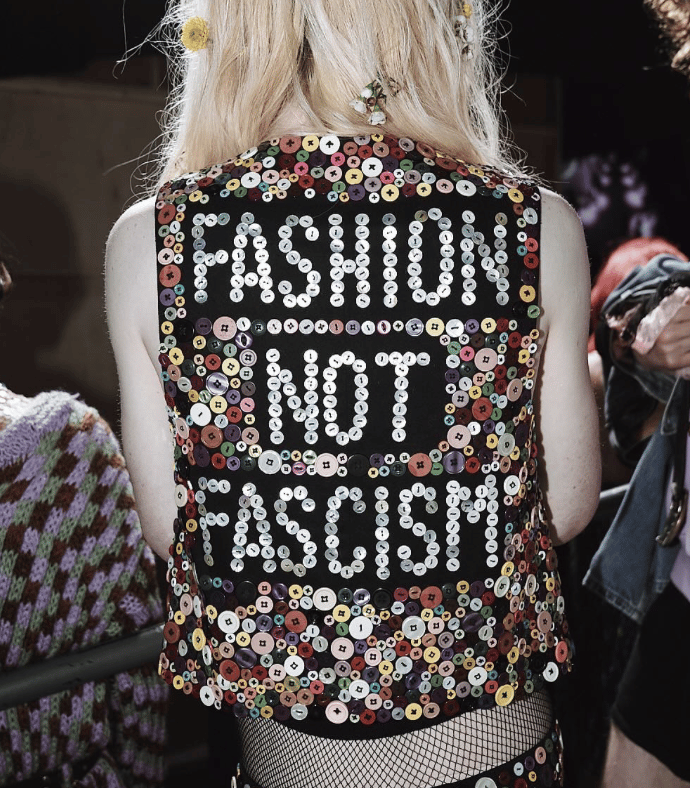
Fashion works because appearance is one of the first things humans register about one another. Before words are exchanged, before stories are shared, clothing has already communicated something about class, culture, gender, religion, and belonging. This is why fashion holds such power – it shapes perception. It can grant access to spaces of influence or block people from them entirely. A suit may signal authority, while a hoodie can trigger suspicion. A hijab can invite discrimination, while luxury brands can imply status and credibility. These visual codes aren’t accidental; they’re social constructions tied to systems of power. Because politics is ultimately about who gets listened to, who gets protected, and who gets ignored, fashion becomes one of its tools. The personal, as feminist theory reminds us, is political – and nothing feels more personal than what we choose to put on our bodies every day.
Because these visual codes are learned early, they operate almost subconsciously. We are taught, long before we understand policy or ideology,
how to read people through what they wear. This makes fashion a quiet but ruthless gatekeeper. It decides who is considered professional, who is perceived as dangerous, who is treated as credible, and who must constantly prove their humanity. These judgments often feel “natural,” when in reality they are rehearsed by institutions – schools, media, workplaces – that reward conformity and punish deviation. Fashion becomes a test you are always taking, often without knowing the rules, where the consequences affect safety, opportunity, and dignity.
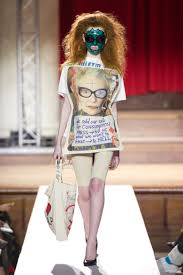
Yet fashion’s role is complicated. It can be liberating and oppressive at the same time. On one hand, it allows people to express identity, challenge norms, and visualize resistance. Climate conscious designers turning waste into wearable art push back against environmental destruction. Cultural garments worn despite bans assert existence in the face of erasure. On the other hand, the fashion industry often reinforces harmful standards, exploiting labor, promoting unrealistic bodies, and profiting off cultures without protecting the people behind
them. Fashion mirrors society’s contradictions: it drives progress while also maintaining inequality. It is both a megaphone for rebellion and a mechanism of control.
This contradiction is not accidental; it is structural. Fashion’s capacity to empower exists alongside its dependence on extraction – of labor, of resources, of culture. Resistance is frequently commodified the moment it becomes visible, stripped of its urgency and resold as aesthetic. What begins as defiance risks being neutralized into trend. Yet even within this cycle, people continue to carve out meaning. The tension itself becomes revealing: fashion shows us how easily systems absorb critique, and how creativity persists anyway. It teaches us that resistance is rarely pure, but it is still necessary – messy, compromised, and incomplete, yet alive.
The idea that fashion is “silly” or unimportant is itself political. Women, in particular, have long been dismissed in political spaces for caring about clothing, as if aesthetic interest disqualifies intellectual seriousness. Yet history proves the opposite. Fashion is a dialogue, not a distraction. It communicates
not only how we want to be seen, but how we want the world to look. From Lady Gaga’s peace dove brooch at a presidential inauguration to thrifted protest outfits worn by students in the streets, style becomes a form of storytelling. Even beauty itself carries political meaning – choosing joy, elegance, or creativity in difficult times is a declaration that life is worth dignity and hope.
To dismiss fashion as frivolous is to misunderstand how power operates. Aesthetic control has always been central to governance – from uniforms to dress codes to the policing of bodies deemed excessive, improper, or unruly. When women or marginalized people invest in fashion, it is often framed as vanity; when dominant groups do the same, it is reframed as authority or taste. This double standard exposes how beauty itself becomes political terrain. To care about beauty is not to escape reality, but to insist on meaning within it – to assert that survival alone is not enough, that presence deserves intention.
Across centuries, politics has shaped fashion and fashion has shaped politics. Fabrics once symbolized trade alliances, colonial influence, and economic power. Eccentric styles were worn to oppose dominant political groups. Today, artists like Bad Bunny use both music and image to confront gentrification, immigration violence, and cultural erasure, proving that art and aesthetics remain inseparable from political reality. Whether through albums, runways, or
everyday outfits, culture captures moments of resistance and struggle.
Fashion also functions as an archive. Styles record the anxieties, aspirations, and conflicts of their time in ways official histories often avoid. They preserve what people feared, resisted, or longed for when words were censored or erased. In this sense, clothing becomes a form of memory that travels across borders and generations. Global fashion trends reveal unequal flows of power –who gets copied, who gets credited, and who gets erased. What circulates on runways and social media reflects not just taste, but whose cultures are deemed consumable without consequence.
Ultimately, fashion is one of the most accessible forms of political expression. Not everyone has a platform, a microphone, or institutional power – but almost everyone gets dressed. Each outfit becomes a small decision about visibility, conformity, rebellion, or solidarity. It reminds us that politics isn’t confined to government buildings or debates on television. It lives in streets, classrooms,
workplaces, and public transport. It lives on bodies. Every thread carries history, every style reflects social forces, and every choice participates – consciously or not – in a larger conversation about power. Fashion, in all its beauty and contradiction, is not separate from politics. It is one of its most human forms.
This is what makes fashion uniquely intimate as political practice. It does not require permission. It operates in the ordinary, where power is most effective and least questioned. Choosing what to wear can be a way of signaling grief, anger, solidarity, refusal, or hope – sometimes quietly, sometimes defiantly. These gestures may seem small, but they accumulate. They create visual communities, shared recognitions between strangers, moments of alignment in hostile spaces. In this way, fashion reminds us that politics is not only about institutions changing, but about people recognizing one another – thread by thread, body by body, in a world that constantly tries to make them invisible.
See everyone next time! - isabella m