Making The Machinery Hum
A Deep Dive on The Engineer - The second of 16 creative archetypes used to explore your wellbeing - by Kailey Fry
In the last newsletter, we discovered The Architect and how it calls us to build order from chaos, designing supportive, invisible structures for our wellbeing from the ground up. This time, we explore The Engineer. Although these two creative archetypes share a love for systems and clarity, they are distinctly different in what they call you to do and the way you approach a creative path. Where The Architect creates the blueprint from nothing, The Engineer steps in to look at what already exists and knows exactly how to make it hum.
Meet The Engineer
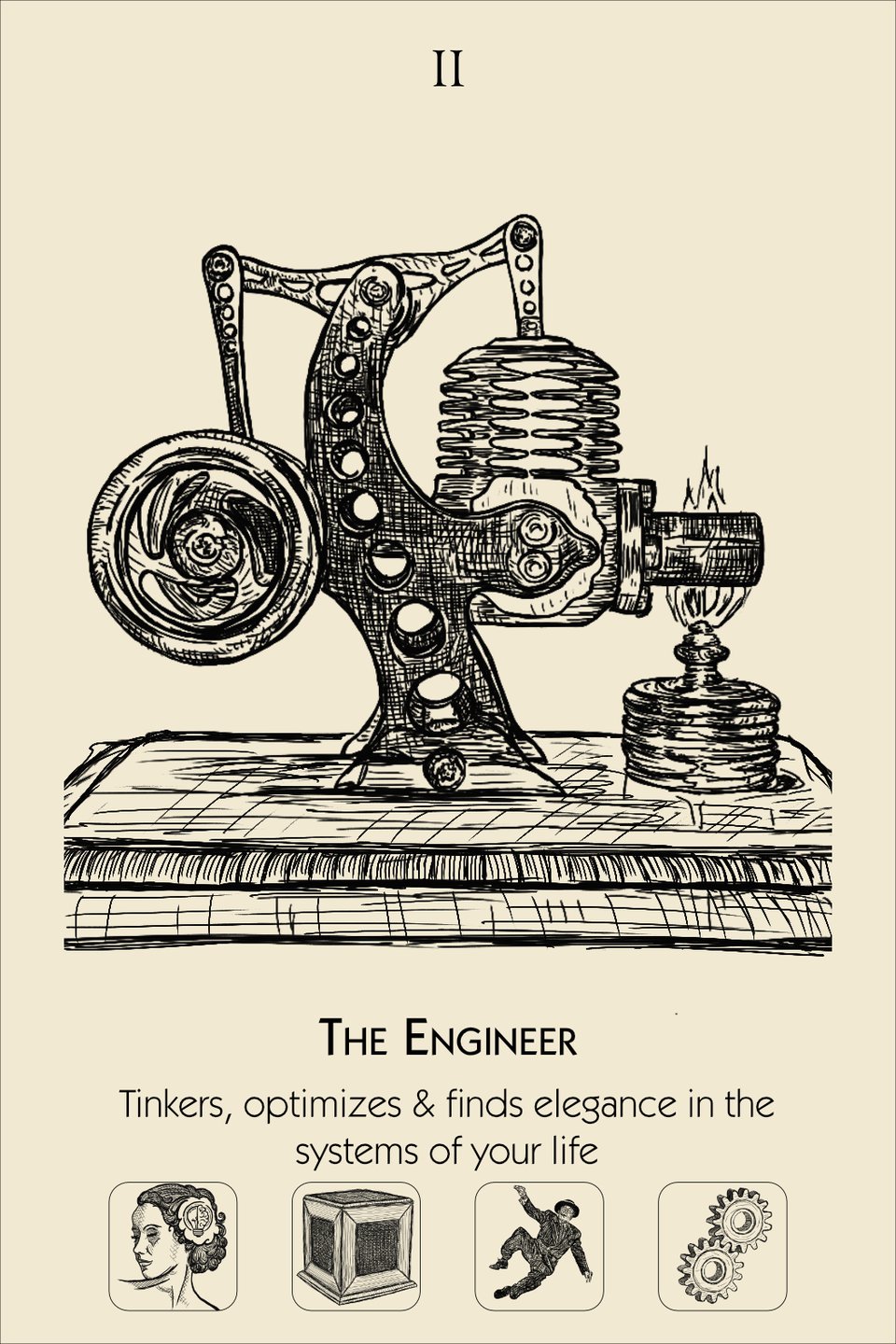
The Engineer invites you to look at what already exists and ask: “What if this worked better?” When you remove the friction from your days, your energy is freed up for what matters most.
There is a specific kind of relief that comes from fixing a clunky, frustrating thing. That relief is not trivial. That relief is The Engineer at work.
How is this a creative archetype?
Creativity is often seen as starting from scratch, like painting a blank canvas or writing on an empty page. But The Engineer reminds us that creativity is also tinkering. It's the act of looking at the machinery of your daily life (your habits, your routines, your physical space) and seeing them not as fixed, unchangeable systems, but as dynamic constructions that can be adjusted. You don't have to reinvent the wheel; you just get to make it turn in a new way. That is a creative act.
How can I use this for my wellbeing?
When life feels hard, we often assume we need a massive overhaul or a completely new plan, but that just adds to our exhaustion. The Engineer knows something wiser: you don't always need a revolution. When we work with complex systems, small tweaks can have a big impact. Consider the simple mechanics of a lever: a small, intelligent application of force that makes a heavy load feel miraculously light. By finding the small points of friction in your day and making a minor adjustment, you create a major shift in your quality of life. Finding that leverage is self-care.
"The most dangerous phrase in the language is: We've always done it this way." - Grace Hopper
The Engineer’s Energy Signature
Mental + Concrete + Expressive + Constructivist

What it means for The Engineer
Mental - You think in cause-and-effect, noticing exactly where the gears grind.
Concrete - You work with the actual, physical steps of your day and real, tangible objects.
Expressive - You design these solutions for your own ease first. This is personal optimization, not a performance.
Constructivist - Unlike The Architect who builds from nothing, you start with what already exists and transform, rearrange, or repurpose it to work better.
The Engineer asks questions like:
"Where is the friction in this routine?"
"What is one small adjustment that would make this feel 10% easier?"
"How can I reframe this stubborn thought to be more compassionate?"
"What if I changed just one single step?"
"Where is the leverage point here?"
The Expanded Invitation
The Engineer arrives with a playful, troubleshooting spirit, ready to optimize the world around you. You are someone who intuitively notices friction, such as a morning routine that feels like a battle, a communication style that leads to misunderstanding, or a thought pattern that reliably causes stress, and feels a deep, almost physical desire to smooth it out.
This isn't about grand, sweeping changes or scrapping everything to start over; it's about the quiet art of the elegant tweak. The Engineer finds joy not in the brand new, but in the potential hidden within the existing. It looks at the "machinery" of your daily life not as a fixed reality, but as something that can be infused with moments of ease and even delight.
This creative archetype is a call to put on your playful problem-solver hat. The Engineer’s genius lies in its efficient empathy, its ability to see a problem not as a personal failure, but as a fascinating puzzle. Your mission is to make life work better for you, one elegant solution at a time. You don't have to carry the heavy weight of a broken system. You are allowed to grab a wrench and adjust it.
"There's a way to do it better... find it." — Thomas Edison
The Engineer's Sunlit Side (upright)
The Engineer removes friction so your energy can flow toward what actually matters.
Signs this energy is available to you
A natural instinct to notice where a process could be smoother
Relief when you find a shortcut that actually works
Feeling a sense of playfulness when faced with a "puzzle"
Treating your own struggles with efficient empathy, seeing them as fixable, not fatal
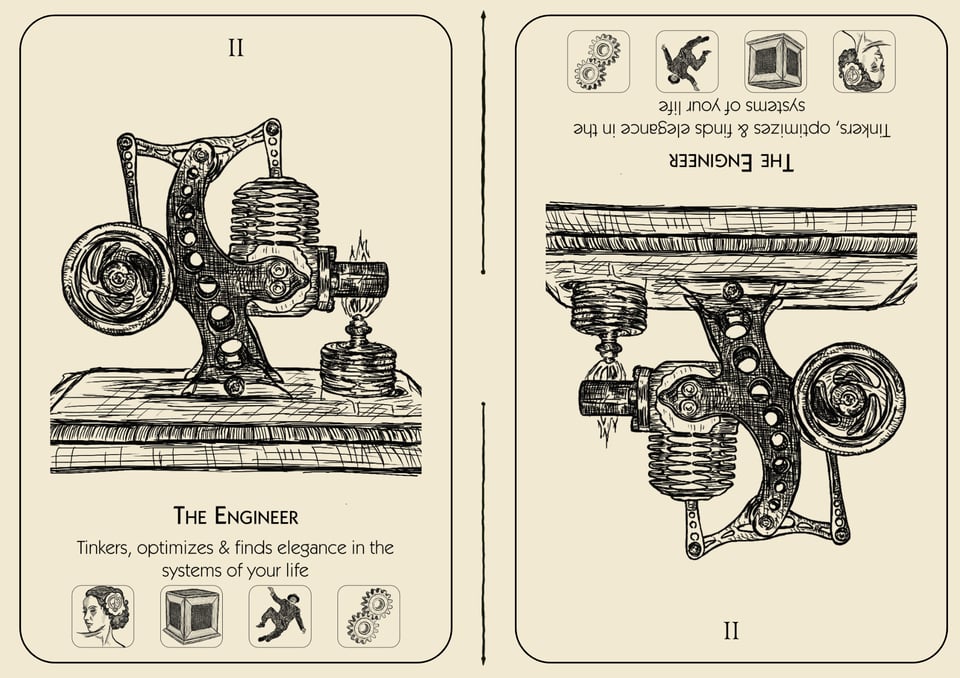
The Engineer's Shadow Side (in reverse)
The Engineer can become obsessed with optimization, treating your life like a machine to be perfected rather than a life to be lived.
Signs you might be resisting this energy (or using it against yourself):
You can't rest because everything could always be 1% more efficient
You view your natural human rhythms and emotions as "bugs" to be fixed
You are constantly tinkering with your life systems instead of actually living your life
When you feel resistant to The Engineer, step back and ask:
"Am I trying to optimize the humanity out of this?" Give yourself permission to be beautifully, messily inefficient sometimes.
Real-World Examples of The Engineer
You have met The Engineer before. You may have even been them once or twice. The Engineer understands that complex systems do not require massive overhauls; they just need the right leverage point.
The Trim Tab on an Airplane - A massive airplane doesn't turn because the pilot forces the whole heavy machine to move. It turns because of a tiny flap on the edge of the rudder called a trim tab. One microscopic tweak changes the airflow, which effortlessly moves the rudder, which turns the entire plane.
The Air-Fuel Ratio in a Car Engine - A car engine is a heavy, loud symphony of moving parts. When it's stalling or lacking power, you don't rebuild the engine. You adjust the air-to-fuel ratio. A tiny shift in the mix, and suddenly the engine stops knocking and idles smoothly.
A Symphony Orchestra Tuning - Before a hundred musicians play a complex symphony, they don't rewrite the sheet music. The oboist plays a single note, and every musician makes a microscopic turn of their tuning peg to match it. That one small adjustment brings the whole massive system into harmony.
Consider how these principles of leverage, tuning, and mixture might be applied to your own everyday life, creative practice, or overall wellbeing. Where or when have you played The Engineer before? What did you tweak?
Three Core Activities
Activity 1: Redesign a Routine
Choose one routine or activity that feels clunky (your morning, commute to work, your wind-down time). Make adjustments to it for more pleasure or ease. Write or draw the new "instructions."
Ways to Use This:
Low-Energy Option: Don't redesign the whole routine. Add just one element of beauty or fun to an existing step. Light a candle while you do dishes. Play a specific song while you fold laundry.
Journal follow-up: "What was the hardest part of this routine before? How does my body feel now that the step is tweaked?"
Shared version: Find an instruction manual you have around the house or online. Use its formatting as a playful template to write the "Instructions for My… fill in the blank" to share with a friend.
Digital alternative: Take a picture of parts of a routine that work well. Use it as inspiration.
Archetype pairing: Before you make adjustments, ask The Dreamer: "What would this routine look like if it felt like magic?" Then use The Engineer to build it.
Activity 2: Mend a Memory
Find a small, worn down, or broken object. As you physically repair it (with glue, tape, or thread), reflect on a difficult memory or a frustrating thought pattern. The act of careful mending is a metaphor for integration.
Ways to Use This:
Low-Energy Option: Don't fix the object perfectly. Just apply one piece of tape or one dot of glue with the intention of offering compassion to yourself.
Journal follow-up: "As I repaired this object, what parts of my memory showed me my strengths? How do those strengths serve me today?"
Shared version: Tell someone about the object you fixed. "I broke this, but here is how I put it back together."
Digital alternative: Take a photo of a broken thing, use a digital editing app to "draw" the invisible tape or glue that would hold it together.
Permission statement: You don’t have to finish the repair. It's the intention to mend a thought pattern that matters.
Activity 3: Create a Cause-and-Effect Chart
Track a symptom, mood, or energy level alongside what happened right before it, and potential alleviators. Use simple symbols instead of words if that feels right.
Ways to Use This:
Low-Energy Option: Track just one thing for one day using three symbols (e.g., ⚡ for high energy, ☁️ for brain fog, 🛑 for pain spike).
Journal follow-up: "Did I notice any patterns I didn't expect? What alleviator brought me the most relief?"
Shared version: Consolidate your findings from your chart to share it with your supporters (family, friends, doctors). You are translating your data for your care team.
Digital alternative: Use the notes app on your phone. Just log the symbol and the time.
Archetype pairing: Use The Translator to help you turn your chart's symbols into words when it's time to share your findings with a doctor or loved one.
If You’re Feeling Resistant
The thought of "optimizing" your life can feel like just another exhausting to-do list. That is not laziness. That is the weight of the clunky system finally pressing down on you.
Try this instead:
Take one breath.
Look at the task in front of you.
What is the very first, smallest step of this task? How can I make that step physically easier? Just adjust one single step - move the paper closer, turn on a lamp, grab an extra pillow. That is a perfect act of engineering.
Pairing & Contrasting
Some archetypes work beautifully together. Others offer a gentle correction when you've leaned too far in one direction.
Architect + Engineer: The Architect builds the structure from scratch. The Engineer takes that structure and tweaks it until it feels good. Design, then refine.
Engineer + Dreamer: The Engineer wants to fix what is. The Dreamer wants to imagine what could be. One grounds you in reality; the other expands your possibilities.
Prompt: If you have been living in Engineer energy too long (over-optimizing, treating yourself like a machine, unable to rest), what might The Dreamer offer you today?
If You've Been Avoiding The Engineer
Maybe you feel like you don't deserve ease. Maybe you're so used to things being hard that friction feels normal. That's okay.
If that's you, ask yourself this: What is one tiny friction you could eliminate today?
Moving the charger so you don't have to reach behind the bed.
Putting the TV remote in a consistent spot so you stop searching for it.
Deleting one app that causes you stress.
Your Turn
Answer this question in your journal, notebook, your mind, or wherever else feels natural.
"What is one small, clunky gear in my day that I could tweak to bring me more ease?"
It doesn't need to be a grand life hack. Not a total system reset. Just one elegant solution to make your life work better for you.
That is engineering. That is care. That is just one creative version of you.
Next Time in the Deep Dive Series
Meet The Cartographer – Map your inner world as you discover it.

Where The Engineer tweaks the machinery of your life, The Cartographer asks: "Where am I, and what is the terrain of this experience?"
We'll chart the unknown together.
Until then, tweak gently.
Made with ❤️ Kailey Fry
Enjoy this deep dive?
Reply to this email, or tag me in your socials! I'd love to hear what kinds of things you’ve been building.
Instagram- @kfrycoaching
Explore The Good Stuff Here

