Charting the Inner Wilderness
A Deep Dive on The Cartographer - The third of 16 creative archetypes used to explore your wellbeing - by Kailey Fry
In the last two newsletters, we explored how to build supportive frameworks with The Architect and how to make the machinery of our daily lives hum with The Engineer. This time, we venture into the unknown.
This month, we're charting the inner wilderness with The Cartographer.
Meet The Cartographer
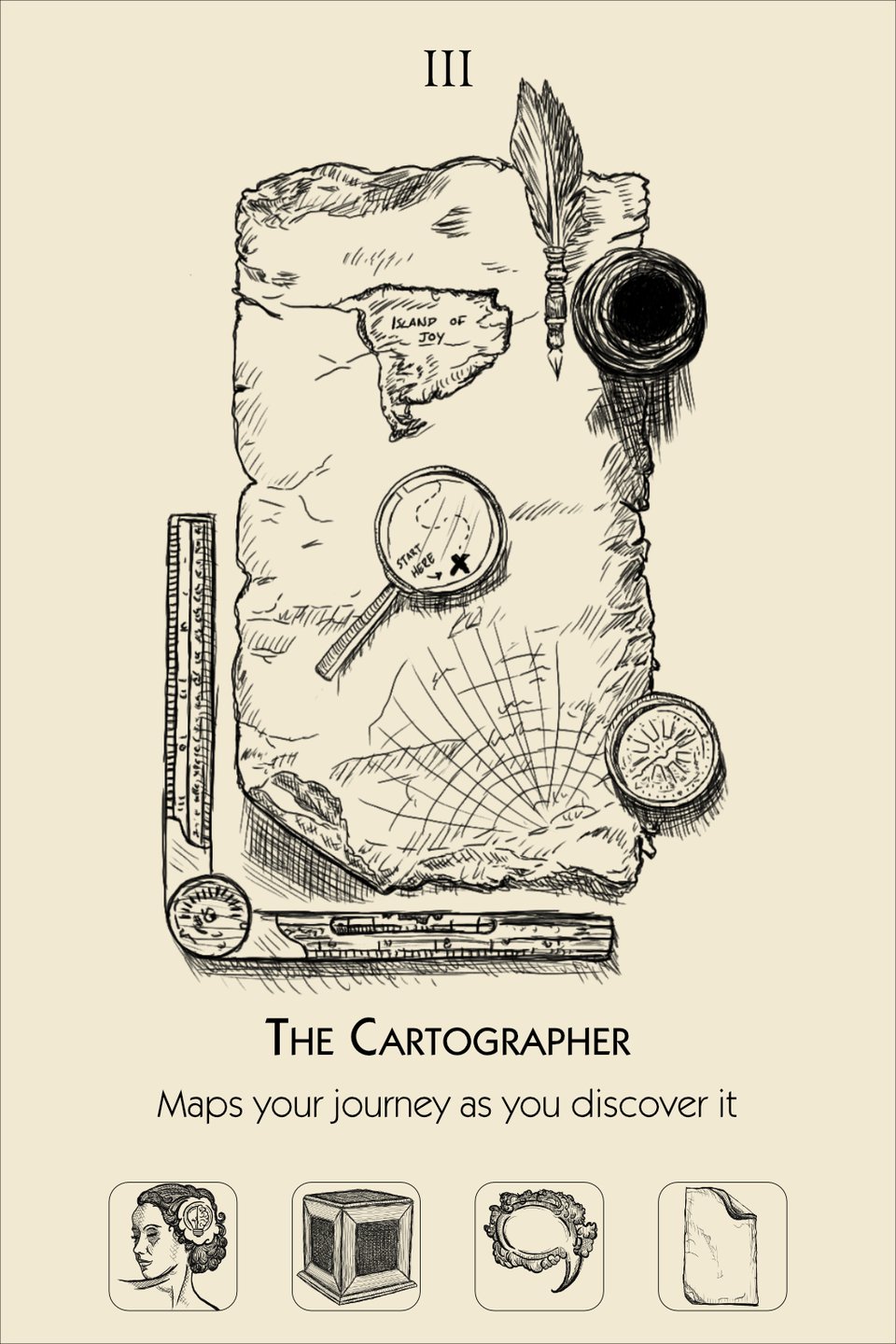
The Cartographer invites you to map your inner world and make the unknown navigable. By drawing the contours of your experience, you become the trusted guide of your own journey.
There is a specific kind of relief that comes from finally knowing where you are. That relief is not trivial. That relief is The Cartographer at work.
How is this a creative archetype?
Creativity is often seen as making something beautiful out of physical materials. But The Cartographer reminds us that creativity is also translation. It's the act of taking the vast, uncharted wilderness of your internal experience and putting it onto paper. You are not just lost in your feelings; you are allowed to draw the boundaries of them. You are allowed to make the unknown visible. That is a creative act.
How can I use this for my wellbeing?
When life feels disorienting or overwhelming, most people panic and try to run blindly toward a destination, any destination. The Cartographer knows something wiser: you don't need to sprint. You need to orient yourself. When we face complex emotions or a confusing health journey, we feel lost in the fog. By charting the terrain, marking the steep climbs, the dense brush, and the clearings, you make the unknown navigable. You take away its power to terrify you simply by naming the landscape. That is self-care.
“Maps are like campfires – everyone gathers around them, because they allow people to understand complex issues at a glance, and find agreement.”
— Sonoma Ecology Center
The Energy Signature
Mental + Concrete + Communicative + Blank Slate
What it means for The Cartographer
Mental - You think in spatial relationships, landscapes, and the connections between different parts of your experience.
Concrete - You draw with real marks, symbols, and tangible legends. You work with pen, paper, and physical objects to make the abstract real.
Communicative - You map this not just for yourself, but to be understood. You are creating a guide that can eventually be shared with others.
Blank Slate - You begin with a blank page, charting the unknown territory of your inner world from scratch. No template required. Just your truth.
The Cartographer asks questions like:
"Where am I right now?"
"What is the terrain of this experience?"
"What are the landmarks I can rely on?"
"Where are the steep climbs, and where are the clearings?"
"If I mapped this feeling, what would its legend look like?"
The Expanded Invitation
When The Cartographer appears, you are being called to make the unknown navigable. This archetype arrives when your inner world feels like a tangled forest or a vast, featureless desert. Not to hand you a compass, but to hand you a pen, reminding you that you are the trusted guide of your own journey.
You have a deep-seated need to understand the topography of your own life. Where does your energy peak? Where does it bottom out? What triggers feel like sudden drop-offs, and what support systems feel like reliable bridges? The Cartographer asks you to stop guessing and start observing.
Think of the timeless principles of cartography itself: the way a coastline is charted not as a single line, but as a series of observations. The way a legend turns chaotic scribbles into universally understood symbols. "The map is not the territory," as the saying goes, but it helps you navigate the territory nonetheless.
This isn't about rigid diagnosis or clinical tracking. It’s about compassionate observation. It’s about asking: What does my grief look like when I draw it? If my fatigue was a landscape, would it be a swamp or a steep mountain? What symbol represents my safe harbor?
This is your permission to stop stumbling blindly through your hard days and to start consciously charting them. When you map your experience, you step out of the storm and into the role of the weather watcher. What landscapes inside you are waiting to be discovered?
“A map does not just chart, it unlocks and formulates meaning; it forms bridges between here and there, between disparate ideas that we did not know were previously connected.”
― Reif Larsen, The Selected Works of T.S. Spivet
The Cartographer's Sunlit Side (upright)
The Cartographer makes the unknown navigable so you can guide yourself through it.
Signs this energy is available to you
A desire to draw, doodle, or visualize a problem
Relief when a confusing situation is laid out spatially
An urge to create symbols or legends for your moods
A need to find your " bearings" when life feels disorienting
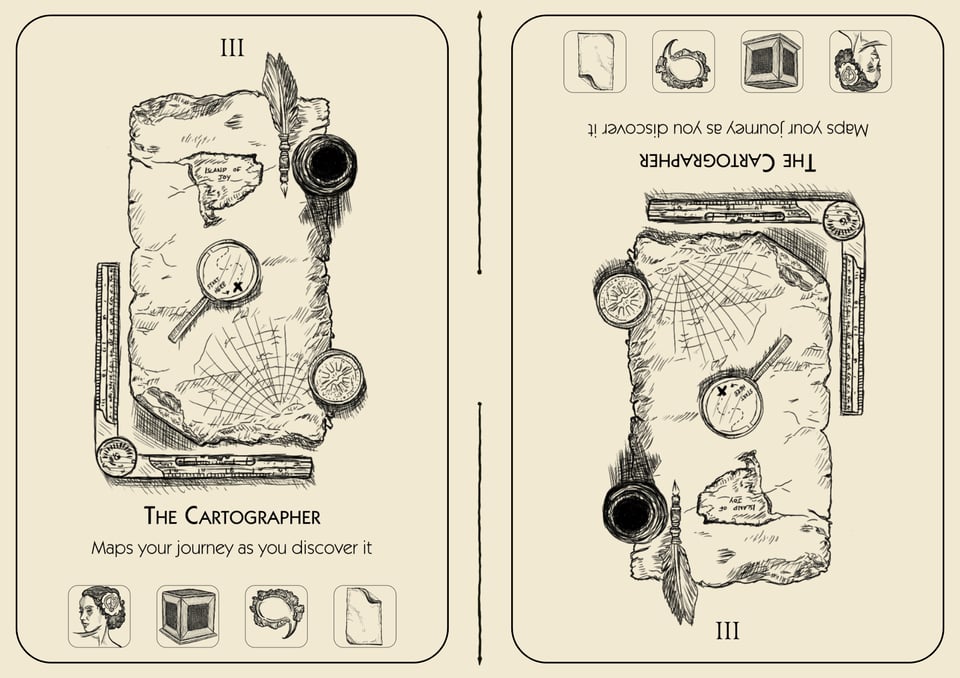
The Cartographer's Shadow Side (in reverse)
The Cartographer can become detached. Too much mapping can keep you observing your life from a distance instead of actually living it.
Signs you might be resisting this energy (or using it against yourself):
You get so caught up in analyzing your feelings that you forget to feel them
You believe if you just make the "perfect map" of your life, it will fix it
You use your maps to predict and control the uncontrollable, rather than to navigate
When you feel resistant to The Cartographer, don't try to chart the entire landscape. Start with where you are right now by placing a single symbol on the page to represent yourself in this moment.
Real-World Examples of The Cartographer
You have met The Cartographer before. You may have even been them once or twice.
Daily life - The person who, when feeling lost in an overwhelming shopping mall or hospital, hunts down the "You Are Here" map because just seeing the red dot gives them the instant relief of orientation.
Pop culture - Moana – who learns the ancient maps of her ancestors to navigate the unknown ocean, trusting the stars and the water to guide her.
History/Art - Leonardo da Vinci – who mapped not just the land, but the inner anatomical landscapes of the human body, charting the unknown.
Health journey - A patient who draws a "body map," marking where pain moves and shifts, rather than trying to find the perfect clinical words for it.
Parenting - A parent who creates a visual "emotion chart" with their toddler, mapping out what "volcano anger" or "puddle sadness" looks like.
Work life - A manager who draws a flow chart of team communication to see exactly where messages are getting lost in the swamp.
Where or when have you played The Cartographer in your life? What did you chart?
Inspirational examples of the cartographer at work
Da Vinci Cartography Art Exhibition on Internal Mapping Movement Mapping ActivityThree Core Activities
Activity 1: Chart Your Wellbeing Terrain
Map the terrain of your chosen topic (a symptom, a relationship, a life transition). Mark the steep climbs, dense brush, and clearings. Create a legend of symbols for your obstacles, support systems, and breakthroughs.
Ways to Use This:
Low-Energy Option: Draw a single wavy line on a page. Label one side "The Hard Part" and the other "The Clearing." That is your map.
Journal follow-up: "Where is the highest point on my map? How did I get there?" or “where else can this map take me?”
Shared version: Show your map to a friend or supporter. Share your insights and ask if they would add or change anything.
Digital alternative: Use a digital whiteboard app (like Miro or Apple Notes) to drag and drop icons representing your feelings.
Archetype pairing: Ask The Architect to help you build a structure in one of the clearings you just mapped.
Activity 2: Create a Support System Map
Use small objects (coins, stones, buttons) to represent people and resources in your life. Place them spatially on your desk to show emotional closeness or the type of support they offer.
Ways to Use This:
Low-Energy Option: Place just two objects on your desk. One for you, one for someone who supports you. Notice the distance between them.
Journal follow-up: "Who is closest to me on the map? Is there anyone I want to move closer?"
Shared version: Take a photo of your object map and send it to one of your support people as a way of saying thank you.
Digital alternative: Use an app like Canva to drag and drop photos of people in spatial relationship to a "central" photo of yourself.
Archetype pairing: Add The Translator's energy by writing one word next to each object describing the type of support they offer (e.g., "listener," "challenger," "shelter").
Activity 3: Emotion Line Graph
Graph the flow of a day or an hour related to your topic. Annotate the peaks and valleys with one-word notes about what caused the shift.
Ways to Use This:
Low-Energy Option: Draw a single dot on a page. Write the emotion you are feeling right now next to it. That is your starting coordinate. Build off that dot when you are ready.
Journal follow-up: "What caused the biggest peak? What caused the biggest valley? Can I identify the trigger?"
Shared version: Share your graph with a therapist or coach to help them see the literal topography of your day.
Digital alternative: Use the notes app on your phone to draw a jagged line and type labels at the points.
Archetype pairing: Use The Observer to simply watch the peaks and valleys without judgment as you draw them. What do you notice about the patterns and shapes that spill onto the page?
If You're Feeling Resistant
The thought of "mapping" your complex feelings can feel overwhelming, like you're trying to tame a tornado with a pencil. That is not avoidance. That is the fear of seeing the true size of the wilderness.
Try this instead: Take one breath. Look around your immediate space. Choose one object that makes you feel grounded. A heavy coffee mug. A smooth stone. A favorite book. Place it in front of you. You do not have to map the whole forest. Just know where your home base is. That is a perfect act of cartography.
Pairing & Contrasting
Some archetypes work beautifully together. Others offer a gentle correction when you've leaned too far in one direction.
Cartographer + Architect – The Cartographer maps the terrain of the land. The Architect builds a structure on it. Understand the landscape, then build your foundation.
Cartographer + Dancer – The Cartographer needs spatial awareness. The Dancer needs flow. One grounds you in reality; the other reminds you that maps are meant to be danced across, not just studied. Prompt: If you have been living in Cartographer energy too long (endlessly analyzing your emotions, mapping but never moving), what might The Dancer offer you today?
If You've Been Avoiding The Cartographer
Maybe you're afraid of what you'll find if you look too closely at the terrain. Maybe you'd rather stay blind to the landscape than admit you are lost. That's okay.
Don't draw the map yet. Just draw the legend. Pick three simple, silly, or abstract shapes (a squiggly line, a star, a dot). Assign one to "comfort," one to "friction," and one to "surprise." You don't have to place them anywhere on a page yet. Just identifying your symbols is a perfect act of cartography.
Your Turn
Answer this question in your journal, notebook, your mind, or wherever else feels natural.
"What is the terrain of my current experience, and what is one landmark I can rely on to find my bearings?"
Not a complete atlas. Not a perfect geographic survey. Just one small, honest sketch of where you are today.
That is cartography. That is care. That is just one creative version of you.
Next Time in the Deep Dive Series
Meet The Translator – Bridge the gap and turn complex experiences into language others can understand.
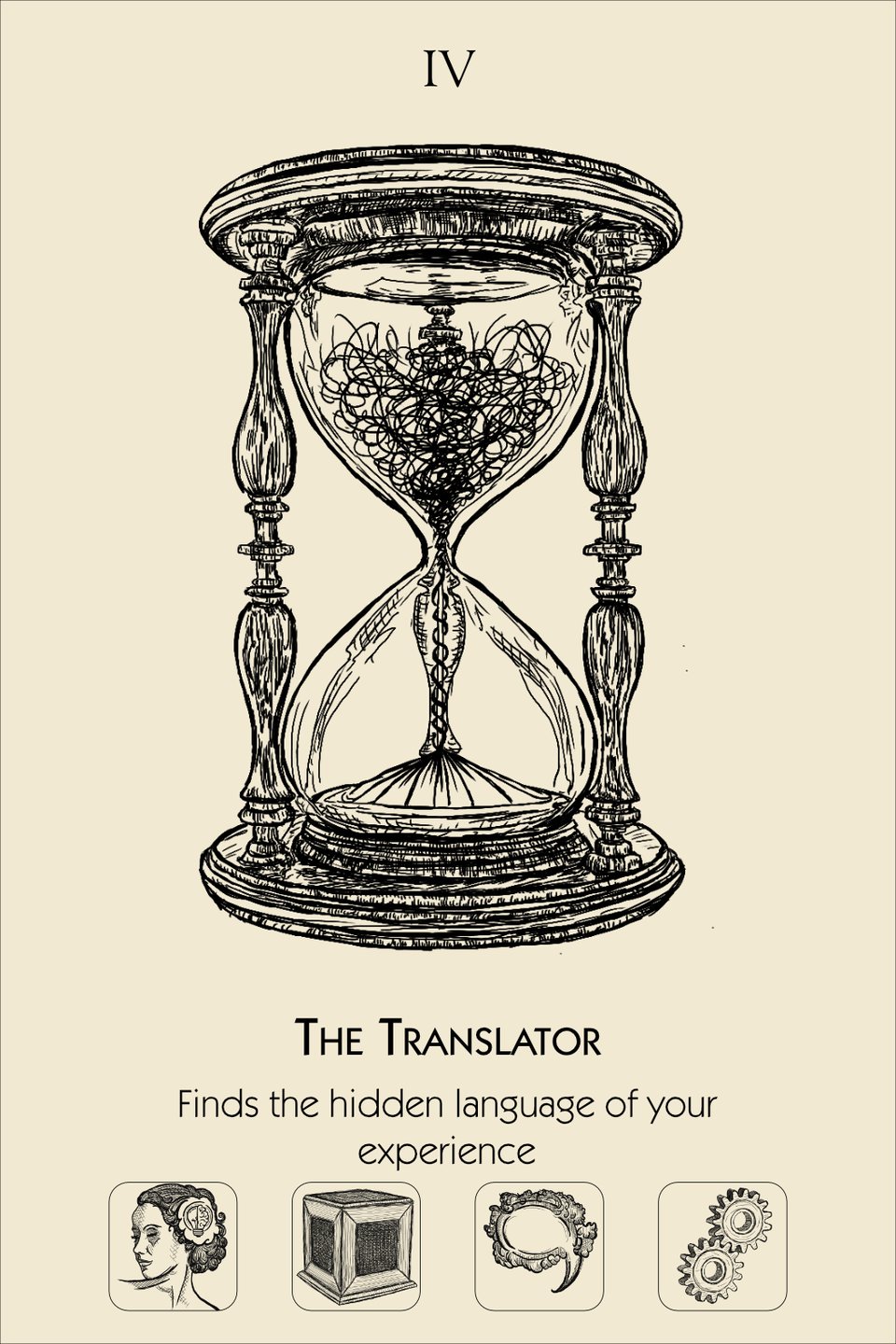
Where The Cartographer draws the map of the unknown, The Translator asks: "How do I explain this map to other people?"
We'll find the right words together.
Until then, map gently.
Made with ❤️ Kailey
Enjoy this deep dive?
Reply to this email, of tag me in your socials. I'd love to hear what kinds of landscapes have you been discovering?
Instagram- @kfrycoaching
Explore The Good Stuff Here
