Cultural Relativity
Friends,
First, a celebration! Taiwan Travelogue won the International Booker Prize, which led to an avalanche of great content about the book, the writer Yang Shuang-zi, and the translator Lin King. I especially recommend their acceptance speech at the Booker award ceremony, The Conversation’s summary of the book, the Poets & Writers conversation between Emily Y. Wu and Lin King, and the BBC’s profile of the writer (no English subtitles, but you’ll still enjoy the visuals!). The book is really good, and is a remarkable act of translation prowess. I’ve written about how much I love it before, so I’ll add just one small detail: I was shocked to see the main characters drink iced coffee in the novel, but apparently that was a thing in 90-years-ago Taiwan/Japan. The writer did a ton of research.
So go read it!
Cultural relativity is always all around us, but for the last month I’ve been thinking about it a little more. It kicked off with the Taiwan International Documentary Festival. I managed to watch three documentaries that were somehow all three about grandparents and death. The one that stuck in my head the most was SPI (Mandarin name: 《烤火房的一些夢》, roughly “A Few Fire Lodge Dreams”). It chronicles the director’s Tayal (the third largest of Taiwan’s 16 main indigenous peoples) family+community as they cope with both the patriarchal grandfather’s death and retaining their culture while existing in the modern world at large. The film raised so many interesting points, but left me feeling like I missed out on the full picture because a lot of those points weren’t very explored. For example, the director simultaneously focused on how to preserve Tayal culture and live as a Tayal person in modernity, and also focused on how her grandmother and other members of the community have an intensely devout relationship with the Christian church, but there was zero exploration of how those two things interact and/or conflict. Or, for another example, the film shows the director doing a lot of research about the tribe’s history, making this incredible 3d map for their community center and interviewing elders about their old traditions. One of the traditions was a New Year ceremony that hadn’t been done since the authoritarian KMT took over and made them stop in the ‘50s. Then the film cuts to the ceremony being done recently, clearly implying the director’s questions prompted its reemergence, and it’s very moving, except it’s a male-only ceremony and the director is female and is not present. Did this bother her? Did she expect differently? Not touched upon, at all, despite the director’s feelings about wanting to be more Tayal being the framing device for the whole film.
Instead, the film spends a huge amount of space on a pregnant high school student who is encouraged to get married in a hurry. The father is from another indigenous group, and there’s a fascinating negotiation of the marriage (mostly involving who will give who pork and how much), and it’s maybe the only insight into Taiwanese teen pregnancy I’ve seen since living here. However, a lot of it is just the matriarch refusing to speak to the pregnant girl, or the family awkwardly sitting around trying to figure out how to talk to her, or tears lost for what might have been. I wanted to fast forward because that part, which was maybe the longest segment of the film, was the least specific to the subject. The broad strokes would’ve felt in-place with almost any culture.
But then the most culturally disorienting part came when I described this documentary to three separate Taiwanese friends and said I wish there had been more reflection from the director, all three of them reacted in the exact same way: that doing that would make it less of a documentary. Cultural relativity! To me thinking that a director needs to be as absent as possible from a documentary is a very old-fashioned attitude, that observers can never truly be neutral. Just observing is affecting, in life as in physics, and of course this kind of work is rarely just observing.
I will try the festival again next year, and my hope is for some more food-centric films! My former student who introduced me to the festival interviewed the director of another documentary,《水火山》/Water Volcano. It’s a great conversation, check it out (use a translate app to read it if necessary!).
Cultural relativity also disrupts my social habits. I already tend to avoid stores in the neighborhood where the boss is regularly smoking outside, but now I find myself turning away when I see obviously AI pictures in the window. I have no idea what AI acceptance is like in general in other countries besides Taiwan, but surprisingly I find more of my students are hesitant about it than it seems like the population is at large. My Bluesky Mandarin feed is full of people who “chatted with ChatGPT” about their latest work dilemma or domestic situation. So if AI usage is the norm, am I shooting myself in the foot by not wanting to interact with people or businesses who blatantly do so?
Or, a little more old school example. I’ve been trying for years now to find new friends to play video games with (my old cohort drifted apart), especially Taiwanese people with whom I might practice my English. There’s already a barrier because finding people my age here who play video games besides cell phone/Switch games is an impossibility, so usually it’s much younger people. And here’s what’s happened a few times now: I find a group, they seem nice, then in Discord (the most common gaming chat program) they start posting things that make me uncomfortable. Most recently it was a bunch of Asmongold clips (a gaming-related video “personality” whose primary shtick is fostering regressive reactionary anger in the online gaming world). And, again, cultural relativity - we see those clips from totally different points of view. What do they see when they watch them? Why do they want to share them? Is it worth me figuring it out, or do I just move on? What about when it’s a Kanye profile picture in 2026? What about when it’s a MAGA hat behind the bar at a coffee shop? (When the owner saw me looking at it, he quickly said, “a friend gave it to me from the US!” as explanation. We’d already ordered, so I nodded and kept my sighs internal.) What about when it’s when it’s when it’s
Exhausting! Is there another choice?
I don’t think so. But. I have no problem with disqualifying problematic writers from my teaching repertoire because there’s an infinite number behind them to replace those spots (even when it makes me very angry because I really liked my Graveyard Book lesson plans). However, with socialization it’s a little different. I only have so many neighbors. There are only so many businesses in the area. Taipei is a big city, but the number of compatible social circles for us to join is probably smaller than I think. Plus, how many red flags am I blind to, due to my own cultural and linguistic limitations?
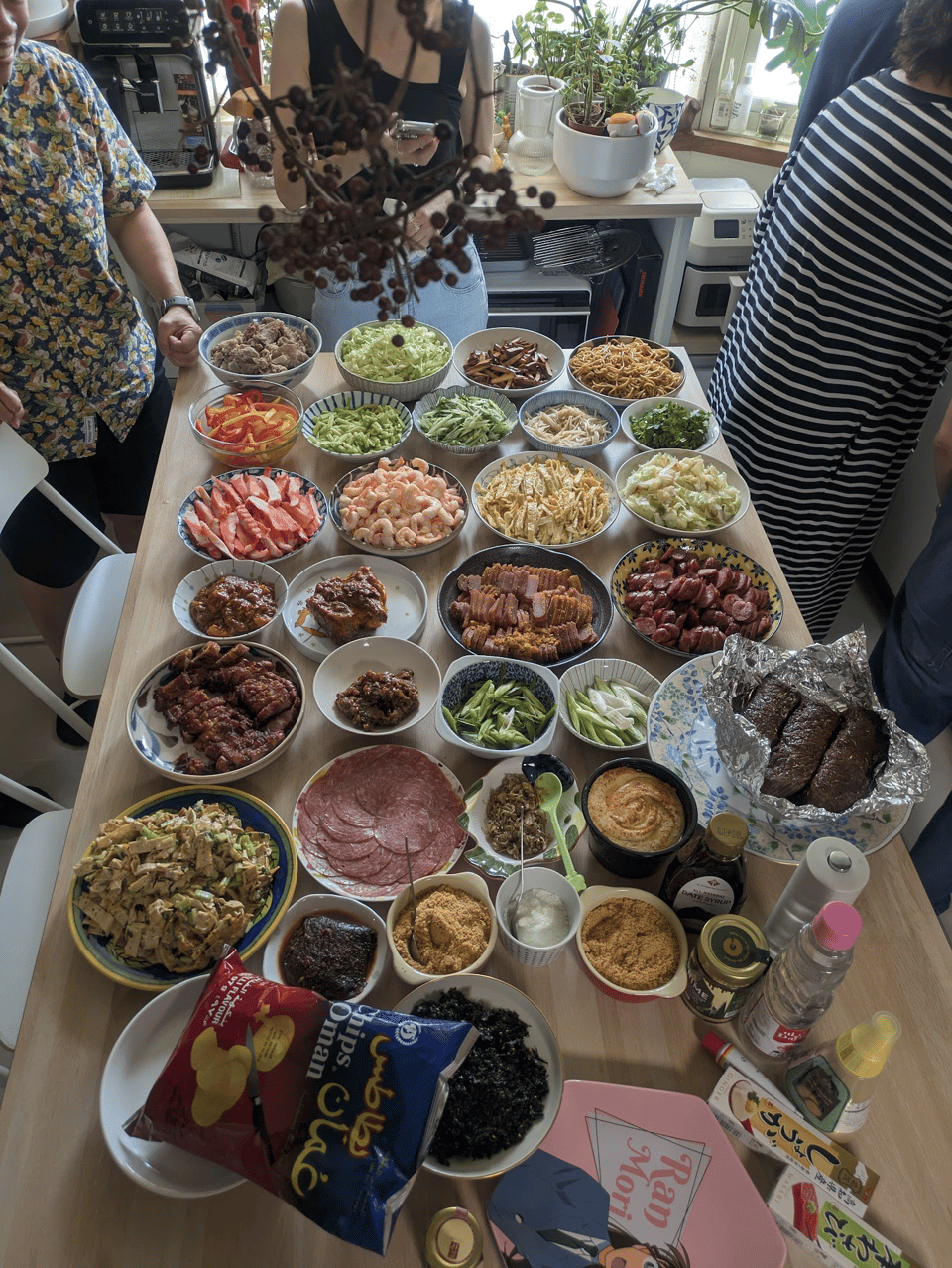
Thankfully, there’s still awesome people out there to meet! Case in point, we were lucky enough to be invited to a run bing/潤餅 party this month. Run bing are translated as spring rolls, but they’re much bigger and kind of akin to a burrito or a sandwich wrap. Typical fillings are marinated cabbage, bean sprouts, shredded omelette, pork, ground peanut, and more. As you can see form the above picture, this party involved stretching filling choices past typical. Our contributions were a tofu skin-based “chicken” salad and some hummus. We met a lot of people and struggled through small talk with our bad Mandarin and ate a lot. My favorite wrap was ice cream with peanut and cilantro, a common night market treat. We tried to go buy some of the wraps themselves after enjoying them so much, but we were too late. They were sold out at 10:30am. Better luck next time.
Further reading:
NASA profiled the geometrically satisfying agriculture of Yunlin County, Taiwan! This article, in turn, led me to Taiwan Panorama’s photo series from the same county, which is absolutely gorgeous.
Does every new article about David Foster Wallace have a responsibility to talk about his abuse towards women? I don’t know! So I was uneasy about this article about his sister, but also found it to be very touching. h/t to Alex Shephard for the link.
The title alone of Morgan Parker’s April New Yorker poem should be enough to get you to click, but devastation lies below it. “Meanwhile It Rains for Two Weeks and the Heat Never Breaks" Thanks Cat Manning for sharing.
I am ashamed to say that I didn’t know my hometown was the venue for the a lesbian film festival called Cinema Systers. The festival celebrated its 10th anniversary this year, and Western KY’s Public Radio Station WKMS has a great profile to mark the occasion.
Jason Koebler put an essay to the feeling I’ve been experiencing a lot, that AI is eating into my cognitive energy: “Our brains are now performing untold numbers of calculations per day: Is this AI? Do I care if it’s AI? Why does this sound or look or read so weird? Does this person just write like this? Is this a person at all?”
Also, lol.
The Onion gets a little too real, as usual.
Nature recently ran a wonderful article asking scientists to describe their best work days. It was so warm and full of contagious positivity! Thanks Jenna Newman for the link.
I’ve been on a “read manga on my phone while commuting or resting at the gym” kick (which has mostly replaced my crossword addiction for now), and I just finished the available issues of Skip & Loafer. It’s a high school manga about an earnest, ambitious girl from a rural corner of Japan moving to Tokyo to go to a good high school, and bumping into the “lazy hot popular guy” of her class on the first day, which starts off their friendship, the heart of the comic. What I loved about it was that the author kept seeming to be headed directly for typical dramatic stakes—will they won’t they, mean girl sabotage, betrayal, etc.—but, instead, at the last minute it always swerved back towards wholesomeness. Exactly the vibe I wanted.
The semester is basically over, with just some grading left. I capped off my work this year in the writing center with a really excellent conference discussing a literature student’s master’s thesis about one of my all-time favorite novels, Remains of the Day by Kazuo Ishiguro. Our conversation really energized me and reminded me why I love being a professor. The student had a totally different point of view on the novel, thinking about it as a book about death and legacy as opposed to how I’ve focused on the duty/work/morality/class elements, and it set my mind abuzz, pulsing off on a host of wonderful latent tangents.
Then I read this incredible interview with Amy Hempel about dying and as morbid as it sounds I’ve always thought that if I had the chance to teach a theme-based literature class it would be about end-of-life. I’ve already got a syllabus draft going, just waiting for the opportunity to spring it on some unsuspecting students. Gilead and Nǎi Nai & Wài Pó and The Year of Magical Thinking and Being Mortal and The Unit and When Breath Becomes Air and more.
I hope you’ve got a nice little draft of a project going in your life, as well.
-g