Connection is Our Factory Setting
Thoughts on daycare, popsicle parties, and AI's impact on humanity.
By Therese Fessenden • 12 min read
“Mommy is coming back later, okay?” I reassured myself my 2-year-old son, as I dropped him off for his very first day away from home, at daycare. He’d been under the care of an amazing nanny until now, and she still watches our youngest son. But, we’d known this day was coming for a long time. Still, to feel its gravity was perhaps definitely harder on me than on my son, who had quickly busied himself with saying hi to the resident cat, TJ, and puttering around on a miniature version of his favorite form of 4-wheeled transport: a tractor.

If there’s anything I’ve learned about being a parent, it’s that every single day, you feel a strange combination of immense pride, immense annoyance, and immense grief. Every day, you love this tiny human more than the last, proud of how quickly they learn and grow. And every day, they also find new ways to test the boundaries of their free will (despite your best attempts to teach them how to use it). And every day, you grieve the loss of the person they once were. The percentage of each varies day to day (depending on how well they’ve napped or eaten), but the combination — of celebration, rage, and mourning the last chapter — remains.
I’m sure I’ll be processing the complex feelings of this 10-minute interaction for the next 5 years and beyond; but, as I haplessly watched from our car window while he puttered wordlessly around some new potential friends, there was one thing I kept coming back to. Even if you’re shy, there’s a tiny part of you that already knows, without explanation, that the answer to your problems lies somewhere within the nearest group of people. Connection is our factory setting, no matter how terrifying or anxiety-inducing that process may be.
In an act of blind faith, we drove the car away, hoping that this factory setting would carry our little boy into the arms of his first real friendships. (And if the photos from daycare were any indication, he had no idea I even left.)
Finding community means risking a few popsicles.
This week, I saw a post by ex-UX researcher Paul Derby that felt particularly inspiring. In true, UX-researcher form, he designed a simple experiment to address a simple question, “If I invited my neighbors over for a popsicle, would anyone actually show up?”
He printed 80 party invitations, left them on neighbors’ doors, then waited to see what would happen. Worst case, he’d be out a few dozen popsicles. Best case, he’d meet everyone in his neighborhood.
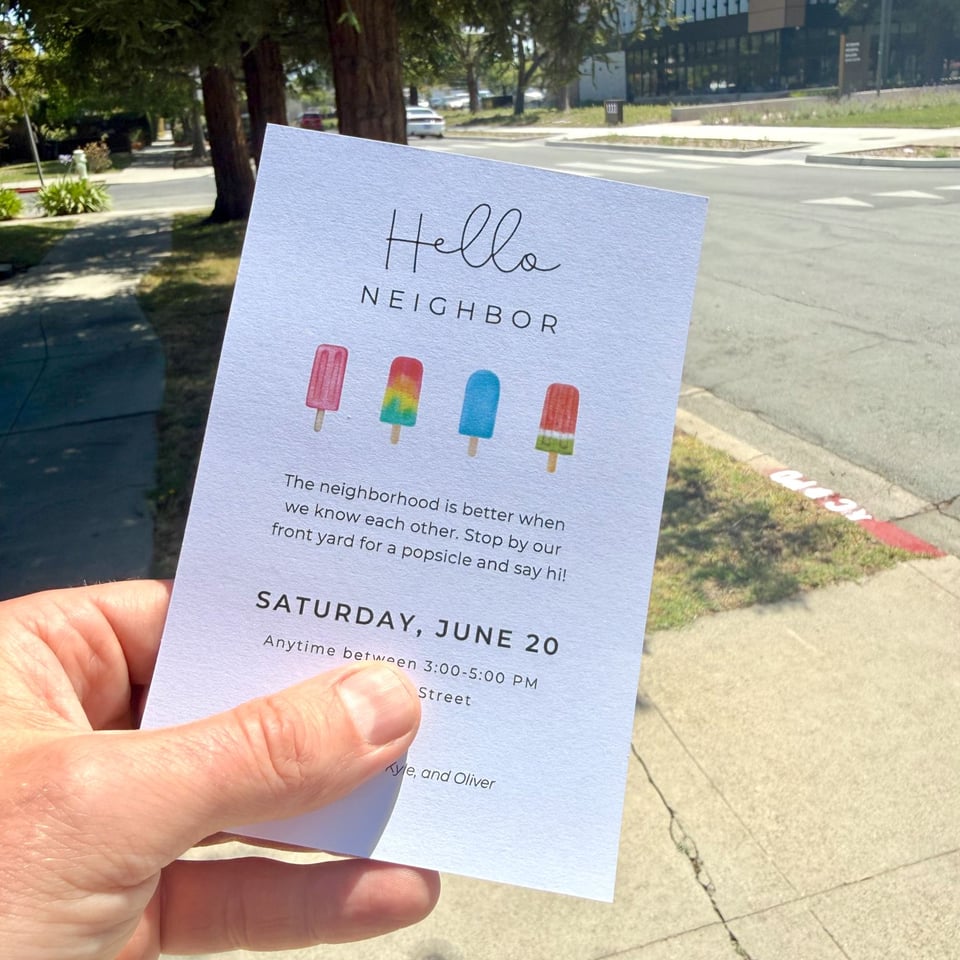
The result? “Neighbors flowed through our front yard for two straight hours. Some stopped by for a few minutes. Others stayed for much longer. We met people we’d never met before, despite living only a few houses apart. A few neighbors even brought flowers and cards, which was unexpected and kind.”
“The experiment wasn’t really about popsicles. It showed me that people want to know their neighbors.”
This wholesome story is hopeful and important. Whimsical even! However, I also want to acknowledge why it doesn’t always feel as easy as handing out a few popsicles and throwing away some spares.
People kinda suck, dude.
As a Senior Experience Specialist, I spend a lot of time thinking about how people interact with things and with each other. And as a nerd whose adolescence coincided with the rise of the internet, I spent a lot of time participating in and thinking about online subcultures in high school and college. In 2006, I blogged and predicted, rightly, that ragebait, exaggeration, and polarization would be algorithm-beating strategies that would get noticed on social media, but would also yield toxic tribalism, push people into unhealthy group-seeking norms, and give rise to a new influencer social class.
The rest of the full analysis is pretty horrendously written, even for blogging standards (and is thankfully unfindable via the Wayback Machine). But I did save the writeup. Here’s the one nugget I find eerily accurate, even now, in 2026:
“Keeping an online identity is like whispering your name in the middle of New Years in Times Square. No one will notice you unless you: A) join a group, or B) scream loudly enough; and when you're online, "screaming" is nearly impossible if you are not connected with anyone.”
Why am I sharing this? As CEOs of tech giants wax poetic and espouse the benefits of AI to improve productivity, overcome bias, and improve quality of life, I’m reminded of the 15-year-old me who — amidst the same hype about social media — felt lost in that sea of big data and anticipated that others would feel similarly lost. And now, more than ever, the velocity of data creation has grown exponentially; even the most qualified, credible people (like the 50-year-old researchers and engineers who are wildly overqualified for the jobs they’re applying to) are grappling with that same, shipwrecked feeling as they yeet their resumes into the abyss, hoping that someone, somewhere, will notice their message in a bottle resume, and call them in for an interview.
Even if you’re not actively job hunting, if you work in tech or work from home, you’re probably still feeling this same sense of disconnect and isolation, wondering if what you’re doing even matters anymore when someone can just prompt a chatbot instead.
I can’t speak to what you’re doing, because I can’t guess what you’re doing from this side of my screen. But, you still matter, and so do the people you’re doing things for.
And idk, the reason I signed up to be in this field of work in the first place was, deep down, I knew that the real value of a good design wasn’t aesthetics, but the act of connecting with people, and connecting them with what they really need. The gritty optimist in me believes that still matters, and always will.

Loneliness doesn’t have to be permanent.
For the past several years, the US has been facing a loneliness epidemic. I would venture to guess the rest of the world is seeing that same epidemic, although perhaps with varying levels of support that would make it more tolerable.
I’ve heard tales of the incredibly community-oriented plazas in Europe, and the longevity-boosting benefits of moai, the Japanese concept of a social support group (often close lifelong friends) that forms to provide varying support for social, financial, health, or spiritual needs as people age. There have also been several researchers and think tanks predicting a revival of spirituality and religion as a balm to loneliness.
(To be clear, as someone firmly agnostic — as paradoxical as that may sound — this is not a ploy for religious conversion. This is a secular analysis. But, I am a futurist, and it’s my job to name likely trends, even if I don’t personally follow them.)
What all of these trends have in common is the central theme of needing to feel connected to others by something greater than any individual person. That could be a greater purpose or cause, a shared experience, or simply a shared geography. It’s hard to feel connected when staring at a screen with a chat interface, and getting messages from something that doesn’t have a pulse. (We have seen instances of people developing parasocial relationships with their chatbots… but that’s a topic for another newsletter.)
The implications are wide and far-reaching, but my two big arguments are that:
When Meta execs are on the record saying “sleep is a competitor” to Meta, then they probably have a financial incentive to convince you that community isn’t the answer, and technology is. And idk, maybe they’re wrong sometimes.
If we’re building something to outlast the enshittification of technology and services over time, then a good place to start is with something that won’t become obsolete over time: people’s need to be seen, heard, and included.
The point is: none of this is new. I/we felt this way 20 years ago. We felt this way before the internet, too, when manufacturing necessitated that people relocate to live in places they hadn’t lived before, and communities had to be built from scratch. The difference, though, was that people didn’t hop from job to job the same way, and someone worked at the local auto factory for 20 years, with their kids going to school with their coworkers’ kids. Now, staying at a job for longer than 10 years is an anomaly, almost seen as a liability rather than an asset. Neighborhoods and companies themselves are a Ship of Theseus of rotating bodies, making it even harder to feel connected to something greater.

Community isn’t found, but built (for better or worse).
I grew up in Jersey City, NJ — just across the river from New York City, which has its share of transplants and transient residents. So, at 15, I not only journaled about online community, but also about gentrification’s impact on myself and on my friends’ families. My friends’ families got priced out of neighborhoods that lacked any semblance of rent control. My nearest lunch spots closed and reopened under new ownership, with offerings doubling and tripling in price. My old turkey sandwich combo meal went from $7 to $20 almost overnight — hardly something a high school student working at a pet supply store could afford.
I had strong opinions about community, then; about who decides who belongs, and who doesn’t. I have strong opinions now, as I understand the bias in real-estate lending algorithms and the absolutely criminal enterprise of gerrymandering. It’s fair to say I was, and still am, quite hostile to the concept of people moving into my hometown and the threat it poses to the community that lives there, even though now I live about 200 miles away. And honestly, I say the feelings are valid, as people do become economically disenfranchised by the very notion that some people are more entitled to a community than others.

It wasn’t until I moved to my tiny hamlet in Central New York that I started to rethink my relationship with community and understand the role I play in cultivating it. Unlike Jersey City, people aren’t clamoring to move to Cayuga County. It’s got more dairy cows than people, and far more acreage in corn than in housing. But the people who do live here are deeply committed to the well-being of their neighbors. The notion of a volunteer fire department is laughable in cities, but it is the very foundation of humanity in communities like mine. There’s something deeply comforting about knowing that your neighbor would voluntarily run into a burning building to help you, and it makes you more inclined to stay.
The thing about building community, though: some cultures are more inclined to building it than others. If you’ve attended any sociology or organizational behavior classes, you know about Geert Hofstede. Hofstede is known for pitching several different cultural dimensions, but ultimately popularized the idea that collectivist cultures are more inclined to prioritize group goals and well-being at the expense of individuality, while individualist cultures tend to prioritize individual well-being at the expense of collective well-being.
Generally speaking, in the US, the core defining values are individualism and motivation toward success and achievement (as opposed to more collectivist tendencies toward conformity, cooperation, modesty, and consensus). To be fair: no nation’s a monolith — but the broad pattern tends to hold at the level of lived, daily norms.
US political agendas also make this hard.
These values are so fascinating to consider, especially in a US bipartisan political climate, because some radical folks on the political fringes will have you believing the other side of the political spectrum is focused on individuality to a fault.
Meanwhile, both sides of the political spectrum are quite good at alienating each other unnecessarily: either your neighbor hates you and wants to take away your rights, or your neighbor hates you and wants to take away your rights (take your guess at which of these italicized versions is the right- or left-leaning flavor).
Lest I be misunderstood here: there absolutely are hostile people out there who are dangerous to communities, who will take the opportunity to maintain their power by being racist, sexist, or phobic in some shape or form. This is not excusing harmful, violence-instigating rhetoric that’s spanned multiple US presidential administrations.
However, in frustrating times like these, I look to the wisdom of Mr. Rogers, “Look for the helpers.”
Sure, you might side-eye your neighbor’s choice in American flag regalia this weekend, and wish you could talk sense into them to adopt more sensible beliefs (and clothing choices). But also, idk, you might find that using your sad, shriveled freezer bananas to make some extra banana bread for them might be a much quicker way to actually make a trustworthy connection who can watch your cat or water your plants for you while you’re out of town. (At the very least, it’ll work a lot better than some passive-aggressive Facebook comment.)
There’s also a popular expression, “It takes a village to raise a child,” that lately has soured on many overburdened parents facing increasing pressure to perform as both parent and employee (and ever-decreasing support from friends, family, and work combined). However, a common addendum to this (worth repeating) is, “If you want a village, be a villager.”

Community doesn’t have to be perfect; it just has to start.
I think a fundamental misunderstanding of community is that you need to love your neighbors and network connections like they are your family for that relationship to be worth maintaining, and that anyone you don’t love spending time with, you should prune from your extended circle. Sure, I want positive and exciting relationships for everyone reading this newsletter. But, that’s why this article is titled with the word “connection,” not “family.” Connection & community are not binary; and they should never be seen as all or nothing.
In reality, networks are not simple at all. They are messy, and comprise a mix of weak-tie and strong-tie relationships. And while strong-tie relationships can feel more familiar and comfortable, there is immense value in weak-tie relationships, and keeping them cultivated. Your loose acquaintance might not be your best friend, but might know of a job opening that fits you perfectly. Your neighbor or extended family might say some annoying sh*t on Facebook, but they also might be the first one to cook a meal for you when they hear your dog has passed away.
You don’t have to mask or pretend to be someone else, but you do have to tolerate some degree of non-uniformity in behavior and thought to access the benefits of a large support structure.
And no, weak tie relationships don’t all become strong-tie relationships, but all strong-tie relationships started as weak-tie relationships. You’ve got to start somewhere.
The price of admission to community is vulnerability and service.
I’ve seen lots of click-baity articles lately along the lines of “GenZ hates being cringe!”
“They don’t want to do anything uncomfortable!”
“They justify their issues with therapy-speak rather than fixing them!”
“We’ve sheltered them too much!”
I don’t know how much truth any of this has, but there’s a real critique buried in the clickbait: that Gen Z and Gen Alpha reach for tech before they reach for the harder, slower, and awkward work of building an actual relationship with a person two feet away.
However, I’ve also seen, in equal measure:
“GenZ boycotts/sabotages AI adoption efforts”
“Young people are choosing to have a 90s summer”
“Cell-phone free zones are a fun new way to connect”
“GenZ and GenA are teaching us how to take up space”
All this to say… if my son taught me anything today, it’s that growth and change is uncomfortable. Metamorphosing yourself out of your chrysalis of social comfort puts you in a vulnerable position.
And putting yourself out there? Scary.
Inviting 80 neighbors to your yard for popsicles, not knowing if one will show? Scary.
Seeing your kid off at daycare, not knowing if they’ll make friends? Scary!
But something about that friction, itself, holds immense value, and anything worthwhile ahead of us is worth grieving what we leave behind.
If all of us truly want the same thing: to find each other and be there for each other when it matters, then it might really be as easy as kissing your mother goodbye, picking up a tractor toy, and trusting that this innate quest for community is baked into every one of us; someone, somewhere is bound to share our enthusiasm.
All we have to do is get out of our own way.

Add a comment: