A Love Letter to the Delimiter that Ruined My Career
Thanks for the memories, I guess.
Welcome to the worst idea I've had in a long time: a newsletter to publicly process my
griefopinions on the dumpster fire that is the tech industry, society, and life. Every installment, I'll share some topic that's been stewing in my brain for the last few days (or years) and why you might want to stew on it, too.
No one: "So, why is this called The Semicolon?"
I'm so glad you asked!
The story begins about 16 years ago.
When I was a sophomore at Cornell in 2010, my future was imploding in front of me. Despite being a pre-vet Biology major, Biology and Organic Chemistry were doing me in, and my rock-bottom GPA was threatening my ROTC scholarship. In a Hail-Mary attempt to save my scholarship and remaining college career, I switched majors to Information Science, because, as my father put it, "making websites for fun is not a normal hobby," and it turns out people pay for that kind of thing.

I started taking classes that actually engaged my interests: psychology, sociology, communications, and, of course, computer programming. As someone who once identified as a gamer and played online games like Counter-Strike and League of Legends, the thought of building my own worlds with code was intoxicating. That buzz fizzled as quickly as it started thanks to a tiny set of dots on a screen…
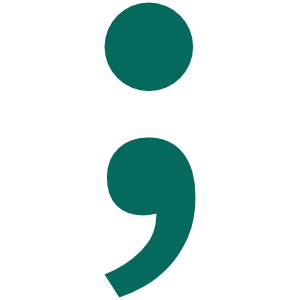
Semicolons.
Yes, the little punctuation mark that separates thoughts while continuing sentences; the one that seems to have gotten lost to history in favor of the — somewhat parenthetical — em-dash. But, despite the small number of pixels it inhabits, the semicolon is one of the most powerful symbols in computer programming (and in life).
(I acknowledge this is niche; please, humor me a tad longer.)
As a teenager, I breezed my way through HTML and CSS lessons while learning about the power of brackets and backslashes. But in college, when I started learning other programming languages, where the code was much longer and more complex, I started slowing down. Way down.

Every time I would do a programming project to build a cute little video game, replicate some simple interface, or build some scripted animation, I could almost guarantee that it would not work on the first try, because, somewhere, some stupid little semicolon was missing.
I'd spend hours into the night debugging some code I'd written the morning before, banging my head against the desk as my eyes would glaze over and cross, searching for the missing (or extra) pieces of code that broke the experience. I attended more office hours for CS2110 (Object-Oriented Programming) than for any other in my entire four years of college (and subsequent two-year master's degree, for that matter).
That punctuation mark made me hate programming so much that I swore off an entire future career of building software, in favor of one focused on design and research earlier in the value chain.
But, here I am now, 16 years later, on the precipice of one of the biggest changes to software development in the last 2 decades, and it's easy to question whether my education and skills are still relevant. Ironically, as I throw myself headlong into learning how to incorporate AI tools into my work, I find myself in a very familiar position as I was a decade and a half ago: looking at lines of code and following a long trail of semicolon-breadcrumbs. Now, I have a lifeline (or several) with a multitude of AI tools available; but, the problem is still the same: figure out the unseen context a system is dealing with so we can make things work better.
I hate semicolons. But I also love them. Not just for the job security, but because they symbolize the tiny details people overlook that can break experiences. They connect otherwise disparate thoughts. They are intentionally placed, deciding what comes before and what comes next.
(And as an aside, if you have ever paid close attention to mental health resources, then you also know about Project Semicolon, the suicide prevention organization, in which the semicolon is a symbol of new beginnings and life carrying on. This publication is not affiliated with that non-profit, nor any similar-sounding mental health org. But does strongly support the concept and cause.)
As a senior researcher, service designer, and writer, the semicolon represents to me the things that will matter most in the future of our professions: the small details lost in the sea of mediocre, templatized designs, and the complex concepts that make life a little messy and harder to organize; in other words, the things that make us human.

The funny thing about this industry is that algorithms (and people, for that matter) like to sort things and put them into boxes. A triangle-shaped idea goes into a triangle-shaped blog; a square-shaped designer gets hired for a square job. Unfortunately for me (and for you, dear reader), I've never been a square-shaped person.
So, I don't know what to tell you about what you can expect to read next. Some of you have been following me since my analysis about Meta’s fascist design. Others maybe found me when I “came out” about having ADHD and wrote a series of articles about neurodivergence. Or heard me talk about UX and product design on a podcast. There might be more of these sorts of things lying ahead. But you might also read stories about my late grandfather that inform how I operate as a business owner. You might see something about how my toddler has forced me to introspect about traits I used to deride. You might even see some posts about futures thinking, and how AI fits into product research and design.
I can’t promise much. But, I can promise you that a human, messy as they come, has written these thoughts. And maybe that can be enough.
Thanks for reading; here’s to the complicated, messy thoughts that make us human, and the tiny details that make a difference.
-
So relevant to so many of us, age not important. Looking forward to the next edition.
-
This was fun to read! ;)
-
If only you had tried Python... Not a semicolon in sight, such a blissful world. Here's to our messy neurospicy brains!
-
I think my entire trajectory in life would've changed if I learned Python first!! Thanks for subscribing :)

Add a comment: