
Summer reading and other bookish fun
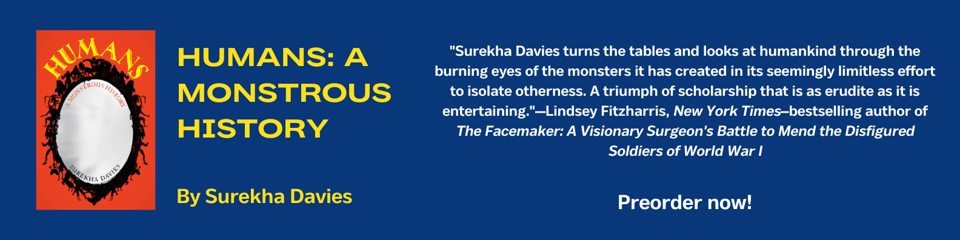

Thanks for reading my free newsletter! If you’d like to support my work, buying or gifting HUMANS: A MONSTROUS HISTORY would be wonderful. Excellent free ways to support me include: borrowing HUMANS from your library or recommending they buy it; reviewing the book on, say, Amazon, Goodreads, or Storygraph (the links take you to the Humans pages); adding it to your wish list or TBR list; or telling friends, family, colleagues, or students about it.
Hi friends, and welcome, new subscribers!
My brain is currently fried from working on sixteenth-century manuscripts in the place in the picture: too much excitement! Instead of the usual novella, today’s newsletter has reading and listening recommendations at the crossroads of history, science, and monsters. I’ll finish up with a couple of links to novella-newsletters you may have missed.
The American Medieval podcast
I had a delightful time talking monsters on the American Medieval podcast hosted by Prof. Matthew Gabriele. We discussed medieval hypotheses about nature, geography, and human bodies and souls, how they shaped European ideas about who or what inhabited the so-called New World, and how Star Trek: The Next Generation inspired me to research early European voyages to the Americas.
Early encounters between Indigenous peoples of the Americas and Europeans have things to teach us about first-contact situations that might arise in future. Such encounters might involve extraterrestrial life (a subject that astrobiologists research) or pandemics. As I wrote in Human: A Monstrous History, asking a question at an astrobiology conference a decade ago helped me realize that despite running from physics to history of science as an undergrad I had Things To Contribute to science. Disaster management for the (admittedly unlikely) possibility of meeting hostile aliens or (space) pathogens shouldn’t just about building more weapons. It’s arguably more important that we learn how to pull together as a species.
What I’m enjoying this summer

I’m continuing my adventures into horror with Stephen Graham Jones’s The Buffalo Hunter Hunter. It’s the story of a Native American called Good Stab — a Blackfeet in Montana at the end of the nineteenth century — who had an encounter with a strange beast thing and then All The Things happened (no spoilers!). That story’s nested within a couple more timelines. The present-day arc follows an academic who needs an idea good enough for a book contract to improve her shaky tenure case. A hundred pages in, it’s perfectly safe to read in daylight, even for this scaredy-cat.
Staying with the disasters but moving to nonfiction, I’m enjoying Julian Sancton’s Madhouse at the End of the Earth. This is also (coincidentally) set at the very end of the nineteenth century. A ship laden with adventurer types including one Roald Amundsen is going to get stuck in the Antarctic and have a horror-movie-like set of problems.
If you’d prefer something goofy and light-hearted, you might check out the Peculiar Book Club for author interview shows about books at the intersection of science, history, and the peculiar. The shows are available as video and as podcasts — and I did a show last year.
Click to subscribe now for free!ICYMI — earlier newsletters and writings
The Renaissance is usually associated with art and beauty, but it was (also) a time when people were thinking about ugliness, something they defined using monsters.
I wrote some longer musings about another horror novel, Daniel Kraus’s Pay the Piper.
On real-life monster-horror, my previous newsletter — about the latest AI fallacy — has been resonating with folks on Bluesky.
An excerpt from the “Animals” chapter of Humans: A Monstrous History appeared in The Hedgehog last summer. The essay begins on p. 28.


Add a comment: