Beauty and the monster: New worlds and Renaissance bodies
Hallo friends, and welcome, new subscribers! In today’s newsletter:
Beauty and the monster: a riff on the Beauty and Ugliness exhibition (Bozar, Brussels)
Humans in Greek and other translation news
Beauty and the monster

About 25 years ago, the V&A Museum in London began planning a re-display of their medieval and Renaissance galleries: a 30-million-pound refit and re-frame. They started by running audience focus groups with (I think) regular museum visitors to find out what the words “medieval” and “Renaissance” brought to mind.
Visitors connected the Renaissance to art, science, light, and beauty; “medieval” evoked mud, darkness, ugliness, and (of course) plague — irritatingly persistent stereotypes for professional historians.
The splendid new galleries, which opened in 2009, did a good job of messing up that medieval/Renaissance binary and side-stepping value judgements about what counts as beauty. Instead, the galleries create the experience of falling into the past in all its strangeness.
The story told through the Bellezza e Bruttezza: Beauty and Ugliness in the Renaissance exhibition (Bozar Centre for Fine Arts, Brussels, Belgium, until June 14) is also refreshingly stereotype-busting in some respects. With its vibrant street scenes, compelling caricatures, and exquisite portraits the show invites audiences to excavate the premodern foundations of norms that still drive empathy algorithms in the West.
The show’s overarching message is that between the late fifteenth and late sixteenth centuries artists paid greater attention to ugliness. They increasingly juxtaposed beautiful, even “divine heads,” alongside ugly and monstrous ones.
The interpretative panel at the exhibition’s entrance asks:
“Why this unprecedented interest in representing the seemingly contradictory? Because beauty cannot exist without ugliness: they are inseparable, for one derives its meaning, and — perhaps even more so — its brilliance, from the other.”
Well, sort of. Beauty and ugliness do help define each other, but that doesn’t explain why Renaissance artists began depicting the gorgeous and the ghoulish together in ways they (allegedly) hadn’t before. And why might representing ugliness suddenly have mattered more between the late fifteenth and late sixteenth centuries than it had in, say, the previous century?
My take: Sixteenth-century artists surely paid greater attention to the parameters of beauty and ugliness because they lived at a time when what it meant to be human was changing anatomically, politically, and spiritually. Ugliness was potentially the marker at the edge of the cliff separating the human from … nasty things.
Subscribe for free! You’ll receive a book excerpt and a story behind the Smithsonian essay discussed below…Renaissance Europeans who sailed across oceans encountered what were, to them, unprecedented peoples and animals in regions where ancient geographers had predicted only monsters could live. On the return leg of his first Atlantic voyage (1492-3), Christopher Columbus penned two letters to his Spanish royal sponsors. His letter to Luis de Santángel, keeper of the royal privy purse, went viral, appearing in print in twelve editions and translations in 1493 alone. On the inhabitants of the Antilles island chain in the Caribbean, Columbus observed:
In these islands I have so far found no monstrous people, as many expected; rather, they are all people of very beautiful appearance; nor are they black as in Guinea, but have long flowing hair, and where they live the sun’s rays are not too intense …. So I have found no monsters nor heard of any, except on one island ….1
To sail south towards the Equator was to sail into the latitudes of Guinea, its people darker than Europeans due to the local strength of the sun. But Caribbean peoples were lighter-skinned than expected: good news, since harsh climates were supposed to generate monsters. The lens through which Columbus framed these peoples was the binary of beauty and monstrosity.
As if adding two new continents wasn’t mind-blowing enough a change to live through as a decades-long news cycle, sixteenth-century Europeans also faced a fracturing religious world. The Catholic church was shedding followers to Protestant offshoots. Feelings ran high enough for a lot of violence, with both saintly statues and not-so-saintly humans losing their heads. But how could you reliably identify a Christian, a heretic, a pagan, an idolater, or even a human?
Emotional responses were potential signifiers of “normal.” Thus beauty could work as as a proxy for humanity and the divine, and ugliness for monstrosity and the diabolical.
Last Halloween I published a Smithsonian Magazine essay about a Portuguese painting of hell, a potent example of a beauty/monster mashup c. 1510-1520 in that age of existential polycrisis:
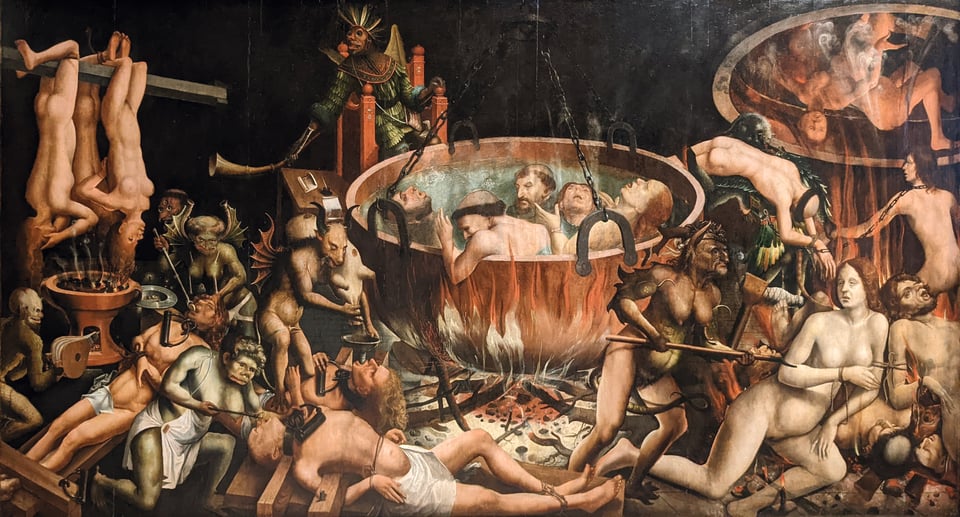
The canvas shimmers with exotic luxuries (zoom in here!): spices enjoyed though a funnel (cough); feather outfits; an exquisite throne inlaid with mother-of-pearl, perhaps. And yet all this is in hell, where hapless humans enact a pantomime of the earthly sins that sealed their fate, and monks simmer in hell’s cauldron.
Atlantic-facing regions of Europe were in an “everything is monsters” era (not unlike today, but I digress). But surely the categories of beauty and ugliness have always been contested. The beauty/ugliness scale maps a dimension of the human; fall outside the scale and you’re no longer “normal” but rather angelic, divine, bestial, or monstrous.
If you’re “too beautiful” you’re unattainable, the target of jealousy and suspicion. From Helen of Troy to Snow White, beautiful women in Western literature and folklore have been victim-blamed as attracting trouble.
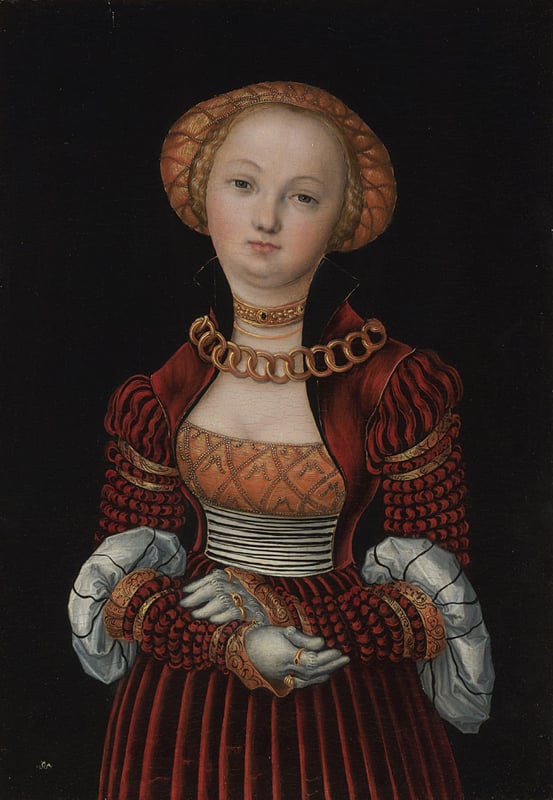
At the other end of the scale, ugliness (in the eye of the beholder) segways into monstrosity in appearance or behaviour. Renaissance prints of witches leaned into this: witches (unless disguised) looked nothing like sweet, young, mimsy-pimsy ladies who posed for portraits. Compare, for example, one of Lucas Cranach the Elder’s paintings of a sweet young thing, more innocuous than vanilla, posing as if she hopes she’s invisible despite her girl-boss-ishly intimidating outfit, with Albrecht Dürer’s goat-riding witch in the print below:
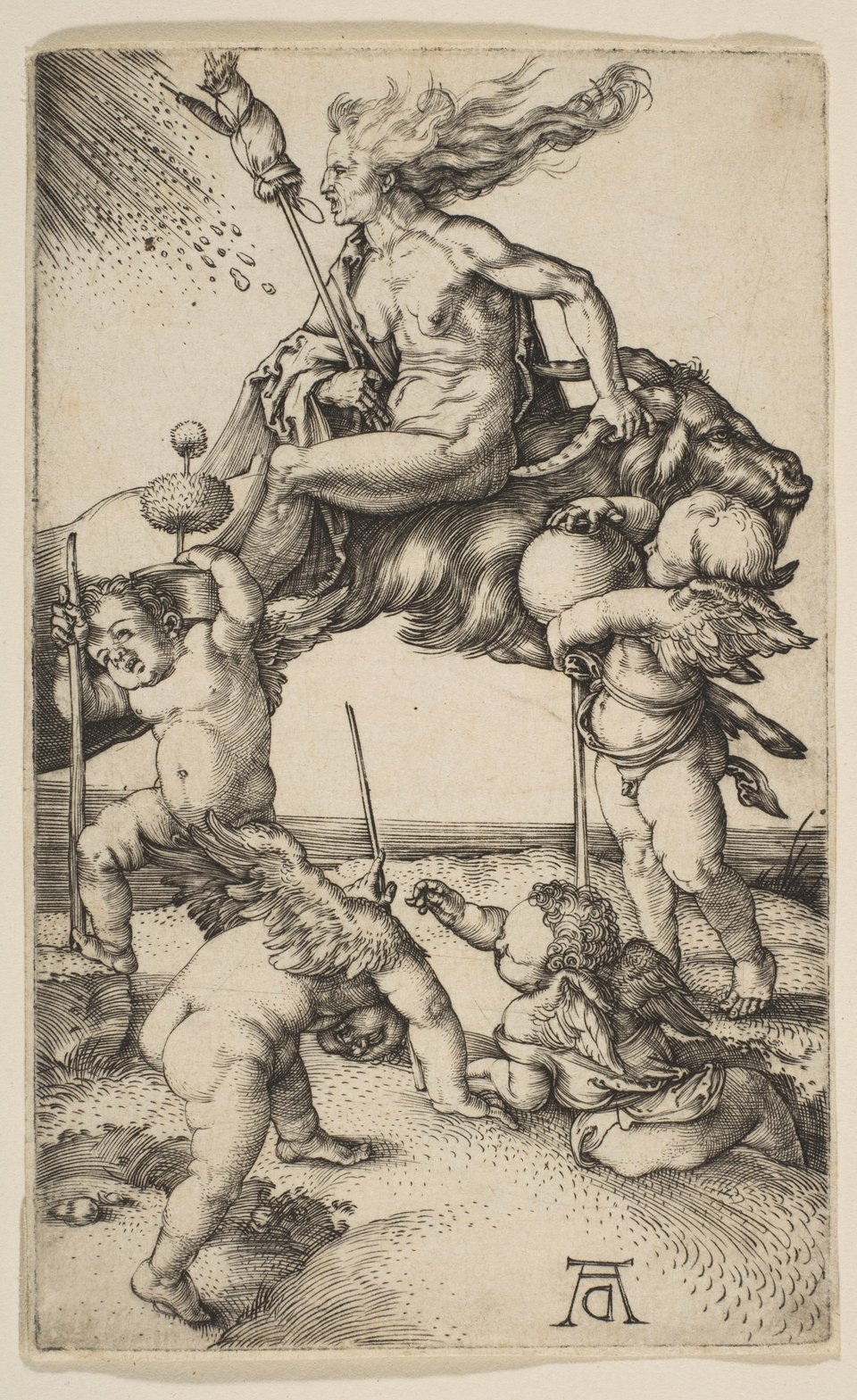
Judging by her musculature Dürer’s witch has been hitting the gym — or riding goats — for years. Her aged, wrinkled body transgresses norms for feminine beauty.
The beauty/ugliness scale also positioned the human safely away from animals. But too much ugliness — recognized via one’s feelings (vibes!) — might signify a monstrous hybrid. As I wrote in Humans: A Monstrous History, once Darwin’s Origin of Species had appeared (1859), unusually embodied individuals whom Indiana-Jones types had abducted in Asia, Africa, and the Americas were exhibited in Europe and North America, monstrified via dehumanizing slogans like “the Missing Link.”2
The Bozar exhibition doesn’t meander through new worlds, representations of race, or the early modern witch-hunt, but it’s still a richly rambling show. Its themes are the influence of antique sculpture; ideal types in portraiture; monsters and prodigies; vices and virtue; caricatures; the professionally ugly (fools and jesters) as truth-tellers; artifice, or the Renaissance equivalent of photo re-touching; and paired representations of beauty and ugliness (as in the painting of Pomona and Pan at the top of this newsletter).
What was at stake in how a society “read” the signs of someone’s body? People whose communities storied them out of the parameters of human found their rights curtailed. A poignant reminder is a highlight of the show: a portrait of Madeleine Gonsalvus, a member of the famous Renaissance “hairy family” whom I wrote about in Humans: A Monstrous History (excerpted here).
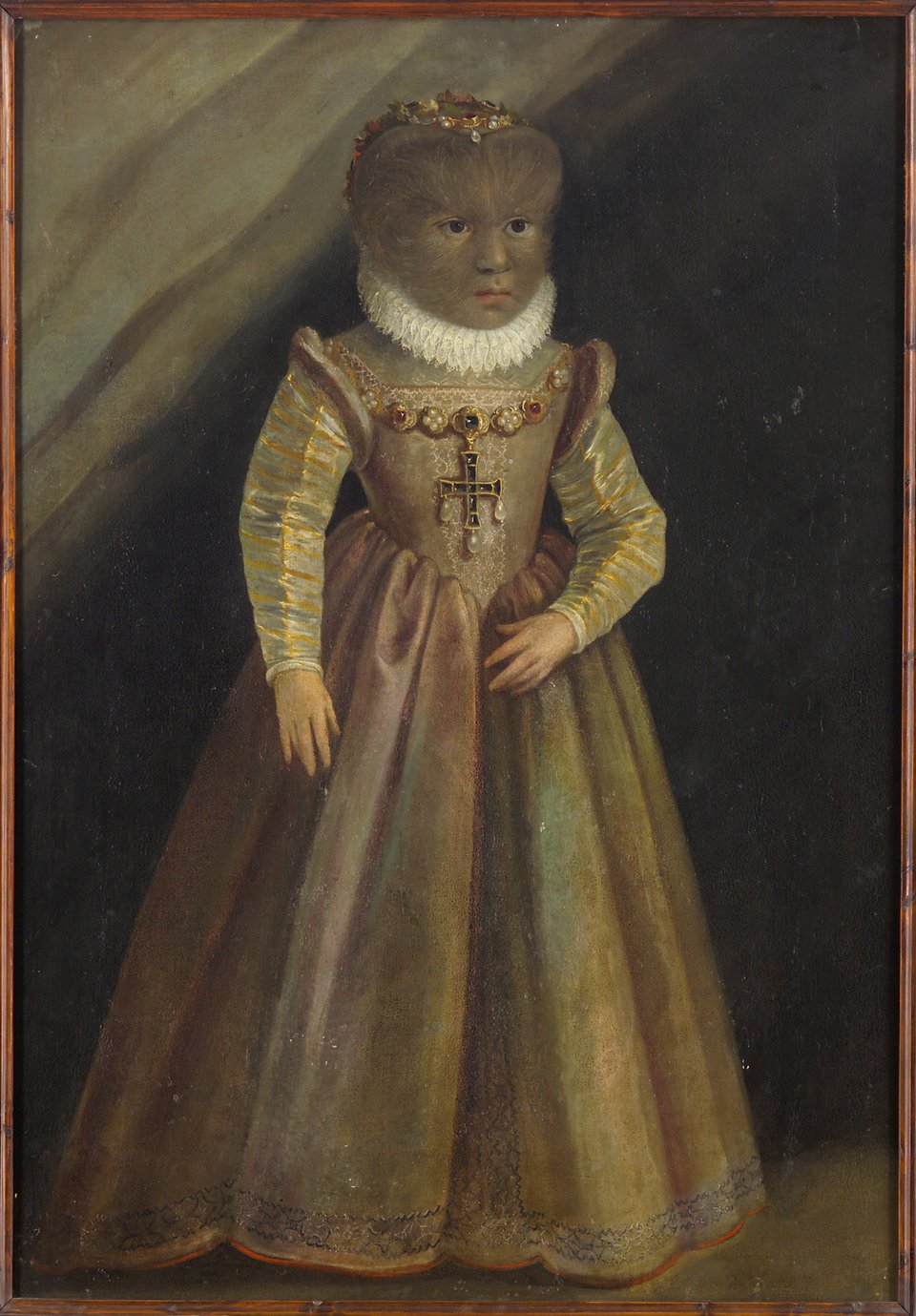
This is a large, sumptuous painting, one of several commissioned to represent members of the Gonsalvus family. The paintings hang in the medieval and Renaissance palace complex of Schloss Ambras in Innsbruck, Austria, where they have been since the sixteenth century. Fancy clothes and painted portraits notwithstanding, aristocrats treated the family like possessions, even gifting them to one another. Physicians considered them specimens they could prod and undress to see how far the hairiness went.
We too live in an age when beauty, ugliness, and monstrosity seem volatile, intermingled, and weaponized. It’s a time of heightened racial profiling, gender policing, and plasticated billionaires with plasticated wives. Ozempic has entered the chat on weight and stigma, prompting new ways to blame people for not fitting a stereotype. Catastrophizing about testosterone levels is the latest panic-fad for men, surely a new psyop to distract from the real existential threat — billionaire oligarchs and everything they touch — by fabricating ever-narrowing stereotypes of gender and moral panic around their transgression.
One thing us peasants can do is use words like pitchforks: resist attempts to judge people’s minds and souls by their appearance, and use our voices — where we can — to get in the way of monstrification.
Translation news
Humans: A Monstrous History is available in Greek! If you have Greek-speaking friends or move in Greek-reading circles (classicists! Byzantinists!) it would be fabulous if you could let them know, perhaps by forwarding this newsletter to them.
Humans also came out in Chinese (traditional characters) from Gusa Publishing earlier this year. A few more translations are under contract; here’s hoping there are more translation deals to come!
Christopher Columbus, Letters from America: Columbus’s First Accounts of the 1492 Voyage, ed. and transl. B. W. Ife (London, 1992), 58-61 (I have made minor changes to the translation): “in estas islas fasta aqui no he hallado ombres monstrudos como muchas pensauan mas antes es toda gente de muy lindo acatamiento ni son negros como en Guinea saluo con sus cabellos corredios, y no se crian adonde ay impeto demasiado de los rayos solares …. Así que monstruos no he hallado ni noticia saluo de una ysla …’”
The monsters on the “one island” were eaters of human flesh who would soon come to be known in Europe as canibales: cannibals. For a nerd-core dive into Renaissance travel writing and images of peoples of the Americas, with lots on the invention of the cannibal, check out my first book, Renaissance Ethnography and the Invention of the Human: New Worlds, Maps and Monsters. ↩
Humans: A Monstrous History (University of California Press, 2025), 138-43. ↩
-
Interesting, as ever. This puts me in mind of a very beautiful woman friend who told me how she’d be hit and have drinks thrown at her by other women in nightclubs.
-

Thanks for the kind words - and the additions! Eek; I thought that sort of thing only happened on TV.


Add a comment: