"Everything is Tuberculosis" and modern medicine's global origins
Thanks for reading my free newsletter! If you’d like to support my work, buying or gifting HUMANS: A MONSTROUS HISTORY would be wonderful. Excellent free ways to support me include: borrowing HUMANS from your library or recommending they buy it; reviewing the book on, say, Amazon, Goodreads, or Storygraph (the links take you to the Humans pages); adding it to your wish list or TBR list; or telling friends, family, colleagues, or students about it.
Hallo friends, and welcome, new subscribers!
Today’s newsletter:
John Green’s Everything is Tuberculosis
It’s still April on Pluto
In case you missed it: essays, interviews, speaking
John Green’s Everything is Tuberculosis
Sometimes I wonder whether my last book should have been called Monsters: A Human History, not Humans: A Monstrous History.1 On balance, the answer’s still no. The book is about people: the monster-makers who tell monstrifying stories and the targets of monstrification about whom the monster-makers spin stories. And for readers of Yuval Noah Harari’s Sapiens, my actual book title may signal that they should read Humans next (as they should!).
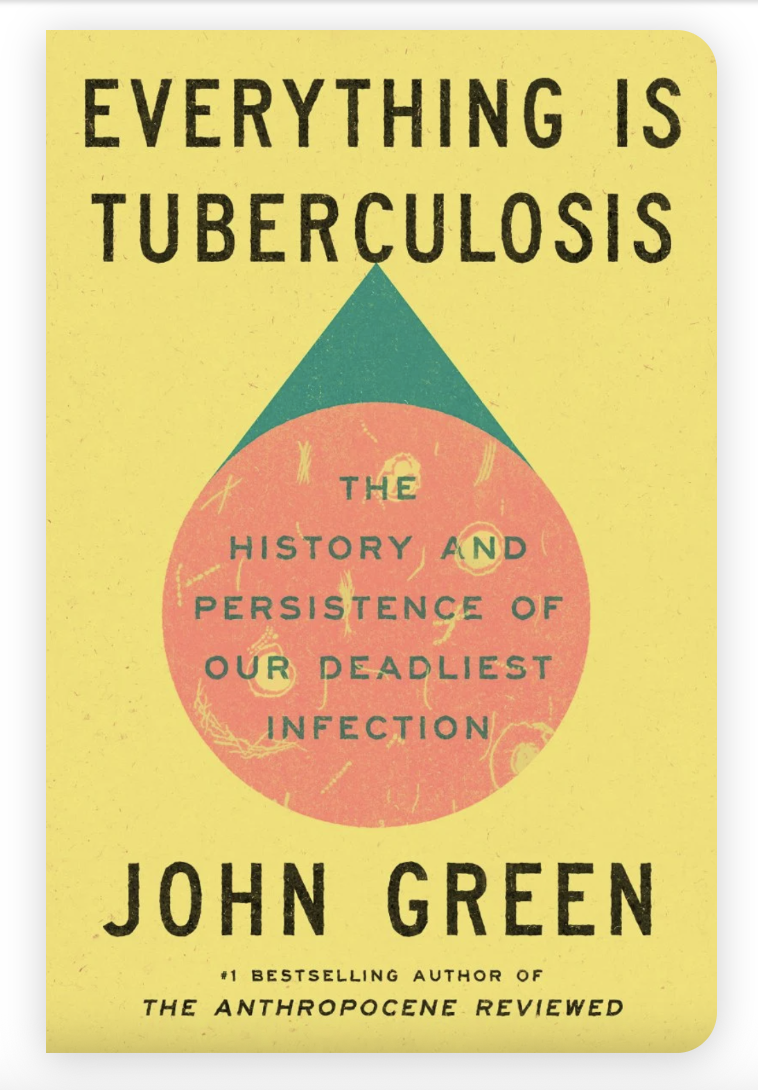
A more compelling alternative for a title format might be John Green’s wonderfully titled (and wonderful) Everything is Tuberculosis. Through the story of Harry Reider, a teenager with drug-resistant TB who Green first met in Sierra Leone in 2019, the book tells the story of TB: what it is, attempts to understand it, community reactions to patients, and how we might drastically reduce cases and mortality in the future.
In the early nineteenth century people in the West associated TB with Romantic poets dying young (think John Keats). Patients received sympathy. But a few decades later the disease was associated with the working classes — think “Dickensian London” — and TB was linked to alleged moral failings. Eventually, the disease became associated with poor countries in ways that implied that their citizens were at fault for its mortality rate and spread.
Societies tell stories about what diseases are. Through these stories and responses to them — the ways doctors and societies treat patients — they bring particular manifestations of diseases into being. As Green explains: not only is tuberculosis embedded in surprising facets of human history, from the invention of the Stetson hat to the origins of World War I, but — and this is the book’s core — human culture has shaped tuberculosis.
In a similar vein I write in Humans: A Monstrous History that “there are no monsters, but all of them are real.” Stories about what a monster is configure the category of the human and the parameters of “normal.” They inflect people’s thoughts, words, and actions. And so those stories steer human history and lurk in the foundations of the modern world. In this sense, not only is everything tuberculosis, but everything is monsters.
Subscribe now for free! You’ll receive an excerpt from HUMANS: A MONSTROUS HISTORY and a behind-the-scenes essay about writing for Smithsonian Magazine.Like many diseases, tuberculosis “has long exploited human biases...wriggling its way through the paths injustice creates.” And so “for centuries, the disease has used social forces and prejudice to thrive wherever power systems devalue human lives…”2
Today, TB is preventable and curable. Yet it still kills over a million people annually, especially in Global Majority countries that were once colonized by European powers. Here’s one example of the systems and historical inequities behind this, in a country at the heart of Green’s story:
On independence from the British Empire in 1961 Sierra Leone’s infrastructure was a legacy of colonialism. You know those “but we built railways!” defences of empire? Sierra Leone is rich in diamonds and metal ores. Those railways connected mines to the coast so that the region’s wealth could be shipped away, its diamonds cut and set into crowns and tiaras, sported on watches and cigarette cases, blood-soaked baubles that would glitter in state rooms and ballrooms thousands of miles away.
Those railways didn’t connect population centres. And so today, one of the challenges in treating tuberculosis is limited public transit connecting people with clinics and hospitals.
Effective medications began to appear in the 1950s, and TB is now preventable and curable. But early, accurate TB testing and a full course of treatment for active-TB patients are expensive. These options are harder to come by in middle-income and poor countries.
This is a multi-part predicament caused by drug companies’ pricing-gouging polices and the economic legacy of colonialism.3
Preventative treatment costs more again (but is cost-effective in the long run). In the twentieth century the World Bank’s loans to recently decolonized countries came with limits on expenditure, which led to less being spent on healthcare and education.
And thus ten million people develop TB every year. Something like a quarter of the world’s population carries the disease in its inactive form (!). Ten thousand people in the US develop TB annually, but most recover from it.
Great physical stress, of which malnutrition is a form (a compromised immune system is another), triggers active tuberculosis. And hence the combo of malnutrition, inadequate testing, and limited access to treatment means that more than a million people die of TB annually. It’s our deadliest disease (well, excepting racism, the Ur-factor behind this and much else that kills).
In Green’s devastatingly honest terms: “The real cause of contemporary tuberculosis is, for lack of a better term, us.”4
Subscribe now for free!But there’s an additional, historical story, one that Green doesn’t tell (no book can tell all). That piece is the global history behind the origins of modern medicine.
Buckle up.
Who do you think of when someone says “modern medicine”? Jonas Salk, a virologist who devised a polio vaccine? Joseph Lister, a surgeon who realized that germs infected wounds and made the aftermath of surgery deadly?
But “modern medicine” is also built on the experience, knowledge, and visionary thinking of thousands of people, many of whose names will never been known.
In classical antiquity and the Middle Ages, people and their medical knowledge criss-crossed Asia, Africa, and Europe, carried in minds, printed books, scrolls, and manuscripts. Between the fifteenth and nineteenth centuries — during the age of European colonialism and empire — European naturalists, physicians, specimen collectors, and colonial administrators observed, diagnosed, gathered, and classified plants, animals, diseases, and peoples everywhere from Lima to Luanda, and from Barbados to Batavia.5
European physicians and naturalists leaned on the often-coerced labour and expertise of Indigenous people, including healers. Long story short, the modern medicine chest was assembled using healing practices and medical knowledge that Europeans learned or extracted from Indigenous and enslaved people around the world.
Yet, leaving aside some folks who took a history of science class at university, few people in the West know that modern medicine isn’t exclusively composed of “Western” medical knowledge and techniques.
Erasing the global origins of modern medicine helped create a narrative of the West giving medicine to the Global Majority. It’s a narrative that implies that providing poorer countries with affordable modern medicines would constitute a gift rather than being a necessary element of humanity, profit-sharing, and reparative justice.
Understanding this gets at the heart of what “human” means. “Human” is not simply a biological category — falling within H. Sapiens. It’s also a social, political, religious, legal, and economic category. To recognize someone’s humanity is to recognize them across all of these categories. Among other things this means understanding:
That they deserve equal rights and protections under the law.
That they deserve a fair share of the proceeds of the fruits of their labour.
That they deserve access to the necessities of life (food, clothing, shelter, medical care, education, and clean air, water, and soil) and the potential to flourish before company shareholders and CEOs take a cut for their yachts, bunkers, and democracy-destroying political lobbying budgets.
Preventing a million deaths a year (and reducing the chances of ever-more drug-resistant strains of TB emerging) is not just a moral obligation for rich countries. Funding the cost of the system known as “search, treat, and prevent” — the three steps for fighting TB — is not about simply about adopting a mindset of being “kind” or “donating” stuff and patting oneself on the back. It’s about being humane, certainly, but also about being fair and honest.
For without millennia of Black and brown people’s expertise, medicine as we know it would not exist. Integral to modern medicine — and thus to the Big Pharma — is medical knowledge from what are now middle-income and poor countries.
The stories societies tell about who really counts as human also determine whose contributions are recognized and rewarded. Women’s medical knowledge is another sort that is traditionally erased or attributed to men — and women have also had trouble being recognized as fully human (a problem that’s worsening today).
But things don’t have to stay that way! The ship of history may be hard to turn sometimes, but that doesn’t mean it can’t be done. Green’s Everything is Tuberculosis makes an eloquent humanitarian case as well as a pragmatic one for our interconnected world.
It’s still April on Pluto
It’s still April somewhere, right? On Pluto? This newsletter is few days late, so there will be two more this month. There’s no such thing as a rabbit-hole-free newsletter and I fell into a few en route (stories for a future newsletter!).
I’m currently working on some new book ideas by returning to my historical roots: the first two centuries of European exploration of the Americas. If you know anyone who might like to follow along — a history or science nerd, a travel fiend, or a grad student or educator — please feel free to share this with them!
In case you missed it: essays, interviews, speaking
Links to my essays op-eds, and interviews.
An interview with me in the German periodical Geo Magazin.
A recording of my recent talk at the Linnean Society, London.
My new speaker page on the Chartwell Speakers website.
People sometimes mis-remember the title that way, anyway. I refer to the book as my monsters book (even though there were plenty in my previous one). And perhaps a title leading with “MONSTERS” would prompt search engines to rank it higher when people type “monsters.” ↩
John Green, Everything is Tuberculosis (Penguin, 2025), 19. ↩
The “but we built schools and hospitals!” argument falls flat, too. The British didn’t build many, and they built them with an eye to training and treating, as Green puts it, the “servants of empire” (Everything is Tuberculosis, 21). ↩
Green, Everything is Tuberculosis, 182. ↩
The global dimensions of premodern medicine is has been thriving arena in the history of science in recent years. For unpaywalled snippets, check out this story about the ancient history of psychedelics and this essay about cinchona, the bark behind the anti-malarial drug quinine. And you might listen to historian of medicine Pablo Gómez on the New Books Network podcast, talking about his book, The Experiential Caribbean: Creating Knowledge and Healing in the Early Modern Atlantic (University of North Carolina Press, 2017). ↩
-
I love the scope and depth of your newsletter, Surekha.
-

Thanks Mark; delighted to hear it!


Add a comment: