
Star Trek's defence of the humanities; more international editions of HUMANS
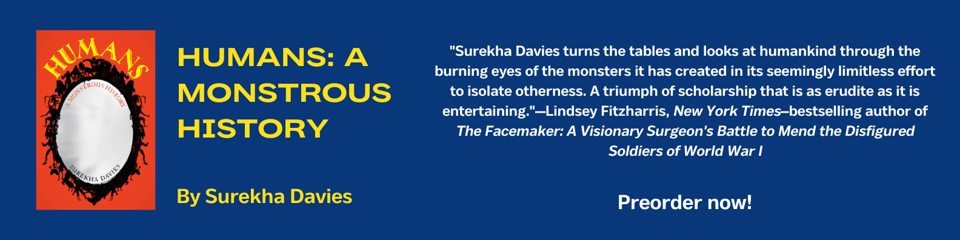
Thanks for reading Strange and Wondrous: Notes from a Science Historian! If you’d like to support my work, buying or gifting HUMANS: A MONSTROUS HISTORY would be wonderful. Excellent free ways to support me include: borrowing HUMANS from your library or recommending they buy it; reviewing the book on Amazon, Goodreads, or Storygraph (the links take you to the Humans pages); adding it to your wish-list or TBR list; or telling friends, family, colleagues, or students about it.
Happy fall, friends; and welcome, new readers! In today’s issue:
Star Trek’s defence of the humanities
A podcast interview with American Philosophical Society CEO Patrick Spero
South Asian and other international editions of Humans
Star Trek’s defence of the humanities
This week marks the sixtieth anniversary of Star Trek, the multi-generational TV franchise that launched a thousand child nerds into physics majors at college. I was one of those suckers. Star Trek: The Next Generation, the series that ran into the 1990s, offered me not just escapist excitement but a way of life and a set of values: of endless learning, curiosity, and the knowledge that wealth, power, and technology were never ends in themselves.
Once I had taken a quantum mechanics class it was clear that faster-than-light travel was not going to happen in my lifetime. There was no getting around it now: my secret reason for studying physics — to have intergalactic adventures — was a pipe-dream. So I became a historian of science instead, focusing on exploration and first contact.
Star Trek: The Next Generation is unique in sci-fi in how the arts and humanities are central for the characters and storylines.1 Captain Jean-Luc Picard of the USS Enterprise, played by the magnificent British Shakespearean actor Sir Patrick Stewart, is also an amateur archeologist with a deep knowledge of history, literature, and theatre. That is why he’s able to decipher the language of the Tamarians, a crotchety species whose language is incomprehensible to members of the United Federation of Planets (of which Earth is a member).
In the fan-favourite episode Darmok (season 5, ep. 2), the universal translator technology that enables species to understand one another renders Tamarian speech into seemingly meaningless strings of words. During the Tamarians’ latest attempt to communicate with the Federation they abduct Captain Picard and transport him to a deserted planet alongside the captain of one of their own ships. Here they encounter a monstrous predator that they must fight together.
During the ordeal Picard realizes that the Tamarian language is composed of allegories from their myths and histories. The battle with the monster has an Earth parallel in the ancient Mesopotamian Epic of Gilgamesh. In order to communicate with the Tamarians, members of the Federation would do well to become better acquainted with their own ancient myths.
This blending of science, history, and literature is the most vital lesson Star Trek offers for the present. The Next Generation conjures up a world with a deep respect for fields of expertise based on words and real literacy, fields that don’t try to reduce humans to machines, or knowledge to numbers.
I started college as a numbers person who also loved words and had given them up, reluctantly, in search of a Captain Picard-like future. I soon learned that there’s plenty that numbers-only people don’t necessarily understand. Perhaps that’s why it’s obvious to me that today’s university administrators, managers, and elected officials who mindlessly admire or pander to techbros are being silly and dangerous. They are mortgaging humanity’s future to those who know nothing about humanity (except perhaps how to manipulate and weaponize their worst, dinosaur-brain traits)
If you’ve never watched Star Trek: The Next Generation and are now curious, let me know in the comments if you’d like suggestions for humanities-centred episodes!
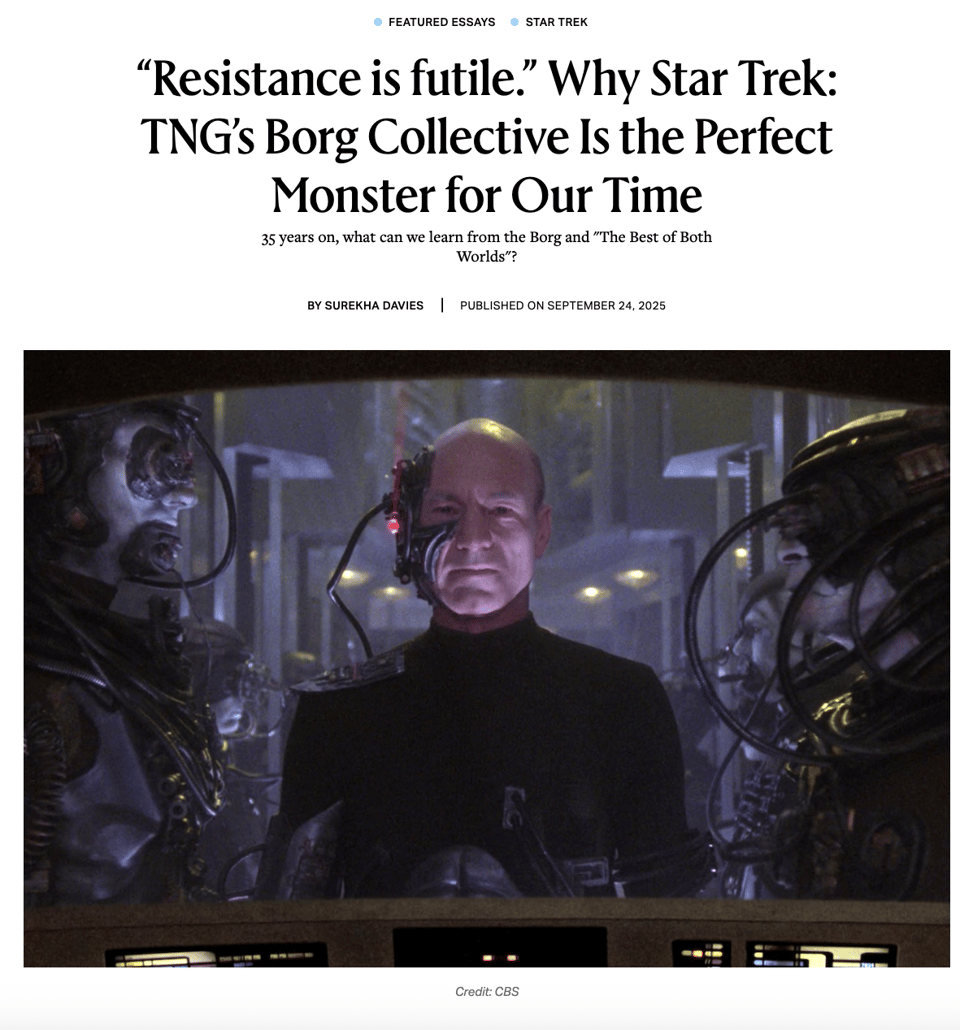
“Resistance is futile.” Why Star Trek: TNG’s Borg Collective Is the Perfect Monster for Our Time” is an essay of mine on an all-time favourite Star Trek storyline: the first encounter with the Borg Collective.
I just read “Planetary Kin: learning from Star Trek’s space whales,” a magnificent essay by the astrophysicist Professor Chanda Prescod-Weinstein and published in Orion Magazine. If you’re interested in marine life, ecology, technology, industrialization, or Moby Dick, you might love this!
Podcast interview
I was delighted to chat with American Philosophical Society CEO Patrick Spero about Humans: A Monstrous History on the Useful Knowledge podcast. Among other things, we talked about another space-science related origin story behind my writing! I’m deeply grateful to the APS for funding research that ended up in both of my books.
Subscribe for free! You’ll receive an excerpt from HUMANS and backstory bonus content about a recent essay in Smithsonian MagazineSouth Asian edition of HUMANS and some translation news

And now there’s a South Asian edition of Humans! It’s available in major bookstores in the region and online.
Also now published are Chinese (traditional characters), Greek, and Korean translations (waiting for author copies as I type), and a couple more translations are in the works.
I don’t watch/read in the genre exhaustively, so please feel free to share other examples in the comments if you know of them! ↩


Add a comment: