Goodbye summer, and how glorious you were! Now it is fall, and I have been weary for reasons that are entirely my fault, so please accept my apologies that this dispatch will shorter than usual and devoid of my usually jaunty tone. I have been functionally a hermit for the last few weeks—sequestered in my apartment as I revise my book. I was supposed to go birding with a friend this week but I had to cancel because I’ve been so overwhelmed by my book, which is to say that I have been remiss in my enjoyment of the city’s nature.
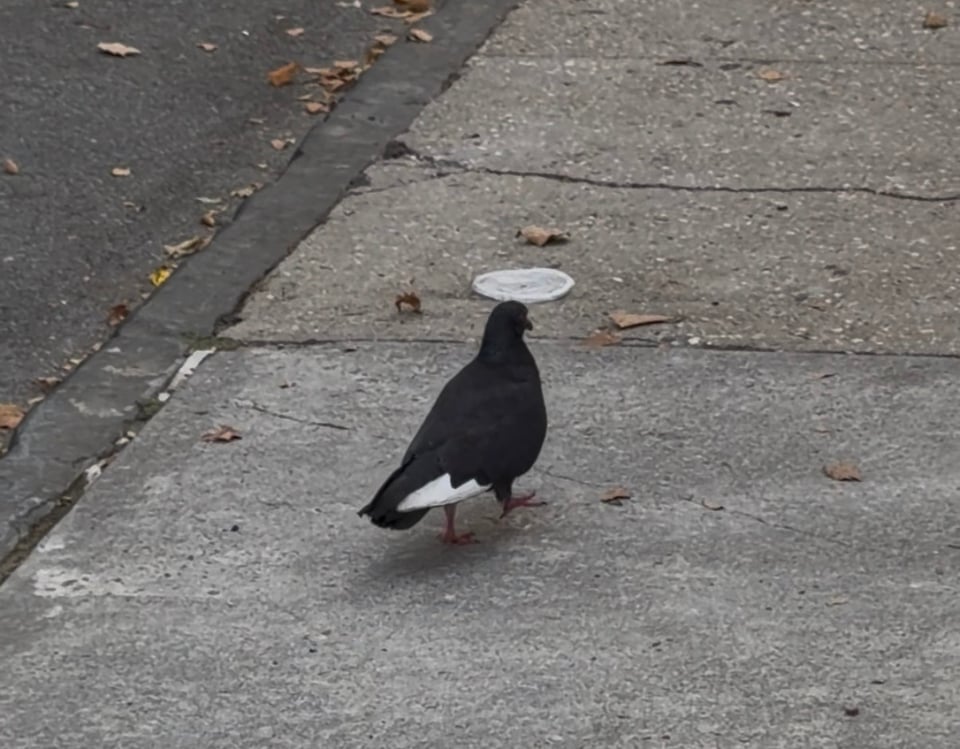
But. BUT. I want to draw your attention to a rather sharp-looking pigeon I saw many months ago in my neighborhood. I thought they looked very distinguished, what with their jet-black body and pair of white wing tips. I took a photo to remember this pigeon and their style. And then, this week, who did I see again, on the very same block? Hello!
I like their style!
I think of all of the NYC’s wildlife as my neighbors, as we all eat and sleep and divert ourselves in the same city and under the same mayor. But I am always touched when I encounter, or maybe I should say recognize, one of my actual neighbors. This pigeon clearly lives on my block, and they’re always looking far more put-together than I am. This pigeon’s also got business to take care of in this big city. We’ve all got dreams, and there’s no better place to make them happen!
I have gone to to Riis nearly every weekend this summer, and this has made me feel almost incomprehensibly happy. I love everything about the gay beach. I love seeing pals and crushes and people I’ve only ever seen on Feeld. I even love having unexpectedly emotional reunions with ex-lovers. The best thing about Riis is that everyone gay is going to be there.
But this is not always true of the creatures of Riis, who are less reliably and perhaps understandably avoidant of the most crowded section of Riis. There are always gulls, most notably the laughing gulls that will dive-bomb an abandoned tray of fries the first chance they get. I watched such an ambush happen a few weeks ago to an unsuspecting child, whose fries were swiftly confiscated. But to me, the most exciting creatures at Riis are the marine ones. This summer I saw half a horsesehoe crab carapace, the occasional clear and firm pancake of a moon jellyfish, the usual potpourri of sand fleas, mole crabs, and regular crabs, and of course the broken shells of many a bivalve.
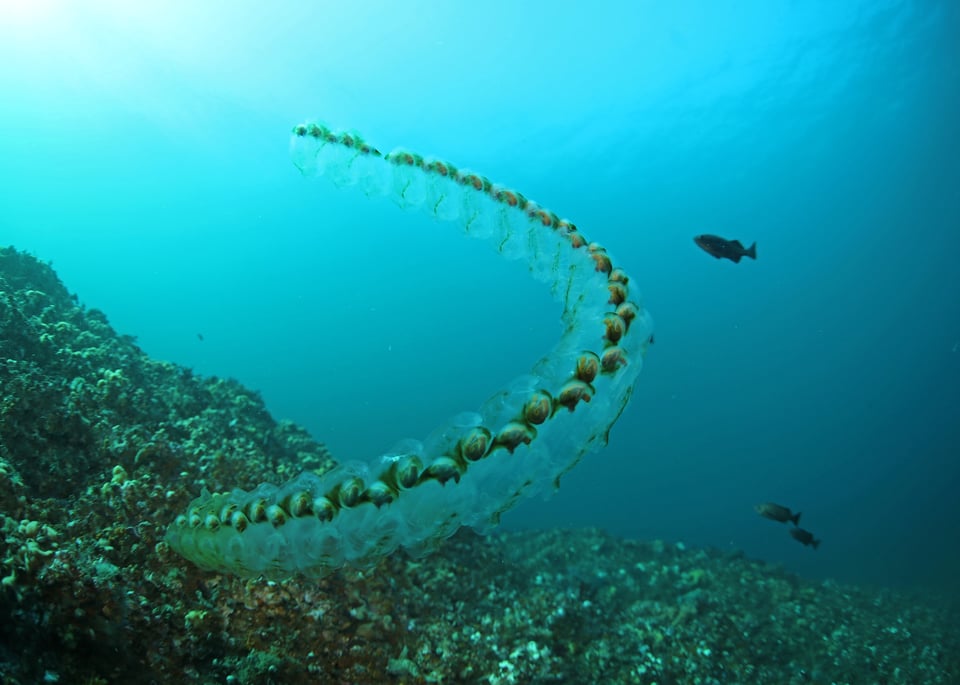
My favorite of Riis’s creatures, the salps, are less reliable visitors. I’ve only seen them three times in New York and twice at Riis, the first time nearly a decade ago on a warm September beach day. Salps are extraordinary creatures. They have a complex life cycle that alternates between a colonial sexual stage and a solitary individual stage, meaning that a salp can be both a community and an individual. As a solitary individual, the salp grows its future chain of clones inside its body until the chain bursts free. This is what a colony of salps looks like in the water. Marvelous!
The very end of June and beginning of July marked the end of my favorite time of year. I’m not talking about cancer season or Pride or even its predecessor, Asian & Pacific American Heritage Month. I’m talking, of course, about horseshoe crab mating season. I was out of town during most of horseshoe crab mating season last year, so this year I was resolved to go as often as I could to see my favorite residents of the greatest city in the world.
Early in the season, the frigid ocean and coastal wind whips you into a kind of numb torpor. But such bodily discomfort is a small price to pay to see the first crabs of the season, those grand brown frying-pan-like crabs that come ashore during full and new moons to clank hornily against one another on the sand. Horseshoe crabs are not true crabs, or even crustaceans; they are chelicerates, a group of animals that include fellow living freaks (sea spiders), fellow extinct freaks (sea scorpions), and also all arachnids, so spiders, ticks, mites, etc.
Not to get corny on main — although I feel like that’s actually my whole deal — I am deeply moved watching these armored invertebrates cling to each other on the shores of a beach I can reach by bus. It is simply magical that such ancient creatures, who appeared basically fully-formed in the fossil record 250 million years ago and have changed very little in the years since, grace us with their primordial presence under the light of the moon.
I think I can speak for all of us when I say that 2026 sucked absolute shit for a long time. As I plowed on through an unrelenting winter and spring, I kept telling myself: Summer will be better. I believed this to be true, at least a little, but I could not have anticipated how amazing summer would actually feel in Mamdanistan. The combination Knicks win + Pride + socialist sweep in the primaries + a freaking rent freeze has made me feel delirious with joy on top of my regularly programmed sadness and ongoing grief. Anyway this is how I was feeling and then, two weeks ago at the beach, I saw dolphins for the first time in New York City.
I know for many people seeing dolphins is old hat. They swim by our beaches quite frequently, passing in jubilant pods dipping in and out of the waves. But even though I go to the beach quite a lot, I had never seen them. I had been at the beach when friends saw dolphins, but I missed them, probably packed between several beach tents at the extremely overstimulating stretch of sand that is (gay) Riis. But this time around, standing in the waves on the sandbar during low tide at Riis, I saw the dolphins. They were just out there, glossy and powerful as Toyotas, swimming so close to me! Everyone screamed. How can you not be moved to elation by a dolphin, let alone a whole pod of them?
You may be wondering: How did you get such crisp, high-resolution, perfectly composed shots (this is satire) of the dolphins if you were standing in the waves?
Last Friday, I made my way to Prospect Park for one of Gabriel Willow’s spring migration morning walks with the NYC Bird Alliance. I love these walks. Gabriel is such a knowledgeable and generous guide, and while I now feel confident birding on my own, I know I’m going to see many, many more birds with Gabriel listening and pointing them out. This was proven immediately true around an hour into the walk, when we stumbled upon not one but two scarlet tanagers. Can you believe it?
Imagine the other just a few branches above!
I had never seen a scarlet tanager before, although I’d heard one singing on another one of Gabriel’s walks. I was very upset when I didn’t manage to see that tanager, given that the bird is incredibly bright and theoretically easy to spot among the green leaves. It took me a minute to see this tanager. But when I did, I had the reaction that presumably anyone does upon glimpsing this beautiful bird: Look at that red!
Two things can be true: I am a staunch supporter of uncharismatic microfauna, and also I love to see a hot bird. The male scarlet tanager is probably one of the hottest birds to pass through New York City. It felt like seeing a celebrity, but in an actually cool way. Last month I saw Maggie Gyllenhaal in Cobble Hill and was like, well, that’s a likely place for her to be. But even though I knew a scarlet tanager might feasibly be in Prospect Park, I was still stunned by his presence. Just look at that guy! It was an honor to bask in his glow.
I hope everyone has had a tolerable April! Mine has been exhausting. My cat Melon, who I love with my whole heart, nearly died last month of FIP, and I’ve spent the past four weeks ferrying her to and from the vet and treating the many complications that she’s been dealing with. Thank you to everyone who wished her well. She is my best friend and my only daughter and I cannot imagine my life without her.
As such, I have spent the past month almost entirely in my house and have therefore not seen many creatures in NYC. Scrolling back through my photos, I was afraid the only creature I could meaningfully report was seeing the spotted lanternfly nymph I found drowned in Melon’s water bowl. But then I saw this incredible footage I took in early April, of a flock of pigeons flying in a tight circle above some brownstones on an ethereal and smoky night. I wish I could include said video, but Buttondown does not yet have that capacity, so I hope you can believe me when I say the following stills came from a very captivating video.
When I saw these pigeons circling so intently, hovering over a stretch of a few buildings, I wondered, as many naturalists have before, why the hell they were doing that. I posted the video — which, again, is so much cooler than the above photo — to my instagram story, where people far wiser than I identified them as pigeons and several even suggested they might belong to a rooftop coop, one of the last in Brooklyn.
Hello again! I am emerging from a terrible weekend spent largely in the animal hospital attending to my most precious creature, my beautiful babygirl Melon. She’s back home now and we’re awaiting test results. Please keep her in your thoughts.
Forgive the lack of transition, but I am now going to pivot to another creature named Pepper, who I had the privilege of meeting early this month. Pepper was one of the highlights of my March, and I hope they can be one of yours soon.
Pepper
Pepper lives at Marine Park, which I visited for the first time in early March. It was very cold and the park was very smelly but I saw a great many sights, some of which I will include below. I didn’t bring my binoculars which was stupid, but I admired these mergansers a great deal from afar. They were diving underwater and kept popping up in surprising places. Fun!
Whenever I find myself with a scowling expression of the mouth; whenever it is an icy, sleeting February in my soul; whenever I find myself involuntarily pausing before towering new luxury apartment complexes; and especially when I must stop myself from deliberately stepping into the street and methodically smashing the windows of every T*sla I see — then I account it high time to get to sea, and see some seals, as soon as I can.
This was my particular disposition at the very start of the new year, but my plans were foiled again and again by the devilish nature of the skies. I was initially supposed to go on Classic Harbor Line’s seal boat in January, but then a winter storm cancelled the cruise. I rebooked in early February, but this cruise was cancelled, too, because temperatures were in the low 10s. But on February 14, I finally made it, and as we sailed into the splintering ice sheets of the Hudson under the dazzling winter sun, the great flood-gates of the wonder-world swung open, and in there my innermost soul was at last reacquainted with the creature I love above all others: the harbor seal.
Seal season is, to me, the saving grace of New York City winters. Sure, it is too cold to hang outside with my friends. Yes, I am constantly at risk of eating shit on invisibly icy sidewalks. Of course I too am experiencing seasonal depression. But the seals are a salve. Seals begin to arrive in New York City in November, migrating south to enjoy our ice-free waters for easier fishing. They stick around through spring and can be spotted on remote shores or sandbanks at Orchard Beach, Lemon Creek Park, as well as beaches at Coney Island and in the Rockaways.
Two weeks ago, I had planned to wander Shirley Chisolm with my friend Noah and take in the beauty of a wintry ocean moment and hopefully see some creatures. But of course the day of our hike snowfall turned into sleet and so we ended up wandering a much shorter distance to Pier 6 of Brooklyn Bridge Park. The creatures here were largely hidden, their presence announced by prints or chittering choruses of song in snow-covered trees. But it was still a grand old time, and I enjoyed looking at the prints of non-dog creatures and guessing who they might belong to.
Are we thinking raccoon?
I quickly learned I knew nothing about tracking, because my only guess was raccoon. (If any track-knowers want to weigh in, I would love to know which little fellows were trekking across this beautiful blanket of snow.)
One of the prints in this photo is mine but I won’t say which ones!
I was feeling guilty because I haven’t properly ventured into NYC nature the last two months. I have some good excuses — I’m newly immunocompromised and have been getting sick a lot, and also it’s been really freaking cold! But instead of writing about some random bird (no offense) I can see from my window, I came up with the idea to hand out some superlatives to what I think are my creatures of the year. These superlatives are all supremely subjective, as I have both invented the categories and chosen the winners, but I hope you enjoy nonetheless.
Honorary Creature of the Year
This award goes to an entity I encountered that is not technically a creature but is existentially a creature. And I am pleased to announce the winner is the corpse flower, Amorphophallus gigas, that bloomed at the Brooklyn Botanic Garden in January! I stood in the freezing cold for two hours with my friend Rafa waiting to see and sniff the flower. It reeked! What a day!
I just moved into a new apartment. I’m living by myself for the first time, which is both amazing and overwhelming, in part because I live above the BQE. I have felt guilty that I haven’t properly ventured out into the wide and wonderful world of NYC wildlife lately—though, to be fair, it’s been cold! But fortunately, I’ve gotten a chance to meet some of my new neighbors, who I can hear drilling most mornings outside my window.
I don’t mind this at all, of course, because my neighbors are woodpeckers! When I first saw a male downy woodpecker hammering away at the mostly barren tree in front of my kitchen window, I marveled at the sight. Such a tiny, precious bird! Such a rare sighting in the city, at least for me! I have mostly seen woodpeckers in Prospect and Central Parks, and assumed such vaunted little birds would not dare venture so near the BQE, which seems to stand in opposition of all that is natural and peaceful in the city. But here one was, slamming his little precious head into the bark, his small red stripe zigging and zagging, and I felt that his presence marked something auspicious, either about this new chapter of my life or my apartment.
Sorry this is a still from a video from my shitty phone!
But then I saw a male downy woodpecker again later that week, and then two at once the week after, and soon I stopped counting. That’s when I realized that these little guys simply must hang out here a lot. My friend Barry suggested that they might live in these trees, which now feels very obvious, but I suppose I assumed woodpeckers a nomadic bird, roaming from bark to bark in search of caterpillars and beetles. So these woodpeckers are literally my neighbors! Magnificent!
Let’s get straight to it: Last weekend I saw a hawk up close. How close, you might ask? Very close, I would answer! I was walking around The Ramble in Central Park with my mom, who was in town last weekend. We were enjoying the sights of the turning leaves and many a sparrow fleeing into the leaf litter. To me, these sparrows seemed big, all plumped up for the coming winter. But then, above us, flew a really big bird.
I’ve watched as hawks fly above me and always admired their heft, power, and their casually murderous vibes. Even from a distance, a soaring hawk is a thing to behold. You watch and wait to see if it will swoop down and snag some poor rodent or pitiful pigeon in its claws. But this hawk flew very, very close above our heads, and this proximity to the raptor made my hairs stand on edge. And then it perched directly above us on a branch. I stopped walking and craned my neck upward, squinting against the cloudy sky to better admire the bird. What a beauty!
The big fellow of the moment!
When I walked to the other side of the branch to better admire the hawk’s face, the bird turned around. And when I walked back to where I had originally stood, the bird turned once again. I understood then that this hawk did not want to be perceived, and yet I could not stop staring. The bird was so big, and so close!
A few weeks ago I went on one of Gabriel Willow’s fall migration walks in Prospect Park, which are one of my favorite ways to get out and see some birds. Gabriel is a font of seemingly infinite knowledge about the city and its creatures, and I learn something new every time we go. Each walk offers something different, all depending on which birds have happened to migrate over the city the previous night.
But this walk was particularly special. As we made our way into the Vale of Cashmere, the overgrown oasis that offers birds a place to drink, splash, and overall chill, we saw some of the least-chill birds of all time. That’s right, we saw some freaking hummingbirds!
Oh sorry, did you want photos of hummingbirds? Well they’re very small and I only have my dinky phone camera. But I took this photo because there WAS a hummingbird somewhere in the greenery so if you spot it, let me know.
First off I’d like to apologize for titling an earlier edition of this newsletter “it’s bat time, babes” without actually having any bat updates to share. I did so intending to alert people to upcoming bat-related events. But this time, I have come prepared with a bat update of my own. I have sought, and seen, the bats. It’s bat time for real now, babes!
This Monday, my friend Kate and I went to a really lovely bat walk in Green-Wood Cemetery, hosted by the Urban Bat Project NYC and Queer Birders. Green-Wood Cemetery is one of my favorite green spaces in the city, and I’d never gone there after dark before. We all gathered by the giant gothic gates as the wildlife biologist Nic Comparato talked about the bats that make their home in NYC. Some species, like eastern red bats, migrate here each year. Others, like big brown bats, live here year-round. Then we set off to one of the cemetery’s reflecting pools, where we lay down blankets and waited for the bats to emerge.
This is when Kate and I realized that this was kind of a perfect date night — blankets, bats, a throng of kind creature-oriented queer people whose faces we could barely make out in the moonless night. It was very cute! I recommend this event (whenever it is held again) to anyone who hoping to plan a sweet and slightly spooky date.
The other day I was walking in my neighborhood when I saw alarmingly large insects hovering on someone’s lawn. At first I was excited and thought they could be hummingbird moths, which are pleasantly plump with these unreal clear wings. Then as I approached, I wondered if I was in fact seeing a “murder hornet,” or Vespa mandarinia, the enormous wasps that were recently introduced to North America. But there have been no confirmed sightings of these hornets in New York. Rather, what I was seeing was Sphecius speciosus, or the eastern cicada-killer wasp. Up close, I realized I had no idea the cicada killer was high key a cunty wasp! Look at her* pose!
*the cicada killer below is a male but he is objectively slaying and so here I deploy “she.”
Coincidentally, about a week later a friend asked me what enormous and intimidating bug they had seen, describing a big yellow-and-black wasp like this, and it seems they, too, glimpsed Sphecius. They’re kind of unmissable. Wikipedia describes them as “uniquely fearsome” and I have to agree.
Apologies for the lateness of this month’s Creatures! I just got back from a blissful month in the Adirondacks without wifi and am now reluctantly returning to the internet. I have only been back in the city for a morning and thus have no real creature report from NYC to share besides the dead cockroach on my stairwell that I think was there when I left. Instead, I will share some photos of the moths I saw in the Adirondacks, and will return in August with some actual critters in this city.
There’s a lot to look forward to this month, with a bounty of bat walks (which also spotlight the many other creatures of the night that grace our skies). I really can’t recommend the bat walks, or nighttime ecology walks, enough. They illuminate so many amazing creatures we rarely get a chance to see or interact with, as their dark worlds are so different from our lighted one. Hearing a bat hunt a moth through an echolocating device is an amazing experience. Intrigued? You’re in luck — there’s a nighttime ecology walk tonight!
The next few weeks also features one last horseshoe crab walk and plenty of coastal ecology events, from shorebird walks to tidepool adventures. On really hot days, the best place to be is by the ocean! Hope you’re all taking care during these horrible times. Okay, on to the moths.
Spring could not have come at a better time, because I’m kind of falling apart mentally and everyone I know and love is struggling in some way. So I have been grateful for all the life flocking, scuttling, and crawling into the city. I’ve loved going out for morning walks amid spring migration. I recently downloaded the Merlin app for the first time, and it’s made a huge difference in my abilities as a true beginner birder. It’s so helpful to watch as the calls I’m hearing in real life light up on the app next to a photo of the bird, which allows me to walk closer to those calls and actually find the bird in the tree. This is how I saw my first Magnolia warbler! They’re really freaking small!
But while many birders define this season as the peak of spring migration, to me, late May belongs to the crabs. I’m talking, of course, about horseshoe crabs — the helmet-like arthropods that scoot around in the shallows during May and June and lay their eggs on the beach during high tide. I’ve seen the crabs twice now, once on a volunteer tagging night with the NYC Bird Alliance and again at the 9th Annual Horseshoe Crab Festival. I never tire of picking up the crabs by the side of their shell and watching their many legs unfurl like a beautiful, chitinous flower. I love watching them relentlessly mount each other, as well as my shoes!
It’s really, truly spring in New York City, which means the weather is suddenly beautiful and I am a congested, blotchy mess. This is always a bittersweet time, because I would love to be outside, and yet my body believes that outside wants to kill me? So I have not spent much time in nature because it makes me feel physically miserable, if somewhat psychically uplifted.
I have no real creature report this month, partly because of my freaking allergies and partly because I wanted to send the newsletter out early because there’s so much happening in the city this weekend in honor of Earth Day, which was this week. Ordinarily this would be a cause for celebration, but the people in power are currently waging an obscene and ruthless war against Earth and all its living beings, including us.
For one, DOGE fired the entire staff overseeing the Low-Income Home Energy Assistance Program (LIHEAP), which which helps 1.2 million New Yorkers pay their heat and cooling bills.And the Trump administration has proposed a rule change to the Endangered Species Act that would only prohibit actions that directly hurt or kill actual animals, not the habitats they rely on, essentially gutting the act, per NPR. This would devastate the status of countless species, endangered or not, because habitat loss is the biggest driver of extinction.
I hope you read the above title in the breathy intonation of Lana Del Rey, because that is how I intended it. But seriously, did you know there’s a crypt below Fort Greene Park? Because I did not know that at all, despite having walked around that park a lot! I learned this fact while on a Winter Tree Walk in the park last week, which was hosted by NYC Parks. If you already knew this, as maybe many of you did, I apologize for coming late to the Ft. Greene crypt game. But I am here now, and I’m never forgetting it!
A branch of a maple tree, with tender red leaflets emerging.
We started the tour by the visitor’s center, where the rangers explained we would be learning how to identify trees in the winter, when they are denuded of their beautiful and easily identifiable leaves. On this walk, we concentrated on things including, but not limited to: the color, texture, and patterns of bark; the angle at which branches split from each other and their general shape; and also the presence and placement of any tender leaf buds. If this sounds like a lot, it was!
The first tree we stopped by was a gingko, which had a tall, straight trunk rippling with vertical creases. Its branches erupted in bulbous little buds. To confirm the identification, we examined a smattering of crispy fallen, fan-shaped gingko leaves littered below. Even while utterly naked, the gingko seemed quite a distinct tree. At this point, I was feeling very confident in my identification abilities.
February was another brutal month politically and emotionally, with even more horrors yet to come. But this month also marked the first time I’ve ever seen seals in New York City. When I saw them, I remember thinking: I’ve never needed seals more. Looking back, I still can’t believe I saw them. Seals! Bobbing and barking in waters not so far from the various office buildings where I have had a good long cry in the stairwell!
I saw the seals on a special new Classic Harbor Line cruise, “Seals, Seabirds, and Winter Wildlife.” The tours, hosted by the fantastic urban naturalist Russell Jacobs, take you out from Chelsea Piers and into the harbor. The tours do not guarantee seal sightings, and so the boat bristled with our anxious anticipation. Many of us glued our faces to the windows as soon as we set off, despite the fact that the abandoned islands where the seals are known to haul out were still miles away. And yet, within the first hour of the cruise, some of us saw the dark gray snout of a seal bobbing in the waves. With one seal down, the rest of the day suddenly had less to prove.
Eventually we reached Swinburne Island, an artificial island once used for cholera quarantine and now is a beloved hangout for seals. At a distance, the island appeared to be a heap of large rocks. But some of the rocks were moving! As we drew closer, it became clear that the shores of this island were teeming with big, fat, and blubbery harbor and grey seals. This, I knew then, was more beautiful than any skyline.