when "no" feels safer
I’ve been sitting in a unique lull period. There’s not much to do, for the next little while. The march is a few weeks away. The happenings that brought me to Europe are behind me. I have some agency to choose when I return to India, and how.
These moments of relative quiet are sacred, for me. First, it’s a distinct chance to rest, something that is rare while traveling. But there’s another thing.
A sort of unease creeps up from the cracks. A slowly-dispersing, greenish mist that starts at the bottom of my stomach and steadily swirls around my heart. There’s that familiar urge to dispel these sensations. Login to instagram or download another video game.
But I’m committed to growing intimacy with these sensations.
This time, I label the feeling as homesickness. Not for the Bay Area, necessarily - though I really miss it - but perhaps for a home that doesn’t exist anymore, or maybe never did.
Do you know that feeling?
Recently, a few of us have been talking about what I call the trust epidemic. I’ve noticed this pattern in group spaces, communities, in my own relationships and in those of others.
I see it when we’re coming together in groups and people need more care before they can welcome instruction. I see folks needing to say no, and feel heard, so that they can say yes.
I, myself, have had to say no, when maybe before I would have said yes. “No” has felt safer lately.
It used to be that saying yes opened doors. Then, I started saying yes because I was afraid the doors would close. And now, as I slow down, as I come into my own mistrust of the larger world - and grow my trust in myself - I notice the doors shutting. Some right in my face; some silently, slowly, as I look the other way.
I think learning to trust my own refusal has helped expand my availability for the mistrust and refusal of others. We’re living in times where the structures we were raised to trust are eroding. Why wouldn’t that affect our ability to trust everything else?
I’m talking about the onset of global conflict: war and genocide and instability. I’m talking about ecocide and natural disaster. I’m talking about the illusion of democracy serving the people being stripped away - though it’s not clear if democracy ever promised that1.
Naming it like this helps me feel some peace about how much mistrust is out there. It helps me recognize my own conviction about mistrust: it’s not in the way. No, it’s a collaborator, pointing us to where we need to slow down and listen more deeply.
It helps me feel the full sacredness of my own “nos” and the closed doors that follow.
I’m watching things that I used to lean on to feel "okay” about my place in the world come apart at the seams. Part of me wants to say more, but it’s too much to share in an email blast, at least right now. There’s still shame, heartbreak, disbelief, and a sense of dignity and protection towards these processes of discernment.
I notice myself feeling the rightness of the changes, though. Something in me is willing to see things fall apart.
As I stand in the corridor, all the doors closing, there remains only one path in front of me. And that’s the path of more grief, more homesickness, more longing. It’s also the path of returning to faith.
It’s something Uta suggested to me; that this moment we’re in is an opportunity to drop in deeper to our relationship with faith and surrender, while growing our discernment about spiritual bypassing. For me, it’s an invitation to learn how to be lost. Not lost and confused and immobilized by despair, though that’s been a sacred stage for me.
These days it’s more like lost and taking the next step forward. Step after step.
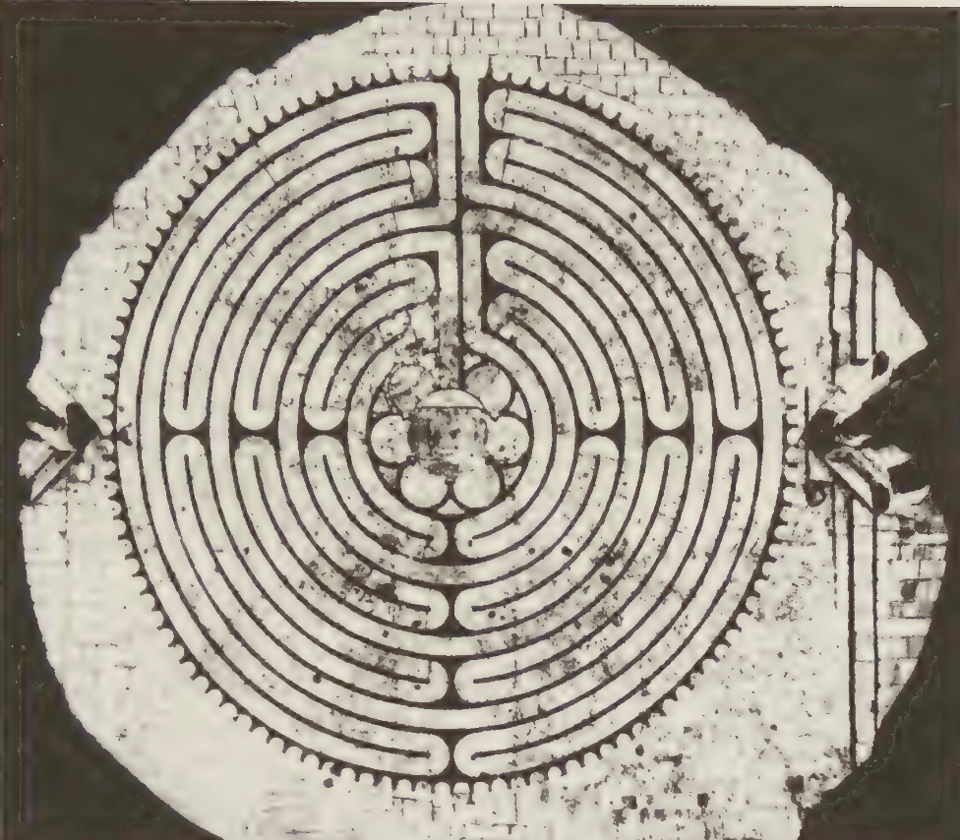
I’d like to share an excerpt from The Book of Symbols, which is a beautiful tome and powerful divination tool. I intuitively flipped to a random page and came across The Labyrinth. I hope this excerpt serves you the way it frees me to relish the turns of my own journey.
The purpose of the labyrinth’s frequent inclusion in initiatory rites is to temporarily disturb consciousness to the point that the initiate becomes confused and symbolically loses his way, or his rational, linear frame of orientation.
The essentially dual, paradoxical nature of the labyrinth is both circular and linear, simple and complex, historical and temporal. Contained within a compact space, a long and difficult path constantly doubles back on itself, leading circuitously to a mysterious and invisible center.
From within, the view is extremely restricted and confusing, while from above one discovers a Supreme artistry and order. Thus the labyrinth simultaneously incorporates confusion and clarity, multiplicity and unity, imprisonment and liberation, chaos and order.
On the journey through the labyrinth, once the center, or goal, has been reached, the way back will always be utterly new.
As I tread the steps of my personal labyrinth, step after step, I feel the urge in me to create. The greenish fugue gas comes to me in a dream, and in the dream I sing, a song of grief and longing and right-ness and connectedness with life.
I sing a song of knowing that there’s more for me than closed doors, and there’s more for our species than disrepair. There’s another way forward.
The unease isn’t going anywhere, though. We’ll have to make friends. And together, we’ll sing our way towards conviction.
Peter Kingsley, historian, has some fascinating ideas about how Athenian democracy was received by neighboring communities - see page 17 for the DL. ↩
-
"I’m committed to growing intimacy with these sensations." "I think learning to trust my own refusal has helped expand my availability for the mistrust and refusal of others." These two point resonated so deeply with me in the season of liminal that I am in. Thank you for articulating it so compassionately.
-
Reply: