Unreal and undead
The Blood of Dawnwalker moves like The Witcher, but feels different where it matters.
by Kambole Campbell
This is part of re:frame's Per Second, a month of coverage focused on all the ways animation touches video games, from the culture surrounding the medium to high-profile outliers to the everyday bread and butter of video game animation.
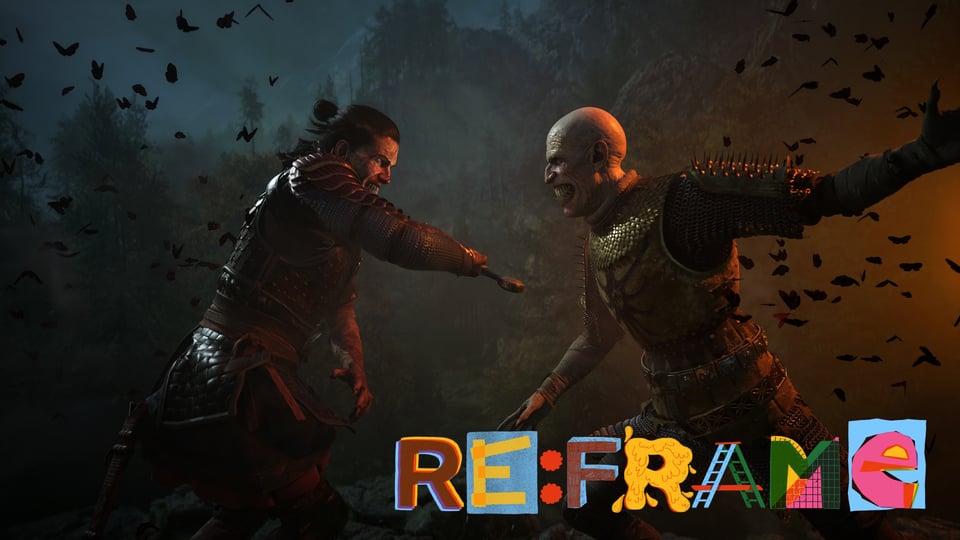
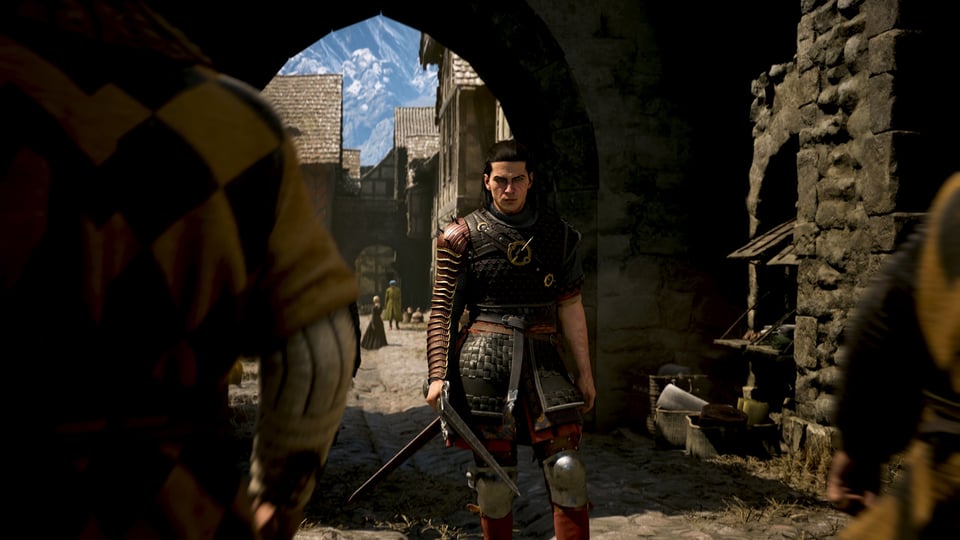
You could be easily forgiven for glancing at Coen of Laslea and mistaking him for Geralt of Rivia – both in their vaguely similar visages, and the way they dance and pirouette through sword duels. By now, it's pretty well known that The Blood of Dawnwalker has common ancestry with The Witcher 3, sharing a director in Konrad Tomaszkiewicz1, as well as a setting inspired by eastern European geography and folklore.
The game, situated in the fictional Vale Sangora, follows the mostly mild-mannered, soft-spoken Coen on a mission of revenge (or justice in general, depending on how you roleplay as the character) against the vampires who have kidnapped his family. After killing the former noble families in charge of the land, the vampires run Coen's village in a faux-benevolent dictatorship where the villagers have to pay with blood every month, at the same time they drink the blood of the ruling vampire named Brencis, which has healing properties which they need in order to keep the Black Plague at bay. Sounds like a good enough deal; the problem is the weak are often culled and people are sacrificed at the whims of their vampire masters. The boot heel is still a boot heel.
None of this, even the style of the combat, is particularly outside of the familiar for anyone who has played an open-world RPG (or any video game for that matter; there's a lot of digital families to avenge). The animation carries a touch of familiarity, even though the actual combat and feedback feels different with the directional parries and strikes. You have to press attack or block plus shift the stick up, down, left, or right depending on where your opponent is swinging, making for an overall more involved sequence.
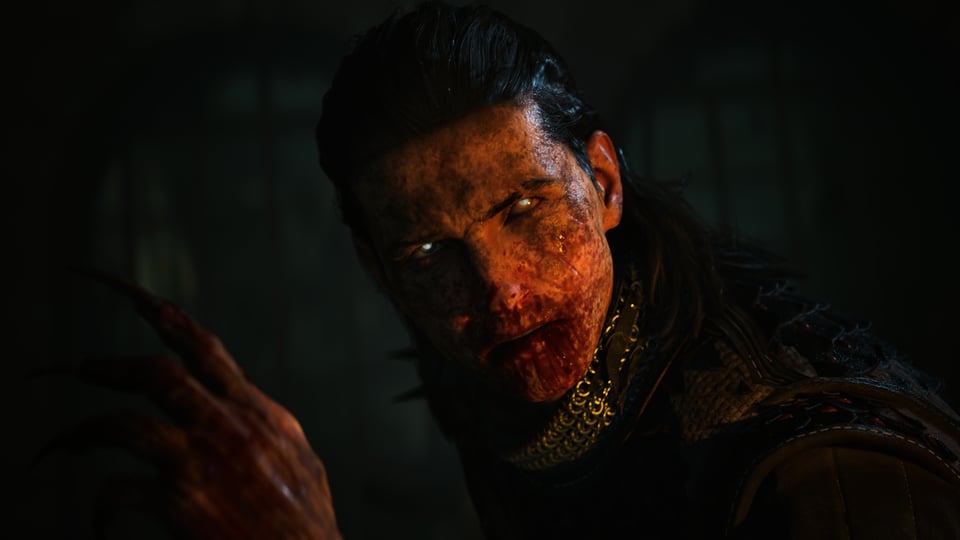
It's not quite as bespoke as something like Onimusha: Way of the Sword, which seems to have a different, detailed and characterful response to almost every possible combat instance, but the direct connection Dawnwalker creates with the sword makes the realism of the game's art and animation feel natural rather than an obligation of the modern video game. But it also creates a layer of separation between Coen and Geralt. The relative lack of impact of combat in The Witcher 3 could be considered in tune with Geralt's station as a genetically engineered monster hunter, trained in various arts of killing, so this sort of thing comes easy. Coen is a farmer's son. His father Pieter has a history as a brutal mercenary, yes, but both backgrounds are reflected in his simple, meat and potatoes approach to sword (or claw) fighting. Switching to claws as a vampire by night is more reflective of the blunt savagery of Dawnwalker's combat by comparison to the careful prep and artisanal approach of The Witcher 3.
There is still some overlap. Coen's sword moves like Geralt's, minus a twirl or two, once you unlock specific sword arts he uses magic and other abilities in four quick slots just as Geralt did, and the camera holds at a similar distance to the point where their silhouette feels the same. You can't haggle up payment for a job because this isn't work for Coen, but you can still follow tragic side quests to different outcomes based on how you talk to people. You can, however, accidentally kill NPCs by involuntarily draining them of blood. Oops.
It doesn't look remarkable, visually. I don't mind fidelity, or performance really, those are solid, I guess. But the production design favors rustic villages and grand vistas and realism as Unreal Engine games are wont to do, nothing mindblowing. The difference maker, as many have noted, is the big timer looming over your objectives. You don't have to just worry about timing in more minute, immediate terms as you wait for a parry, but you also have to think about your time on a larger scale.
The main quest – save your family – is presented in the same way the final objective of Breath of the Wild is: a problem to solve in whatever way you can. You can even head straight to it, just like Link could, even if it's ill-advised. The map is left open, though there's a vague order to it as locations are soft-gated behind levels (a big red skull next to quests or place names warn you where you'll probably get immediately humbled). Leveling up, doing quests, learning skills, finding stuff, all of this you end up literally paying for with segments of the time of day or night, roughly about eight segments for each cycle, two cycles adding up to a full day. You have 30 days to complete the main quest. Different tasks have different costs — a step in a major quest can cost six segments, wiping out a camp of vampire stooge soldiers might cost one or two.
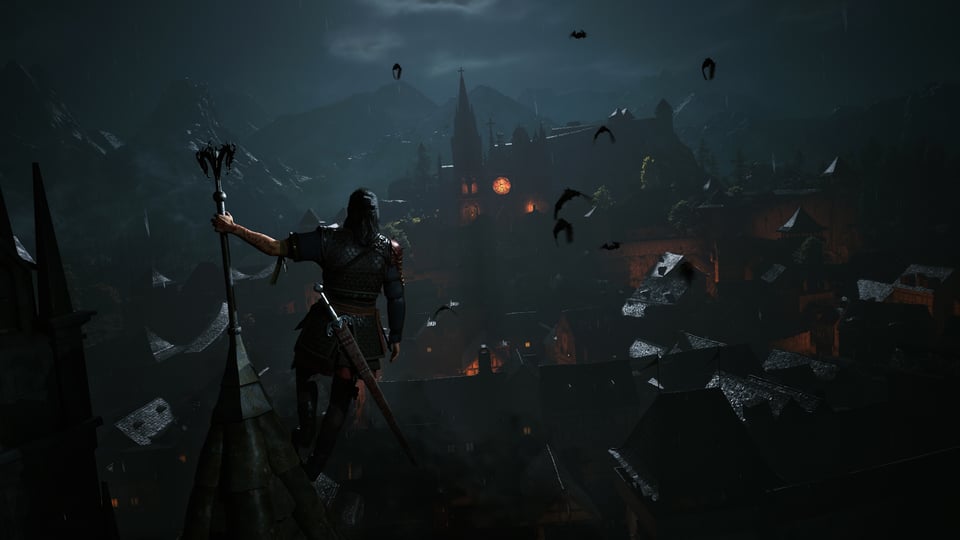
The urgency this inspires pushes beyond feeling like the second coming of The Witcher, even if gamers (as ever) have reacted to any kind of experiment with limitation negatively. It's not unlike the time limit on Persona, though the in-game month you'd get multiple times over only applies once here. While the time management isn't unprecedented, it does feel unique that each mission comes with a price tag of hours, and problems which stem from how you parse out those costs.
For example, if you initiate a quest and the cost carries you from day into night (or vice versa) in the process, the manner in which you can engage with that quest changes. You can't use witchcraft at night (which is handy for seeking clues by talking with dead bodies), and in the day you don't have the same traversal skills which you do by night as a vampire. The aforementioned accidental killing of NPCs can also happen if you wait too long to do certain quest steps, though I haven't personally ran into that problem yet.
As someone who lives in perpetual fear of time management (freelance writer) it's admittedly not so much daunting as it is a big puzzle to consider, a constant balance of deciding when the ideal time to pick up an activity is, rather than "do I have time to do this at all?" — even if that question has occurred to me. It's a clever way of driving me to other icons on the map, a spiritual extension of how The Witcher would dangle question marks in places until you went over to check out what that thing might be (Dawnwalker does this too). I haven't finished the game yet, I'm a good 12 days in (or 13-15 real hours). Somewhat paradoxically, I'm taking my time. But at least, when considered against the intimidating sprawl of The Witcher 3, a game which took me three years on and off to complete, The Blood of Dawnwalker feels a lot more approachable, in its insistence that time is literally money.
1Tomaszkiewicz left CD Projekt Red following allegations of workplace bullying (the internal investigation found him not guilty, though Tomaszkiewicz does mention "bad blood," as per IGN.)
/out of frame
🤖 Kambole: The next season of Marathon hit a big delay and I am big sad. In the meantime, I have recently finished the wonderful Big Walk with friends who write on games with me at Reverse Shot. I might shout about the work which results from that big playthrough soon. In the world of animation, I've been enjoying The Ghost in the Shell and Jaadugar (obviously) but also, to some extent, the recent Forgotten Island by Joel Crawford and Januel Mercado. I have a full review of that on the way for Little White Lies for the UK release in October, but I'll say for now that I had more mixed feelings than other people I know who saw it (I am also a miser who disliked Puss in Boots: The Last Wish, please don't yell at me, my friend Amon does this plenty on this very subject). But, in Forgotten Island, the merman is very funny, and that counts for a lot.
🐱 Rollin: Normally we reserve this space for talking about whatever it is we personally have been doing or are interested in, but I will now buck tradition by saying: what do you mean you didn't like Puss in Boots: The Last Wish, Kam?? How very dare you.