
Air quality, shared accessibility knowledge, and who gets a say
Fall is here. The weather is changing. And here I am with a newsletter for October!
This month, a memory of a stuffy meeting room in Chicago has me thinking about air quality and accessibility. From the archives, I’ve picked a conversation with Jessica Ivins about helping your team learn accessibility, and a blog post about including disabled people in decisions.
In this newsletter
- Support my work
- Getting through the door isn't enough
- Podcast archive: Help your team learn accessibility
- Blog archive: Include disabled people in decisions
- Wrapping up
Support my work
I've reached the point where I have more than 100 subscribers. This is very cool and I'm glad all y'all have enough interest to subscribe. But also, it means I have to pay!
I'd appreciate your financial support for my newsletter. The newsletter will always remain free to read. Donations go towards art supplies (have you seen the price of watercolor paint?!?), and the occasional hosting bill.
Pay what you want: monthly, yearly, or as a one-off
Getting through the door isn't enough
In the mid-1990s, I was in Chicago for a meeting. There were maybe 30 of us packed into a small room. I don't recall seeing any ventilation, although I wasn't looking for it. I could not stay awake. I don't mean I was bored. My eyes were heavy, my head was foggy, concentrating was nearly impossible. Eventually, I stepped outside into the fresh air. My head cleared. I went back inside, and before long the fog returned.
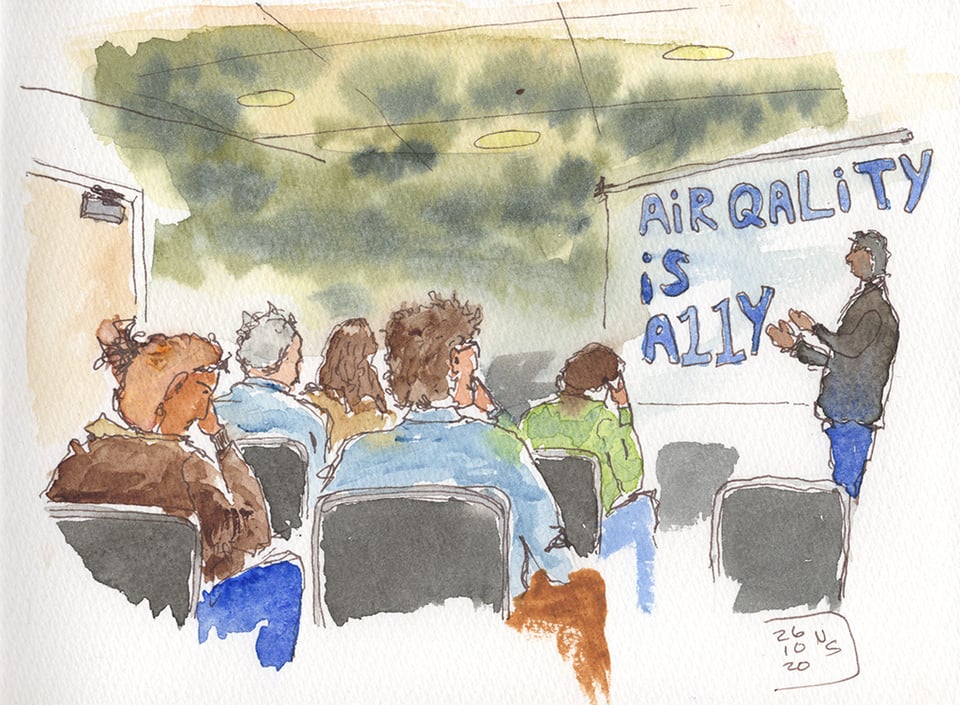
Today, I'd wonder about the CO2 level in that room, about ventilation and air exchange. Back then most of us weren't thinking about that when we walked into a meeting room. We certainly weren't talking about indoor air quality as an accessibility issue.
So I did what many of us do when an environment doesn't work. I assumed the problem was me.
The pattern of blaming yourself
Disabled people know that pattern well. When we can't concentrate, keep up, or stay for the whole event, it's easy to see that as personal failure. We tell ourselves to just push through.
I've done the same thing in rooms with bad lighting, telling myself I needed more coffee when the real problem was fluorescent flicker. A colleague of mine used to leave conferences early and apologize for her "low stamina," when the actual problem was hours of sitting in a space with no quiet area to decompress. The environment fails, and we absorb the failure as a fact about our own bodies.
Sometimes the environment is creating the barrier. Air can be one of those barriers.
We're used to thinking about whether someone can get into a room. We might plan for wheelchair space, interpreters, captions, microphones, lighting, and seating. We rarely ask whether the air in that room lets everyone stay and function.
Poor indoor air can contribute to headaches, fatigue, and difficulty concentrating. For some people, respiratory conditions, migraines, or other disabilities can make air quality an even bigger issue. That's a health and safety issue. It's also an accessibility issue.
It's worth being clear about where this sits, because our usual accessibility standards don't really account for it. WCAG governs digital accessibility, so air was never going to be in scope there. The 2010 ADA Standards for Accessible Design, the standard for the physical built environment, cover things like clear floor space, door width, ramp slope, and counter height. They don't set ventilation or air quality requirements. Those live in building codes and ASHRAE standards, written for health and comfort reasons, not accessibility ones. So the air in a room can meet every applicable code and still be a barrier, and no accessibility framework will have flagged it.
Changing the format doesn't fix it
The obvious alternative is to hold the meeting online. Except online meetings have their own access barriers. Captions can be inaccurate or missing. Platforms can be hard to use with assistive technology. Following slides, chat, video, and several voices at once can be exhausting.
Hybrid meetings complicate things further. Some people are together in the room, while others join remotely. In theory, everyone participates. In practice, the room takes over. Someone speaks away from the mic, side conversations happen, someone points at a whiteboard that remote folks can't see, everybody in the room laughs and the people online wonder what they missed. I've sat in hybrid calls where the remote attendees effectively became an audience watching the room have a meeting, checking in every few minutes to see if anyone remembered they were there.
Changing the format doesn't automatically make it accessible. Sometimes it just changes the barriers.
The air we don't notice
But I keep coming back to that room in Chicago. And to the air.
Air is easy to overlook. We assume it'll be fine. I notice whether I can get my wheelchair through the door because the door tells me right away, I either fit or I don't. Air doesn't announce itself that way. I don't notice the ventilation until my body starts telling me something's wrong, and by then I've already lost the meeting.
Maybe air quality needs to become one of the things we notice before that happens.
A room can have an accessible entrance, enough space for my chair, good lighting, captions, and microphones. But if the air leaves people foggy, exhausted, struggling to breathe, or needing to leave, we still have an access problem.
Getting through the door is not enough. We also need air that lets us stay.
Help your whole team learn accessibility
“Because one person can't be in every meeting, they can't be involved in every decision.”
Jessica Ivins explains why everyone on your team needs to understand accessibility. Hiring a specialist is a good start. You also need to help your other colleagues make accessible decisions.
In this episode from the A11y Rules archive, Jessica and I discuss how you can start sharing that knowledge:
- Find colleagues who care about accessibility.
- Work together to make part of your product accessible.
- Share what you learn with others on your next project.
Change takes time, especially in a large organization. But you can start with a few people and build from there.
Jessica also shares an example from her own work. Her team made parts of a product more accessible and easier to use. Customer support then received fewer calls. Results like that can help you make the case for spending more time and money on accessibility.
Listen to my conversation with Jessica Ivins, part two.
Include disabled people in decisions
You can invite disabled people into your organization and still leave them out of decisions that affect them.
In “A culture of inclusion,” from my 2015 blog archive, I wrote about the gap between saying accessibility matters and making it part of how an organization works.
I saw that gap on Joomla’s Core Development Team. I was tasked with improving accessibility and refactored the entire codebase as a proof of concept. The other Core members chose to make accessibility improvements a third-party add-on.
As I wrote then: “There was no culture of inclusion.”
Doing the work wasn’t enough to get those changes into the main product. The team’s decision kept accessibility outside it.
The post also asks how organizations see disabled people. Are we people who receive whatever accessibility improvements others choose to provide? Or do we help decide what gets built?
If you want a culture of inclusion, disabled people need a say in those decisions. Getting through the door should give us the chance to shape what happens inside.
Read “A culture of inclusion.”
Wrapping up
That's it for now! I hope you enjoyed the newsletter. I'd love to get feedback - What was good? What could be improved? What topic would you like me to talk about? I'm not making any promise, but if a topic you suggest catches my fancy, I'll share my opinion on it. Just hit reply to this email, or send an email at [email protected]. I read every response. And a reminder that my content is Human Generated Content #HumanGeneratedContent