
Left behind, burnout, and recent blog posts
We just went through a pretty gnarly fall storm. Winds up to 100 km/h (65 mph). Torrential rain falling horizontally. We were lucky not to lose power, this time.
So I spent time working on this newsletter! I hope you enjoy it as much as I enjoyed writing it.
This time I'm writing about the time I was left behind because the bus driver told me the bus was full. In -17°C temperatures.
And I'm revisiting an older podcast episode about accessibility and burnout.
And I'm telling you a bit about four recent blog posts I published on my site.
In this newsletter
- Support my work
- Left behind in plain sight
- Podcast archive: Accessibility and burnout
- Blog archive: 4 recent posts
- Wrapping up
A note about donations
This newsletter will always be free to read. If you’d like to chip in, donations help pay for art supplies (have you seen the price of watercolour paint?) and the cost of sending this newsletter.
You can give monthly, yearly, or as a one-off, and choose the amount. Donate
Whether you donate or not, thank you for reading. I’m glad you’re here. You're the reason I write this newsletter.
Left Behind in Plain Sight
Years ago, I was waiting for a bus in -17°C weather. I’d dressed for the cold, but after a while I was shivering. Moving around to warm up is difficult when you’re seated in a wheelchair. Even the best boots won’t keep your toes warm.
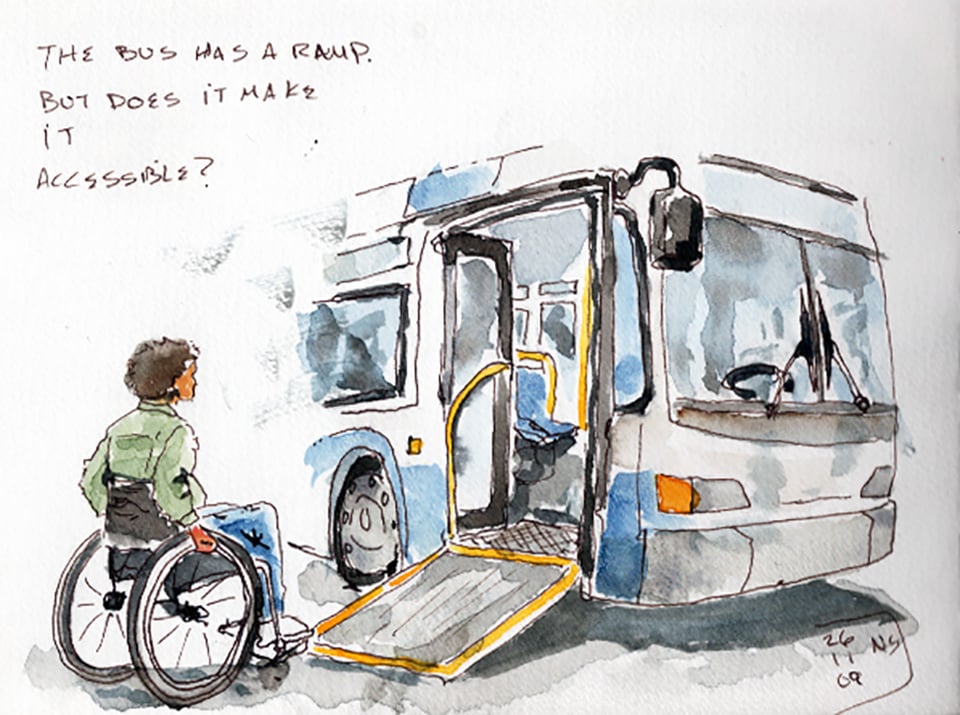
The bus arrived and the driver began lowering the ramp. Before it was down, people behind me started boarding. Some literally climbed over me to get on.
After every other passenger waiting at my stop had boarded, the driver told me the bus was full. The ramp was fully down by then. He started retracting it, and I couldn’t get on.
A blind friend told me about trying to book an appointment at a “walk-in” clinic. You don’t need a family doctor, but apparently walking in requires being online by 8 am. Appointments open each day. He told me that most of the time, they’re gone before he can get through the booking with his screen reader.
I tried the booking afterward, without a screen reader. With more than 25 years in digital accessibility, I could identify likely barriers and connect them to what he’d described. I found it partly accessible, but convoluted. His account explained what that meant when trying to get an appointment.
People at the bus stop could see what happened to me. My friend’s experience takes place away from the clinic, on a website. Nobody there has to stand beside him while he tries to book.
The ramp
The ramp worked. A check for a working ramp would have passed, even as I was being told I couldn’t board.
The clinic booking has controls a screen reader user can operate. But getting through the booking takes time, during which other people are taking appointments. Testing at leisure, without appointments being taken, would miss why my friend usually loses out.
The ramp was part of boarding the bus. It lowered while the available space filled. The clinic’s controls are part of booking a medical visit, and their accessibility has to be considered within that booking, including the time it takes.
The people climbing over me
Some passengers chose to climb over me. The booking website puts my friend behind other people each morning without anyone having to make a fresh decision about him. Decisions already made about how booking works keep costing him time.
He can be there when appointments open and still reach the end too late. That isn’t a matter of being unprepared for the 8 am opening. He’s spending the available time getting through the website.
The people running the clinic don’t encounter him at reception. The website keeps the failed attempt out of the waiting room.
The full bus
“The bus is full” described how things stood after everyone else had boarded. I had been there while it filled, waiting for the ramp.
A full appointment list leaves out the people who were trying to book as the appointments disappeared. My friend’s attempt doesn’t appear as an appointment, however early he started or however long he spent trying.
Without watching someone use the booking, it’s easy to mistake a fully booked clinic for a booking system that works. His account gives information the schedule cannot: he was trying to get medical care, and the booking took too long for him to get it.
The cold
Waiting for another bus would have meant more time shivering outside. My boots weren’t going to get warmer because the bus had a ramp.
My friend still needed a medical appointment after the booking failed. The time he’d spent on the website hadn’t gotten him any closer to seeing someone. He had to find another way to arrange care.
That is the consequence behind “unable to complete booking.” It extends beyond the page where he stopped. Just as my need to get out of the cold remained after the ramp began retracting, his need for medical care remained after the appointments were gone.
The complaint
I filed a complaint with the local transit authority. It went nowhere.
A complaint can tell an organization about something its staff never witnessed. My friend’s account prompted me to investigate the booking. His description, together with what I found, helped me understand where it was failing him.
Sending a report to an organization offers no assurance of that kind of response. Reporting a broken form must be possible without using that form. Even when someone manages to send the report, they can be left waiting for an answer while the organization gets to say it welcomes feedback.
Being told what happened
Making exclusion visible doesn’t make someone take responsibility for it. I have no reason to pretend otherwise after my experience with the bus.
Watching disabled people use a website helps uncover what went wrong. Listening to someone describe their experience can do that too. My friend didn’t need me to reproduce his attempt with a screen reader before I took it seriously.
For people running a booking service, learning that its design regularly leaves screen reader users without appointments calls for a response. Continuing with the same booking system after learning that is a decision.
At the bus stop, I was right there when the driver told me the bus was full and began retracting the ramp.
Accessibility and burnout
Devon Persing asked me a good question on A11y Rules: how had I stayed in accessibility work for so long without burning out and leaving?
We’d been talking about working in isolation and having to convince people over and over again. Devon described the exhaustion of spending your days pointing out problems while teams are pushed to release things so quickly that accessibility issues stay in the backlog.
When Devon turned the question on me, I talked about stepping away from the computer for creative hobbies and bird photography. I also mentioned a listener who recognized their reading difficulties in an episode, sought testing for dyslexia, and got tools that helped them. Knowing the podcast had made that difference helped me keep going.
We recorded this conversation in 2020. Plenty of it still feels familiar.
Listen to my conversation with Devon Persing or read the transcript.
Recent posts
I've published several blog posts recently. If you haven't seen them, here they are:
Phone-only support leaves some disabled people out
A client used an exit survey to decide that phone support was better for their customers. The customers who couldn't use the phone never saw the survey. They’re the people who would have said, “The phone doesn’t work for me.”
Read the phone-only support blog post
AI Can write accessible code. Can you trust it?
AI coding assistants can promise to follow accessibility requirements and still produce inaccessible code. My experience shows why trusting those assurances is risky.
The digital front door is part of healthcare
An unlabeled form or a video platform without captions can stop a patient from getting healthcare. Clinics are responsible for making the whole service accessible, from booking an appointment to reading follow-up instructions.
Read the digital front door blog post
Read the AI Can write accessible code blog post
AI, Climate change, and disabled people
AI data centres are consuming growing amounts of electricity and water. What does that mean for disabled people who depend on reliable power to survive? I look at the environmental demands of AI, the failures exposed by past disasters, and the risks disabled people face as pressure on essential resources grows.
Read the AI, Climate change, and disabled people blog post
Wrapping up
That's it for now! I hope you enjoyed the newsletter. I'd love to get feedback - What was good? What could be improved? What topic would you like me to talk about? I'm not making any promise, but if a topic you suggest catches my fancy, I'll share my opinion on it. Just hit reply to this email, or send an email at [email protected]. I read every response. And a reminder that my content is Human Generated Content #HumanGeneratedContent