The Internet is Breaking
Gigantic hacks and massive outages may be the new normal for all of us
I’m not the most technical person out there. Like, I know more than the Average Joe but when I get in conversations with the people in my life that do this stuff for a living, I quickly find myself out of my depth.
But even Nate-the-Amateur can tell it’s been a wild few weeks on the internet and there likely are wilder times ahead.
Subscribe nowOn October 29, the world’s largest crypto exchange, Binance, experienced the largest hack in crypto history. Attackers, believed to be from North Korea, hit the exchange for $6.3 billion (6,300,000,000 USD). The hack was more than four times the size of the prior record holder, a $1.5 billion dollar hack of Bybit. The breach reportedly was the result of an engineer downloading infected software that gave the hackers access to the company’s online wallets.
On November 10, thousands of Russian language websites hosted by Beget went dark after a breach of their servers. Beget’s entire cloud platform was wiped, as of writing they are still down.
On November 12, most of the Microsoft suite of services including Outlook went down globally for about 24 hours: No Office 365. No Teams. No Co-Pilot.
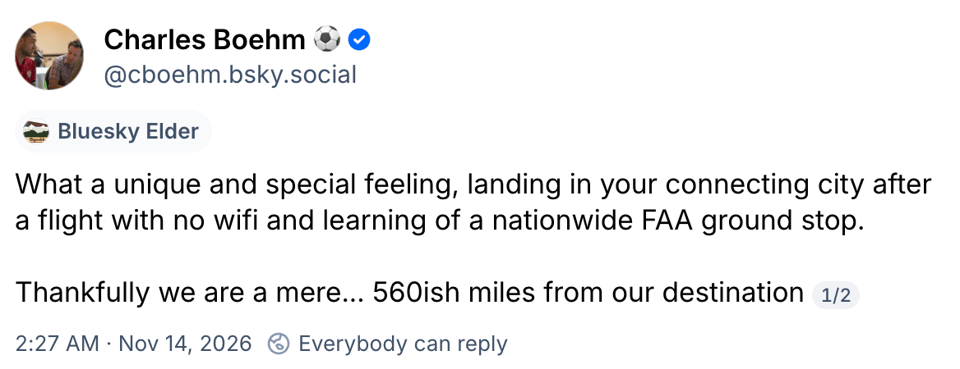
On November 14, the FAA experienced cascading failures that led to a full ground stop for air travel within, to, and from the US for about five hours, stranding passengers including past podcast guest, soccer writer Charlier Boehm (below).
The internet became a thing normies used while I was in high school and by now it feels like something that just exists. We connect to it, we use it. But the internet isn't a single thing. It's a collection of undersea cables, data centers, relays, servers, cloud services, etc. What we experience as a “digital world” is actually a web (pardon the pun) of interconnected systems, operated by a relatively small number of enormous corporations.
There are four factors that help me put the recent surge of hacks and outages in context and lead me to believe we’re at the front end of this curve:
The infrastructure of much of the internet is old and not especially secure
AI is making experienced hackers more effective
AI is also lowering the bar for entry for inexperienced and/or aspiring hackers
Major corporations have laid off tens of thousands of experienced engineers and are replacing them with under-tested AI
First, a surprising amount of the internet’s infrastructure is old and not especially secure. You ever go to the hospital and see the nurse or doctor sign into their workstation and say to yourself “damn, is that thing still running Windows XP?” Well, that’s what the backend of a lot of the internet is like.
Much of the hardware and software that hosts the internet is beyond “end-of-life,” a term used to describe products that no longer receive updates and patches from their manufacturers. These devices are more vulnerable to hostile actors and they are increasingly taking advantage.
The internet as we know it simply wasn't built for the load it bears nor the threat(s) it faces today. But the cheapest thing to do with an old system is leave it alone. So we do. But it feels like things are starting to break.
AI is Part of the Problem
For experienced attackers, AI is a multiplier. Instead of entering 20-30 commands an hour someone using an AI agent can attempt thousands per hour. The ceiling is no longer human capacity but a token budget. To be clear, I haven’t tried my hand at hacking, but I reckon it would be faster at helping a bad actor brute force a password than whatever the old fashioned way was (see below).
The practical consequence is that experienced bad actors are able to scale up their efforts and reach.
Maybe more importantly, AI is also collapsing the barrier for people who aren't experienced at all. Online forums and Telegram chats used to be full of amateurs running break-in tools they didn't really really understand. For IT folks, they were likely easy to spot and limited in the damage they could do largely because they didn’t know what they were doing. That ecosystem is being replaced by "vibe hacking." Instead of hunting with a tool someone else built, a beginner tells an AI model what they want in plain English, and the AI writes it for them. Then, they can ask the model follow-up questions and they keep going until the tool fits the specific target in front of them. No expertise required. Just a conversation.
Here’s an example where nine South Korean banks were allegedly hacked by a Chinese 20-something with limited technical experience using an AI tool called ARTEX.
From Reuters:
This assessment is made with moderate confidence based on the use of the Chinese-developed tool ARTEX and observed Chinese-language prompts.
CrowdStrike said the individual also asked Claude where threat actors typically sell Korean data breach information and sought assistance in finding Korean Telegram data sales groups.
In another session, the person also requested Claude to create a security researcher resume, which included details such as a Telegram account, age, educational background and a location in Maoming, a city in the southern Chinese province of Guangdong, which CrowdStrike said likely belonged to the attacker.
In summary, a 25-year-old with no real technical background, used AI to construct a fake security-researcher identity, seek out online markets for stolen data, and used it all to break into at least nine major South Korean banks.
So attackers are now faster and there are more of them, which brings us to the part that is self-inflicted.
At the same moment, a lot of companies have shed thousands of jobs in their hasty embrace of AI. Ford reportedly replaced human quality inspectors with an AI alternative that included putting over 900 AI cameras in its plants. But they found the AI output inferior, and began hiring the human engineers back. Microsoft laid off tens of thousands of employees this calendar year and according to Bloomberg is offering buyouts to up to 60,000 more.
According to an industry tally by TrueUp, there have been 206,877 layoffs in the tech sector this calendar year. That works out to roughly 649 people per day.
There’s a recursive irony at the center of this. The organizations that most depend on stable, secure software are removing the human layer that used to catch its failures, and trusting AI to test the AI-generated code that is itself producing more defects. In essence, the defenders are thinning their own ranks at precisely the wrong moment.
These four forces don't operate in isolation.
The result is an internet that used to feel seamless to the people using it, is being held together by systems that are older, more exposed, and less carefully checked than almost anyone assumes, and we’re likely to see massive hacks and outages become more common as it all buckles under its own weight.