It's the Housing, Stupid - Part II
Readers sound off on housing
A fortnight ago I wrote about how housing is the great domestic political issue of our time.
I actually didn't use that “domestic political issue” modifier but after a reader chimed in about the urgency of climate change, specifically referencing wildfires, the recent flash flood incident on the Nepal/Tibet border, and predicted future forced climate migrations, I was compelled to concede. “Fair, fair. You have a really good point.”
After making that concession, this week I want to pick up that thread and do two things:
Share and respond to some reader comments about that newsletter
Provide more sources to frame your thinking about housing
For what it’s worth, I am not to the solutions part of this and may never get there. And that’s fine, honestly. The situation wasn’t created overnight and it’s not reasonable to expect a comprehensive set of policy solutions in a thousand word newsletter.
With those caveats out of the way, let’s get to it.
Subscribe nowSeveral of the replies were of the “welcome to the party/we tried to tell you so variety.”
J.K. led a Tacoma nonprofit that worked directly with economically vulnerable households on establishing financial stability and accessing public benefit programs. Their response was succinct: “Welcome, friend.”
Similarly S.M. said “I tried to tell you this in 2014. Housing is a human right.”
K.G. sent along a report, The State of the Nation's Housing 2026, from Harvard’s Joint Center for Housing Studies, echoing some of the data trends I cited in the newsletter, especially in laying out who high housing costs are hitting hardest. The study defines a household as “cost burdened” when it spends more than 30% of its income on housing and “severely cost burdened” when that figure exceeds 50%:
20.7 million homeowner households (24 percent) were cost burdened at last measure in 2024, spending more than 30 percent of income on housing. This is an increase of 4.0 million households since 2019 and includes an additional 2.5 million severely burdened homeowners, bringing the number that spend more than half their income on housing to 9.6 million households. A large share of the increase in burdens was among homeowners earning under $30,000, who were burdened at a record-high rate of 75 percent in 2024.
Again, unless you are living in a low cost of living pocket out there in Middle America, if you’re in the bottom two income quartiles in the US, saving is likely an impossibility. And if you’re in the bottom quartile seventy cents out of every dollar you make goes to housing costs, especially given the median rent in the US is $2000 per month according to Zillow.
Most poignantly, I got a lengthy update from a former student, E.F. They talked about their own struggles with housing instability as a child: repeated moves, informal housing situations, and crashing with relatives. One line that really stuck with me was “I am twenty-six now, and before I was fifteen and in your classroom for the first time I had already moved at least thirty times.”
Thirty moves before the age of fifteen?
Think about all the disruption this would cause. When you move you lose your networks; commutes get longer and more expensive. New moves mean application fees, first, last, a new security deposit, and utility hookups. God knows what happens with things like voter registration and honestly if you’re in that boat, you likely don’t care. This is why political parties who want to disenfranchise working people push voter purges, exact match schemes, and other procedural hurdles to maintaining registration.
In regards to the book recommendations, M.D. echo’d my take on The Color of Law. “I remember reading The Color of Law when it first came out, and holy s**t what an eye opener. I've recommended it to so many people over the years.” Even if you’re not going to take my or M.D.'s advice, the interview below, from Goldman Sachs (of all places) gives you the broad outlines of what the book is about.
Like I said at the top, I am not offering solutions today. But I think it’s important we get our heads around how bad it is out there for many (or frankly most) people. We need to understand how the financial pinch is exacerbated by other societal trends: rising energy costs, rising healthcare costs, and wealth hoarding by America’s oligarchs that is at the highest levels since we started measuring it.
We also need to level with ourselves. If you're roughly my age you hit the generational lottery when it comes to housing.
I graduated from undergrad debt-free, thanks to a part-time job at UPS and the Air Force Reserves. It took me six years, but I did it. I went through grad school when student loan interest rates were capped and paid those loans off nearly a decade ago.
My wife and I kept our jobs through the 2008 Recession and had enough cash for an FHA assisted downpayment to buy a lovely four-bedroom house for $155,000 at the bottom of the post-crash market. We refinanced in 2023 and currently have a 3.5% fixed rate mortgage. Today, there’s nothing in our old neighborhood under three times that price or a mortgage available at close to that rate.
I worked hard and made some good decisions but I was also lucky as hell.
If you’re about eight seconds older than me, none of what you think you know really applies out there anymore. The rules and costs are just different. It’s not like y’all think it is out there and we gotta stop pretending it is.
More Housing Centric Recommendations
I’ve listened to Radio Open Source, a Boston based podcast hosted by journalist Chris Lydon for nearly two decades. If you listen to an episode of Open Source, it’s largely the template I use when hosting my own show. In 2018, they had a conversation about gentrification and displacement that I think about regularly. It’s because of this episode that in my own discourse I try to be intentional about referring to them as distinct, related, societal phenomena. The conversation is ostensibly about Boston but it’s also about Seattle/Tacoma, SFO/Oakland, or any major metro experiencing gentrification over the last decade or so.
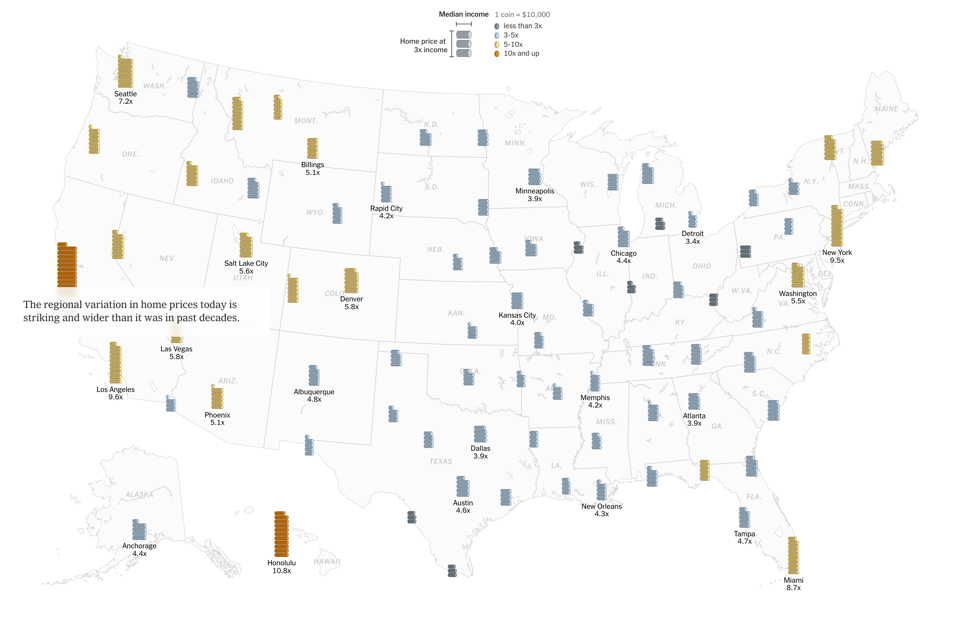
Earlier this year the NYT ran an opinion piece called America Needs to Build More Houses. It’s an excellent work of data journalism that lays out how we got here. The set the table for the avalanche of data in the articles:
In the second half of the 20th century, it was easy for many young Americans to imagine buying a home early in their adult lives. Then something changed: The nation kept gaining population but stopped building enough homes to keep up.
The mismatch between supply and demand has caused home prices to soar in the 21st century, damaging both our economy and our social fabric. High prices prevent families from buying homes, feeling fully invested in their communities and building wealth. They increase generational inequality and breed cynicism among people in their 20s and 30s.
The article also talks about solutions, mainly long-term ones, around in-fill and zoning reform. It and the podcast are worth your time.
If you have further thoughts about this, feel free to opine. Next week you’ll either get more on housing or a piece about how Russian hackers got the drivers licenses of 153 million people in Canada and the US.