
Ranking the National Book Awards Longlists
Ranking fiction and translation titles nominated for this year's National Book Awards.
This newsletter is free to the public, and appears infrequently due to my chronic illnesses. If you would like to support me, you can subscribe to my podcast's Patreon here. Although I'm on leave, this still helps. Otherwise, feel free to send me a couple bucks through Ko-fi.
I have a mixed relationship with book awards season: I eagerly await the Booker, National Book Award, and National Book Critics Circle lists each year, but typically find myself disappointed. (I’m a member of the NBCC, though I don’t vote for those lists; still, I tend to prefer their selections.) There are just too many books published each year and people’s taste is too idiosyncratic for mass consensus. As silly as the Oscar race is, I think the long campaign process makes it more palatable to me. Yes, it may seem absurd that a certain actor in a film you don’t like wins award after award in a given year, but at a certain point, you just accept the inevitable. Book awards feel more random and, to me, often more aggravating.
I decided to skip reading the whole Booker longlist this year, mostly because I felt dissatisfied with many of the selections. That dissatisfaction has been borne out so far in the shortlist, which I am reading in full. I chose, instead, to delve into the NBA fiction and translated longlists, though I didn’t make an attempt to read all the titles. I happened to have a lot of these galleys, was able to request a few more, and purchased a few books that looked interesting to me.
So I can’t comment on these lists as a whole, especially the translated list, of which I’ve only read 6/10. Out of what I’ve read, though, I’m somewhat underwhelmed. I only disliked one book I read from the translated list, but I wouldn’t have nominated most of the titles. The fiction list has some real standouts, but also some titles that really underwhelmed me. That list also features a novel I chose not to read, Passengers, by Alexander Maksik. Maksik published a novel in 2013 that told the story of his affair with a student when he was teaching as at an American high school in Paris. He admitted to the affair (“affair” does not seem like the right word to use here), but that didn’t stop the novel from being widely acclaimed. Indeed, he went on to “attrac[t] strong interest among publishers for his second novel,” landing a deal with Knopf, one of the most prestigious imprints in American publishing.
Meanwhile, Elissa Strauss wrote in Jezebel at the time that the student in question “is disgusted that he is getting literary kudos for re-telling her very real story. She said Maksik included a number of very personal things she told him in confidence in the book, and that she has worked for the past five years to move past the shame and guilt she felt as a result of the affair only to re-encounter it all again in a widely praised novel. Maksik never asked her for permission.”
Obviously, nominating a book by an author who has admitted to preying on his own teenage student is a vastly more serious crime than nominating books I don’t think are very good. It’s extremely demoralizing that this story has been forgotten, or that the judges simply don’t care.
(I also haven’t read The Renovation because I didn’t want to pay for so many hardbacks! I am going to get to this one at some point, I’ve heard great things.)
Below, I’ve ranked the books I’ve read on the longlists, and written short blurbs with my thoughts on the books. I hope this leads you to find some titles you enjoy.
You can find all the longlists here.
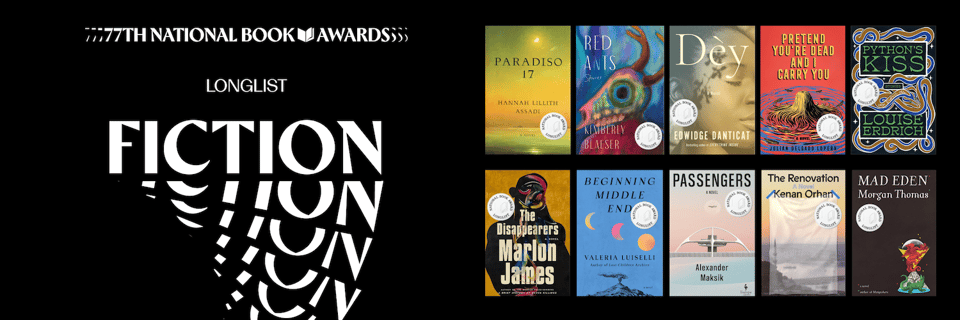
Fiction
Mad Eden, Morgan Thomas
This and the below title, Beginning Middle End, are essentially tied for first place for me; Buttondown’s numbering function does not, however, allow for that, so I’m placing this book first as a gesture to its originality. Mad Eden is written in the voice of Ro, an autistic, nonbinary and trans person, who works at a nonprofit that facilitates gender care for people in red states, including minors. Thomas has previously published a collection of short stories, but this is their debut novel, and it’s astonishingly assured. The relationship between Ro and their partner, Liam, is deeply nuanced and complex: Ro often struggles to communicate or connect, sometimes in ways that are very difficult for Liam to deal with. Thomas never judges either party or takes a firm stance on whether the relationship is working, letting the reader interpret for themselves. The writing from inside the experience of autism, as well as description of the persecution of gender-nonconforming people in America today, are specific and visceral. There’s so much more to say about this brilliant book but I’ll stop here. It’s scandalous this didn’t receive reviews outside the trades; the NBA judges did readers a service by bringing attention to this title.Beginning Middle End, Valeria Luiselli
This was my first Luiselli and I loved it. The main character, a writer recovering from a recent divorce, travels throughout her mother’s native Sicily with her precocious tween daughter.1 Her daughter is fixated on returning an ancient Roman mosaic that their grandfather took out of the country to its rightful place, though she can’t decide where it ultimately belongs. The mother and daughter read classics together over the course of their trip, making this a wonderful companion to this summer’s biggest film, The Odyssey. Threats of volcanic eruptions and wildfires also follow them across the island, reminding them and the reader of the state of the physical world in the present day. Luiselli’s prose is spare, heavy on dialogue and written in fragments. Every image is so carefully selected and so vivid. I loved this book.Pretend You’re Dead and I’ll Carry You, Julián Delgado Lopera
I found this book somewhat difficult to get into because Lopera uses a lot of Spanish in his text—a fully legitimate choice, but one that will be challenging for readers who, like me, speak no Spanish at all. But I adjusted relatively quickly, and got sucked into this tale of a father and daughter, Ignacio and Valentina, in Colombia. Lopera alternates between Ignacio’s adolescence in the countryside, where he grew up with an abusive father and clandestinely explored his urge to dress up as a girl and desire for boys, and Valentina’s adolescence in Bogotá, where she lives with her depressed father in the wake of her mother’s death. This novel is perhaps a bit overfull, and I found myself drawn more to Valentina’s sections, maybe just because I found her easier to relate to. Ignacio’s childhood is tragic, and Lopera shows exactly how he absorbs toxic ideas of masculinity too deeply to ever escape them, even when cross-dressing as an adult. (It seems plausible that Ignacio would identify as trans—like Lopera—or nonbinary in another context, but that is not the context in which he exists.) I think this book’s greatest accomplishment is that it shows Ignacio’s failures as an adult, as a husband and father, without crucifying him: we can understand why he’s in so much pain while also wishing that his daughter were in a better situation. Valentina loves her father but her father does not care for her practically or emotionally. It’s tremendously painful to read.Paradiso 17, Hannah Lillith Assadi
This novel is based on the life of Assadi’s father, who was a child in 1948 during the Nakba. The character in this novel, who like Assadi’s father was forced out of Palestine with his family at that time, lives with his family in other parts of the Middle East before traveling to Italy to study engineering. When his father dies, he no longer has money to study, and becomes a salesman; eventually, he winds up in America. Assadi’s prose is gorgeous, fully embodying this very sympathetic but deeply flawed man, constantly aware of the inevitability of his death (which takes place at the beginning of the novel) even as she chronicles his life. The trauma of his childhood exile never leaves him, a trauma that his American wife can’t ever comprehend, making him an emotionally and often physically absent husband and father. The creation of this book is obviously, though, a great act of love. 300 pages is a bit long for a novel that doesn’t really have a plot, but that’s a minor criticism; I was swept up in this.Python’s Kiss, Louise Erdrich
Here we arrive at books I would not have nominated for this award, though in this case, I liked this book very much. Erdrich is an author I always love to read: she’s a master, and many if not most of the stories in this collection demonstrate that. There are standouts here, including “Python’s Kiss” and “The Hollow Children,” that have stayed with me for many months after reading. But I also think there are some real duds, chiefly her forays into science fiction. I love that she has such a wide interest in different genres and writes in so many different forms—I just didn’t like these particular stories much at all. Given how many other excellent books are out there, this would have disqualified this one for me, though I do still recommend it.The Disappearers, Marlon James
Those of you who follow me on Instagram will know my opinion of this novel is much less positive than most people’s (especially Dwight Garner’s!). But I do admire a lot about it and I’m happy so many people are having such a great experience with the book, so I’m not exactly mad about it showing up here. I do kind of wish it had only gotten on one of the Booker or NBA lists just to make room for something else, especially since it seems pretty likely to win the Booker, but it’s hardly the end of the world.Dèy, Edwidge Danticat
This is another book I don’t think is bad, but whose inclusion on this list somewhat baffles me. It’s a very solid book—Danticat is an excellent writer—but it never really accelerates into a second gear where I as a reader feel true excitement or engagement with a text. The story follows a woman who witnesses a mass shooting at a mall and then struggles to tell others about her experience. I admired how Danticat fused this American form of violence with writing about violence in her native Haiti, but the drama of the novel, particularly in regards to the main character’s husband and child, never really pulled me in.Red Ants, Kimberly Blaeser
I’m afraid I didn’t care for this collection of short stories at all. There are a few standouts that I thought were strong, but they’re overshadowed by many more that I found overly opaque, written less through drama than through extended narration. This stylistic choice didn’t engage me at all. I did wonder whether some of my lack of engagement was thanks to Blaeser being Anishinaabe, and cultural references going over my head; this is certainly possible. But I’m sorry to say that I just don’t think this book is very good.Like what you’re reading? Subscribe below.
Subscribe now
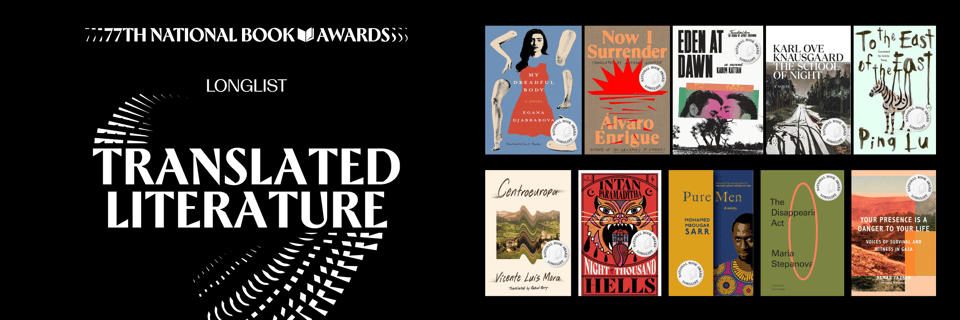
Translated Literature
Now I Surrender, Álvaro Enrigue, translated from the Spanish by Natasha Wimmer
I read this earlier this year and wrote about it on Instagram at the time. As I said then, this is a long, messy book that could have used editing. Perhaps that sounds a bit too close to my description of The Disappearers. Unlike that novel, though, Now I Surrender builds as it goes along: yes, it’s too long, but it reaches its agonizing apex in the last 100 pages of the book or so. While I do wish it were a bit shorter, Enrigue’s conclusion, which sees the last Apaches surrendering to American forces, builds on most of what came before, retroactively justifying the majority, if not the entirety of the novel. The final pages are a heartbreaking elegy to this people and culture that have been destroyed by colonialism and greed. Though the book is flawed, its poetry and pain have stayed with me over this year, and I’m glad it’s on this list.My Dreadful Body, Egana Djabbarova, translated from the Russian by Lisa C. Hayden
It’s hardly surprising that I responded so strongly to this book, which recounts the narrator Egana’s experience of chronic illness. After muscles across her body begin to cramp, becoming permanently rigid, affecting her speech, gait, and more, Egana is finally diagnosed with generalized dystonia. Her disability paradoxically frees her from the patriarchal expectations of the female body that Djabbarova also describes in this novel, which is separated into chapters named by body part. The women in her family, Azerbaijanis living in Russia, work tirelessly at the behest of their husbands, limiting their speech as well to conform to patriarchal rule. Egana, already rebellious because of her determination to write, is also partly freed by her body’s limitations, a painful conundrum Djabbarova doesn’t try to reconcile in this short, brilliant novel.Centroeuropa, Vicente Luis Mora, translated from the Spanish by Rahul Bery
An undeniably enjoyable novel, Mora’s book takes place in 19th century Prussia, in which an Austrian newcomer, the first to privately own land in the district, finds more and more frozen corpses of soldiers from past conflicts as well as conflicts that have yet to take place (Nazis, Roman soldiers, and so on). Mora’s first-person narration is playful, jumping back and forth in time, recounting the narrator’s relationships with his new neighbors, his conflicts with the local government (which has no idea how to deal with these bodies), his past courtship of his now-deceased wife, and more. I did wish that Mora had pushed his conceit a little further: the conceit is wonderful, as is his writing, but the book is short on action. The final twist was also better done, in my view, by a more famous author in a novel that I won’t reveal for fear of spoilers. Still, an enjoyable and entertaining read.The Disappearing Act, Maria Stepanova, translated from the Russian by Sasha Dugdale
I enjoyed this short novel, about an author named M who, like Stepanova, has left Russia as a result of its war against Ukraine. There’s not a whole lot of action here—M wanders out of her own life thanks to train delays, finding herself in an unfamiliar city, intrigued by a strange man and finally fascinated with a traveling circus—but Stepanova’s writing is pristine and she is good at evoking the ennui of an author who’s tired of being known to the public. Plus the circus is fun. Not a book I’d have nominated, but an enjoyable read.Pure Men, Mohamed Mbougar Sarr, translated from the French by Lara Vergnaud
This was a fascinating read, but perhaps one that doesn’t fully work outside of Sarr’s native Senegal. It follows a professor of French literature who becomes fixated on the murder and violent exhumation of a gay man near Dakar. The exhumation is filmed and goes viral, leading people like his father and their imam to declaim on the horrors of homosexuality. Most people in this society, Sarr suggests, believe that gay men should not be allowed to be buried in Muslim cemeteries; death is too good for them. He investigates the professor’s own internalized homophobia as well as the homophobia of Senegalese society at large. There’s much to be gained from this novel on a sociological level, but I ultimately found it a bit too didactic. This makes sense given that Sarr was undoubtedly trying to make an argument to Senegalese readers; for Anglophone readers, it’s more interesting politically than as a literary text.To the East of the East, Ping Lu, translated from the Chinese by Jeremy Tiang
I’m sorry to say this book just didn’t really grab me. Normally I love Tiang’s translations (he’s a great translator but I also think he makes great choices about what to translate), but this book felt like an early draft of a novel to me. In this book, the wife of a businessman from Taiwan travels to Beijing to try to find him, and we hear both their stories. The wife’s sections were very good, but there are also long sections of her writing, which consists of a story set centuries earlier in Chinese history; unfortunately, I found these sections incredibly tedious, and I wanted a bit more from the other parts of the drama as well.
Bonus
A Dead White: An Argument Against White Paint, Wendy S. Walters
I did not even begin to try with the nonfiction list: those books are too damn long and I only had one galley. That happened to be this book so I gave it a whirl. And it was great! It’s superficially very funny that a book about white paint is on the NBA list, but Walters is brilliant and this is a great read. She doesn’t make one single argument, instead letting her curiosity rove around lots of topics and associations. I didn’t agree with every argument she made, but it was hugely fun watching her make them. A good time, if you’re into this sort of thing.
Luiselli and Alvaró Enrigue, another longlister, got divorced several years ago. The details of their family composition are fictionalized in Enrigue’s book (as I recall, he attributes two children to the marriage, with an older son from a previous relationship; in reality they have one daughter together), which makes it tempting to view Luiselli’s book as a more factual record. In fact, I think it’s probably impossible to conclude much about their relationship from either. ↩

