
Wishlist Woes and Post-Cozy Problems: Danchi Days' Low Steam Sales
Hi all! I want to talk sales performance today. Again, I'm really thankful for everyone who's played and enjoyed Danchi Days so far! As of posting, there’s still 5 days left in the 10% off Steam Launch Sale, so please check the game out!
Today is a drier post, it's all about financials. Maybe you'll find this interesting as a player, or useful as a developer.
If you don't know who I am, I'm Melos Han-Tani, and I've made a bunch of games under Analgesic Productions like Anodyne and Angeline Era. Danchi Days is my most recent game, under a new studio (gingham games).
Underperformance
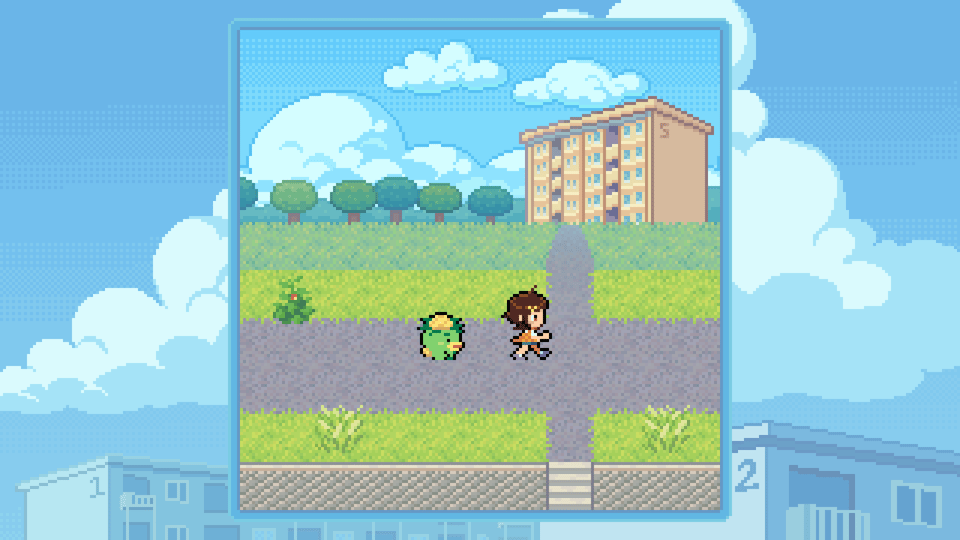
My latest game on Steam is Danchi Days, currently described as "Explore a small world filled with characters and a nuanced, bittersweet-yet-comedic story that reimagines cozy games with surprising mechanics. Visit slice-of-life 2000s Japan, convince 51 neighbors to come to a festival, even browse a retro internet!"
It released on October 29th. Danchi Days sales were about 1/3 of what we had expected over our first week. We went into release with about 55k outstanding wishlists (and 60k total adds), so I was aiming for at Week 1 sales of at least 5,000 copies, but we ended at around 1,500 PC copies.
This means that in the first year we can expect around 5,000 PC copies and over three years about ~10,000 total. Maybe more if we're lucky (big streamer, deeper discounts do better than expected), but it's pretty hard to beat statistics, in my experience. We'll do consoles for the fans on Switch/PS, but probably only break even on there in the long run.
Taking into account the development time, ads/marketing costs, localization costs, steam cut and sales prices, Danchi Days is unlikely to make back its development costs (~$200k). It's a disappointing blow to be sure, but due to last year's successful release of Angeline Era, and the fact we self-publish, it's not a studio-ender, thankfully. So you could view Danchi Days as a game funded by Angeline Era and some savings.
Wishlister Types and Conversion Rate
Danchi Days had a Week 1 Wishlist Conversion Rate (WL CR) of 2.2%. So for every 100 Wishlists (WLs) we had going into launch, 2.2 people bought a copy in Week 1.
This is a very, very low CR. 6-7% is acceptable - my game Angeline Era had this (launching at $25 with a 20% off sale).
By doing some analysis we can figure out what might have happened.
It's common knowledge that not all WLs are the same. A WL by a core fan during the game's reveal month will have a higher CR than one by someone who sees it in a showcase.
On the wishlist dashboard, Steam has WL cohort data that shows how many WLs from a particular month, went on to convert to purchases.
(* Note: You can't actually see how many outstanding (adds minus deletes) wishlists a particular month of wishlisting had, AFAIK steam doesn't let you know the cohort of a wishlist deletion. So that means that the CRs in this post are slightly BELOW their reality. E.g. I can check how many Wishlist Adds I got in a month, but not how many of that month's adds were deleted. Meaning when we calculate CRs (Wishlist Conversions / Wishlists) we get a slightly lower number.)
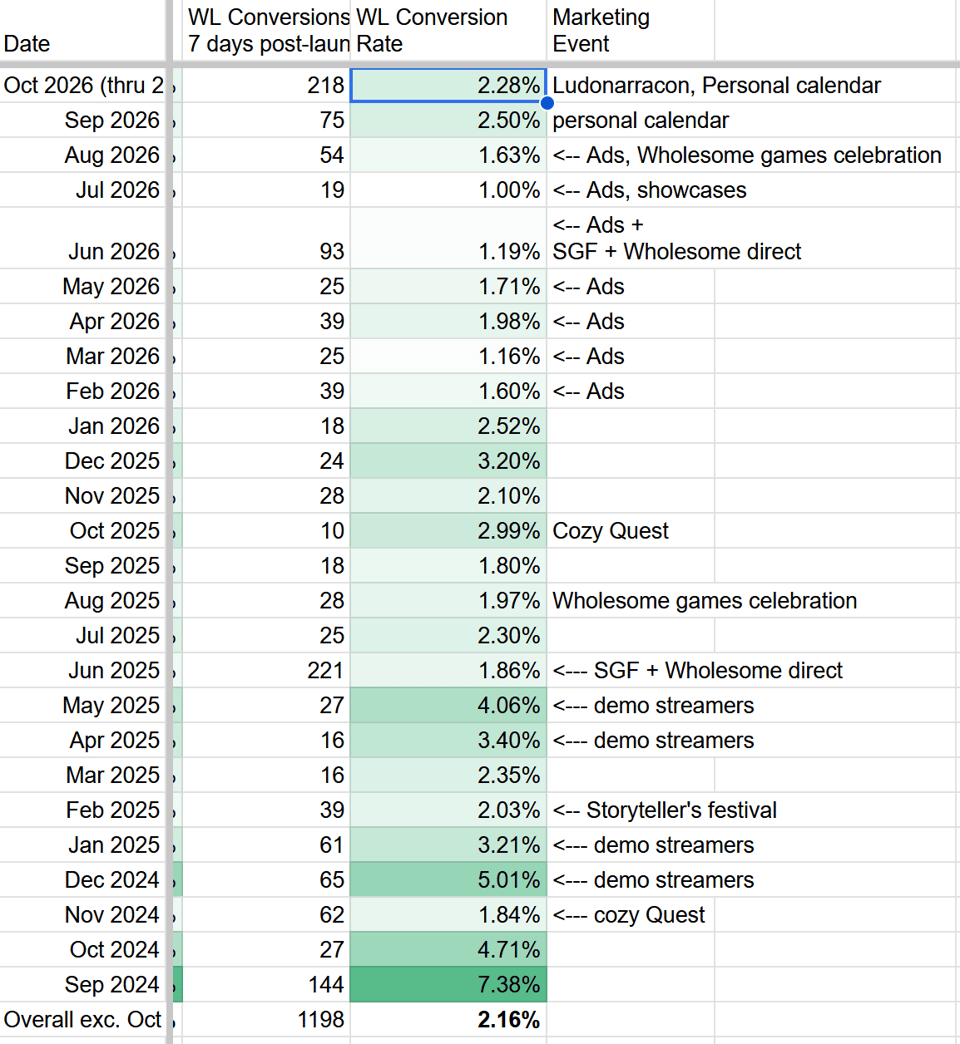
This chart shows week-1 CRs for Danchi Days, based on monthly wishlist cohort data
We had a 7.4% CR for the September 2024 cohort - our reveal month. Our worst CR is 1.0% in July 2026, meaning the Sep '24 cohort was 7x more likely to buy the game than someone who wishlished in July 2026.
Based on my data, there's about 6 types of WLs, and they have different relative likelihoods to convert. Let's give them ratings in terms of conversion likelihood:
100: Announcement-period i.e. people who love your past work are likely to buy your latest work!
60: Streamer audience. People who watch streams of early demos have higher conversion rates. They saw what the game is like, and might be in the right audience.
40: Personal Calendar. Steam personalizes who they show the game to now before your release. People browsing the personal calendar are looking to buy soon, and the game also might loosely fit their taste. But they're also WLing a lot of games at once.
40: Organic (no marketing activities). We had a few moments where we weren't doing anything beyond social media posts. People who wishlist in this period are likely to have some loose interest in the game from what they see, or they find the game by searching, But, they might not see or try what the game is like to play.
25: Showcase Viewers: Perhaps my biggest surprise after running numbers is how much lower this group is vs announcement period! I knew showcase wishlists tended to have lower conversion rates, but not to this extent! It makes sense though: Showcases are all about games that won't be on sale for a while, and people wishlist many things at once.
15: Ad Clickers: This was also surprising. In a now embarrassing post where I talked about the experience of running ads, I severely overestimated how well these would convert. People seeing the game through ads have an even lower conversion rate than Showcases, which surprised me, given that clicking an ad and reading the store page takes a lot of time! In other words I would never recommend spending on ads unless your game costs $25+ and is in a conventional genre with higher overall CRs. But then again, the paradox goes, if you're a conventional designer you're less likely to need ads as the whole economic system works more in your favor.
In other words, a WL from a longtime fan, on average, is 7-8x more likely to become a purchase, than a WL you can get from running an ad.
Now, going into release, with Danchi Days:
Our WLs were mostly from Showcases
A large chunk (10-15%) of WLs were Reddit Ad WLs, which were expensive to acquire and don't convert well
Below-average Steam Follower Growth
DD's Week-1 CR was 2.2%, while my other games had seen 6-10%.
For all games, Week-1 CRs have been falling year by year on Steam as WLs mean less and less, since all devs ask for them, and showcases are designed to make it easier to WL, making the WL more of a bookmark rather than an intention to buy. I already knew this, it’s called "Wishlist Inflation,", but the thing is that it hasn't fallen enough to explain DD's low conversion rate.
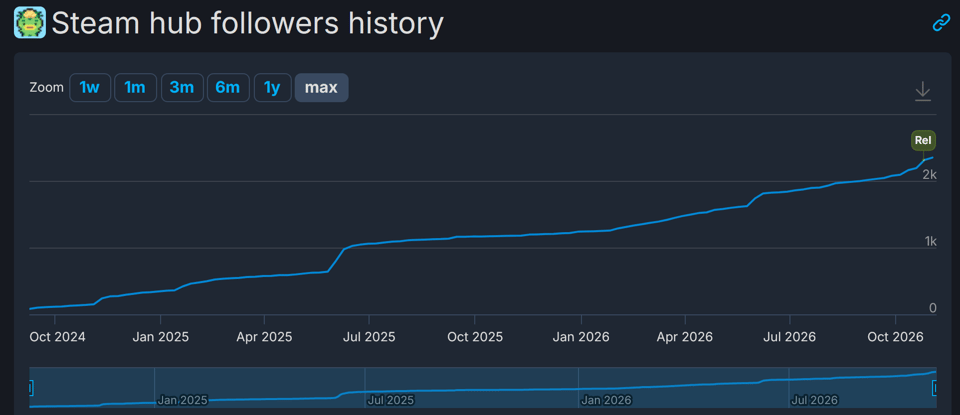
(If you're worried about WL inflation, a better tracker of success is your Steam Follower chart which you can see on SteamDB)
So what caused the low CR?
Well, here's a hint: take a look at our Steam follower growth which was pretty slow all throughout development. I think this is one hint... usually games that do well will see a spike in followers right before or after release, but ours only went up slightly. More on this later...
Common Misconceptions
There's some common theories as to why a game might not sell well.
Timing (If it wasn't released during this sale, then it'd do better)
Competition (There were too many other games coming out)
Pricing (If it was cheaper / if the launch discount was different, then...)
The Economy (People aren't buying games as much because X...)
I don't believe these are very big issues unless you majorly fuck up one of them (e.g. if I price Danchi Days at $60).
Timing matters much less than you would think for indie games, although you probably shouldn't launch during the winter or summer sale. For Danchi Days I checked other games around the same time as our release and they did fine.
Competition between indies, or indies vs AAA, isn't a huge issue either for small-scale games. It might seem like it, but if you've done influencer outreach or sold a few games, you learn that the world is really really big, even amongst indie games which make up less than 1% of worldwide game revenue. E.g. if you released a indie farming game during GTA week it probably doesn't matter because your streamers and players tend to not care about GTA.
The economy being bad is sometimes a theory for game sales, but you can disprove this by looking at other games that sell around the same time as yours, which I did and they seemed to have normal conversion based on their Steam follower count.
The above reasons aren't good to rely on because you can't really measure them, thus they fall more into the "reading tea leaves" category of explanation that tend to put the failure of marketing on a single, individual misjudgment, rather than a long-term failure of planning or a long-term misjudgment which is what happened with Danchi Days.
(However it is worth noting that maybe doing a 15% launch discount vs. 10% would have created more initial momentum for the game - but I still feel like the game itself is the bigger issue here)
Post-Cozy Genre Problems
Again, we did acquire around 60k WLs, coming out to 55k after deletions. With normal CRs, even with most WLs coming from showcases/ads, I'd still expect a max CCU (concurrent users - visible on Steam's dashboard and SteamDB) of 100. Instead we only hit 35-40.
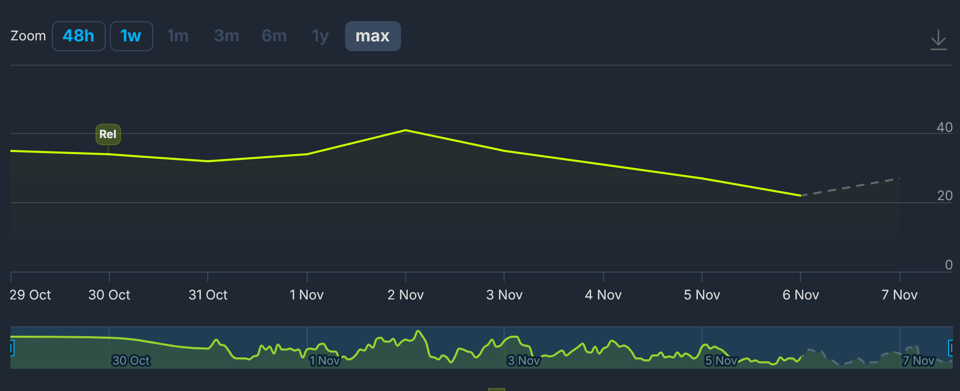
So, the WL count is there: but people weren't buying the game. What gives?
After some thought I concluded that the root cause is that Danchi Days simply exists out of too many genre conventions. Yeah, this is marketing 101 - pick a conventional genre to sell copies - but just remember that the whole time we were being misled by pretty good wishlist numbers.
My previous game Angeline Era got into barely any showcases, and the majority of WLs for Angeline Era accumulated organically over time and a few big influencer videos. Those WL sources all have stronger CRs than Ads or Showcases.
If DD didn't get into any showcases, it would have had less wishlists than Angeline Era. In other words, DD had less immediate organic interest.
Store Page Expectations
Pretend you're browsing a Steam Store Page. When people browse Steam Pages they are trying to parse the game and understand it through their gaming experience. We look for tags, skim screenshots for familiar UI, skim reviews, skim trailers. Thus a lot of players see Danchi Days and will think things like
It's a farming game
It's a cozy simulation game
It's a game for children
However, because the game doesn't actually have UI that definitively confirm these things, I think the game lands more in a mental category of "I'm not totally sure what this is but I'll keep an eye on it because I like the vibe." That applies to players and influencers, and in the latter case I think it's a harder sell to get more people to try it out because the game's kind of hard to pin down.
Danchi Days doesn't have much familiar UI that immediately stand out as belonging to a genre. This is because Danchi Days doesn't belong to a genre, except one I coined myself, Post-cozy, which perhaps predicted the fact that it would be a hard sell, lol...
It has elements of RPG cutscenes (but no battles/numbers), Visual Novels' focus on reading (but isn't a VN), 2D adventure games' exploration (but no combat), cozy games' aesthetics (But no quest logs, small businesses, money, farming), Fake OS interface games (but this is one part of the game, not the main focus), point-and-click narrative design (but isn't a point and click).
For example, in an RPG or action games, one of the core appeals is killing things, or making choices that matter, so when you see this on the store page you know what to expect. Danchi Days’ appeal is more organic - it’s in the act of playing the game and unraveling the relations between neighbors and your familiarity with the game’s internet and world - but you can’t capture that easily in a screenshot or a short video. There are some UI elements we can include to suggest this (the inventory, or a dialogue decision), but I think overall it’s not enough.
The story is perhaps a hard sell too, it’s intentionally very cheery but with realistic ‘darkness’ hovering over everything. It’s different from e.g. putting horror or creepypasta into a game very deliberately, and I think this makes the game’s story a bit more complex to easily market. We have to mention dementia in the advertising, or else it’s kind of misleading - but when you see dementia, sometimes people might be like “Huh, why? Isn’t this for kids or a happy game?” When a cozyish game does address the theme it might pick a more obviously sad aesthetic, but that doesn’t work with the kind of story we’re trying to tell.
Early Warning Signs
I'm pleased with how the game came out, but from a marketer's perspective I think the biggest mistake was putting too much stock into WL numbers and ignoring some signals that the game wouldn't convert well:
Though streamed by a lot of people, the demo and social media never had huge 'blow-up' moments on social media
Our organic Steam Follower growth was quite slow, even underperforming Angeline Era (which launched with less WLs).
Under the idea that "having the wishlists would be enough", I think how we approached marketing made sense: we did ads and showcases, occasionally some social media, and hit a number that seemed good for us.
What Could Have Been Done?
But I think in hindsight, we could have shifted more towards marketing angles that emphasize the mechanics of the game more, so viewers aren't assuming too much incorrectly about the game. Perhaps this could have been done with focusing more on the game’s quest design, and how talking to neighbors plays into the mechanics.
We’re going to try to shift in this direction, post-launch, but… I still don't think that a perfect social media plan would have saved the game's conversion rate, because it doesn't change the fact that the game's design is unintuitive to the average player. But perhaps we'd be looking at 3% Week-1 CR instead of 2.2%?
The other reason the conversion rate was lower is probably the art style, which I love, and which we intentionally picked for game design reasons and narrative reasons. But looking at it from the surface, the style is very cute and draws on sunday morning anime like Hamtaro or Ojamajo Doremi. The first thoughts of many friends and acquaintances and players is "cute!", which I think is correct, but with that comes subconscious associations with the game having a shallow narrative, or having traditional cozy game mechanics. Which has two effects: it attracts wishlisters who may be looking for more conventional cozy mechanics who might be less likely to buy when they look closer, and it drives away people who WOULD like your game's mechanics and design (because of assumptions about the art style.)
Personally, I think it’s kind of a blow to storytelling and games in general if you can’t use certain aesthetics for storytelling. Like, there is a game visual aesthetic for ‘philosophically and emotionally deep’ (it’s darker, featuring brooding or distant-looking characters, certain ways of writing and constructing sentences), but I always think that if we really want to push game stories we have to move away from signalling the whole theme of the game through the aesthetic alone. Of course, as designers and writers we can do that, and succeed artistically, but that’s also just not a method that works well with marketing and mass audiences.
For me, personally, I prefer for the game and story not to adhere to one genre’s conventions too much, because it gives more space for the game to reflect an uncertainty and complexity in our lived reality that then gets depicted in the game. But I also understand that it’s a method that leads to less mass appeal.
Changing Danchi Days?
Here is where it gets kind of scary. Each way to "fix" Danchi Days financial performance involves making it not like itself.
Change the art style: use a more normal anime style or something. I'm not above this if it fits the game , but it doesn't fit Danchi Days.
Change the game's genre: Add uh... farming! Friendship meters! Dating! RPG Battles! None of this makes sense, of course, and many implementations of these things are kinda rote. I don't have much interest in making people do rote things (e.g. giving someone 30 flowers to boost their friendship meter), I have an interest in designing a game with certain themes in mind and then picking the game mechanics that organically fit in
Change the narrative genre. Give Hoshino a knife! Have her fight Rio! Add a survival horror rug-pull! Sure these kinds of twists would probably increase the sales but they would also nullify the whole point of the work in favor of an approach you can find in tons of other games or media.
Change the marketing approach: a valid suggestion which would improve things somewhat.
Future plans…
I'm a bit tired to do TOO much, but my plan is to (within my capacity) just post on some consistent schedule with a new direction to the posting focusing on character interactions and concrete mechanics. I don't think this will fix everything, but it will probably lead to some increased percentage in performance versus doing nothing.
The Curse of Post-Cozy
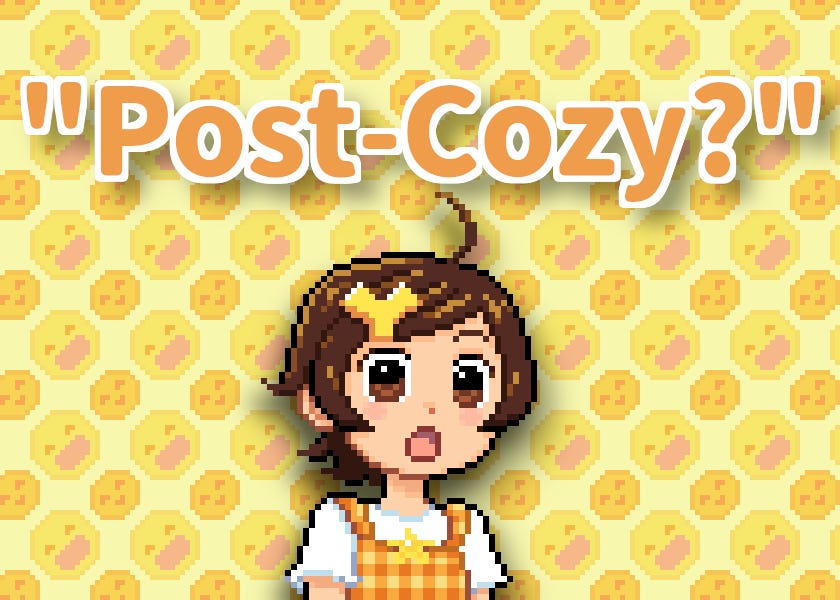
4 Reasons why Danchi Days is a "Post-Cozy" Game
Learn about this cute adventure where a girl revives a Japanese summer festival, inspired by MOON, Hamtaro, Earthbound
Linked above, a few years ago I wrote about "Post-Cozy" and Danchi Days being that kind of game - essentially a game with cozy visual aesthetics that otherwise has little in common with the genre.
We didn’t use this term much in the game’s marketing, it was mostly an idea from that one blog post. Maybe it could have helped if we pushed harder on it, especially since the game never had much core appeal overlap with cozy games?
I think it’s often glorified to be a game that is a ‘genre-changer’ or breaks new ground in some ways… but being the person or team to do that comes with a lot of challenges, especially in today’s game market.
I overestimated how much interest there would be for a game that draws on the visuals/narrative tones of cozy but doesn't include a lot of the genre staples (simulation, crafting, decoration, farming, friendship meters.)
In the 2020s, having the terms Cozy/Wholesome is helpful with marketing, but not as much as I thought. The terms didn’t create new genres, rather, they acted as a convenient shorthand for the above genre staples.
Anyways… thank you for reading haha. If you’d like to support this post, why not go check out Danchi Days’ Steam Page? It’s still on sale for 5 days as of publishing, until November 12th.
-
Hi Melos!
I’m a longtime fan of your work, first time commenter. I just wanted to start by thanking you for being open about Danchi Days’s first week sales (I bought my copy on launch day! Sadly, with parent life, it might be a bit before I get around to the full game🙇♂️). I’m sorry its sales didn’t meet your targets, and I hope that if it doesn’t pick up to your expectations, then at the least this post can be helpful for other devs.
I majored in marketing at university and am a game worker (doing 2D animation), so this kind of discussion interests me. I also think there are productive conversations to be had here, especially about Steam and its userbase, as well as the balance between designing a game to better fit market expectations and communicating what our games are about without greatly altering their artistic intent.
I feel you’re absolutely right when you say that putting too much stock in wishlist numbers was an issue. Though I’d also caution against an emphasis on Steam follower numbers. Unless you have data that tells you how many of your followers converted wishlists to purchases (Do you? Sorry, I’m not as familiar with the dev side of Steam), it might also provide a false sense of security.
Personally, as an artist and game worker, I think the game’s design and aesthetics work for the kind of experience you’re crafting. It’s just that, like Wanderstop, it seems like there’s something in its positioning as a “Cozy” game (especially one that bristles or pushes back a bit against that label’s baggage and assumptions) that fails to break through to sales within that market segment. (IMO all games should be able to tackle more mature themes and ideas! It’s vital for it as an art form!) Maybe there’s more overlap with Wanderstop that’s worth looking into to better understand what’s happening here.
Speaking of, when you define “Post-Cozy” in your linked post, you share a lot of older titles as influences. Do you see anything else in the contemporary space that you feel closely matches your idea of a “Post-Cozy” game? Have they all had success? How have they positioned themselves vis-à-vis “Cozy” as an identity, if at all? How have they been open about or deliberately hidden their more subversize elements? These could be good questions to consider as you tweak the game’s communications or messaging going forward.
One last thing: I want to be clear that these thoughts are all from my interpretation of your post here. You have much more data and insight, and I don’t know the full scope of the marketing work you’ve done pre- and post-launch. I hope my comment here is helpful, and offer my sincere apologies if not.
Wishing all the best to Danchi Days and to you and your team! ❤️
-
This is sad to hear. From the YouTube coverage I’d seen, I was hopeful Danchi Days would organically find a larger audience.
I’m switch only now, and will buy Danchi Days regardless when it’s ported, based on my love for your Analgesic work. But as a purely anecdotal contribution, what would have put me off otherwise is the art style, for the cover art specifically, it’s not graphically concise or bold, and doesn’t immediately explain the game’s content or purpose. The pixel art in the game is also SO lovely, so I’m unsure why you didn’t just use that style again for the cover art. Even on this page, the thumbnail for your post-cozy article is much more immediate and eye-catching.
I’m hesitant to say this as it feels unfair, but when I’m scanning through dozens of store listings, these days my eyes tend to dart past this style of anime-inspired digital illustration, under the assumption it’s AI slop. The appeal of small studios is that your work can feel a lot more hand-made and personal than AAA/AI games, and it’s probably a good thing to lean into that.
In terms of “packaging”, I think Consume Me does a great job of standing out amongst others when scrolling through loads of store listings, while also leveraging cuteness but with a suggestion there’s more going on under the surface.
Apologies if this is a bit of a repetitive message, but I say this as someone who often wishlists and buys games based on cover art alone, including Anodyne 2, which then made me a fan of your work. Angeline Era’s cover art is also stellar.
For what it’s worth, I’m really looking forward to playing Danchi Days when you do port it over. And fingers crossed it gets picked up by some big streamers in the meantime, converting to more sales 🤞
-
I have loved all your prior works and I can’t wait for this one to release on the switch because then I will eat it up and tell everyone about the hearty meal I just consumed!!! Keep up the amazing work!!!!

Reply: