
How To Dance With Time (Guts N' Gutters #21, June 2026)
What do you do when you need more time?
ISSUE 21
TL;DR (Too Long, Don’t (Wanna) Read)
Salvaged Relics, Vol. 1 Coming Soon!
Rise of the Flightless New Contributors! Launches Soon!
Letters from the Void #2 Welcomes a New Writer
Into the Gutters: Life in the Gutters or How to Deal With a Lack of Time
Gutter Buds!
Something Old: Ranma ½
Something New: Go back “Mother!”, Karrot Can't Sleep #1-2, and Magical Women
Something Borrowed: Sister Outsider by Audre Lorde
Something Blue: Wheel of Webcomics Zine Bundle
Sorry that June’s newsletter is late. My account on Buttondown was temporarily disabled and I was never given a reason why. But, we’re back!
WHAT’S THE WORD?
Fluid - having particles that easily move and change their relative position without a separation of the mass and that easily yield to pressure; capable of flowing; subject to change or movement; characterized by or employing a smooth easy style; available for various uses.
Salvaged Relics Coming Soon!
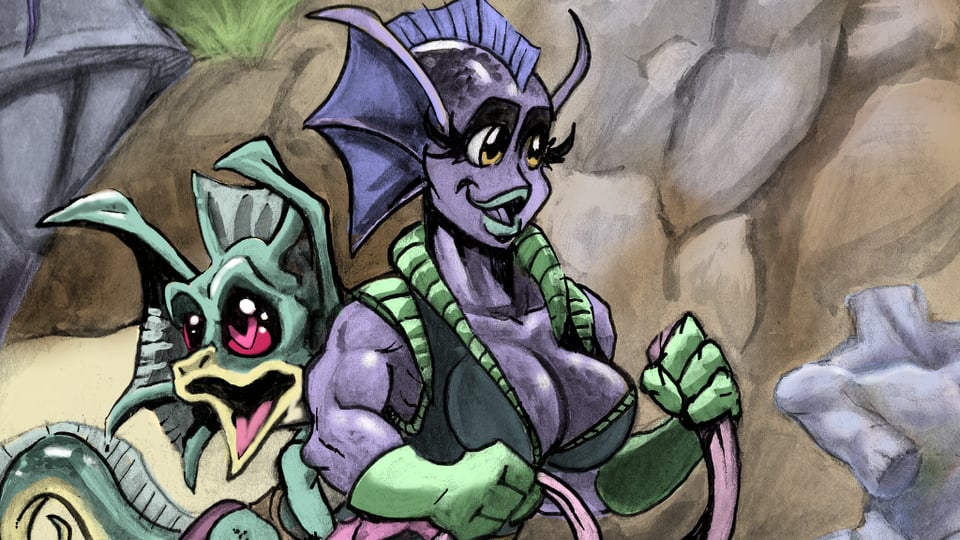
If you haven’t yet, follow the campaign so you don’t miss out on my short horror story!

Rise of the Flightless
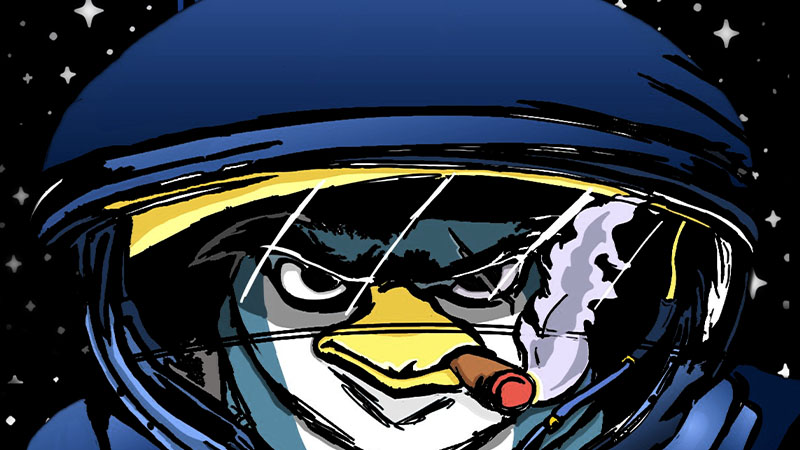
Our ranks have grown, and our resistance is stronger than ever. Please welcome the following contributors to Rise of the Flightless:
Daniel J. Torres (Tales from Toxic Pond, The Cutting Room Floor, Old Man Coyote)
David Monge Bautista (Old Man Coyote)
Frankee White (Who Killed Sarah Shaw?, Eat My Flesh Drink My Blood)
Quinn
Jimmy Gaspero (Penny and the Yeti, Made in Delco)
Fell Hound (Commander Rao, S.I.R.)
Unless something unforeseen happens, we launch on July 14th! Follow the campaign so we have a great day 1.
Letters from the Void #2
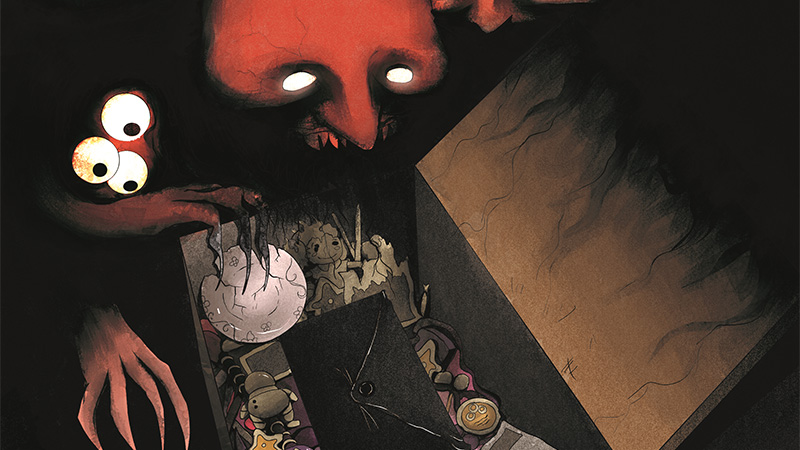
We’ve added a new writer to the book who will be announced at a later date. Followers of the campaign page will be the first to get any announcements, so if you need to know right away, that’s the best place to go!
Fugitive Pieces #4
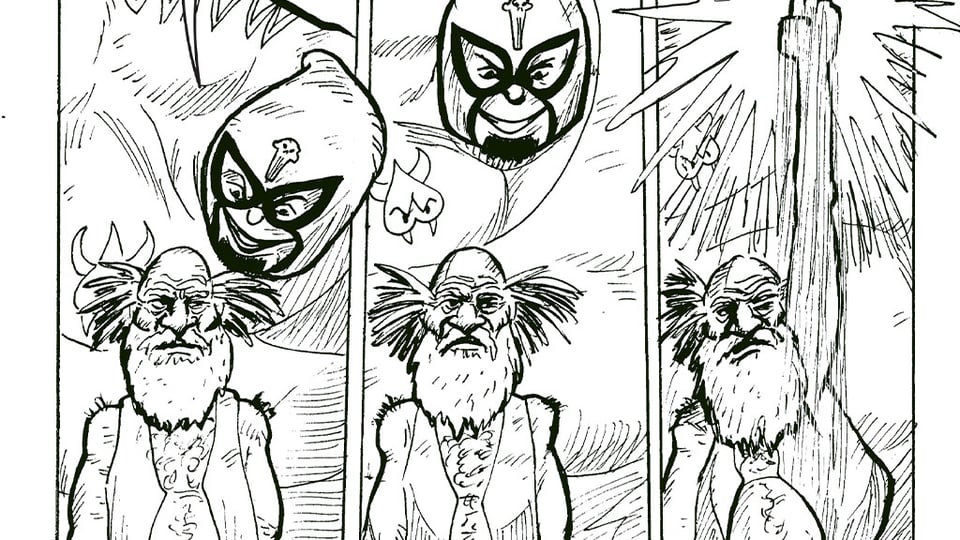
An Internet of Things comic Aaron Brown and I created years ago was published in the fourth issue of Fugitive Poems’ online zine series, Fugitive Pieces, and I lettered the first installment of KVGir’s new series, Meet Vecchio Rossi! Sign up for their email list at FugitivePoems.com to see get all future issues.
INTO THE GUTTERS
Life in the Gutters
Time’s been on my mind a lot lately. It’s shown up in everything I’ve been reading. In Tourmaline’s biography of Marsha P. Johnson, it comes in the form of memories. Johnson often misremembered events in her life. They lived in a sort of asteroid field, smashing into each other while Johnson lived in a glorious present. In Krista Burton’s Moby Dyke, a book half-memoir, half-journalistic account of the US’s last lesbian bars, it comes in the form of a woman yearning for her youth; a time when queer communal spaces were plentiful, and her friends were in close proximity. While chronicling a seemingly dying breed of bar, Burton reconnects with herself and her past while finding hope for the future.
Even my books can’t help me escape thinking about time.
There’s a bullshit idea called the law of attraction that’s prevalent in a lot of self-help literature. It states that people attract positivity and negativity into their lives depending on whether they have a positive or negative mindset. There are many problems with this concept; it’s just the bootstraps myth with a psychological glaze, and it infers that every tragedy stems from a lack of positive thinking. That being said, it’s times like these where I understand why someone could convince themselves it’s real. I’ve had time on the mind, so time has been following me, and feeling its presence breathing down my neck has led to a startling conclusion:
I have to back fewer of my colleagues’ Kickstarters.
This year feels–to me–like the gutter of a comic, that nebulous space between where the reader’s imagination fills the gap between two images. Simultaneously, this space contains nothing, yet multitudes. It will be different for each reader; it’s probably different each time they look at the page. The only things anchoring the gutter are the panels. They hold that sea of white, dance with it, and together, the two make a composition.
My life is in a period of transition. I’m looking toward the future, taking the next steps on my creative journey, and hoping to move on to bigger projects. Come Fall, both of my kids will be in elementary school. My youngest will move from preschool to kindergarten, and my oldest starts fifth grade. One will be entering a routine she’ll repeat for the next six years, and the other will be exiting that routine and preparing for middle school.
At the same time, I’ve been reevaluating my past; thoughts of what led me to this point, and where I, perhaps, wasted opportunities or moments. I even started researching my family history and have become something of an amateur genealogist.
Is my early career of political journalism something I should just leave behind, or a story I could use to tell some greater truth? Should I have gotten into fiction sooner? Why did I pursue a degree in music if I wasn’t going to fight for it more?
And the more relevant question: What would my career look like if I hadn’t backed so many campaigns? I could have already finished a miniseries by now, but I wouldn’t have made all of the connections I have now. The circle of friends and colleagues that surrounds me would be much narrower, less tight.
In Comics and Sequential Art, Will Eisner describes how the border or “frame” of a panel can be a powerful narrative device. This framing is a form of “nonverbal language” in comics that can draw the reader into the story’s environment. He likens the typical box-shaped panel to the reader watching actors on a stage, while different frames (or a lack of one) are the actors interacting with the audience.
“Whereas the conventional container-frame keeps the reader at bay–or out of the picture, so to speak–the frame [used in creative ways] invites the reader into the action or allows the action to “explode” toward the reader.”
By using the frame this way, the overall structure becomes more dynamic, fluid, and conveys more information than a box alone. In a way, the page’s scaffolding becomes nearly invisible as the reader is transported into each scene.
As I reflect, it’s this structure that feels missing right now. I’m searching for that thing that gets me to the next frame, but also feels exciting, like I’ve accomplished something. But how much time will that take, and when will I get to turn the page? It’d be nice not to feel this floating sense of promise.
Another book I’ve read recently has helped me make sense of my time in the gutters. Its author was on Adam Conover’s podcast, and his ideas about humanity’s relationship with reality, our ideal selves, and goals closely matched mine, but he went deeper than I’d ever gone. I requested it from my library the same day.
Four Thousand Weeks: Time Management for Mortals by Oliver Burkeman is a sort of anti-self-help book. It doesn’t batter the reader with words about productivity or efficiency, doesn’t preach that the only obstacle between the reader and success is themselves. It doesn’t blame them for not finding the time or effort to have everything they want. The simple truth is that there is no time to find. If humans are lucky, they live about four thousand weeks, and until science discovers a way to warp the laws of physics, that’s it.
Humans are finite beings; the reality is that everything a person wants to accomplish probably can’t be done. We will miss out on things. We will have to choose some things over others and deal with the consequences. Striving for some ideal situation to truly begin pursuing a passion means that valuable time will be wasted “trying to “get through” tasks in order to get them out of the way with the result that we live mentally in the future, waiting for when we’ll get around to what really matters and worrying in the meantime that we don’t measure up, that we might lack the drive or stamina to keep pace at the speed at which life now seems to move.”
I think I finally understand what Dr. Spain intended when he told this story. As Burkeman’s ideas have been bouncing around my brain, I recalled this moment, and the links began to form a chain. The man wasn’t sacrificing his success for the sake of others. He recognized the facts of the situation and chose to use that time for what mattered to him. His hard work didn’t mean anything if it meant less for him and those in his circle.
I’ve heard the typical “you have to make time for the things that matter” or even more extreme versions like Arnold Schwarzennger’s famous speech, I Hate Plan B, but the sentiment has never been expressed to me like this. It’s always been a subtle call to single-minded effort and transcending limits, but never to recognize my humanity.
I don’t need to find some way from panel 1 to panel 2 because that’s not how it works. I don’t need to escape the gutters; reality is the gutters. It's swimming in that nebulous place, not waiting for it to wash us onto shore. Humans don’t need to “find more time”; we are time. Each moment is a trade-off, and no gadget or method will likely ever give us back those used-up hours. As Burkeman puts it, sometimes things just take the time that they take.
Why do I need to back fewer Kickstarters? It’s not that I don’t cherish my community anymore or want everyone to succeed. I have to better use my time. The truth is that I’ve thoroughly swallowed the many pills of hard work and effort, and it’s been a core of my identity. Simultaneously, I care deeply about being a great creator and a great colleague. There’s a lot of love in my heart, but that’s made me a lifelong people pleaser. It’s gotten to the point where my time and finances are dedicated more to helping everyone, moreso than myself. I need to find a balance, a way to take more of my time for me and still be supportive, but recognize that I’ll miss out on some great books. Hopefully, my time will make more things that connect with people, and if not, I’ll at least not regret having made more art.
GUTTER BUDS
SOMETHING(S) OLD
Ranma ½ by Rumiko Takahashi
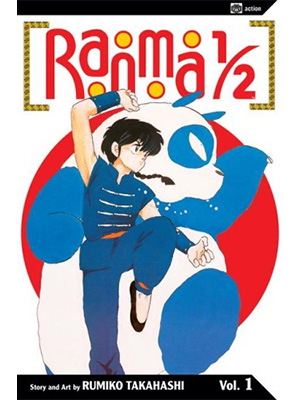
This series has always intrigued me as a person who doesn’t neatly fit into the gender binary and a lover of stories that play with gender. Ranma ½ follows a martial arts student who is betrothed to the daughter of his father’s dear friend. The only hiccup is that, after falling into a cursed pool, Ranma turns into a girl whenever he’s doused in cold water. After reading the first two volumes, I can safely say it’s delightful, hilarious, and I can’t wait to see how the relationship between Ranma and Akane. It’s also neat how Takahashi portrays nudity in this series because it’s rarely meant to be titillating, more often humorous than anything.
SOMETHING(S) NEW
Check out these campaigns by friends, colleagues, and things I just thought looked cool:
“Mother!” An anthology about Motherhood from Mothers
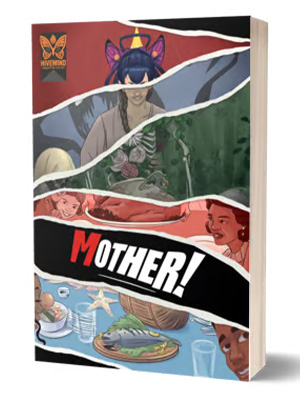
Mothers are often asked to take a backseat in the professional world in service of domestic responsibilities. In addition, motherhood can be seen as a liability in professional spheres. A father may be seen as a hard worker, dedicated to providing for his family, while a potential employer may view a mother as someone who is going to take frequent abscenes to care for sick children or potential future maternity leave they may not want to deal with. In the creative industry, taking long leaves can also completely halt a budding career, while the increased domestic duties can cause failures to launch on wonderfully talented creators.

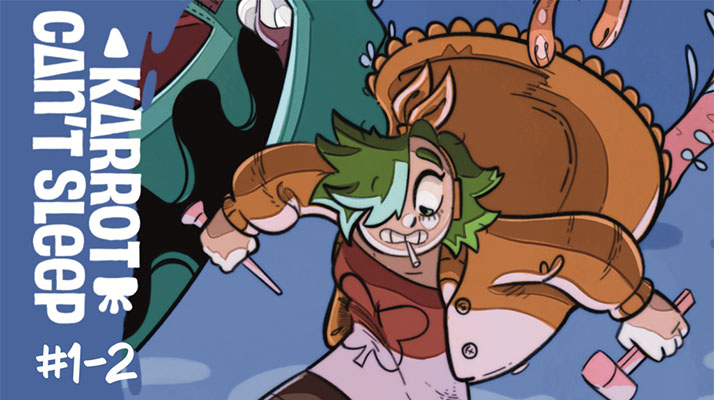
Karrot Kurtzburg is a sculpture student committed to ending her academic career on a high after four years of coasting through life. The plan is foolproof until she's visited by a Jackalope and becomes embroiled in a plot cooked up by a vampire from the dawn of time... Val.
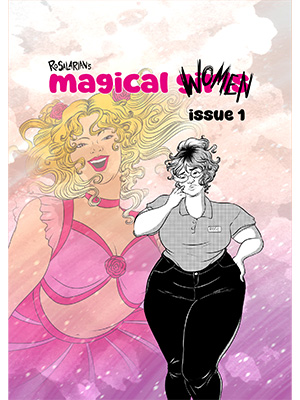
Magical Women is a story about a group of magical girls who failed to save the world 20 years ago, who are now trying to re-learn how to fight evil in their late 30s after the bad guys have taken over the world. It features a diverse cast of different colors, body types, sexualities, genders, disabilities, and basically all the kinds of things that make fascists poop their diapers.

SOMETHING(S) BORROWED
Sister Outsider by Audre Lorde
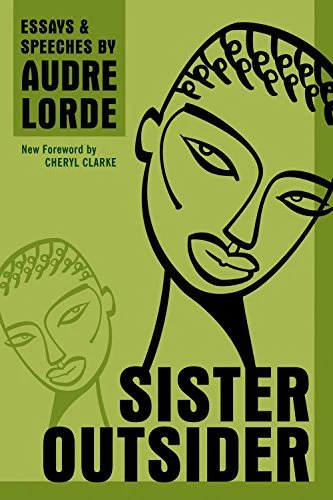
I think this book should be an essential read for everyone, but for creatives specifically, Lorde’s essays Poetry is not a Luxury and Uses of the Erotic and her interview with Adrienne Rich are amazing reads about the source of art and using emotion as a creative force. Lorde argues that in order to make theories, we first have to feel them, and that’s where poetry happens. It’s an excellent thought exercise for anyone looking to get deeper into their creativity.
SOMETHING(S) BLUE
Justice League: Dream Girls
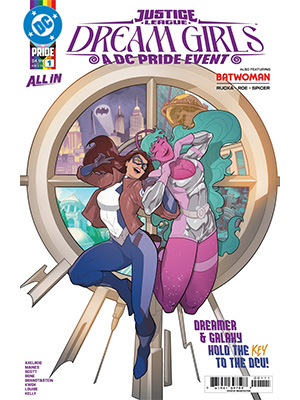
This year has seen an explosion of releases from DC featuring Jadzia Axelrod’s Galaxy. I picked up the first three issues over Father’s Day weekend, and it made me want to catch up on everything I’ve missed. Galaxy has to choose between being a member of the Justice League and protecting her best friend, Dreamer, whom the League has deemed a danger to humanity. It’s a scenario where any queer person can relate: to be accepted or to give up on something that means the world to you. I can’t wait to see how this series ends and learn more about Galaxy and Dreamer’s friendship.