Financial Symphony, Storytelling for Sonification course, Datarates tool
We're Miriam and Duncan, the duo behind Loud Numbers -- the studio that turns data into sound. You might know us from our podcast, our sonification tools, or our artistic work.
This is our highly irregular newsletter, which you're getting because you signed up for it -- likely via loudnumbers.net. It's free to receive, but if you need fewer emails in your life then there's a quick and simple unsubscribe link lurking in the footer of this message.
With all that out of the way, let's get started.
The Financial Symphony
Our newest project has just been released. It's called "The Financial Symphony", and it's a four-minute electroacoustic sonification where 11 years of UK business data drive the rhythm and volume of a live string quartet, while electronic pulses track payroll and payments in France, South Africa and the US. It was commissioned by PR agency Axicom for financial software company Sage.
We've put together a page on our website where you can hear the music and get more details on how the sonification system works. You can also listen to the track on Spotify, or watch the making-of film where you'll get a glimpse into our studios and our creative practice. Finally, you can also listen to Duncan chat about the project to BBC 5Live presenter Kathryn Stanczyszyn at this link.
If your organisation (or your client) is sitting on data with a story in it and you'd like to explore a project like this, then we'd love to hear from you. Drop us a line at hello@loudnumbers.net and we can go from there.
Learn Storytelling for Sonification
We're launching a new course! Following hot on the heels of our Create Your First Sonification courses in the spring, we've scheduled our first advanced course focusing on storytelling - which came out top in the survey we ran asking what you would be most interested in. The survey, incidentally, is still open if you want to share your thoughts.
The new Storytelling with Sonification course will be held over Zoom in two parts, on Monday 30th November and Friday 4th December from 1300 to 1700 UK time. In it, we'll go deep into our process and give you the knowledge you need to go from scattered bleeps and bloops to taking your listeners on an emotional journey that they won't forget in a hurry. Tickets are £230 full price or £150 low-income, plus a small booking fee. They're on sale now.
In case you missed our Create Your First Sonification courses earlier this year, we'll also run one of those this autumn. That'll be held on the 6th November, from 1300 to 1730, with tickets costing £140 full price or £90 low income. This one is aimed more at beginners - we'll introduce everything you need to know to get started making your first data and sound projects. Tickets are available here.
If you have questions about either of the courses - content, ticket buying, or anything else, drop us a line any time at hello@loudnumbers.net and we'll get back to you.
Datarates - a new tool
In the process of making The Financial Symphony (see above), we needed a tool that didn't exist - one that creates MIDI files with notes spaced equally at specific intervals. So we made it. Introducing: Datarates.
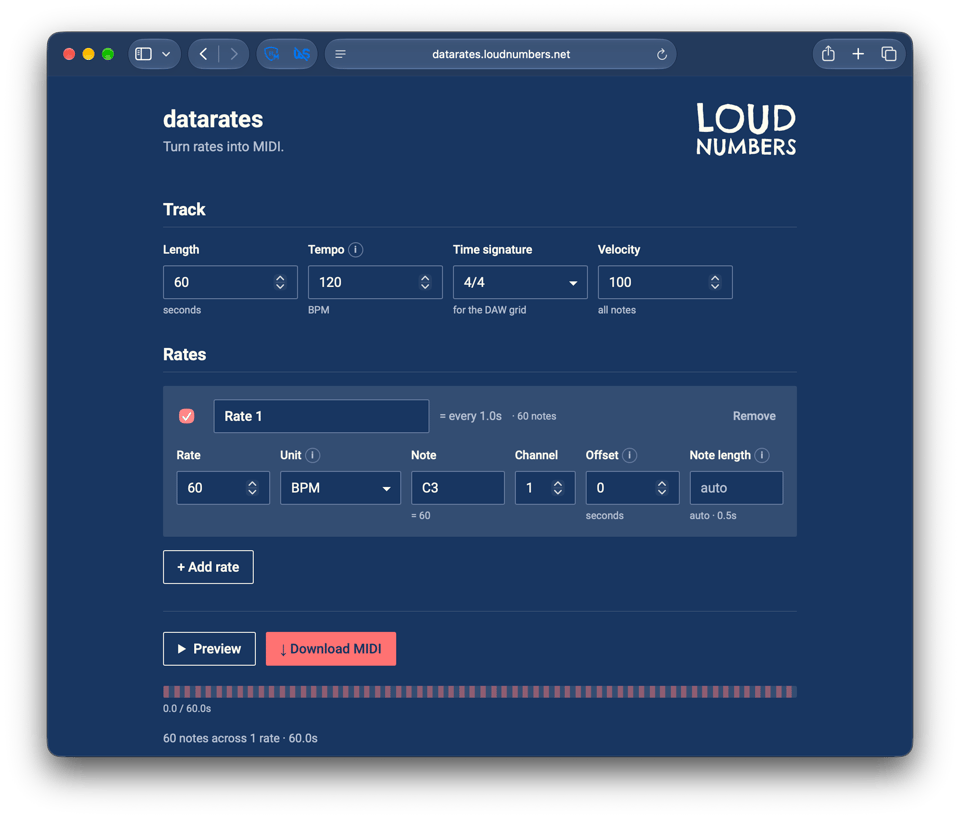
It's super simple to use. You put in your track parameters - a length, a tempo, a time signature, and a velocity for all the MIDI notes. Then you can add as many rates as you like - defining each one in BPM, Hz, or seconds-apart. Pick a note, a MIDI channel, a note length, and an offset from the start if you want one, and then hit 'Preview' at the bottom to get a sense of what your collection of rates look and sounds like. Once you're happy, hit "Download MIDI" to get a MIDI file that you can drag into any DAW.
This is useful for any situation where you want to sonify a constant real-time flow of data - birth rates, financial transactions, things accumulating or draining. Here's an example: let's make a quick sonification of how quickly CO2 is accumulating in the atmosphere. In 2025, the EU says global carbon emissions were 54.1 billion tonnes of CO2 equivalent. Two minutes in a spreadsheet tells us that 54 billion tonnes over a year translates to 1,714 tonnes per second. Inverting that tells us that 1,000 tonnes of CO2 is released every 0.58332 seconds. Put that into Datarates in the "rate" box, select "seconds apart" (or click this link for a pre-filled version), hit "preview", and you get to hear the insane pace that we're changing our climate. Sample it for your next techno track, if you like.
VCV Rack module updates
A couple of years ago, we put together a Loud Numbers plugin for the free VCV Rack virtual modular synthesizer which lets you import data as a CSV file and export it as control voltages that can be used to control other modules - allowing you to sculpt sound with data. It's easy to get started with, but surprisingly powerful when you integrate it with the thousands of other modules in the VCV Rack library.
Over the summer, Duncan implemented some of the feature requests that we've received since release, and fixed a handful of bugs. The data display on the module can now be clicked to select a datapoint, different CSV delimiters are supported, patches embed loaded data when saved (so you don't need the data file), missing datapoints are handled much better, and there are clearer error messages. The full changelog can be found here.
If you've not played with the module (or you haven't played with it for a while) then go grab VCV Rack and install the Loud Numbers module. Right click it to load a CSV and then connect it up to a clock and your favourite oscillator to get started.
Design Ambassadors of the Year
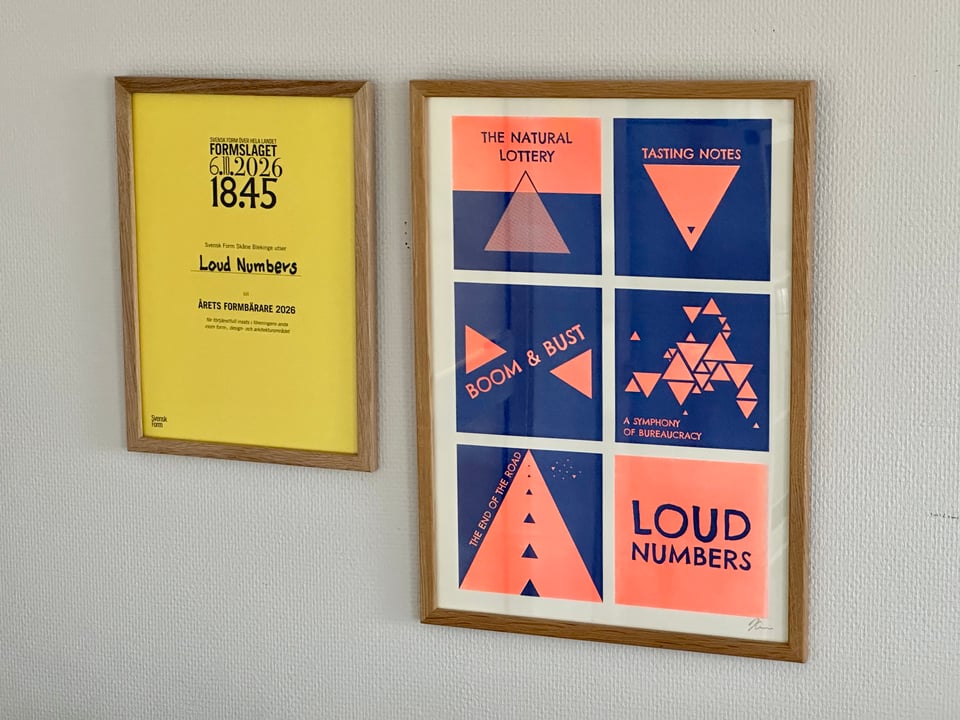
We're deeply honoured to have been named as Design Ambassadors of the Year by Svensk Form, the world's oldest national design organisation (founded in 1845!). Every year, each part of Sweden nominates an ambassador and this year the Skåne and Blekinge chapter has chosen to recognise Loud Numbers for our sonification work. We're thrilled, and hope to use the opportunity to spread our love of sonification far and wide.
Listen to On Standby in Stockholm
Our ten-hour-plus sonification composition, On Standby, has been selected for an installation called Phonosium which plays sound art pieces 24/7. Located in Frihamnstorget in Stockholm and created by Sonic Assembly out of PVC tubes and Bela embedded hardware, Phonosium will be looping four distinct pieces on a continuous schedule for the next year.
If you're passing through Stockholm, then visit Frihmanstorget between 8pm and 6am any day of the year to hear it. You can also stop by at other times to hear other pieces from Isle of Aila, Mac Tire, and Joshua Ng. If you stop by, take a pic and share it with us at hello@loudnumbers.net!
Elsewhere in Sonification
This is an originally short but increasingly lengthy round-up of sonification news, links, and other stuff that's caught our eye in the last few months.
- IEEE Spectrum has a feature piece about sonification, including an interview with Stephen Roddy.
- Friend of Loud Numbers Max Graze is launching a super-cool new podcast called The Shape of Listening. Check out the trailer.
- If 10 hours of sonification in in our piece On Standby sounds like too much for you, here's 42 minutes of "audiotransduction" of the infrared spectra of the four DNA bases - adenine, thymine, guanine, cytosine.
- The European Space Agency has created a "musification" (we're not wild about that word) of the 2026 solar eclipse that was seen in Europe about a month ago. It has nine different sound parameters mapped to data.
- The Audio Universe has developed a new tool called the Sonification Suite, designed partly for astronomy datasets used in planetariums and partly for more generic data-to-sound uses.
- Alexandria Smith has a whole collection of data-driven music. We particularly like "All Because We Can" - a sonification of the rate of construction of datacenters and their power needs.
- "Can a mushroom make music?" asks the Guardian. No, but you can get some data from its electrical activity and turn that into music, which is what Jason Singh has done at the Royal Albert Memorial Museum & Art Gallery (RAMM) in Exeter, UK.
- Hyperblam looks like a fun way to compose music with HTML. Bet you could do some nifty sonification work with it.
- New bioacoustics research suggests that playing the sounds of a healthy ecosystem in a damaged ecosystem can help to accelerate its recovery.
- A company called Ultrasuono is making a little gadget that sonifies sensor data from the surrounding environment and turns it into audio and midi.
- Finally, did you know that Pink Floyd's 1994 album The Division Bell opens with about a minute of sonification of the solar wind? Neither did we, and it's Duncan's favourite Pink Floyd album. Apparently it "caused some confusion among fans in 1994, who were unsure, on playing the album for the first time, whether or not their copy was faulty".
Spotted or created something we should feature here? Hit reply and tell us about it.
Decibels
Dipping your toes into sonification? We help run a friendly and welcoming sonification community over at decibels.community. There are spaces to ask questions, share your work, find an audience, and exchange tips. You can also just join and hang out. Go sign up here.
We'll be back in your inboxes again when we've got new work or courses to share. In the meantime, don't hesitate to hit reply if you have any questions, want to work with us, or if you want to share something sonification-adjacent that you've made.
See you soon.
- Miriam and Duncan


