
LLTT Newsletter - May 2026 - Nobody Is Jealous of How You Got There

LLTT Newsletter - May 2026
Nobody Is Jealous of How You Got There
Everyone wants the view. Nobody wants the climb.
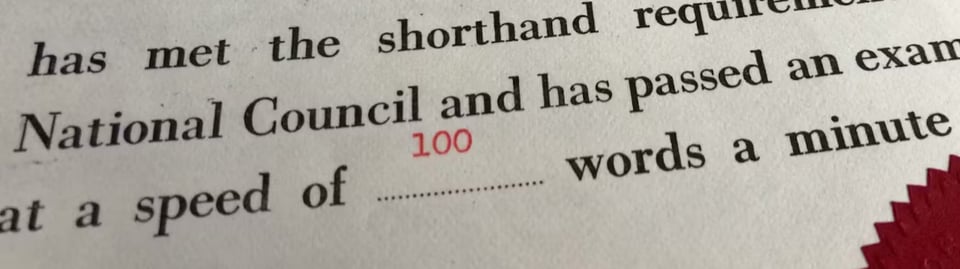
There is a moment most shorthand students will recognise. You are sitting in a room, or scrolling through Insta, or perusing a Reddit post, and someone shares their result. A speed they have just passed. And you feel something complicated.
There can be genuine pleasure for them, of course. But alongside it, quietly and perhaps a little guiltily, there is something else. A wish you were there too. A wondering about what they did differently, what they know that you don't. A sense that the gap between where you are and where they are is insurmountable.
That feeling is not a character flaw. It is simply a natural human response to seeing the view from the top of a hill you have not yet climbed. But here is what you should remember: you are only seeing the summit, not the complete path.
What You’re Actually Looking At
Every result shared online was posted at the end of something. What it does not show is the beginning, or the long middle. It does not show the mornings the person did not want to sit down and practise. It does not show the mocks they did not finish, the outlines that refused to stick, the dictations that fell apart in the final minute. It does not show the sheer accumulation of ordinary, unglamorous sessions that made the result possible.
What we see of someone else's success is almost always the view, not the climb. The result, never the process.
This matters, because when you compare your current speed to someone else's result, you are not making a fair comparison. You are comparing your full experience, your doubts, your bad days, your sense of how far you still have to go, against a single edited highlight from theirs. It is not a meaningful measure of anything, and it is certainly not a reason to feel discouraged.
The Feeling Is Universal and Useful
Let’s be clear: feeling unsettled by someone else's progress is not a sign that you are doing something wrong. Quite the opposite. It is a sign that you care, that you have a goal, and that the outcome matters to you. It is the very thing that keeps you returning to your notes.
So the question is not whether you feel it. The question is what you do with it.
The unproductive response is to measure your chapter three against someone else's chapter twenty and conclude you are failing. That way only leads to practising less, because it starts to feel pointless.
The productive response is to let the feeling redirect your attention. Not towards what they have, but towards what they did. Not the view, but the climb.
The Climb Nobody Usually Talks About
Much of what we have covered in this newsletter, deliberate practice, sentence-level drilling rather than word lists, the strategic use of slower speeds, has been an attempt to describe the climb as honestly as we can.
Why? Because the climb is where building shorthand expertise actually happens. Not in the passing of a test, which is a moment in time, but in the accumulated weeks of daily practice, the careful attention to outlines that keep going wrong, the willingness to go back to basics when progress stalls. That is the work. And it is largely unglamorous, and largely invisible to anyone watching from the outside.
There is an old gardening truth that applies just as well to shorthand: you plant a seed and you do not dig it up every day to check if it’s growing. The work is happening underground.
It is the same with Teeline. You are practising, and nothing seems to be changing, and then, one day, something clicks. What felt like a plateau was not a plateau at all. It was consolidation. The climb was happening; it just was not showing yet.
This is why comparison is so misleading. You do not know how long someone else's invisible climb took. You do not know how many times they rewrote the same outline, how many dictations they did not finish, how many mornings they sat down without particularly wanting to.
The result only tells you where they arrived. It tells you nothing about how long they were walking.
Using Comparison as a Compass
Instead of asking why do they have success and I don’t, ask what did they do to get there, and am I actually doing it?
The first question leads to nowhere useful. The second leads directly back to your notes.
Comparison is best used as a signpost. It points at something you want. And that is genuinely valuable information, provided you use it to direct your effort, rather than to measure your shortcomings.
The person whose result you admire almost certainly did not get there by being unusually talented. They got there by sitting down, regularly, and doing the work. The climb itself is not a secret. It is available to anyone willing to take it.
The View Will Come
One thing the climbing analogy captures is that the view changes as you ascend. Progress at 60 wpm does not look like progress at 80, which does not look like progress at 100. Each stage has its own obstacles, its own small satisfactions, its own moments where you think you will never get any further.
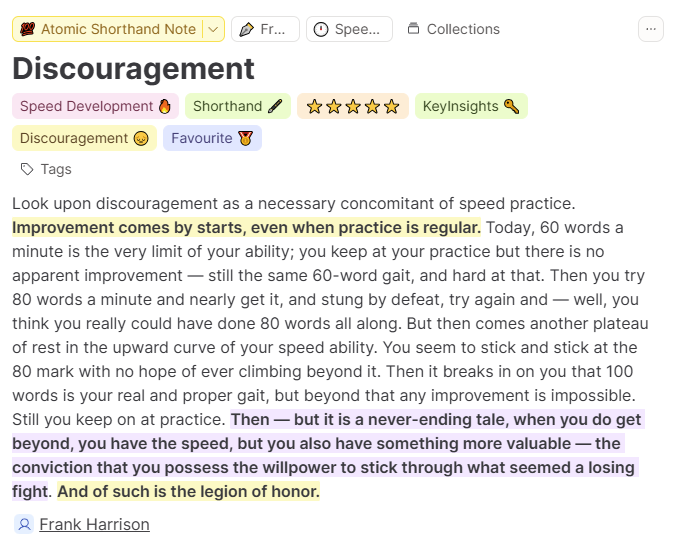
And then you do. Remind yourself daily of Frank Harrison’s “Discouragement” quote. It would not be a stretch to say you should memorise it.
If you are reading this as a relative beginner, the person passing 100 wpm genuinely was where you are.
If you are stuck on a plateau at 80, the person at 100 genuinely knows the feeling of being stuck at 80.
The climb is shared by us all, even if the stages in between are different.
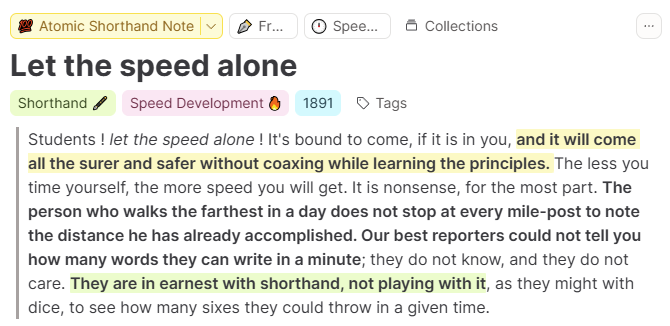
So when the feeling comes, and it will, notice it, let it point you in the right direction, and then pick up your pen.
The view at the end is real. But so is the climb. And the only way to one is through the other.
If any of this resonates, you might find it useful to look back at our October 2025 issue on deliberate slow practice, our January 2024 piece on why drilling alone is not training, and our November 2025 issue on what you can and cannot control in your shorthand journey. All three (and more) are in the newsletter archives.
LLTT+ Update — What We've Been Building Lately

In May, we released a new mock breakdown entitled 100: Row Over Nuclear Energy Reform Grows. We introduced something new with this one: The Themed Pair dictation.
It presents two related passages on the same subject, but approached from different angles. The first passage front-loads the vocabulary so by the time Passage Two begins, those word families are already warm in your mind. The vocabulary overlaps partially, but not completely. That overlap is where the real skill-building happens, and it's what makes this format more productive than two unrelated passages.
There's a reason for that. A student who sits down to a dictation on an unfamiliar subject is effectively doing two jobs at once: decoding meaning and converting to Teeline simultaneously. Subject familiarity removes one of those burdens. The brain begins to anticipate rather than merely react.
The mock follows a three-tier scaffolded structure: a 100wpm passage to build familiarity with the vocabulary, a 120wpm passage to put it to work at speed, and a 60wpm NCTJ-format mock for exam practice and accuracy checking.
If you are already a member, you will find it in LLTT+. If you are thinking about joining, head over to https://www.letsloveteelinetogether.com/llttplus.
As always, if you have suggestions or topics you'd like to see covered in future newsletters, please contact us:
https://www.letsloveteelinetogether.com/contact-us
If you find this newsletter helpful, please help us spread the word and forward it to a friend!
A Parting Thought
Be sure to visit us at the LLTT Website, YouTube, Facebook, Instagram, Quizlet and Soundcloud.
Looking for Teeline reading practice? LLTT’s Skill Building Through Reading 📗 is available for purchase online.
Five 5️⃣ carefully selected passages: Improve your sight 👁️ recognition of outlines and word groupings.
Dual Format: Each passage includes both printed Teeline and the longhand ✍️ transcription.
Proven Learning Approach: Reading printed 🖨️ shorthand is a method long-favoured by skilled practitioners.
Whether you're a student, journalist, or professional seeking to improve your note-taking, this book will be a valuable addition to your Teeline learning resources.
To order, please visit the book’s landing page.



Add a comment: