
LLTT Newsletter - April 2026

LLTT Newsletter - April 2026
Making Your Own Rules: The Elliptic Shortcut and the Challenges of "Knowing" What You Heard

Look at the outline above. It reads as "reasonable time," and it is correct: the disjoined Teeline A for the -ABLE ending, the disjoined M for TIME. Clean, unambiguous, and well established. And yet, there is something about it that might give one pause.
Think about the slightly different phrase, "a reasonable amount of time." It is one of those phrases so deeply embedded in our language the brain supplies it almost automatically. In fact, many an experienced reader, seeing this outline cold, might instinctively read it that way, and in the majority of sentences, no harm might be done.
Consider, though, sentences like these:
"The repairs were completed within a reasonable time and the road was reopened to traffic."
"The court ruled the suspect had not been informed of her rights within a reasonable time."
"Paramedics arrived within a reasonable time given the distance from the nearest station."
In each case, reasonable time is exactly what was said, and nothing has been left out. A writer who transcribes reasonable amount of time would get it wrong, and nothing in the sentence would tell them so.
So what's happening here, and what does it tell us about how high-speed writers make their choices?
The Elliptic Group in Practice
An Elliptic Group is one where words are omitted but whose absence does not obscure the meaning. The word elliptic comes from ellipsis, meaning the omission of words whose absence does not change the meaning. Simple examples include face [to] face and Act [of] Parliament where the bracketed portion is omitted from being written.
In short, your knowledge of word patterns provides the missing words.
This is precisely what is happening when a high-speed writer writes the outline for reasonable time but means it to stand for reasonable amount of time. The words ‘amount of’ are left out on the basis that the phrase is so familiar that the writer, when they come to transcribe, will not notice they are gone.
And here is what you need to be very careful of: reasonable amount of time is a set phrase. Everyone knows it. The brain, especially one trained on thousands of hours of dictation, will fill it in automatically if you are not careful.
Where It Gets Dangerous
The problem is, context will not always save you.
Over-reliance on context can be dangerous. When you become too confident in your contextual understanding, you might miss important details. If two interpretations seem possible, read the full sentence and consider whether the word makes sense in context. But as we have already seen, that test will not always rescue you. Sometimes both readings make sense, and that is precisely the difficulty.
Dictation Memory: An Unreliable Friend
There is another phenomenon at play which deserves naming, even though it is rarely discussed in the literature. Let's call it auditory, or dictation memory, and we will define it as the tendency when transcribing to reconstruct not just what the notes say but what you (think you) remember hearing. At slower speeds, this is relatively harmless and can even be helpful. But the risk is well established as speeds increase.
You will likely know the feeling yourself: you fall behind, you catch up, and somewhere in the scramble, the words get written in the wrong order, or perhaps not at all.
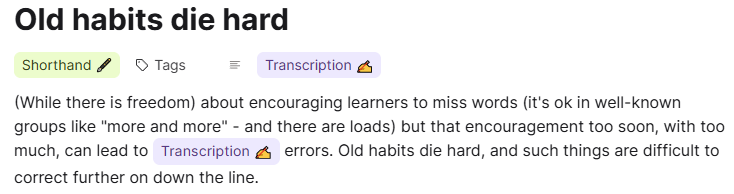
The remedy, and it is an old one, is to make transcription a non-negotiable revision habit rather than an occasional exercise.
Bernard De Bear, writing in High Speed in Shorthand (1901), was unsparing on this point:
"…let no one be misled into thinking that reading over their notes is as beneficial as writing them out."
A greater error, he said, could not be committed. It is only when a transcript is made and carefully checked against the original that a writer truly becomes acquainted with their own writing. In other words, convincing yourself that all is well by scanning your notes is not quality control. It is wishful thinking.
There is a fancy name for relying on what you think you heard rather than what your notes actually record. It is called confabulation, and it means your brain fills in the gaps with what sounds right.
The more familiar a phrase, the more confidently the memory will supply it, and the less carefully the writer will question that memory against what is actually on the page. Reasonable amount of time is a phrase so well-worn that memory will often volunteer it without being asked.
The High-Speed Writer's Bargain
None of this is to say that elliptic groupings are wrong. They are not! Used wisely, they are among the most powerful tools in the advanced writer's toolkit. But it is equally clear that with advanced word groupings, it is only possible to lay down guidelines, and that what is a fluid, easy grouping for one writer may be a source of confusion for another. Any examples you come across should be regarded as suggestions, not rules.
The high-speed writer who chooses to use ‘reasonable time’ as shorthand for ‘reasonable amount of time’ is making an informed, personal bet. They are gambling that context will resolve any ambiguity. Most of the time, that bet can pay off. But as our example shows, there will occasionally be a sentence where it does not, and in an examination or a professional reporting context, that loss could matter.
What This Means
The question to ask yourself at the transcription stage is not simply "does this make sense to me?" but rather, “does it match precisely what I have written?” There is a real difference between reading your notes and reconstructing them from memory, and the more transcription work you do, the more you will understand this.
If you choose to adopt personal shortcuts that omit common words, and many accomplished writers do, the safeguard is straightforward: always trust the outline over the memory. The outline on the page is the official record. Everything else is reconstruction.
LLTT+ Update — What We've Been Building Lately
A new mock examination breakdown has landed in LLTT+: Fire Station Closures in Rural Communities. It is modelled on the kind of speech you would find in Hansard. It moves between hard statistics and the direct, emotionally weighted language of parliamentary debate, and closes with a quote from a station commander. It is the kind of thing you will encounter regularly in court reporting, council proceedings and committee hearings.
Alongside the breakdown itself, we have included a dedicated syllabic analysis of the five most demanding sentences in the passage, with specific, practical guidance on how to approach each one. The longest sentence runs to 32 words and 54 syllables. By the time you have worked through the analysis, it should feel manageable.
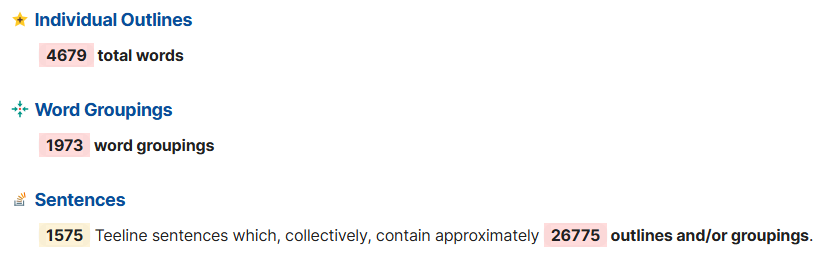
In April alone, we added 43 new word groupings and 75 individual outlines to the LLTT+ database. As of 30 April 2026, the LLTT+ database contains:
If you are already a member, you will find it in LLTT+ now.
If you are thinking about joining, head over to https://www.letsloveteelinetogether.com/llttplus.
As always, if you have suggestions or topics you'd like to see covered in future newsletters, please contact us:
https://www.letsloveteelinetogether.com/contact-us
If you find this newsletter helpful, please help us spread the word and forward it to a friend!
A Parting Thought
Be sure to visit us at the LLTT Website, YouTube, Facebook, Instagram, Quizlet and Soundcloud.
Looking for Teeline reading practice? LLTT’s Skill Building Through Reading 📗 is available for purchase online.
Five 5️⃣ carefully selected passages: Improve your sight 👁️ recognition of outlines and word groupings.
Dual Format: Each passage includes both printed Teeline and the longhand ✍️ transcription.
Proven Learning Approach: Reading printed 🖨️ shorthand is a method long-favoured by skilled practitioners.
Whether you're a student, journalist, or professional seeking to improve your note-taking, this book will be a valuable addition to your Teeline learning resources.
To order, please visit the book’s landing page.



Add a comment: