Space Opera for Fun and Profit
A review of "We Only Find Them When They're Dead," a comic book by Al Ewing and Simone Di Meo.

On Al Ewing and Simone Di Meo’s “We Only Find Them When They’re Dead”
For the last couple of years, I’ve been regularly impressed by writer Al Ewing’s work in comics. Unlike many of the writers whose work I seek out, the vast majority of Ewing’s writing has been for Marvel and DC. (There are some exceptions, including the 2000ad title Zombo and the terrific novel The Fictional Man.) There’s a density to Ewing’s writing in books like The Immortal Thor and Absolute Green Lantern that rewards repeat reading: the kind of long-term plotting that one doesn’t see a lot of in shared-universe comics.
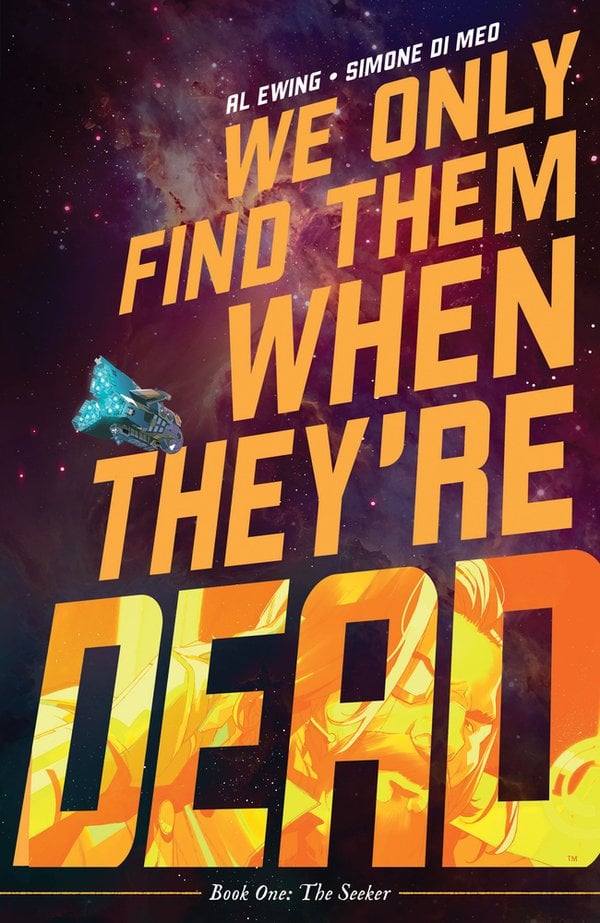
Ewing is certainly capable of snappier work as well — his Contest of Champions is an absolute blast, and one that lovingly embraces some of the Marvel Universe’s most madcap qualities. (Though not, I should stress, the actual Marvel character Madcap.) Thinking about this prompted me to revisit Ewing’s recent creator-owned title We Only Find Them When They’re Dead, a collaboration with artist Simone Di Meo. Collected in three volumes, this series taps into themes that readers of Ewing’s Marvel and DC work will find familiar: the search for transcendence, the nature of divinity, and the outer limits of belief among them.
[Spoiler warning: I’m going to talk about structural details and plot elements for the later volumes. I’ll try to talk around some especially shocking moments, but — if you’re looking to go in cold, you may want to stop here.]
We Only Find Them When They’re Dead is a shockingly ambitious work of science fiction, one which begins hundreds of years in the future and continues from there, with a few time jumps depicting social and technological advances over the course of the series. The basic premise of the first volume is not a template for the rest of the series; instead, Ewing and Di Meo are delving into the same territory as Frank Herbert’s Dune and Gene Wolfe’s Solar Cycle. They aren’t simply looking to follow compelling characters making bold decisions; they’re also curious about how those decisions reverberate over decades and centuries.
The “Them” of the series’s title refers to the central conceit of this science fictional universe: centuries in the future, humanity discovers the corpses of massive humanoid gods floating in space. As the title makes clear, no one has ever encountered a living version of these deities, and a cottage industry now exists dedicated to harvesting organic material from the god-corpses. It’s all very reminiscent of the whaling eras of a bygone era, albeit with some very Jack Kirby-esque designs for the dead gods and a premise that echoes James Morrow’s 1994 novel Towing Jehovah.
Each of the three volumes of We Only Find Them When They’re Dead tells a self-contained story with an even more dramatic cumulative effect. Book One (“The Seeker”) is a story of a ragtag crew led by Captain Georges Malik and the obsessive figure hunting them. There’s more than a little Moby-Dick in its DNA: Malik’s obsession with finding a live god puts his crew in jeopardy, while a secret from his past also leaves them at risk. The ins and outs of life on board a vessel dedicated to slicing up massive corpses is not the only way that this volume echoes a certain Herman Melville novel. Readers of Moby-Dick will be reminded of Melville’s passages riffing on Transcendentalism, and the hunger for an ecstatic, transformative encounter with the divine is never far from the surface.
Book Two (“The Stealer”) is set decades later, and the tone of this book is more palace intrigue/political thriller. Following the climax of the first book, in which Captain Malik made a fateful decision, a human settlement with a peculiar religion has established itself in the far reaches of space, and an agent from the Inner Worlds travels there with a very specific goal. Book Three (“The Soul”) features another jump ahead in time along with more societal changes; here, technological advances have paved the way for artificial beings to walk alongside humans.
Subscribe nowEwing and Di Meo show the reader how one member of the crew of Malik’s ship, Jason Hauer, ages over time; we see him move from a young man in the first volume to a political prisoner in the second and something of an elder statesman in the third. Georges Malik is another figure who recurs as well, albeit in a much different way. Through these two characters, Ewing’s script allows the book to reckon with the way that class and authority work in these futuristic societies, and what might prompt someone to rebel.
Di Meo’s art is kinetic throughout, while also accomplishing the job of making each of the eras in which the volumes are set (as well as some flashbacks to other periods of time) feel distinctive. Like much of Ewing’s best work, this is a densely-plotted work; We Only Find Them When They’re Dead uses captions to situate the reader, while also establishing a kind of rhythm about the inner workings of different spacecraft.
This is not a series that can easily be described. There’s plenty of space opera in here, to be sure, as well as elements that echo cosmic horror. Here, though, the massive deities that populate different realms of space aren’t necessarily menacing; it’s more that their origins and intentions are utterly bewildering. Much of the appeal of We Only Find Them When They’re Dead is the way that Ewing and Di Meo introduce an absolutely bizarre element into a more traditional science fictional space and observe as it plays out. In that way, then, it’s an unorthodox take on a classic trope: how will humanity react when it confronts a sign that it isn’t alone in the universe? That some of these characters respond with religious devotion, while others see an opportunity for profit, feels all too realistic in 2026.

