Slices of Life: On Joe Ollmann’s “The Woodchipper”

Did I come to Joe Ollmann through the most roundabout way possible? Almost a decade ago, I reviewed his biographical comic The Abominable Mr. Seabrook for Paste; that work, a book about the writer William Seabrook, was both a detailed look at its subject’s life and a virtuosic demonstration of Ollmann’s artistic skill. Whether that’s representative of Ollmann’s work, though, is less clear. As he himself explains in an introduction to The Woodchipper, his passion is for short stories: “Saki, O. Henry, Guy de Maupassant, Shirley Jackson — these were my loves.”
That introduction also features a bittersweet gag at his own expense, when he reprints a stick-figure comic made by his daughter Grace sending up his own comics work. That’s the gag; the “bittersweet” part is that it comes up as part of a story about longtime comics journalist Tom Spurgeon, who died in 2019.
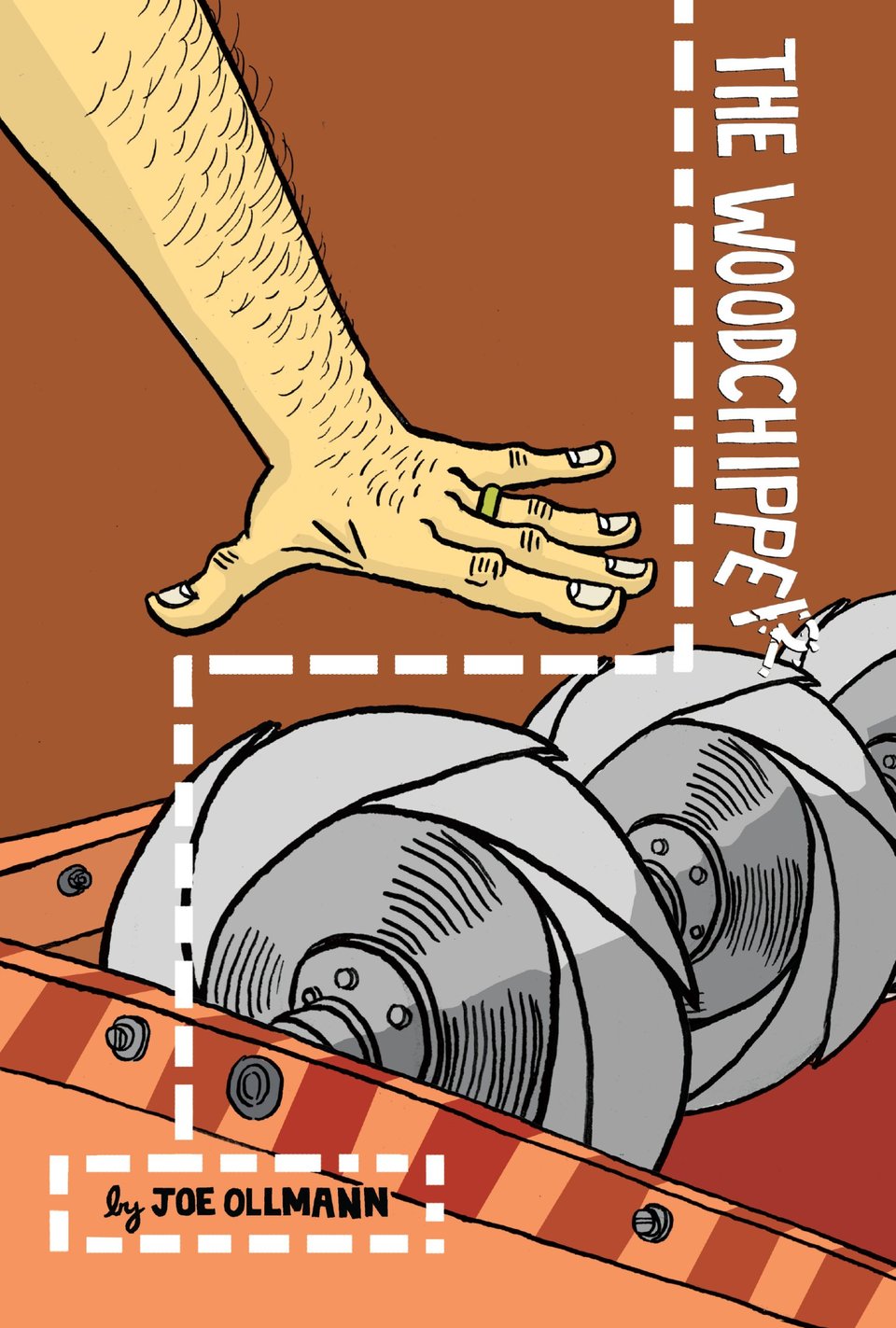
Ollmann excels at something that is extraordinarily difficult to quantify. His art hews more to the cartoony side of illustration than formal realism. These five stories are largely driven by inner struggles; the title story makes those stakes clear in its sixth panel. There, the narrator — a haunted-looking middle-aged guy — seeks the right way to explain a critical moment in his life. “Nothing actually happened, but I lost everything because of it,” he tells us.
This is a great setup for a story, but it also raises the bar considerably. Comics are, after all, a visual medium; how do you show nothing happening? “The Woodchipper” is framed as a cautionary tale, its narrator describing himself as having once been “one of those older guys who kind of sneered at the New Agey bullshit of ‘trigger warnings’ and P.T.S.D.”
The protagonist explains that he once worked a maintenance job for the city. His interactions with an accident-prone and oblivious co-worker set the story’s key incident into motion — but, again, it isn’t an incident as much as it’s a lack of one. That’s a challenge, but Ollmann pulls it off, due in part to his command of body language and especially his talent for faces.
We see the narrator’s face at various points in his life throughout the story. Ollmann makes it clear exactly when we’re seeing him, whether it’s at his most confident or a few steps from rock bottom. It’s something that recurs again and again throughout this collection: stories that demonstrate the different, oftentimes contradictory, facets of these characters.
That can manifest itself in the form of cautionary tales. It’s certainly the case in the title story. “The Late Checkout,” too, follows a middle-aged guy forced to question some of his basic assumptions about the world. Here, the character is the proprietor of a sandwich shop with a sideline in short-term rentals. When something goes very wrong in one of them, our anti-hero faces a series of difficult decisions and moments of recognition.
Subscribe nowSome of the protagonists here are more overtly sympathetic than others, but Ollmann seems driven by a curiosity to understand what makes someone in a situation he might not support (such as a security guard for a factory farm) tick. In a closing note, Ollmann explains the process that led him to write about these characters; I never had the sense that he was acting as a judgmental deity, punishing his creations for their bad decisions.
That said, it would also have been easy for some of these stories to have much tidier endings. Instead, Ollmann understands that even epiphanies don’t miraculously solve problems practical or existential. Memorable short stories are often built around complicated people making bad decisions; Ollmann seems to have learned that at an early age, and applied those lessons well here.

