Why Not Both? On Keezy Young’s “Hello Sunshine”
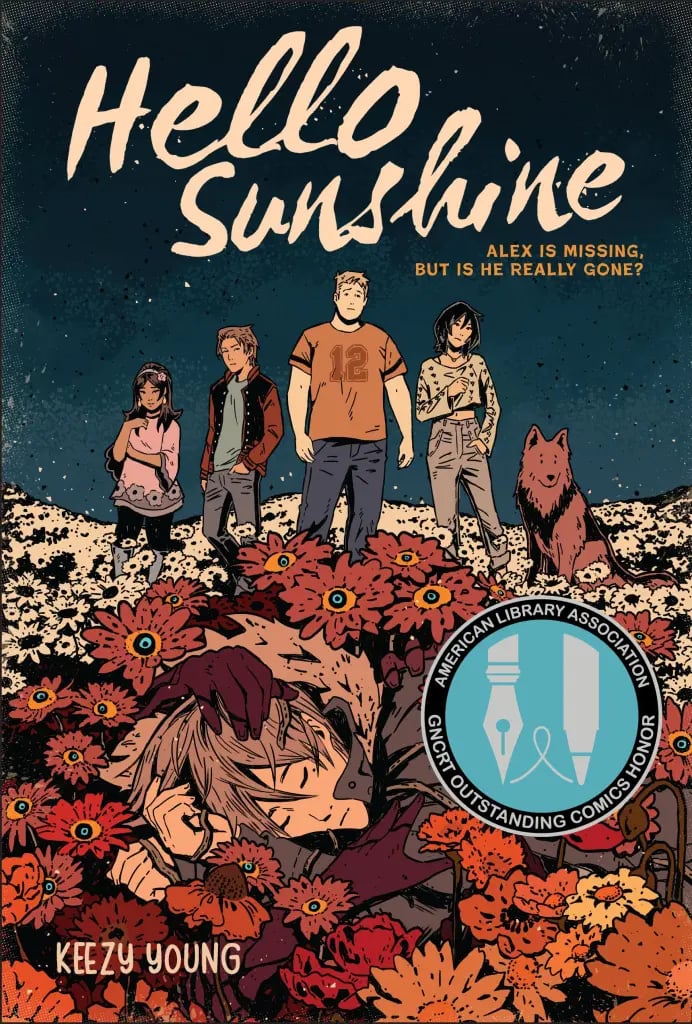
This time out, we're reviewing Keezy Young's "Hello Sunshine."

Keezy Young’s Hello Sunshine focuses on a disappearance: a young man named Alex, who vanishes from his small town one summer. The question of what happened to Alex, and the efforts of his friends and boyfriend Noah to find him, loom over the proceedings. Is Alex dead? Did he run away? Or has something much more uncanny taken place?
There are a lot of threads running through this narrative, and Young juggles a lot of seemingly disparate elements in telling the story. This is a story about young adults; unsurprisingly, their lives are often messy and complex. Noah and Alex’s relationship, for instance, is complicated by Noah’s conservative religious background. There are moments where Hello Sunshine comes close to a kind of trauma horror plot, where it isn’t clear if certain aspects of the story are meant to be taken at face value or as metaphors. There’s also something of the mystery box approach at work here: presumably, when the disparate group trying to piece together what’s happened to Alex solves their conundrum, all will be revealed.
But mystery box stories have a tendency to click or fall apart depending on how they resolve. And in reading Young’s empathic, absorbing story of a group coming together to find someone they all care about, I started to worry: were the uncanny elements in this story going to eventually be revealed as a metaphor or a kind of coping mechanism?
Before I go any further, I’m going to say: spoilers from here on out. Big ones, probably. Because I don’t think I can talk about Hello Sunshine without getting into almost all of Hello Sunshine. (If you haven’t read it yet, let this be my recommendation to you: this is a story that’s well worth your time.)
[Please enjoy this spoiler space. -ed.]
Hello Sunshine begins with Alex and Noah on a date. We learn a few things about them from their dialogue: Noah makes an offhand Biblical reference, suggesting he’s had a religious upbringing; Alex talks about being a fraternal twin. And then what had been an idyllic moment fragments into something else: neatly ordered panels fall out of alignment, and Alex becomes distant. And in the background, there’s something ominous and demonic. You might wonder what, exactly, is happening here. Noah certainly is.
The section that follows focuses on Noah, and implies that what we just read was some combination of dream and memory. Noah has just returned from a Christian summer camp; when he gets back to high school, he discovers that Alex has been missing since June. He links up with a circle of Alex’s other friends and family — Alex’s brother Jamie, Jamie’s girlfriend Izzy, and Alex’s longtime friend Sky — and they begin searching for someone they all care about.
The search for Alex creates the spine of Hello Sunshine, but it isn’t the only thing going on. There’s the story of Noah being rejected by his biological family due to his sexuality; there’s the discovery of what looks like a crime scene in one local house. And there’s the way that Jamie has been seeing ghosts — specifically, the ghost of his mother. This is absolutely a work designed for its medium: Young uses interesting panel layouts and color schemes as integral parts of the storytelling here. But there’s also an expansiveness to the storytelling reminiscent of television, with subplots and allusions aplenty.
That’s a feature rather than a bug. While Noah is at the center of the story, the other three characters also seeking out Alex are compelling and get their moments in the spotlight. And it’s through their eyes that we see a picture of Alex emerging, even if it’s contradictory at times. We’ll learn that Alex was reckoning with his own mental health; we’ll also learn that there have been some strange things happening around town.
Subscribe nowI’ve read and watched a lot of ambitious stories in which a character or subplot was revealed to be a hallucination or other work of imagination. While this has been effective in some cases (Scrubs’ “Where do you think we are?” is a key example of how to do it right), I found myself dreading that Hello Sunshine was setting up a huge rug-pull, that its forays into the uncanny would have mundane explanations, that its nods in the direction of the miraculous would be given rational explanations.
To be fair, Young also takes the mental health element of this storyline seriously, and that makes for one way in which an “it was all a metaphor” conclusion might have made sense. To Young’s credit, that isn’t what happens here; instead, they find a way to tell a story that is both tinged with the supernatural and capable of reflecting more mundane troubles. This is a big, ambitious book, one to lose yourself in. Thankfully, there’s a compelling path through this proverbial labyrinth.

