Two First Issues, Two High Concepts

Discussed: No One Escapes the Dialectic #1, Mad Science Division #1
Trying something new this installment — specifically, trying a pair of short reviews of two first issues. Why? Well, I’ve enjoyed work by these two books’ respective writers before and like the idea of exploring some of their creator-owned work. No One Escapes the Dialectic is writer Spencer Ackerman’s first creator-owned comic, following work for Marvel and DC; Mad Science Division is Dan Watters’s first creator-owned book in a little while, as much of his work — including a terrific ongoing run on Nightwing — has been in shared universes.
While the two first issues are very different, both tonally and visually, they do share a willingness to venture into morally grey places. No One Escapes the Dialectic #1 (written by Ackerman and illustrated by Antonio Fuso) follows employees of a government agency that reads like an analogue for ICE. It posits a struggle between three factions: the relatively normal, law-and-order types at the agency; the far more gung-ho, fascist-adjacent employees of the same; and an organization tracking down both with murder on their minds. Mad Science Division #1 (written by Watters and illustrated by Brian Level) follows the failson of a wealthy family sent to reduce expenses in a corporate research division specializing in experimental work. There, things do not go according to plan.
Arguably, both are also about office politics that are very likely to turn lethal before too long.

The first issue of No One Escapes the Dialectic establishes the milieu and characters quickly. We’re in the world of the Intelligence & Analysis directorate of a governmental agency called Special Naturalization Operations. (Alternately: SNO, an acronym that I’m sure is entirely coincidental.) The central character here is one Mike D’Angelo, who is taking over I & A while also feuding with the members of Gladio Unit, a group of especially gung-ho agents who show up for meetings in tactical gear.
Internal conflicts aren’t the only ones present here. There’s also the work of a masked group killing SNO agents and leaving behind cards emblazoned with the phrase that gives the series its title. A group chat among a local activist group, Briarwood Ballers, offers a perspective on life outside of the world of ethically dubious law enforcement. In a fairly bleak issue, the Ballers’ use of basketball-themed pseudonyms and knowing commentary — “That way lies the sort of sectarianism that always dooms the left” — leaves
Fuso’s art has a stark and stylized quality. I don’t think I’ve encountered Fuso’s work before, but it reminded me (at least in broad strokes) of the style of Danijel Žeželj. It’s no coincidence that Žeželj handled art on Days of Hate, another series that combined pulp thrills with heady politics. Soto keeps the characters’ looks distinctive here and has a good command of body language. And while the scene of a murder is kinetic, he also makes a briefing sequence interesting to read as well — no small accomplishment.
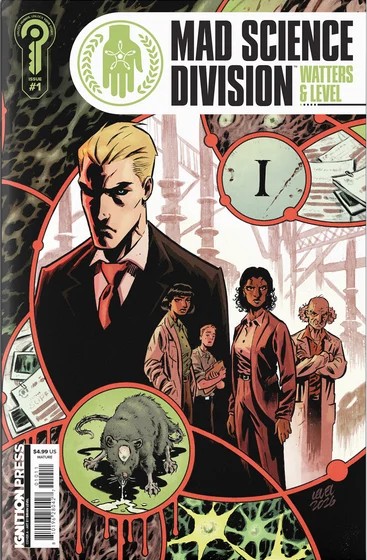
Mad Science Division #1 begins at the end, with much of the issue’s story consisting of an extended flashback to Archimedes Anderson’s first month on the job. We’re given a lot of information without context here, but some of it doesn’t necessarily need context: “supercocaine,” for instance, is pretty self-explanatory. He is the character we spend the most time with here, but he isn’t terribly likable: Watters reveals that he got the job through his family’s connections, and is not terribly qualified for the work he’s meant to be doing.
After showing Archimedes in bad shape — missing a few teeth, with an ominous reference to some element of his work having followed him home — the issue flashes back a month to his first day working at the offices of Miyashi-Smith. Their department of Research and Development, the titular “Mad Science Division,” has five sections, one of which is classified. (Or “Classified.”) Given that one of the sections is “Lethal Bioweaponry,” this begs the question of how ominous something must be to fall into the category of forbidden knowledge. Something tells me that this series will answer that question before long.
The art is stylized, with Level utilizing a number of chaotic page layouts, something that echoes Archimedes’s barely-contained anxiety. It’s telling that Level largely draws Archimedes at an angle, while his colleague Regina Butler — who is presented in a much more sympathetic light, at least thus far — is presented as more (literally) on the level. By issue’s end, we understand just how Archimedes came to be in the condition that the opening page finds him in, while also laying the groundwork for future stories.
Subscribe nowAt least based on the first issues, there’s one more thing that both of these books have in common: a willingness to straddle genres. No One Escapes the Dialectic has a tincture of speculative fiction in its creative makeup, but there’s also a procedural element to it, even as its storyline seems primed to critique at least some of the tropes of law enforcement procedurals.
Mad Science Division also establishes a tension in its underlying premise: there’s certainly some Succession/Billions-esque corporate intrigue in the mix, but some of the corporate projects here, including rats that are not actually rats, suggest a more sinister purpose. Both Ackerman and Watters are talented writers, so seeing how those particular circles are squared adds some suspense on a more metatextual level. Though if we’re invoking the metatextual, it’s worth a reminder that one of these books is called No One Escapes the Dialectic, so we’re already knee-deep in all things metanarrative. Each of these first issues is a book that abounds with big ideas while also leaving room for plenty of kinetic thrills. I’m on board with both.

