katexic clippings logo

katexic clippings

Archives
Subscribe

katexic clippings katexic clippings

Archive

|k| clippings: 2015-07-23 — sugar, spice and the not-so-nice

WORK

“Do you urge immorality against these ice-cream shops?” he was asked.

“I should not like to urge it, but it is known,” came the answer.

Among the more egregious crimes committed by the shops’ proprietors was that of allowing young people of both sexes to intermingle and smoke. One inspector had said that he had seen girls of “tender years” smoking cigarettes in the shop. They were also seen dancing to “music supplied by a mouth organ.” Even worse, some of these young girls had become prostitutes.

Another inspector was asked: “Do you ask us to believe that the downfall of these women was due to ice cream shops?”

“I believe it is,” he replied.

It was concluded that ice cream shops embodied “perfect iniquities of hell itself and ten times worse than any of the evils of the public house. They were sapping the morals of the youth of Scotland.”

—Christine Baumgarthuber
—from “It Ought to Be Called Vice Cream”

WORD(S)

zeppole /ZEP-oh-lay/. noun. May refer to two different Italian pastries. The first is a deep-fried dough ball usually topped with powdered sugar and filled with custard, cream or honey-butter. The second is a baked cream puff made from choux pastry (or pâte à choux). The latter may be sweet—filled with ricotta and chocolate, candied fruits or honey—or savory, filled with anchovy. See also the US crispelli. Italian zeppole, plural of zeppola (fritter).

“For the common people of Naples, Christmas is a festival of eels, Easter a revel of casatelli; they eat zeppole to honor Saint Joseph; and the greatest proof of affliction that can be given to the dying Saviour is not to eat meat.” (Marc Monnier)

“Vinny preferred eating to talking. And the only white powder he liked was the sugar on his zeppoles.” (F. Paul Wilson)

“There were roulette wheels, zeppole and sausage stands, and a big glass cotton-candy machine in which sugar was spun into billows of flyaway, pale blue hair.” (Meg Wolitzer)

“Zeppole man across the street began to sing. Angel and Geronimo started to sing. The band across the street acquired an Italian tenor from the neighborhood…” (Thomas Pynchon)

WEB

  1. “War and Peach” anyone? That’s just one of a half-dozen book-inspired ice-cream flavors. Or perhaps “S’Moria Steinem” is up your alley, in which case there are 10 Solutions to Ben & Jerry’s Women Problem flavors. Or, since I’m trying to stay away from the stuff, there are horror-inspired flavors like “Human Centipeach.”

  2. Keats, Lincoln, Coleridge and many more faces in the Pictorial Guide to the Laurence Hutton Collection of Life and Death Masks.

  3. A non-French speaker just won the French Scrabble championship [no surprise to any of us who have lost at Words With Friends to possibly-illiterate opponents].

  4. Scientists are using DNA origami to 3-D print structures just nanometers across

  5. Today in 1904, according to some stories, Charles Menches comes up with the idea of filling a pastry cone with ice-cream. His title as the emperor of ice-cream cones is in dispute, though, as other vendors at the St. Louis World’s Fair—at which the “cornucopia” waffle cone came to prominence—laid claim to this most wonderful invention as well. In fact, the Menches brothers of today, descendants of Charles and his brother Frank, claim their ancestors also invented the hamburger.

WATCH/WITNESS

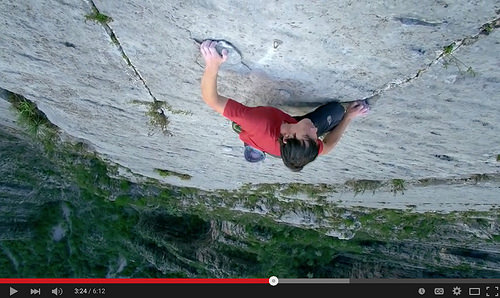
Alex Honnold - El Sendero Luminoso

On January 15, 2014, Alex Honnold free-soloed El Sendero Luminoso (The Shining Path) in El Portrero Chico, Mexico in a little over 3 hours. The climb rises 2,500 feet to the summit of El Toro. It could be the most difficult rope-less climb in history.

REPRISES/RESPONSES/REJOINDERS/RIPOSTES

  • Reader W. supplements last issue’s WORD with, well, the Word: “As you probably know, the most common use of ‘imago’ is theological: the ‘imago dei’ or image of God that symbolizes how we are fashioned in God’s image and therefore should love one another as we should love Him. If you believe in that kind of thing. Not that there’s anything wrong with that.”

I welcome comments, suggestions, thoughts, feedback and all manner of what-have-you. Just press ‘Reply’ or email to: clippings@katexic.com.

And please feel free to share anything here as far and wide as you want! If you want to give a shout-out, please link to: http://katexic.com/clippings/.

#231
July 23, 2015
Read more

|k| clippings: 2015-07-21 — a prime number of words

Today’s WORK is best read aloud…but then most good writing is, isn’t it? And…we’re having a contest. You should enter.

WORK

This sentence has five words. Here are five more words. Five-word sentences are fine. But several together become monotonous. Listen to what is happening. The writing is getting boring. The sound of it drones. It’s like a stuck record. The ear demands some variety. Now listen. I vary the sentence length, and I create music. Music. The writing sings. It has a pleasant rhythm, a lilt, a harmony. I use short sentences. And I use sentences of medium length. And sometimes when I am certain the reader is rested, I will engage him with a sentence of considerable length, a sentence that burns with energy and builds with all the impetus of a crescendo, the roll of the drums, the crash of the cymbals–sounds that say listen to this, it is important.

So write with a combination of short, medium, and long sentences. Create a sound that pleases the reader’s ear. Don’t just write words. Write music.

—Gary Provost
—from 100 Ways To Improve Your Writing

WORD(S)

imago /i-MAY-go/. noun. In psychology, an idealized image of a person—including possibly one’s self—formed in childhood and persisting into adulthood. In biology, the final, adult stage of an insect’s transformation (see also: nymph and pupa), usually winged. From classical Latin imāgō (representation, natural shape).

“But it had all come hard upon: realignment of mother, death of father (the two imagos now transfigured)…” (Margaret Atwood)

“Signifying the imitation of a portrait, the word imago was applied to the image of the deceased. It designated the mask made from the imprint of a face.” (Barbara Cassin)

“The burst of lightning was the white of the sunlit room when he came up for air and opened his eyes. His mother’s tiny rotating imago faded against the ceiling. What seemed like heavy breathing was him trying to scream.” (David Foster Wallace)

Beneath the dun and the watershine—
Incipient spinner, set for the take-off…
And does, in clean tear: imago rising out of herself
For the last time, slate-winged and many-eyed.
(Charles Wright)

WEB

  1. In The Care Package, editorial cartoonist Jack Ohman illustrates his father’s final years. And it is powerful.

  2. Ever heard a podcast so good you didn’t want to listen to the last episode because you just didn’t want it to end? That’s how I feel about Mystery Show (which isn’t about mysteries in the sense of Serial or even crime). Thankfully it’s just on a short hiatus. Treat yourself!

  3. “When a writer invokes the insidious progress of a cancer, you know she hopes to forestall the objection that there is little visible evidence to support her argument. What is this cancer threatening democracy and the world? Declining enrollments in literature courses.” → Why College Kids Are Avoiding the Study of Literature

  4. “Calvin and Markov digests Calvin and Hobbes strips and generates new comics using Markov chains…”

  5. Today in 1983, the coldest (natural, ground-level) recorded temperature on Earth—−128.6° F (−89.2° C)—is recorded in Vostok, Antarctica. That’s, as various writers have put it: colder than a hair on a polar bear’s ass / colder than the frost on a champagne glass; colder than a well-digger’s butt; colder than a witch’s brass brassiere; colder than Hoth; colder than a Tibetan tin toilet top; colder than a cavern eel; colder than a halibut on ice; colder than moonlight on a tombstone.

WATCH/WITNESS

Gala Contemplates the Mediterranean (Salvador Dali)

“Dali’s title — ‘Gala Contemplating the Mediterranean Sea Which at Twenty Meters Becomes the Portrait of Abraham Lincoln (Homage to Rothko)’ — provides a perfect description of this painting…”. Instead of backing away from your screen, you can also view the thumbnail size to get the full effect.

REPRISES/RESPONSES/REJOINDERS/RIPOSTES

  • Reader B. on Salinger: “I, too, enjoy rereading Catcher in the Rye. ¶ And both of my children hated it.”

  • Reader S. shares an anime connection: “The anime Ghost in the Shell also draws on Catcher in the Rye, with the Laughing Man using a quote from the book as part of the image he displays in people’s visual implants instead of his actual face: http://ktxc.to/laughing-man-logo ¶ I’m more of a Franny and Zooey fan myself.”


I welcome comments, suggestions, thoughts, feedback and all manner of what-have-you. Just press ‘Reply’ or email to: clippings@katexic.com.

And please feel free to share anything here as far and wide as you want! If you want to give a shout-out, please link to: http://katexic.com/clippings/.

#230
July 21, 2015
Read more

The (Cormac) McCarthyisms Contest

“She was at her triturations. Spooning to death in a salver a speckled slug, marked like an ocelot, viscous and sticky. A whitish paste. Crooning a low threnody to her pawky trade.” (Cormac McCarthy)

A few months ago was inspired by the quote above to say, “I’d nominate this for a contest to determine The Ultimate Cormac McCarthy Sentence.”

#229
July 20, 2015
Read more

|k| clippings: 2015-07-16 — the hurly-burly & hullabaloo

Today’s WORK via Reader N.—thanks!

WORK

Yeats said that he wrote in form because if he didn’t he wouldn’t know when to stop. Like Samuel Beckett I prefer the word ‘shape’ to ‘form.’ At Trinity [College Dublin] during a course on Aristotle’s Poetics our Greek professor W. B. Stanford told us to come back the following week with our own definition of poetry. Mine was: ‘If prose is a river, then poetry’s a fountain.’ I still feel that’s pretty good because it suggests that ‘form’ (or ‘shape’) is releasing rather than constraining. The fountain is shapely and at the same time free-flowing.

—Michael Longley
—from “A Jovial Hullabaloo”
—found in One Wide Expanse (The Poet’s Chair: Writings from the Ireland Chair of Poetry)

WORD(S)

tintamarre /tin-tə-MAR/. noun. Generally, an uproar, a din, a hubbub…a clamor. Also a community parade filled with noise and noisemakers. From French tintamarre, from Middle French tinter (to ring), from Latin tinitare (to ring frequently), which is a frequentative/repetitive form of tinnire (to ring).

“He learn’d and profited much by that hurly-burly or tintimarre.” (Michel de Montaigne, translated by John Florio)

“I was president of the August 15 Committee in Edmunston the year they decided to hold the Acadian Tintamarre parade. I spent half my time arguing you do the Tintamarre on foot, not in cars.” (Frances Daigle)

“I did guess, by such a tintamarre, and cough, and sneeze, and groan, among de spirit one other night here, dat there might be treasure and bullion hereabout.” (Sir Walter Scott)

“A tintamarre of voices and a jingle of glasses accompanied the violins and tambours de Basque as the company stood up and sang the song, winding up with a grand burst at the chorus…” (William Kirby)

WEB

  1. How Sleep Deprivation Decays the Mind and Body

  2. Readers B., C. and K. all shared a link to “The Really Big One”, about the possible future Cascadia earthquake that could destroy Seattle. Further reading from both ends of the spectrum of reactions: “Earthquake experts on ‘The Really Big One’: Here’s what will actually happen in Seattle” and “The Five Scariest Takeaways From the New Yorker Article About the Earthquake That Will ‘Devastate’ Seattle”

  3. The Great Britain Air Letter, 1941–2011 A Miscellany to Celebrate 70 Years

  4. Little girl hands in the world’s scariest poem to ‘Creativity Corner’

  5. Today in 1951, J.D. Salinger’s Catcher in the Rye is published by Little, Brown and Co. Even now it sells more than 250,000 copies annually (more than 65 million so far). Dismissed by many as a dated book for adolescents, I enjoyed re-reading Catcher in the Rye just a few years ago…which may just mean I’m a dated adolescent. A few years ago, it was revealed in the documentary Salinger that five new Salinger books would be published starting this year.

WATCH/WITNESS

Word as Image by Ji Lee

Word as Image (by Ji Lee) — “Challenge: Create an image out of a word, using only the letters in the word itself. Rule: use only the graphic elements of the letters without adding outside parts.”

REPRISES/RESPONSES/REJOINDERS/RIPOSTES

  • Reader G. writes in: “For my money, James Tate was one of our best short story writers even if everyone insists on calling them ‘prose poems.’”

  • Reader W. wonders: “What happened to the Cormac McCarthy contest?” — Stay tuned. Real soon now…


I welcome comments, suggestions, thoughts, feedback and all manner of what-have-you. Just press ‘Reply’ or email to: clippings@katexic.com.

And please feel free to share anything here as far and wide as you want! If you want to give a shout-out, please link to: http://katexic.com/clippings/).

#228
July 16, 2015
Read more

|k| clippings: 2015-07-14 — the hoping machine

This issue was delayed by an automated security system that, I'm guessing, didn't like Woody Guthrie's all-caps! So today will be a daily double...

WORK

NEW YEAR’S RULIN’S

  1. WORK MORE AND BETTER
  2. WORK BY A SCHEDULE
  3. WASH TEETH IF ANY
  4. SHAVE
  5. TAKE BATH
  6. EAT GOOD - FRUIT - VEGETABLES - MILK
  7. DRINK VERY SCANT IF ANY
  8. WRITE A SONG A DAY
  9. WEAR CLEAN CLOTHES - LOOK GOOD
  10. SHINE SHOES
  11. CHANGE SOCKS
  12. CHANGE BED CLOTHES OFTEN
  13. READ LOTS GOOD BOOKS
  14. LISTEN TO RADIO A LOT
  15. LEARN PEOPLE BETTER
  16. KEEP RANCHO CLEAN
  17. DON’T GET LONESOME
  18. STAY GLAD
  19. KEEP HOPING MACHINE RUNNING
  20. DREAM GOOD
  21. BANK ALL EXTRA MONEY
  22. SAVE DOUGH
  23. HAVE COMPANY BUT DON’T WASTE TIME
  24. SEND MARY AND KIDS MONEY
  25. PLAY AND SING GOOD
  26. DANCE BETTER
  27. HELP WIN WAR - BEAT FASCISM
  28. LOVE MAMA
  29. LOVE PAPA
  30. LOVE PETE
  31. LOVE EVERYBODY
  32. MAKE UP YOUR MIND
  33. WAKE UP AND FIGHT

—Woody Guthrie (1941)
—from Lists of Note: An Eclectic Collection Deserving of a Wider Audience

WORD(S)

kakistocracy /ka-ki-STAW-krə-see/. noun. Coinage for government by the worst citizens, supposedly the opposite of the aristrocracy (try to avoid the brain-numbing regression of what happens when the aristocracy is the kakistocracy). From Greek kakistos (superlative of kakos, bad) + English -cracy (government, rule). See also: the likely related cack (to discharge excrement, to vomit). See also: khakistocracy, a portmanteau referring to military rule of a country in conjunction with that country’s elites.

“…it had spotted the weapon-blink from Ablate, communicating this to its home GSV, the Kakistocrat, which had been cautious enough to pass this on to a select few of its peers including the Pressure Drop rather than broadcast the news.” (Iain M. Banks)

“The OED is full of words for different types of governments. I find most of them forgettable. But kakistocracy, describing so aptly the fear, which seems common in every generation, that their government is truly the worst possible one, is a word worth remembering.” (Ammon Shea)

“Should your agitation succeed it would result in the French Revolution over again, together with all its corollaries,—anarchy, kakistocracy,[Pg 30] a glorious tyranny on a false foundation, kakistocracy again, and chaos: a counter revolution, again a kakistocracy, and finally impotence, false and evil as the destroyed feudalism.” (Ralph Adams Cram)

WEB

  1. Newly discovered annotations by Dickens in a bound collection of his All the Year Round journal reveals new work by Wilkie Collins, Lewis Carroll and Elizabeth Gaskell (among others).

  2. Lisa Brown’s Three Panel Book Reviews.

  3. “To publish a plain ol’ book that people actually want to read is still a solid achievement. But I think Markus Persson and his studio have staked out a new kind of achievement, a deeper kind: To make the system that calls forth the book, which is not just a story but a real magick manual that grants its reader new and exciting powers in a vivid, malleable world.” → Robin Sloan on Minecraft and the possible future of the “networked, generative” novel.

  4. An interesting look at translations of a poem that ultimately cost the original author his life. → Three [and a few more] translations of Osip Mandelstam’s ‘Stalin’s Epigram’

  5. Today in 1912, singer-songwriter Woody Guthrie is born in Okemah, Oklahoma. Creator of, most famously, “This Land is Your Land” and a notable influence on scores of famous musicians, the “Dust Bowl Troubador” made a beautiful noise out of his experiences during the Great Depression and his experience of an America that still exists…kind of…if it ever did. Listen to ► The Best of Woody Guthrie. Watch the ► BBC Arena documentary on his life.

WATCH/WITNESS

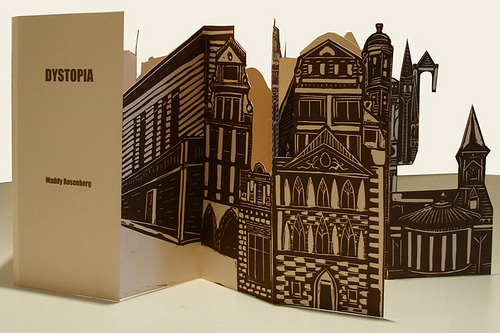
Dystopia (book art by Maddy Rosenberg)

Dystopia, book art by Maddy Rosenberg - “Dystopia - 2007, 9 x 4 x.5 inches, edition of 30, linoleum block prints with digitally printed cover Cut, folded, and bound, open the cover and a three-dimensional city emerges, unfolds, metamorphoses.”

REPRISES/RESPONSES/REJOINDERS/RIPOSTES

  • Reader J. on James Tate: “I’m a little more enthusiastic about Tate’s strangely drifting gifts of association than you seem to be. Something about him caught me early—in the early 70s—and has stayed with me through the later books. Maybe we’re just more ready to forgive the excesses and shortcomings of our favorite poets because the poems they write that really touch us really touch us. Strangely, I was just talking with one of his (very, very fine) ex-students, Lesle Lewis, last Wednesday, and we spoke of him—of the dryness of his humor (which, she noted, he didn’t always let on he was aware of), and also what I’d call his strange gift of surreal decorum. Maybe a midwestern thing—I think by way of comparison of another wonderful midwesterner of a quite different stripe, Bill Sylvester. We also felt that in some ways Tate struck us like Ashbery—that each evolved a certain enormously resilient diction that took them through a fine stretch of admirable years. I thought today (though I didn’t know him) of writing a poem that might catch my feelings for him. I didn’t, but I did have a first line that might have gone somewhere: So Jim Tate’s gone to meet his funny maker. Well, so that’s enough. The funny makers often seem the best, to me.”

I welcome comments, suggestions, thoughts, feedback and all manner of what-have-you. Just press ‘Reply’ or email to: clippings@katexic.com.

And please feel free to share anything here as far and wide as you want! If you want to give a shout-out, please link to: http://katexic.com/clippings/.

#227
July 14, 2015
Read more

|k| clippings: 2015-07-11 — trust and pixie dust

RIP, James Tate. An acquaintance stated it well in an appreciation when he noted that Tate’s “particular brand of whimsical absurdism somehow doesn’t age too well.” Too true, particularly when reading Tate’s many, many surreal prose poems. But there are so many wonderful poems living among their “average” neighbors (which are typically quite good). Today's WORK is from Tate’s first book of poems, published in 1967, when he was just 24. A volume of poems he apparently wrote as a college undergrad.

WORK

“Epithalamion for Tyler”

I thought I knew something
about loneliness but
you go to the stockyards

buy a pig’s ear and sew
it on your couch. That, you
said, is my best friend— we

have spirited talks. Even
then I thought: a man of
such exquisite emptiness

(and you cultivated it so)
is ground for fine flowers.

—James Tate
—from The Lost Pilot

WORD(S)

aposematic /a-POH-sə-mat-ik/. adjective. Animal colorations that warn and repel potential predators. See also the noun form aposeme. From Greek apo- (off, away) + sēmat (sign).

“Short of instinctive programming to avoid the aposematic organism (which is seen occasionally), it is unlikely that any potential prey will be prepared to sacrificially educate its predator. Thus, a combination of camouflage and its antithesis, aposematism, often occur.” (World Heritage Encyclopedia)

“Red or yellow spots are common aposematic colors in frogs.” (John D. Lynch)

“These reproductive leviathans publicly aroused and engulfed each other, or overwhelmed the humans thrown into their path. The organs became more elaborate, more aposematic. They proliferated, reared and tumbled, sucked, slimed, and reproduced.” (Brian W. Aldiss)

WEB

  1. “The city of Melbourne assigned trees email addresses so citizens could report problems. Instead, people wrote thousands of love letters to their favorite trees.” → When You Give a Tree an Email Address.

  2. “Print and online readers of a heart-wrenching true story display equal empathy and emotional engagement, regardless of the medium in which they read…” I’m not surprised. It’s not only a matter of the culture(s) around print and electronic reading, but our habits with them that makes the apparent difference. → A Columbia Journalism Review study.

  3. How Walking Fosters Creativity: Stanford Researchers Confirm What Philosophers and Writers Have Always Known.

  4. The interesting stuff isn’t about love, but about “embodied cognition” (which relates to the above link as well), which I am belatedly beginning to notice and understand. → How Grounded Is Your Love Life?

  5. Today in 1955, deep into the Cold War, legislation is passed requiring the phrase “In God We Trust” appear on all U.S. coin and paper currency. The earliest request for the phrase came in 1861, when the Reverend M.R. Watkinson petitioned the Treasury Department to recognize “Almighty God in some form in our coins” in order to “relieve us from the ignominy of heathenism.” The familiar phrase’s presence has been challenged in court many times, on obvious grounds, but the Supreme Court has chosen not to hear the cases and the challenges have always failed.

WATCH/WITNESS

"Postcard to My Third Crush" (Sean Hill)

Sean Hill’s poem “Postcard to my Third Crush” made into a short film by Sam Hoolihan. This is one of many short poetry films produced by Motionpoems which, until today, I’d never heard of, but which features short films of poems by Lux, Beulieu, Merwin, Zapruder, Hicok and many more.

REPRISES/RESPONSES/REJOINDERS/RIPOSTES

  • Reader P. was also moved: “Wow. I read both installments of ‘Innocent Man’, as well as the ‘Guilty Man’ piece linked to them. I am speechless–rare for me. Pamela Colloff is a powerful writer, deserving of much praise. If I were younger, I’d join the Innocence Project, in any capacity I could. This is why I am against Capital Punishment—and why I believe our justice system needs a serious overhaul…sadly, this is not a singular occurrence.”

  • Reader C. shares another interesting punctuation court case: “k readers may enjoy this little case that also turned in a comma and incurred the wrath of the judge.”

  • Reader B. enjoyed the Frank Stanford poem: “‘The Quiver’ is one fierce war poem.”


I welcome comments, suggestions, thoughts, feedback and all manner of what-have-you. Just press ‘Reply’ or email to: clippings@katexic.com.

And please feel free to share anything here as far and wide as you want! If you want to give a shout-out, please link to: http://katexic.com/clippings/.

#226
July 11, 2015
Read more

|k| clippings: 2015-07-09 — but who is?

Finally received my copy of Frank Stanford’s collected poems and it is, as I expected, phenomenal.

And today’s word and some choice examples via Reader C. Thanks!

WORK

“The Quiver”

Come back dull and bloody all of you
let it hold the shame inside
itself like a helmet
bring a little soil each time
for a pillow
you aren’t as many as you were

—Frank Stanford
—from What About This: Collected Poems of Frank Stanford

WORD(S)

tatterdemalion /ta-tər-di-MAYL-yən/. noun & adjective. One garbed in ragged, tattered clothing or such clothing. Of disreputable or tattered appearance, decayed or dilapidated. From tattered plus, as the OED puts it, a “factitious element suggesting an ethnic or descriptive derivative.” Tattered comes from Old Norse tötrar and Old French tatereles (tatters). But perhaps also influenced by Tartar, an old term for a vagabond or beggar.

“Florry Talbot, a blond feeble goosefat whore in a tatterdemalion gown of mildewed strawberry, lolls spreadeagle in the sofacorner, her limp forearm pendent over the bolster, listening.” (James Joyce)

“Venomous weeds grew here, and tatterdemalion flowers, white, blue and rose; among crevices in the rust and tangled ancient iron a lizard would peep out drunkenly at the burning sun.” (William Styron)

“Most promising of these, to my mind, had been a small, tatterdemalion math constructed on a lookout tower originally put there to detect forest fires.” (Neal Stephenson)

“The occult knowledge of the Egyptians passed from Hermes Trismegistus to Moses, who took care not to pass it on to his band of tatterdemalions, their craws still stuffed with manna; to them he offered the Ten Commandments, which was as much as they could comprehend.” (Umberto Eco)

“…the company around the table grew a little closer together, their tatterdemalion garments rustling as a wind of consternation blew through them…” (Angela Carter)

WEB

  1. The Yale Grammatical Diversity Project: English in North America examines and maps regionalisms of syntax (as opposed to the more common studies of slang and vocabulary) such as the “Drama So” and “Double Comparatives.” Fun to browse. Nothing from Alaska, sadly.

  2. A break-down showing, shot-by-shot, how the “Ozymandias” episode of Breaking Bad visualized the poem. → Breaking Bad and “Ozymandias”

  3. Man does something cool—busking with a typewriter, writing stories on the spot for one and all—and the Internet Outrage Machine turns on him. → I Am An Object Of Internet Ridicule, Ask Me Anything

  4. Your next selfie could be your last, Russia warns

  5. Today in 1958, a magnitude 7.8 earthquake rocked the Fairweather Fault in the Gulf of Alaska, triggering the Lituya Bay Megatsunami, the largest in modern times. The tsunami devastated vegetation more than 1720 feet above the bay thanks to a wave that crested over 100 feet on the open ocean. Scars and changes in vegetation are still visible there today.

WATCH/WITNESS

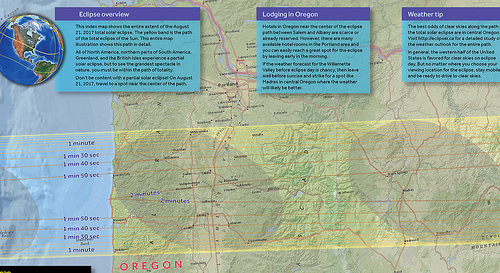
10-foot Long 2017 Eclipse Map

On August 21, 2017 (my son’s 25th birthday…coincidence?) there will be a total solar eclipse across the United States. The last one was in 1991. GreatAmericanEclipse has created an awesome 10-foot long map tracing where it will be visible across the US.

REPRISES/RESPONSES/REJOINDERS/RIPOSTES

  • Reader G. sees a change: “If authored by a man than of course he would think the Bycorne would be always plump and the Chichevache always starving. A woman author would have the opposite point of view (at least in my experience). Or perhaps over time women have gotten better and men have gotten worse. Present company excluded. ;)”

  • Reader M. is inspired by the same: “Bycorne and Chichevache are going to be two characters in my next age-inappropriate children’s book. Very inspiring stuff!”

  • (A different) Reader G. asks a good question: “I love the Deutscher book you quote from, there are so many insightful ideas about language in there. His perspective in color reveals a lot about how we think. ¶ Regarding this quote, I wonder if expressive power was sacrificed to some degree for expressive ability? Some words, because of the physical limits of our mouths, tongues, lips, etc, are just more difficult to pronounce than others.”

  • Reader B.’s reaction mirrors my own: “‘Innocent Man’ was powerful, worth every paragraph. ¶ Such buried horror in the child’s statements!”


I welcome comments, suggestions, thoughts, feedback and all manner of what-have-you. Just press ‘Reply’ or email to: clippings@katexic.com.

And please feel free to share anything here as far and wide as you want! If you want to give a shout-out, please link to: http://katexic.com/clippings/.

#225
July 9, 2015
Read more

|k| clippings: 2015-07-07 — blown, broken, bred

WORK

“Anyone who has tried to learn a foreign language knows only too dearly that languages can be full of pointless irregularities that increase complexity considerably without contributing much to the ability to express ideas. English, for instance, would have losed none of its expressive power if some of its verbs leaved their irregular past tense behind and becomed regular.”

—Guy Deutscher
—from Through the Language Glass: Why the World Looks Different in Other Languages

WORD(S)

Bycorne /BIY-korn/. noun. A mythical, human-faced cow which fed on patient, kind husbands (and was thus plump)…a counterpart to the chichevache, which fed on obedient, faithful wives and so was perpetually starving. Also, an obsolete spelling of bicorne, a two-pronged pitchfork.

“Now are portrayed two beasts, the one fat and flourishing, the other weak and thin. And the legend says: ‘These fearful beasts, Bycorne and Chichevache, according to their nature, can eat only patient husbands or sweet-tempered wives.’” (John Revell Reinhard)

“Chichevache (or lean cow) was said to live on good women; and a world of sarcasm was conveyed in always representing Chichevache as very poor,—all ribs, in fact—her food being so scarce as to keep her in a wretched state of famine. Bycorne, on the contrary, was a monster who lived on good men; and he was always bursting with fatness, like a prize pig.” (E. Cobham Brewer)

WEB

  1. Powerful, Pulitzer-worthy storytelling about justice denied far too long. → “Innocent Man” Part One and Part Two. See also, the Nieman Storyboard interview/annotations

  2. “As from February 2014, a series of Euro Banknotes, are drawn, scanned and spent on a daily basis. A social medium hacked to become part of a new territory. This site is a documentation of this attempt.” → banknotes.gr [Via Reader C.]

  3. 3 reasons the American Revolution was a mistake [also Via Reader C.]

  4. Various court cases have turned on an issue of punctuation. Various members of the Clamor shared the story of a missing comma’s place in Ohio appeals court history. That led me to the equally interesting story of Minnesota’s Great Umlaut War.

  5. When you’re thinking of the greatest thing since sliced bread, keep July 7, 1928 in mind. That was the day Otto Frederick Rohwedder’s new loaf-at-a-time bread slicing machine made its commercial debut with the Chillicothe Baking Company of Chillicothe, Missouri. Naturally, the city of Chillicothe maintains a bread news site.

WATCH/WITNESS

[Untitled, 1975/76] by Francesca Woodman

[untitled], 1975/1976 by Francesca Woodman.

Wikipedia has links to many of Woodman's (astonishing) photos. See also: The Long Exposure of Francesca Woodman and Searching for the real Francesca Woodman.

REPRISES/RESPONSES/REJOINDERS/RIPOSTES

  • Reader F. caught me out: “Tricky boy! A wonderful quote from Hesse that just happened to fall on his birthday?”

  • Reader B. observes (correctly!): “Glass Bead Game is one of the strangest, deepest, most original and neglected books of all time.”


I welcome comments, suggestions, thoughts, feedback and all manner of what-have-you. Just press ‘Reply’ or email to: clippings@katexic.com.

And please feel free to share anything here as far and wide as you want! If you want to give a shout-out, please link to: http://katexic.com/clippings/.

Daily(ish) email overwhelming you? Email chris+weekly@katexic.com to switch to the weekly digest edition.

#224
July 7, 2015
Read more

|k| clippings: 2015-07-02 — subdued fire

WORK

“What you call passion is not a spiritual force, but friction between the soul and the outside world. Where passion dominates, that does not signify the presence of greater desire and ambition, but rather the misdirection of these qualities toward and isolated and false goal, with a consequent tension and sultriness in the atmosphere. Those who direct the maximum force of their desires toward the center, toward true being, toward perfection, seem quieter than the passionate souls because the flame of their fervor cannot always be seen. In argument, for example, they will not shout or wave their arms. But, I assure you, they are nevertheless, burning with subdued fires.”

—Herman Hesse
—from The Glass Bead Game

WORD(S)

lapsonym /LAP-sə-nim/. noun. “A word whose meaning you forget no matter how many times you looks it up.” Here we have a fresh portmanteau with a precise origin—coined by Kathryn Schulz on March 20, 2015 at 9:34a PST—that I can’t believe waited this long to be born. From Latin lapsus (a slip or fall) + onoma (name).

“Lapsonym will be the rare word whose meaning I won’t have trouble remembering.” (David Caithness)

“I’d like to think of lapsonym as also applying to a word you forget no matter how many times you look it up. My favorite lapsonym is litotes . Again and again, I have to stop and wonder: what’s the name for the figure of speech…” (Michael Leddy)

WEB

  1. Between 2010 & 2013, Photographer Jimmy Nelson travelled the world to document some of the most fantastic indigenous cultures left on the planet today. → Before They Pass Away

  2. The Little-Known Story of the Night Witches, an All-Female Force in WWII

  3. Some Guy Renamed The Paint Colors At A Hardware Store

  4. No surprise that Tobias Frere-Jones’s series on typography and type design is both excellent and interesting to both casual and hardcore type nerds. → Typeface Mechanics: 002

  5. Today in 1937, at 8:43a, Amelia Earhart—on her second attempt to fly around-the world—transmitted “we are running on line north and south” and disappeared forever. Or maybe not. Modern analysis of radio signals supports a large body of evidence suggesting Earhart and/or her navigator Fred Noonan survived the crash and lived for some time as castaways on the atoll of Nikumaroro, once called Gardner Island.

WATCH/WITNESS

Cross-stitch elephant tattoo by Eva Krbdk

More cross-stitch tattoos by Eva Krbdk

REPRISES/RESPONSES/REJOINDERS/RIPOSTES

  • Reader B. tried out the rhyming keyboard: “I kept typing orange and nothing happened.” — That was, of course, the first thing I tried too…along with ‘silver’

  • Reader S. thinks The Atlantic could have done better : “That reprint of Wallace’s essay is ok, but could they have not put the annotations to the side? There’s copious whitespace, and it would have made the flow of reading easier. But maybe that was intentional; skipping to side/footnotes does always cause an interruption I guess.”


I welcome comments, suggestions, thoughts, feedback and all manner of what-have-you. Just press ‘Reply’ or email to: clippings@katexic.com.

And please feel free to share anything here as far and wide as you want! If you want to give a shout-out, please link to: http://katexic.com/clippings/.

Daily(ish) email overwhelming you? Email chris+weekly@katexic.com to switch to the weekly digest edition.

#223
July 2, 2015
Read more

|k| clippings: 2015-06-29 — degrassé high

Poet, jazz aficionado and radio show host, publisher and editor David Gitin passed away last Friday. He was a master of powerful, compressed, multi-layered poems, the best of them buds filled with flowers that bloom in the reading (and the readers). RIP.

WORK

“The Door”

the door
slopes of light

your body
a delay

in glass

—David Gitin
—from The Journey Home

WORD(S)

opsimath /AHP-sə-math/. noun. One who begins to learn or study late in life. By implication, one who develops slowly. From Greek opsimathēs (late in learning). Hard to believe, given some of the words those crazy kids spell, that this was the word upon which the 1999 Scripps National Spelling Bee turned.

“Do not confuse the opsigamist [one who marries late in life] with the opsimath (a person who begins to learn late in life), as they are of different ilk— the opsigamist has obviously not learned anything at all.” (Ammon Shea)

“He sat in a chair in his office, told himself to calm down. The old wordlists were whipping through his head: fungible, pullulate, pistic, cerements, trull. After a while he stood up. Prattlement, opsimath.” (Margaret Atwood)

“It was a few weeks later that she [the Queen] looked up from her book and said to Norman: ’Do you know that I said you were my amanuensis? Well, I’ve discovered what I am. I am an opsimath.” (Alan Bennett)

WEB

  1. The Dictionary of Obscure Sorrows is blowing up in my social network circles. This little collection (via Reader B.) is a good one. Ellipsism! → 23 Emotions People Feel But Can’t Explain.

  2. Paul Bacon, designer of oh-so-many iconic book covers, died at 91. I bet the Clamor recognizes his work. → His NYT obituary: Paul Bacon, 91, Whose Book Jackets Drew Readers and Admirers, Is Dead and a well-illustrated appreciation.

  3. ►Inside the Studio of William Blake.

  4. The Atlantic has re-designed David Foster Wallace’s 2005 profile of radio personality John Ziegler to take advantage of current web technologies. Oh how I wish DFW were still alive to see new ways his work might be presented. → “Host”

  5. Today in 1908, an asteroid (or a comet) exploded in an “air burst” approximately 3 miles above the earth near the Tunguska River in Russia. Now known as the Tunguska Event, it is—so far—the largest such “impact event” in recorded history. The explosion was at least 1000 times greater than the Hiroshima nuclear detonation knocking down more than 80 million trees across an 800+ square mile area and knocking people off their feet more than 50 miles away. Due to the remoteness of the region, there were no fatalities…and relatively little interest at the time. The first recorded expedition to the epicenter wouldn’t take place for more than a decade.

WATCH/WITNESS

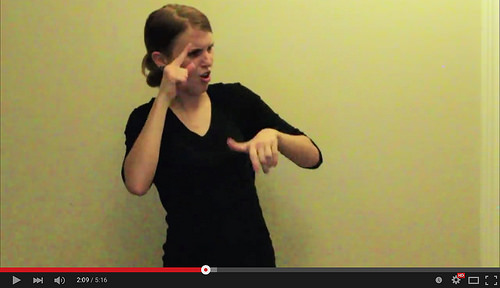
still from "Eminem Lose Yourself ASL" (Shelby Mitchusson)

▶ Eminem Lose Yourself - ASL Interpretation. I’m a sucker for these.

REPRISES/RESPONSES/REJOINDERS/RIPOSTES

  • Reader B. on Borges’ list of books: “I like how Borges mercifully grants two spots to longer books.”

  • Reader D. shares two quotes that resonate with me as well: Here’s a quotation I saw in Jessie Burton’s book The Miniaturist (which I am currently reading) that really resonated with me: “Growing older does not seem to make you more certain, Nella thinks. It simply presents you with more reasons for doubt.” ¶ When I was younger, I thought age brought wisdom. The wisdom, I realize, is that getting older is coming to terms with the fact that you have to become comfortable living with doubt. ¶ The quotation from Burton’s book was balanced out in my reading by this quotation from Martin Luther King, Jr., which I saw on Quinn MacDonald’s that resonate with me as well: “The arc of the moral universe is long, but it bends towards justice.” ¶ That one gives me some measure of peace, too.


I welcome comments, suggestions, thoughts, feedback and all manner of what-have-you. Just press ‘Reply’ or email to: clippings@katexic.com.

And please feel free to share anything here as far and wide as you want! If you want to give a shout-out, please link to: http://katexic.com/clippings/.

Daily(ish) email overwhelming you? Email chris+weekly@katexic.com to switch to the weekly digest edition.

#222
June 30, 2015
Read more

|k| clippings: 2015-06-25 — the eyes have it

I thank everyone in the Clamor who sent email in addition to their votes to keep Clippings going. Obviously the YESs prevailed. Don’t feel, because of the poll, that I was fishing for more interaction—there was no hidden agenda—though I’ll admit I love receiving suggestions and comments. Based on your email, it’s possible I will move to a twice-weekly format. Otherwise I hope to expand Katexic to include some other features/ventures over the next year.

I also greatly appreciate your sharing Clippings with others who have not yet had the pleasure of subscribing. Onward.

WORK

inside a bat’s ear
a rose
opens to a star

—Eve Luckring
—from The Disjunctive Dragonfly

WORD(S)

myrmidon /MəR-mu-dən/. noun. In Greek myth, a member of the warrior tribe who accompanied Achilles to Troy. In more common use, a bodyguard, an assistant, a servant. A member of a posse, a gang-member, a ruffian, a hired thug who follows any order without question. Most broadly, a hanger-on, an opportunist. From Latin Myrmidones/Greek Myrmidones (the tribe), possibly derived from Greek mormos (dread, terror).

“Erskine-Brown and a Mr Thrower, his sedate solicitor, found the Kitten-A-Go-Go, paid a sinister-looking myrmidon at the door ten quid each by way of membership and descended to a damp and darkened basement where two young ladies were chewing gum and removing their clothes with as much enthusiasm as they might bring to the task of licking envelopes.” (John Mortimer)

“The King made a sign and the sages heard the iron step of the myrmidons that surrounded them at the foot of the throne, and whose naked swords did gleam like flame.” (Stanislaw Lem)

“…I would die in this bed as if paralyzed, or be shot to death here on this pillow by the tireless myrmidons whose eyes miss nothing.” (Heinrich Böll)

“She smiles. He sees upside down her mouth, with lips pressed shut, flex like a myrmidon’s small-bow being drawn…” (John Banville)

“No, Arthur, no, it is not so; I am now one of the myrmidons of that most special of special pleaders, Mr. Neversaye Die. I have given myself over to the glories of a horse-hair wig…” (Anthony Trollope)

WEB

  1. PetaPixel’s 20 First Photos from the History of Photography

  2. He did a lot more than dingbats… → Hermann Zapf, the font designer behind Palatino and Zapf Dingbats, has died at 96

  3. If conely Crossed chadd szuch a hing. → Try an online rhyming keyboard

  4. Jorge Luis Borges Selects 74 Books for Your Personal Library

  5. Today in 1977, Roy Cleveland Sullivan (aka “The Human Lightning Rod”) is struck by lightning for the 7th time. And survives. Previous strikes lit Sullivan’s hair on fire (twice), blew his big toe-nail off, knocked a shoe off and pierced his hat, shoulder and a leg in addition to the “usual” burns.

WATCH/WITNESS

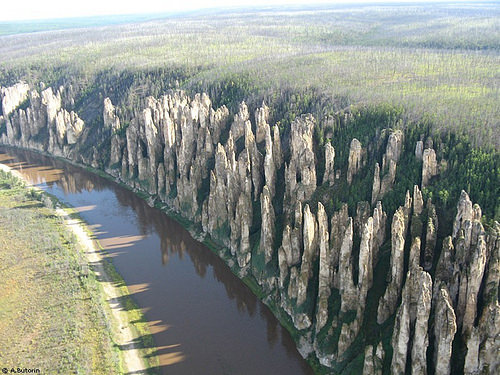
Lena Pillars National Park AKA Lena's Stone Forest

Learn more about (and see other great pictures of) Lena Pillars National Park AKA Lena’s Stone Forest, outside of Yakutsk, Russia. Also, the UNESCO World Heritage Center Gallery.

REPRISES/RESPONSES/REJOINDERS/RIPOSTES

  • Reader B. admired the most recent WORK: “Ah, Enderby. A nicely Joycean passage you selected, too. I should like to reread some lesser-known Burgess.”

I welcome comments, suggestions, thoughts, feedback and all manner of what-have-you. Just press ‘Reply’ or email to: clippings@katexic.com.

And please feel free to share anything here as far and wide as you want! If you want to give a shout-out, please link to: http://katexic.com/clippings/.

Daily(ish) email overwhelming you? Email chris+weekly@katexic.com to switch to the weekly digest edition.

#221
June 25, 2015
Read more

|k| clippings: 2015-06-23 — the final issue?

Today marks the one year anniversary (and 216th issue!) of Katexic Clippings… and a good time to decide if it should continue. I have a sense that many are receiving the newsletter but no longer reading. Every project has a lifespan.

I will let you decide: if you are reading this and Clippings remains of interest, please take a second to click YES, recording your vote to keep the newsletter going. Thanks!

WORK

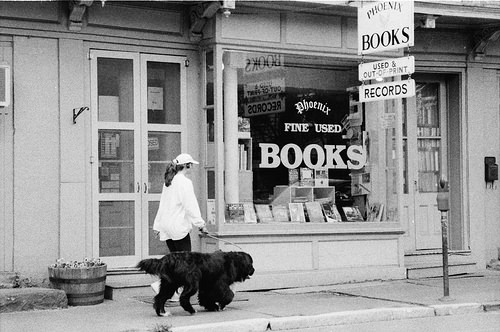
Phoenix Bookstore photo by Bruce Harris Bentzman

One of the bookstores not mentioned in my essay was the wonderful Phoenix in Lambertville. It was launched in 1987 by four English teachers, Michael, Barry and their wives. I don’t know that I ever met their wives, but I knew Michael and Barry. Although they probably never knew me by name, they knew my face. They had promised themselves to give the bookstore two years to pay off their investment. They succeeded in two weeks. Alas, the article about La Hune made me think of it. In ’87, business for them was fantastic. The Phoenix closed a year or two ago. When I learned it was closing, I snapped a picture.

Phoenix is a good name for a used bookstore. One hopes it will rise again. Just as Reader C. shared the article about La Hune with you, so do I. When a bookstore we are fond of closes, the subject tugs at the heart and we are compelled to share it with the like-minded.

—Bruce Harris Bentzman

WORD(S)

cecity /SEE-si-tə/. noun. Blindness. From Middle French cécité, from Latin caecitas (blindness).

“But who was he, Enderby, to adapt a great tragedy to the limited talents, New World phonemes and intonations and slangy lapses, cecity towards the past, Pyrrhonism and so on of this weak cry of players?” (Anthony Burgess)

“After light’s term, a term of cecity.” (Matthew Arnold)

“Beauty is the safest stimulant, the surest tonic, the most precious inspiration; natural beauty first of all, and the beauty of the arts closely following, twinlike handmaids to Aphrodite. But to perceive this the mentally blind are as incapable as the physically blind; and such, mental cecity is as general in these days as myopy is common in the schoolrooms of this generation.” (Ouida)

“Monocularity at home, cecity abroad.” (Julian Barnes)

WEB

  1. On one of the roofs of the world: Xinaliq [via Reader B., who notes, “Some great stuff here, starting with the window.”]

  2. [via Reader S.] → Some funny (and terrible) “Letterspacing” (AKA Kerning) Fails

  3. Knowing my love of Larkin’s poetry, Reader N. shares a couple of links about his enshrinement in the Westminster Abbey Poets’ Corner → Lecherous. Racist. But my friend Philip Larkin deserves his spot in Poets’ Corner and Larkin has secured his place in Poets’ Corner, and about time too

  4. Amazon is going to test paying authors by page views. Fractional payments are logical, business-wise, but how might they shape the work writers create? → What If Authors Were Paid Every Time Someone Turned a Page?

  5. Today in 1868, Christopher Sholes is granted a patent for his “type-writer” machine. It wasn’t the first typewriter but, as this brief history of typewriters shows, it was the most influential design on the myriad machines to come. The Virtual Typewriter Museum is chock-full of fantastic typewriter images and historical notes.

WATCH/WITNESS

Animation for "Un Dia"

Reader J. shares this animated video for Juana Molina’s song “Un dia” with a note that I might “enjoy this and explain it to us.” I have no explanation…but I enjoyed the song and video!

REPRISES/RESPONSES/REJOINDERS/RIPOSTES

None!


I welcome comments, suggestions, thoughts, feedback and all manner of what-have-you. Just press ‘Reply’ or email to: clippings@katexic.com.

And please feel free to share anything here as far and wide as you want! If you want to give a shout-out, please link to: http://katexic.com/clippings/.

Daily(ish) email overwhelming you? Email chris+weekly@katexic.com to switch to the weekly digest edition.

#220
June 23, 2015
Read more

|k| clippings: 2015-06-20 —seeing with my hands

WORK

“Quietly they moved down the calm and sacred river that had come down to earth so that its waters might flow over the ashes of those long dead, and that would continue to flow long after the human race had, through hatred and knowledge, burned itself out.”

—Vikram Seth
—from A Suitable Boy

WORD(S)

grubble/grabble. verb. To grope. To feel about or feel one’s way in the dark. To scrape together. Grubble is a variant of grabble, from Dutch grabbelen (grab, grope).

“There I will be, and there we cannot miss,
Perhaps to Grubble, or at least to Kiss.”
(Ovid, translated by Dryden)

“Lame, cock-eyed hill-bitches, agitated into a perpetual state of oestrus, turning mean, nasty, as they frot and butt and rut and hump in the ordure and straw, gnash and grabble in their squatting capsules on the floor.” (Nick Cave)

“She grabbled around in her black and white bag and pushed some bills across the desk in a lump.” (Raymond Chandler)

“They deserve to grabble in the dirt and get nothing for it but a dry gut-ruble. They won’t listen.” (Robert Penn Warren)

WEB

  1. Man Buys 10.000 Undeveloped Negatives At a Local Auction And Discovers One of the Most Important Street Photographers of the Mid 20th Century

  2. From Reader E. comes Emoji Ulysses…which contains a profile link to a work on almost precisely the opposite end of the Ulysses spectrum, Infinite Ulysses. If you’re planning on finishing that emoji literature degree, you’ll also want to read Emoji Dick.

  3. The Lost Ritual of Photographing the Dead

  4. Dead Writers Perfume from Sweet Tea Apothecary

  5. Today in 1756, 146 British prisoners, including two women and a few wounded soldiers, are allegedly herded at sword-point into an 18x15 foot cell in Calcutta that would later be dubbed the Black Hole of Calcutta. Later historians would conclude that the original number might have been as low as 64, though the fact that only 23 would survive the night, the rest succumbing to suffocation and trampling while their guards laughed at them outside, is not in dispute.

WATCH/WITNESS

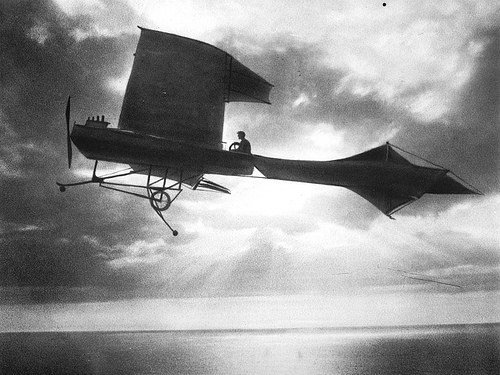
Paul Latham over the English Channel, 1909

Paul Latham flying over the English Channel, July 19, 1909. Before the crash. Which he survived.

REPRISES/RESPONSES/REJOINDERS/RIPOSTES

  • Reader K. writes: “David Curran’s postal explorations from 6/11 will be of great interest to marketers, who are always looking for a new way to reach their audience. One of my favorite ideas is to send an actual prescription bottle, address and stamp on the outside, prescription for success (use our product!) within. They say it has an 80% open rate!”

I welcome comments, suggestions, thoughts, feedback and all manner of what-have-you. Just press ‘Reply’ or email to: clippings@katexic.com.

And please feel free to share anything here as far and wide as you want! If you want to give a shout-out, please link to: http://katexic.com/clippings/.

Daily(ish) email overwhelming you? Email chris+weekly@katexic.com to switch to the weekly digest edition.

#219
June 20, 2015
Read more

|k| clippings: 2015-06-18 — four and more

WORK

People possess four things
that are no good at sea:
anchor, rudder, oars
and the fear of going down.

—Antonio Machado (translated by Robert Bly)
—from The Sea and the Honeycomb: A Book of Tiny Poems

In his later book of Machado translations Times Alone, Bly translated the first line as “Mankind owns four things.” I like the earlier version better.

WORD(S)

villeggiatura /vil-lə-djə-TYəR-ə/. noun. A country residence; a rural retreat suitable for a holiday; a holiday spent in such a place. From Italian villeggiare (to reside in a country villa). Reader J. writes of the word that “as a country-born person who’s spent much of his life in cities, it cracked a kind of nostalgia nut in me—the idea of ‘going back to the village’ is where it took me.”

“Thus in consequence of her mother’s heroic proceedings, and of her brother’s absence on this villegiature, Mrs Verloc found herself oftener than usual all alone not only in the shop, but in the house.” (Joseph Conrad)

“I don’t wonder that she hates the country; I dare to say her child does not owe its existence to the Villeggiatura.” (Horace Walpole)

“Strolling the Hundred Fountains on a hot Roman afternoon, shaded by centuries-old trees and soothed by the gurgle and splash of water, one comes to understand the exalted place of villeggiatura in the Italian soul.” (Thomas Campanella)

“Add to this a multitude of green shutters and striped awnings, and a mass of Virginia creepers and wisterias, and fling over it the lavish light of the American summer, and you have a notion of some of the conditions of our villeggiatura.” (Henry James)

“We penetrate bodily this incredible beauty; we dip our hands in this painted element; our eyes are bathed in these lights and forms. A holiday, a villeggiatura, a royal revel, the proudest, most heart-rejoicing festival that valor and beauty, power and taste, ever decked and enjoyed, establishes itself on the instant.” (Ralph Waldo Emerson)

WEB

  1. When a Bookstore Closes, an Argument Ends [Thanks, Reader C.!]

  2. Maciej Ceglowski is creating a great travelogue as he travels through Yemen (and I love his site slogan: ‘brevity is for the weak’).

  3. Watch the ► trailer for the upcoming Stanford Prison Experiment film. Looks a little over the top but entertaining. And…Ezra Miller!

  4. Paul Ford on the “No to” poem, a collaboratively written litany of sorts, an anaphora poem, a poem of our time in so (too?) many ways.

  5. Today in 1812, the United States declares war on Great Britain. There were many reasons behind the decision to take on the greatest naval force in the world including the impressment, ongoing trade restrictions and the seemingly insatiable desire for territorial expansion…none of which were to change much despite a three-front battle along the American-Canadian frontier and the Atlantic and Gulf coasts that claimed more than 15,000 American lives. As historian James Loewen put it, “the American Indians were the only real losers in the war.” The War of 1812 was more important in the American mind than it was for the British, who were busy dealing with Napoleon. In fact, today in 1812 also marks the anniversary of the Battle of Waterloo, in which nearly 50,000 soldiers were killed.

WATCH/WITNESS

Speculative Fiction Illustrations by Gennady Golobokov

View an album of “fiction-artist” Gennady Golobokov’s speculative fiction illustrations

REPRISES/RESPONSES/REJOINDERS/RIPOSTES

  • Reader B. writes: <<hearing Ulysses is even better than reading it. The best version I know of is the Naxos AudioBooks edition>> ¶ I wholeheartedly agree!

  • Has Reader S. discovered the next Joyce? He writes: My son’s comment on this was “it’s like reading James Joyce, only harder to understand.” I think I agree. It’s an interesting exercise, anyway: http://ktxc.to/trump-2016-transcript


I welcome comments, suggestions, thoughts, feedback and all manner of what-have-you. Just press ‘Reply’ or email to: clippings@katexic.com.

And please feel free to share anything here as far and wide as you want! If you want to give a shout-out, please link to: http://katexic.com/clippings/.

Daily(ish) email overwhelming you? Email chris+weekly@katexic.com to switch to the weekly digest edition.

#218
June 18, 2015
Read more

|k| clippings: 2015-06-16 — vastness & vocabulary

WORK

Captain Basil Hall, who was here in 1827 and 1828, and published his “Travels in North America” in 1829, was so upset by some of the novelties he encountered that he went to see Noah Webster, then seventy years old, to remonstrate. Webster upset him still further by arguing stoutly that “his countrymen had not only a right to adopt new words, but were obliged to modify the language to suit the novelty of the circumstances, geographical and political, in which they were placed.” The lexicographer went on to observe judicially that “it is quite impossible to stop the progress of language—it is like the course of the Mississippi, the motion of which, at times, is scarcely perceptible; yet even then it possesses a momentum quite irresistible. Words and expressions will be forced into use, in spite of all the exertions of all the writers in the world.”

“But surely,” persisted Hall, “such innovations are to be deprecated?”

“I don’t know that,” replied Webster. “If a word becomes universally current in America, where English is spoken, why should not take its station in the language?”

To this Hall made an honest British reply. “Because,” he said, “there are words enough already.”

—H.L. Mencken
—from The American Language

WORD(S)

immane /i-MAYN/. adjective. Inhumanly cruel, brutal. Vast in size and of immense strength. Prodigiously great. From Latin immānis (savage, brutal, vast); from early Latin mānis/mānus (good).

“The immane cruelty of Hieron, the Tyrant of that City.” (John Bulwer)

“That immane and nefandous Burke-and-Hare business which made the blood of civilization run cold…” (Oliver Wendell Holmes)

“The gull circled, calling into the pale blue sky where immane banks of cloud raced toward low mountains in the south…” (Kim Zupan)

“The immane approach of the stronger world to its weaker counterparts has to be countered with strong-arm methods.” (P. Kumar)

WEB

  1. @GuyInYourMFA “should be very recognizable to anyone who has ever taken a creative writing workshop or attended a coffee house poetry reading.”

  2. Two recent NPR stories on the resilience of paper and the power of notebooks/handwriting → In A Digital Chapter, Paper Notebooks Are As Relevant As Ever & Don’t Write Off Paper Just Yet

  3. (dawwwwww) → First photos of the extremely endangred Ili Pika in 20 years

  4. On some intriguing marginalia → Party of One

  5. Today is, it must be noted, Bloomsday, in which fans of James Joyce’s seminal (see what I did there?) novel Ulysses—set on June 16, 1904—celebrate the book and its author. Bloomsday attracts fans of all kinds, enthusiasts and academics and the usual gaggle of hangers-on who really do mean to read Ulysses some day, which doesn’t sit well with some people. I don’t know what to tell you: it’s a wonderful book and celebrating Bloomsday sure ►looks like fun in Dublin. Even more than most of Joyce’s work (that I’ve read; I can’t say much about Finnegans Wake, which eludes me still), hearing Ulysses is even better than reading it. The best version I know of is the Naxos AudioBooks edition (free if you test the Audible service, which I have no feelings about), a beautiful bit of which you can listen to yourself. Close behind is the free RTE Radio Ireland marathon reading from 1982.

WATCH/WITNESS

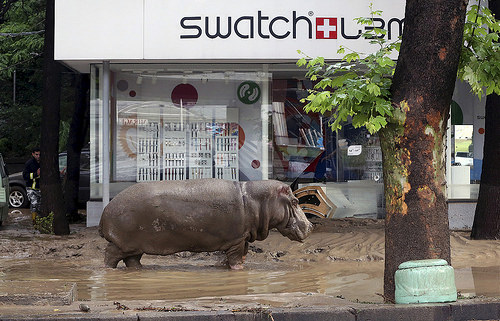
Zoo Animals Escape in Tbilisi Flood

See all the photos in the Atlantic feature: “Zoo Animals Escape Amid Heavy Flooding in Tbilisi, Georgia”

REPRISES/RESPONSES/REJOINDERS/RIPOSTES

  • Reader N. breaks down bibliotherapy: "I was deeply disappointed in this article because it significantly neglects poetry. What could be more therapeutic than some of the sonnets written by the romantic poets? Or perhaps, more realistically, the nostalgia and cynicism of Philip Larkin can position a person’s depression in the zeitgeist. Reading Wordsworth’s THE PRELUDE might be the most helpful poetic cure for melancholy. ¶ Some people can begin with Mary Oliver, but why end there? I just googled poetry therapy and came up with this intriguing link. ¶ I know that I sound like a querulous pedant, but why should we toss out centuries of magnificent poetry for the latest YA pop pap?

  • Reader B. twitches at a word that makes me itch too: “ ‘recency’: this has popped up in discussions of Twitter. I hate it, but there it is. ¶ Example: ’Any time you log in to Twitter, you see the most recent tweets from people you follow. This focus on recency makes Twitter indispensable for certain kinds of users.”


I welcome comments, suggestions, thoughts, feedback and all manner of what-have-you. Just press ‘Reply’ or email to: clippings@katexic.com.

And please feel free to share anything here as far and wide as you want! If you want to give a shout-out, please link to: http://katexic.com/clippings/.

Daily(ish) email overwhelming you? Email chris+weekly@katexic.com to switch to the weekly digest edition.

#217
June 16, 2015
Read more

|k| clippings: 2015-06-13 — the gibberish see-saw

Today’s WATCH is a simultaneous discovery also shared by Reader C., who has contributed some great stuff lately...including pointing out the book that today’s WORK comes from, which is a wonderful thing: Trotta tells the story of cosmology’s greatest discoveries and mysteries using only the 1000 most commonly used words in English.

WORK

"Some of her friends, people she went to college with, have become a different kind of student-person. They are trying to catch the whisper of the dark matter rain all around us.

And to do that, they need silence.

But not a normal kind of silence. They need to silence all other kinds of normal drops that would usually scream over the quiet dark matter drops.

To do so, they have to find a place where normal drops can’t get to.

There are all kinds of normal drops flying around that you must take out, or else you could confuse their chuckle for the dark matter whisper.

Loud sounds come from bursts of fast drops coming from the sky. To take those out, student-people build dark matter ears deep inside rocks. Sometimes, they put the dark matter ears in deep mines, where other people bore to look for pretty things to put on their fingers.

Those are silent places, perfect for listening to dark matter."

—Roberto Trotter
—from The Edge of the Sky: All You Need to Know About the All-There-Is

WORD(S)

glossolalia. noun. Speaking in tongues; using a fabricated language. Particularly when associated with a trance state, schizophrenia or ecstatic religious speech. From Greek glossa (tongue, language) + lalia (talk, prattle, a speaking). [Thanks, Reader T.]

“Those soliloquies of ecstatic spiritual emotion which were known as Glossolalia, or, ‘the Gift of Tongues’.” (Frederic Farrar)

“Though many glossolalists believe they are speaking a real but unknown language, the utterance patterns are quite unlike ordinary language.” (David Crystal)

“Oblivious, the holy man continued his wheezy glossolalia, the goiter in his neck bobbing up and down.” (Robert Boyczuk)

“Long after dark
the men are raveled at a reddened stone
that beats back what cannot be seen, in kin-
dled twos, duplicity, the tongues of love,
the glossolalia of fire.”
(Heather McHugh)

WEB

  1. A familiar spam mail scam…from 1797 → Letter Scam

  2. Waffles? Yes. Keyboard waffles made with a typewriter waffle iron? Yes, please. → Interview With Chris Dimino: the Designer of the Waffle Iron Typewriter

  3. ClickHole is becoming a favorite stop when I need a laugh. → This Spoken Word Poem Is Amazing Even If It Appears To Be Mainly About Don Henley

  4. On bibliotherapy (my own most productive form of self-medication) → Can Reading Make You Happier?

  5. Today in 1865, poet and Nobel Prize winner W.B. Yeats is born in Sandymount, Ireland. It’s hard to know where to start with a writer of Yeats’ poetic power as I myself am only just beginning to learn to “lie down where all the ladders start / In the foul rag and bone shop of the heart.” His use of symbols, his lifelong exploration of traditional form while modernism and free verse poetry was on the steep ascendant, the subtle music of his language, the sweetness and severity…just read some of Yeats’ poems. And read them slowly. Savor them. If there’s any problem with Yeats’ work it’s that so many of us have become unaccustomed to reading poems such as his that the musicality is lost. Maybe make the reading a bit of meditative time in honor of his birthday.

WATCH/WITNESS
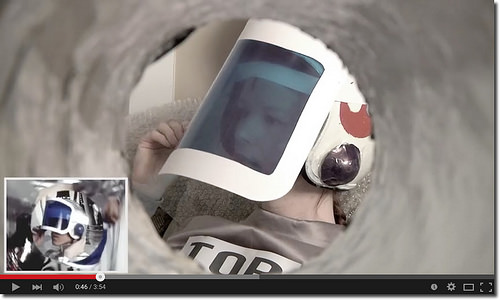
"Space Weird Thing" (Marian Call_

“Space Weird Thing” by Marian Call, “a sweded parody of ‘Space Oddity,’ the David Bowie song (and music video). The lyrics contain only the thousand most common words in English. It’s a loving tribute to David Bowie and it’s inspired by Flight of the Conchords, Michel Gondry, and especially the Up-Goer Five diagram by Randall Munroe.”

REPRISES/RESPONSES/REJOINDERS/RIPOSTES

  • Reader N. has my back: “It is my opinion that Former Reader T. is lacking in intellectual curiosity. Nothing feels less pretentious and less real than Katexic. The subjects you address are amongst the most urgent in the world for me. Former Reader T. sounds like a devotee of Disney World, if I may fling a few stones.”

  • And Reader J. has thoughts on that too: “Don’t let this get to you, Chris—you’re doing fine. Odd thing about the WWW: no one goes gentle (i.e., quietly) into that good night. Everyone feels the compulsion to register one last squawk. I suppose that’s Democracy In Action and we should say yay: but for people like me, of a generation that regards tweeting as silly (information as conspicuous/imperspicuous production), a climate of whining is everywhere, like Pythagoras’s harmony of the spheres, only ceaselessly audible. If there isn’t a song with the refrain ‘Shut up and go,’ there should be.”

  • Reader F. investigated Reader N.’s ‘cellar door’ comment: As I always cite Poe as the originator of the comment that ‘cellar door’ is the most beautiful phrase in the English language, I decided to check out my favorite source for authenticity—Wikipedia, of course—when I saw it attributed to Auden by a Katexic reader. I submit the following, which appears in the midst of a very long dissertation on the two words under discussion. What it may signal, perhaps, is that Auden knew his Poe. ¶ Here is the Wikipedia comment:

A story told by syndicated columnists Frank Colby in 1949 and L. M. Boyd in 1979 holds that ‘cellar door’ was Edgar Allan Poe’s favorite phrase, and that the refrain Nevermore in ‘The Raven’ was chosen as ‘the closest word to ‘cellar door’ he could think of.’ This may derive from a 1914 essay by Alma Blount:

Poe, who studied sound effects carefully, says that he chose ‘Nevermore’ as the refrain for The Raven largely because the word contains the most sonorous vowel, o, and the most ‘producible’ consonant, r. An amusing story is told of an Italian lady who knew not a word of English, but who, when she heard the word cellar-door, was convinced that English must be a most musical language. If the word were not in our minds hopelessly attached to a humble significance, we, too, might be charmed by its combination of spirant, liquids, and vowels.


I welcome comments, suggestions, thoughts, feedback and all manner of what-have-you. Just press ‘Reply’ or email to: clippings@katexic.com.

And please feel free to share anything here as far and wide as you want! If you want to give a shout-out, please link to: http://katexic.com/clippings/.

Daily(ish) email overwhelming you? Email chris+weekly@katexic.com to switch to the weekly digest edition.

#216
June 13, 2015
Read more

|k| clippings: 2015-06-11 — pet perambulations

Today’s WORK shared by Reader N., who also has an insightful RESPONSE later in this issue.

WORK

“Yet, to my thinking, the real pet words are peripheral beings, only occasionally reflecting the author’s deepest themes and concerns. They’re capricious and extraneous—or they would be, if the author didn’t welcome them so warmly, didn’t put them on show so frequently. They are stray cats taken in by the author—as in John Updike’s adoption of ‘lambent’ and ‘crescent’ or Anne Tyler’s of ‘nubbin’ or John Cheever’s of ‘inestimable’ or H. G. Wells’s of ‘incontinently’ or Thackeray’s of ‘artless.’ Each of these words presents the critic with a little puzzle of devotion: What was it about this particular package of syllables? Why was this stray cat escorted into the author’s studio and offered a saucer of cream and a plump pillow by the fireplace? It’s not as though the studio were soundproof; during working hours, the author no doubt could hear other strays, seemingly no less deserving, meowing clamorously for admission.”

—Brad Leithauser
—from “Pet Words”

WORD(S)

purlieu /PəRL-yoo/. noun. In modern terms: an outlying area, the outskirts. Figuratively: the fringes, the margins. Also figuratively: to pursue an illicit relationship, usually with a prostitute. From Middle English purlewe (a piece of land on the edge of a forest), likely an alteration of Old French porale (a royal perambulation) with Old French lieu (place).

“He is weary of hunting in the spacious Forest of a Wife, and is following his Game incognito, in some little Purliew here at Thebes.” (John Dryden)

“Bone palings ruled the small and dusty purlieus here and death seemed the most prevalent feature of the landscape.” (Cormac McCarthy)

“His rather desperate plan was to avoid the cross-streets for now, as he couldn’t know what they might contain, perhaps he might run straight into the purlieus of a police station” (Franz Kafka)

“…my wanderings through the abandoned purlieus of the savage Miskahannocks grew desultory and ruminative…” (Michael Chabon)

“One apocryphal story has it that Berrigan, upon seeing a cantaloupe for the first time, thought it a bust of Max Jacob. There was a good deal of levity that evening in selected purlieus.” (Gilbert Sorrentino)

WEB

  1. Minimalist, GPS-based city maps → Archie’s Press: Maps

  2. David Curran has been testing the Irish postal service with a series of strange mailings including a toilet paper tube, a Möbius strip, various puzzles and more. See also, a similar experiment in the U.S. documented in the Improbable Research blog.

  3. A mysterious book appearing on doorsteps, high tech design paired with calligraphy, intimate knowledge of tech culture and some fine writing (though comparing to Pynchon is a bridge too far) → The Mysterious Case of Iterating Grace (and part 2)

  4. 8 Pronunciation Errors That Changed Modern English

  5. Today in 1805 the old city of Detroit is destroyed in a fire that leaves nothing standing but one stone warehouse, some brick chimneys and Fort Lernoult, which stood on a hill above the flames. This inspired the seal found on the flag of the city which features two women, one looking at the burning city with the words Speramus Meliora (we hope for better things) and the other looking at a new city with the words Resurget Cineribus (it will rise from the ashes). One thing that did rise from the ashes was Detroit’s interesting radial street plan based on a similar plan for Washington, D.C. No cause of the fire was officially established but many attribute it to stray sparks from a local baker emptying his pipe.

WATCH/WITNESS

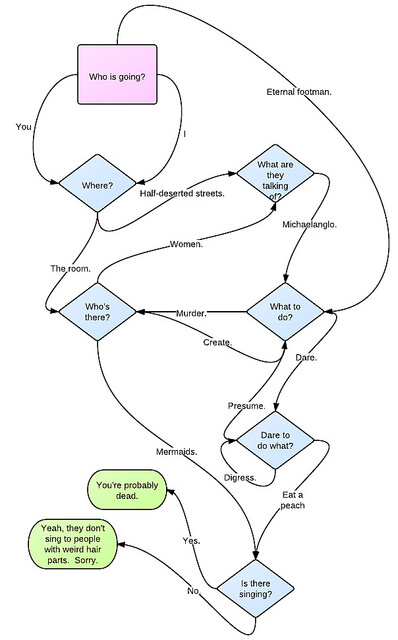
Flowchart of J. Alfred Prufrock

The Flowchart of J. Alfred Prufrock [Thanks Reader S.!]

REPRISES/RESPONSES/REJOINDERS/RIPOSTES

  • Reader T. dons his thinking cap: “Trying to come up with a trolley scenario involving the Journal of Universal Rejection. It shouldn’t be too hard, but the thought of there being such a scenario is enjoyable enough that I’m resisting actually creating one.”

  • Reader N. on the Words We Love link: “I was surprised to find that about half of the favorite words were one-syllable and somewhat harsh sounding. I recollect that the poet W.H. Auden said that ‘cellar door’ was the most beautiful phrase in the English language. Note this discussion: http://www.nytimes.com/2010/02/14/magazine/14FOB-onlanguage-t.html ¶ I also seem to recall that William Faulkner loved the word ‘wisteria’…”


I welcome comments, suggestions, thoughts, feedback and all manner of what-have-you. Just press ‘Reply’ or email to: clippings@katexic.com.

And please feel free to share anything here as far and wide as you want! If you want to give a shout-out, please link to: http://katexic.com/clippings/.

Daily(ish) email overwhelming you? Email chris+weekly@katexic.com to switch to the weekly digest edition.

#215
June 12, 2015
Read more

|k| clippings: 2015-06-09 — dwindling trolleys

WORK

“It’s hardly a coincidence that ‘Shipping Out,’ Wallace’s most well-known essay, appeared only a month before Infinite Jest, his most well-known novel, was published. Both are about the same thing (amusing ourselves to death), with different governing données (lethally entertaining movie, lethally pampering leisure cruise). In an interview after the novel came out, Wallace, asked what’s so great about writing, said that we’re existentially alone on the planet—I can’t know what you’re thinking and feeling, and you can’t know what I’m thinking and feeling—so writing, at its best, is a bridge constructed across the bridge of human loneliness.”

—David Shields
—from How Literature Saved My Life

WORD(S)

dwine /DWIYN/. verb. To waste or pine away, decline, wither. From Middle English dwinen, from Old English dwīnan (to disappear, to languish); also Old Norse dvīna (to dwindle or pine away).

“Lyke as the purpour flour…Dwynis away, as it doith faid or de.” (Virgil, trans. by Gavin Douglas)

“A race, which…must, to use a fine though half-forgotten word, begin to dwine away.” (The Spectator, 1889)

“I will dwine your flesh on your bones.” (Samuel R. Crockett)

“As well die in a bog-hole or break your neck over a crag as dwine away with ague in the cold heather, as you are like to do…” (John Buchan)

“Pine away—dwine away— / Anything to leave you!” (Rudyard Kipling)

WEB

  1. Various authors on their favorite words…and some good ones in the comments area too! → From plitter to drabbletail: the words we love

  2. This Artist is Turning Iconic Portraits into Selfies

  3. “There’s an out of control trolley speeding towards five workers. You’re in a nearby café, sipping on a latte, and don’t notice.” → from Lesser Known Trolley Problem Variations.

  4. “The founding principle of the Journal of Universal Rejection (JofUR) is rejection. Universal rejection. That is to say, all submissions, regardless of quality, will be rejected. Despite that apparent drawback, here are a number of reasons you may choose to submit to the JofUR…” → Explore the Journal of Universal Rejection.

  5. Today in 1860, Erastus and Erwin Beadle release the first dime novel, Malaeska, the Indian Wife of the White Hunter, by Ann S. Stephens. Northern Illinois University has a fantastic collection of digitized dime novels (and “nickel weeklies”) called, appropriately, Nickels and Dimes. Thanks to UMN digital libraries, you can peruse some digitized dime novels. Or check out some of the cracking dime novel covers—one of their hallmarks—in this Library of Congress exhibit.

WATCH/WITNESS

"Aria" by John McAbery

“Aria” — sculpture by John McAbery.

REPRISES/RESPONSES/REJOINDERS/RIPOSTES

  • Reader C. makes an interesting point about retronyms: “Retronyms make me think of a whole group of words where the prefix is political: Asian-American, gay marriage, female scientist, black culture, etc… The modifiers are not actually necessary but they are effective in implying ‘not normal’ or ‘special anomaly’. Americans are American, marriage is marriage, scientists are scientists, culture is culture. It’s an interesting exercise, for instance, to merely take notice any time an article headline feels the need to use the adjective ‘girl’ or ‘woman’ to describe any profession. Would the reverse happen for ‘male scientist’ or ‘man politician’? And would the article suffer any from the removal of that prefix?”

  • Reader B. recommends: “That lovely Carver quote brought to my wandering mind Wendell Berry’s fine early novel Jayber Crow, with its barber protagonist.”

  • Reader C. is disappointed in my Memorial Day issue: “No excerpt from war literature for the work portion of today’s newsletter? Expected but disappointing.”

  • Former Reader T. was disappointed in Katexic as a whole: “The poetry didn’t resonate with me at all and it [the newsletter] felt pretentious, unreal…”


I welcome comments, suggestions, thoughts, feedback and all manner of what-have-you. Just press ‘Reply’ or email to: clippings@katexic.com.

And please feel free to share anything here as far and wide as you want! If you want to give a shout-out, please link to: http://katexic.com/clippings/.

Daily(ish) email overwhelming you? Email chris+weekly@katexic.com to switch to the weekly digest edition.

#214
June 9, 2015
Read more

|k| clippings: 2015-05-25 — the nobody that is there

WORK

The barber turned me in the chair to face the mirror. He put a hand to either side of my head. He positioned me a last time, and then he brought his head down next to mine.

We looked into the mirror together, his hands still framing my head.

I was looking at myself, and he was looking at me too. But if the barber saw something, he didn’t offer comment.

He ran his fingers through my hair. He did it slowly, as if thinking about something else. He ran his fingers through my hair. He did it tenderly, as a lover would.

That was in Crescent City, California, up near the Oregon border. I left soon after. But today I was thinking of that place, of Crescent City, and of how I was trying out a new life there with my wife, and how, in the barber’s chair that morning, I had made up my mind to go. I was thinking today about the calm I felt when I closed my eyes and let the barber’s fingers move through my hair, the sweetness of those fingers, the hair already starting to grow.

—Raymond Carver
—from “The Calm”

WORD(S)

quidam /KWEE-dawm/. noun. An unknown person. An unidentified subject. Usually implies that the subject is insignificant, a nobody. See also quidamity, the state of being referred to as a nobody. Direct from Latin quīdam (an unspecified person).

“If the doctrine of our English quidams be right, the French must be very short of brain.” (Times [London, 1832])

“In regiae libidinis voluptatem castrati sunt quidam; sed nemo sibi, ne vir esset, jubente domino, manus intulit. [Some have been castrated to serve the lust of kings, but no one has ever emasculated himself, even at the command of his master.]” (Michel de Montaigne, quoting Lucretius, translated by M.A. Screech)

WEB

  1. Thanks to Reader S. for sharing this article, which includes some fantastic pictures. Snail mail FTW. “A 92-year-old WWII vet who recently donated his wartime letters to the National Postal Museum reflects on a friendship that lasted a lifetime” → A Memorial Day Memory: Love From the Pacific Theater

  2. “Samurai and courtesans: Japan caught in colour back in 1865 – in pictures”

  3. “For those who love books, but don’t have enough time for reading. Here are the best books you can read in under an hour each.” → 24 books to read in under an hour (infographic)

  4. RIP: William Zinsser, author of On Writing Well, a must-have book for anyone who wants to write clear, powerful prose.

  5. Today in 1938, short-story writer and poet Raymond Carver is born in Oregon. Carver remains one of my favorite authors…I discovered him in my mid-teens and his spare prose and plain poetry touched something in my unformed heart in a way very few others have. Often called a “minimalist” or, worse, a “dirty realist,” Carver’s work is deceptively simple. Not only are there rarely plumbed depths in his work, but the way they are made is easy to imitate but hard to realize, in the way it’s easy to imitate a world-class swimmer’s deceptively simple strokes and movement. As Carver noted in a 1986 interview:

“Critics often use the term ‘minimalist’ when discussing my prose. But it’s a label that bothers me: it suggests the idea of a narrow vision of life, low ambitions, and limited cultural horizons. And, frankly, I don’t believe that’s my case. Sure, my writing is lean and tends to avoid any excess. There’s a saying of Hemingway’s that I could take for my motto: ‘Prose is architecture. And this isn’t the Baroque age.’”

WATCH/WITNESS

Gay Talese's Address Book

Watch: “Legendary American literary journalist Gay Talese has been keeping an address book since the 1950s and has never erased a single name or detail. In this film, Talese gives us a tour of his address book, which contains the names, addresses, and phone numbers of Kareem Abdul-Jabbar, Tony Bennett, Francis Ford Coppola, and many more.”

REPRISES/RESPONSES/REJOINDERS/RIPOSTES

  • Reader T. writes in about ‘retronyms’: “These retronyms are pretty cool. <<Side note: Autocorrect changes the word to ‘retro yam.’>> What about a term for the word that necessitates a retronym? Because I think autocorrect would be one of those, right? ¶ We spent a few minutes this morning coming up with some retronyms. How about ‘straight sex,’ ‘premium cable,’ ‘conventional warfare,’ ‘mainstream media,’ ‘natural death,’ ‘brick and mortar store,’ ‘classroom teacher,’ ‘prescription drugs,’ ‘processed or organic foods’ (depending on when you think about it), ‘whole milk,’ ‘print publication,’ and ‘desktop computers’?”

I welcome comments, suggestions, thoughts, feedback and all manner of what-have-you. Just press ‘Reply’ or email to: clippings@katexic.com.

And please feel free to share anything here as far and wide as you want! If you want to give a shout-out, please link to: http://katexic.com/clippings/.

Daily(ish) email overwhelming you? Email chris+weekly@katexic.com to switch to the weekly digest edition.

#213
May 25, 2015
Read more

|k| clippings: 2015-05-23 — of visible light and bar soap

Today’s WORD describes another fun language group. Do you have any favorite retronyms? Or, better, words that will soon need one?

WORK

#212
May 23, 2015
Read more
  Newer archives Older archives  
Powered by Buttondown, the easiest way to start and grow your newsletter.