katexic clippings logo

katexic clippings

Archives
Subscribe

katexic clippings katexic clippings

Archive

|k| clippings: 2015-10-08 — those hoarded constants

The discover of liquid water on Mars brought to mind today’s WORK. And today’s WORD is inspired by Reader B., who was obviously paying attention to the Zipf’s Law video a few weeks ago.

WORK

“There is Absolutely Nothing Lonelier”

There is absolutely nothing lonelier
than the little Mars rover
never shutting down, digging up
rocks, so far away from Bond street
in a light rain. I wonder
if he makes little beeps? If so
he is lonelier still. He fires a laser
into the dust. He coughs. A shiny
thing in the sand turns out to be his.

—Matthew Rohrer
—from the Columbia Daily Tribune

WORD(S)

hapax legomenon /ha-PAKS lə-GAW-mə-nawn/ (pronunciation guide). noun. A word that occurs only once in a text, oeuvre or a body of literature (aka a corpus). Often abbreviated as just hapax. Surprisingly, 40–60% of large collections of text are made of hapaxes. Read more: Wikipedia. See also: hapaxanthic (a plant that fruits and flowers only once). Borrowed from Greek hapax legomenon ([a thing] said only once).

“This is the Age of Complete Interconnection. No wires can hang loose; otherwise we all short-circuit. Yet, it is undeniable that life without individuality is not worth living. Every man must be a hapax legomenon…” (Philip Jose Farmer)

“The term for a word that only appears once in a text is hapax legomenon, which sounds like a character from an Asterix story, or a Scandinavian death metal band, and in this text appears only once.” (Alex Bellos)

“…where would their practice be or where the human race itself were the Pythagorean sesquipedalia of the panepistemion, however apically Volapucky, grunted and gromwelled, ichabod, habakuk, opanoff, uggamyg, hapaxle, gomenon, ppppfff, over country stiles, behind slated dwellinghouses, down blind lanes, or, when all fruit fails, under some sacking left on a coarse cart?” (James Joyce)

WEB

  1. Metaphor Map of English [Via Reader S. who says “I really don’t understand this but thought you might.” Well, it’s fun to explore even in my ignorance!]

  2. First, the Oregon Shakespeare festival announces a large-scale project to “translate” all of Shakespeare’s plays into “modern English”. I’m no purist by any means—I love adaptations of—and new variations on—the Bard’s work…but this seems deeply misguided. I’m not alone in that. In modern times, this kind of project is actually an outlier. Much more interesting, to me, is the ongoing project to have some of our best novelists re-imagine Shakespeare’s plays as novels.

  3. The strange and fascinating Ribbon Farm is “devoted to unusual takes on familiar themes. What we call ‘refactored perception.’” [Thanks, Reader M.!]

  4. Jana Dambrogio’s “Letterlocking” Page takes forever (well, at least a minute or more; that’s what happens when you have 75+ megabytes of images on a single page) to load…but once it does, it is chock-full of interesting images and resources about historical, locking letterfolds.

  5. Today in 1871, at 11:30 P.M., the Great Chicago Fire (cool site; check it out!) erupts. It would burn for 36 hours, kill nearly 300 people and leave over 100,000 people homeless in the 3.3 square mile area it consumed. While the Irish Catherine O’Leary (and her cow) made a fitting scapegoat during the heavily anti-Irish times, she (and her cow) were later exonerated and theories abound as to what really started the blaze. There’s no question, however, that the thin, mostly all-wood construction technique popular there at the time contributed to the fire going quickly out of control. Ironically, the demand for lumber to rebuilt was so great that some areas of Michigan were totally deforested…and Singapore, MI would subsequently be overrun by sand dunes and become, for a time, a famous ghost town.

WATCH/WITNESS

from The Homeless Library collaboration Hope 1980 [enable images; click to view]

Some of the notes collected for the Hope 1980 artist book; a project from The Homeless Library.

REPRISES/RESPONSES/REJOINDERS/RIPOSTES

  • Reader V. found an assignment: “I love the minimal elegance of the Animated Book Covers and plan to have my digital illustration students make some of their own.”

I welcome comments, suggestions, thoughts, feedback and all manner of what-have-you. Just press ‘Reply’ or email to: clippings@katexic.com.

And please feel free to share anything here as far and wide as you want! If you want to give a shout-out, please link to: http://katexic.com/clippings/.

#251
October 8, 2015
Read more

|k| clippings: 2015-10-06 — give one million and one percent!

It’s not too late to back the Wordnik Kickstarter: Let’s Add a Million Missing Words to the Dictionary. I did. And it feels goooooood.

WORK

“The Urban Life”

These morning, when I pass alongside Parisian fish vendors, I witness blank, white, frozen men in the process of wage and capital, spreading out fish fresh from the sea and just off the boat. The unraveled forms sparkle in the sheen of coin and mother-of-pearl, luminous shocks of ice pounded down in stalls, the clear light of January. I suffer their separate deaths, their stared-through eyes, their void. Such jettisoned and mute nakedness…so suddenly I need to feel my heart beneath my coat to convince me who I am—my clean presence; my still warm, still life.

—Liljana Dirjan (translated by P.H. Liotta)
—from The Best of the Prose Poem

WORD(S)

fougue (fogue) /FOOG/. noun. Ardour; impetousness; passion. From French fougue, same meaning. From Latin fuga (flight, fleeing).

“‘Yes, she does have something of that fougue,’ Andrei Antonovich muttered, not without pleasure, at the same time regretting terribly that this ignoramus should dare to express himself quite so freely about Yulia Mikhailovna…” (Fyodor Dostoevsky)

“Thus Sforza, cursed with a too fertile brain,
Lost by his wiles the power his wit did gain.
Henceforth their fougue must spend at lesser rate,
Than in its flames to wrap a nation’s fate.”
(John Dryden)

“The conscious agility, fougue, and precision which fill the performer become contagious and delight the spectator as well.” (George Santayana)

“About six weeks, however, after his mother’s death, Coryston’s natural fougue suggested to him that he was being trifled with.” (Mrs. Humphry Ward)

WEB

  1. Mostly subtle and wonderful → Animated Book Covers

  2. Digital books stagnate in closed, dull systems, while printed books are shareable, lovely and enduring. What comes next?

  3. 20 Words That Aren’t in the Dictionary Yet.

  4. A Linguist Explains How We Write Sarcasm on the Internet

  5. Today in 1887, Charles-Édouard Jeanneret-Gris, AKA Le Corbusier, is born in Switzerland. A successful painter and co-founder of the Purism movement, Le Corbusier is remembered most for his career in architecture, particularly his continuing (and controversial) influence on urban planning and architecture stemming from his five principles of architecture and the Villa Radieuse (Radiant City).

WATCH/WITNESS

21-day Bee Time Lapse Video [click to view]

“Witness the eerily beautiful growth of larvae into bees in this mesmerizing time-lapse video from photographer Anand Varma.” → http://ktxc.to/vid-bee-time-lapse

REPRISES/RESPONSES/REJOINDERS/RIPOSTES

  • Reader T. pops up in with a well-timed link: “Every time you post a link to the New Yorker [aside: you don’t really read that rag regularly do you?] I think of the New Yorker Minute newsletter, which synopsizes [and sometimes skewers] each issue as it comes out.” — Indeed. I was going to post a link to a recent article about Kenneth Goldsmith, but now I can confine it here. And I might as well toss in Brian Kim Stefans’ destruction of that article (and Goldsmith).

  • Reader K. slips on a journey to use each Katexic WORD in conversation: “I really WANTED to use the word caruncle, but the situation has not come up yet where I might casually slip it into conversation. But soon, I hope!”


I welcome comments, suggestions, thoughts, feedback and all manner of what-have-you. Just press ‘Reply’ or email to: clippings@katexic.com.

And please feel free to share anything here as far and wide as you want! If you want to give a shout-out, please link to: http://katexic.com/clippings/.

#250
October 6, 2015
Read more

|k| clippings: 2015-10-01 — punctuation, lightning

WORK

“For more than three decades, coffee has captured my imagination because it is a beverage about individuals as well as community. A Rwandan farmer. Eighty roast masters at six Starbucks plants on two continents. Thousands of baristas in 54 countries. Like a symphony, coffee’s power rests in the hands of a few individuals who orchestrate its appeal. So much can go wrong during the journey from soil to cup that when everything goes right, it is nothing short of brilliant! After all, coffee doesn’t lie. It can’t. Every sip is proof of the artistry—technical as well as human—that went into its creation.”

—Howard Schultz
—form Onward: How Starbucks Fought for Its Life without Losing Its Soul

“Just the other day, I was in my neighborhood Starbucks, waiting for the post office to open. I was enjoying a chocolatey cafe mocha when it occurred to me that to drink a mocha is to gulp down the entire history of the New World. From the Spanish exportation of Aztec cacao, and the Dutch invention of the chemical process for making cocoa, on down to the capitalist empire of Hershey, PA, and the lifestyle marketing of Seattle’s Starbucks, the modern mocha is a bittersweet concoction of imperialism, genocide, invention, and consumerism served with whipped cream on top.”

—Sarah Vowell
—from The Partly Cloudy Patriot

WORD(S)

caruncle /kə-RUN-kəl/. noun. A fleshy outgrowth. A naked excrescence of tissue. For example: a turkey’s wattle or a person’s dewlap. From Latin caruncula (little piece of flesh), diminutive of caro (flesh).

“I was so scattered, I’m still not sure what to write: About my back aching from where I’d slept? my head still gauzed, Pharaohnically wrapped, from when I’d been woken up? about the cut on my neck? the slit from chin’s caruncle to neck like an against the grain shaving mishap, just healing?” (Joshua Cohen)

“Crooke states that the hymen is not a single membrane but is really made up of eight parts, ‘caruncles’ and membranes, and says that ‘all these particles together make the form of the cup of a little rose half blowne.’” (Hanne Blank)

“We had plenty of farmyard creatures, as, for example, rabbits, the most oval animal of all, if you know what I mean; and choleric turkeys with carbuncular caruncles…” (Vladimir Nabokov)

WEB

  1. This is a Vinyl Record Being Played Under 1000x Magnification

  2. From Books to Ebooks and Back: The Future of Literary Consumption Is Unwritten

  3. “At the intersection of the critical effort to preserve our digital history and the more nefarious impulse to commercially exploit it are formerly private citizens coming to terms with a shifting paradigm in how we understand and control our past, present and future identities. ’Our digital shadows reflect us but aren’t us, and so we shouldn’t let them define our experience in the world…” » Alan Massey on the vast, imperfect memory of the Internet

  4. At the always-interesting BibliOdyssey » 19th Century Maps of Mars

  5. Today is the first consolidated, official, International Coffee Day. Every day is International Coffee Day wherever I happen to be. The Guardian has posted 10 great coffee quotes. If you’re inspired, Sweet Maria’s is my go-to place for coffee brewing and roasting paraphernalia. See more on Twitter and Instagram.

WATCH/WITNESS

Interview and Best of Seb Lester [click to read and view]

An interview with—and selected best-of videos by—calligrapher Seb Lester, who I’ve featured here before.

REPRISES/RESPONSES/REJOINDERS/RIPOSTES

  • Reader F. shares a punctuation story to remember: “Your readers might be hooked by the title of this little gem, ‘UBC student writes 52,438 word architecture dissertation with no punctuation — not everyone loved it’ » http://ktxc.to/dissertation-sans-punctuation”

  • And Reader R. shares another: “I wonder if Katexicans (?) could think of additions to this list of the Five Best Punctuation Marks in Literature?”


I welcome comments, suggestions, thoughts, feedback and all manner of what-have-you. Just press ‘Reply’ or email to: clippings@katexic.com.

And please feel free to share anything here as far and wide as you want! If you want to give a shout-out, please link to: http://katexic.com/clippings/.

#249
October 1, 2015
Read more

|k| clippings: 2015-09-29 — a long way from the home that never was

Somehow I missed the celebration, but it’s not too late to enjoy Little-Known Punctuation Marks for National Punctuation Day!

WORK

“I lingered round them, under that benign sky; watched the moths fluttering among the heath and hare-bells; listened to the soft wind breathing through the grass; and wondered how anyone could ever imagine unquiet slumbers for the sleepers in that quiet earth.”

—Emily Brontë
—from Wuthering Heights

An OuLiPian version, substituting each noun from the seventh noun following it in the Random House Unabridged Dictionary:

“I lingered round them, under that benign skyflower; watched the Mother Gooses fluttering among the heathenesse and haircots; listened to the soft windcheater breathing though the grasshopper; and wondered how anyone could imagine unquiet slurs, for the sleaaping chairs in that quiet earthiness.”

Another version, substituting nouns, verbs and adjectives from Harrap’s Shorter English-French Dictionary:

“I lived round them, under that bestial slacker, wove the motorcades following among them the hecatomb and harlots, lobbed to the sorrowful windrow brimming through the grave; and wrangled how anyone could immolate unreceipted slynesses, for the slickers in that quotable easement.”

—OuLiPian versions from Word Recreations: Games and Diversions from “Word Ways”
—A. Ross Eckler (Ed)

WORD(S)

hiraeth /HEER-IYəTH/. noun. A Welsh word often portrayed as one of the mythical “untranslatables” that invokes a deep, nostalgic homesickness—sadness and longing—for a time, place and feeling in the past one cannot return to…or that never was. See also: sehnsucht and saudade.

“Well, with my pay in my pocket, and 500 pounds at my back, I thought I would enjoy myself as much as I could, and smother the hiraeth that was so strong upon me, the longing to go home to see Morva…” (Allen Raine)

“It’s pronounced ‘here-eyeth’ (roll the ‘r’) and it’s a Welsh word. It has no exact cognate in English. The best we can do is ‘homesickness,’ but that’s like the difference between hardwood and laminate. Homesickness is hiraeth-lite.” (Pamela Petro)

“…in other parts of the world those of us self-diagnosed with ‘Hiraeth’ oscillate between belonging to the home we’ve created in our heads…” (Lara Atallah)

WEB

  1. Another in a long line of efforts that is, at best misguided, at worst…well… → A Facelift for Shakespeare

  2. Where Do Languages Go to Die?

  3. "Here you can see the pages from the original manuscript ‘Alice’s Adventures under Ground’ … The drawings are of his own hand.

  4. First Line, Last Line, a blog of the first and last lines of many books.

  5. Today in 1930, British crime novelist Colin Dexter—creator of the iconic Inspector Morse—is born in Stamford, Lincolnshire, England. Forced to resign from teaching due to progressive hearing issues, Dexter, a Cambridge graduate, worked as an administrator at Oxford for more than 20 years. During this time he started publishing his famous Inspector Morse novels, including Last Bus to Woodstock, the first novel in the series (and the first piece of fiction Dexter ever wrote). He would go on to write 13 novels from which a 33-episode BBC series was produced (not to mention an ongoing prequel series and spinoff). You might enjoy this interview with Dexter and seeing a few handwritten pages from the first Morse novel.

WATCH/WITNESS

How to Make a $1500 Sandwich in 6 Months [click for video]

“I spent 6 months and $1500 to completely make a sandwich from scratch. Including growing my own vegetables, making my own salt from ocean water, milking a cow to make cheese, grinding my own flour from wheat, collecting my own honey, and killing a chicken myself.”

REPRISES/RESPONSES/REJOINDERS/RIPOSTES

  • Reader B. writes: “That’s one doom-laden quote from F Stop Fitzgerald. A too-nice summary of writer’s block. ¶ Re: audio theater, I know it’s bad form to damn something before taking it in. And I will listen to the hour-long podcast as soon as I can. But podcasting is one decade old. People have been doing tons of creative digital audio work before NPR listeners caught on.” — ‘F Stop Fitzgerald’ … heh.

  • Reader C. sends some love: “concīs is fantastic! The simple layout fits the premise and the editorial vision and selection is a step or three above the pack.”


I welcome comments, suggestions, thoughts, feedback and all manner of what-have-you. Just press ‘Reply’ or email to: clippings@katexic.com.

And please feel free to share anything here as far and wide as you want! If you want to give a shout-out, please link to: http://katexic.com/clippings/.

#248
September 30, 2015
Read more

|k| clippings: 2015-09-24 — conjuring whole cloth

WORK

“Anthony was glad he wasn’t going to work on his book. The notion of sitting down and conjuring up, not only words in which to clothe thoughts but thoughts worthy of being clothed—the whole thing was absurdly beyond his desires.”

—F. Scott Fitzgerald
—from The Beautiful and the Damned

WORD(S)

chock-full /CHOK-FUL/. adjective. Filled to the limit. An interesting phrase because of its mysterious origin. Like most, I assumed it must come from choke, as in “full to choking” (choke, incidentally, comes from Middle English cheek, relating to the jaw). But it could also come from the Old French choquier (to collide, crash) and, thanks to non-uniformity of spelling in historical sources, we’ll probably never know.

When you’re before me, then I think you’re meat and bones,
chock-full of blood and tears, a mortal just like me;
but when I see you from afar, in memory’s mist,
then you grow monstrous like a god, and I go daft!
(Nikos Kazantzakis, translated by Kimon Friar)

“For while television has from its beginnings been openly motivated by—has been about—considerations of mass appeal and L.C.D. and profit, our own history is chock-full of evidence that readers and societies may properly expect important, lasting contributions from a narrative art that understands itself as being about considerations more important than popularity and balance sheets. Entertainers can divert and engage and maybe even console; only artists can transfigure.” (David Foster Wallace)

WEB

  1. ► A fantastic video on Zipf’s law (which explains, or at least rationalizes, so many things about life and language) with a description chock-full o’ links. Thanks to Reader S., who notes: “apologies if you have covered this in earlier issues and I just missed it, but when I saw [this] I immediately thought of you as it is a phenomenom of language (and other realms) like no other…”

  2. Ann Heppermann on the rebirth of audio fiction

  3. A roundup of Super Seventies Japanese Film Posters. See also: Swinging Sixties Japanese Film Posters

  4. ‘I’m awful, I’m awful’: writers spill the secrets of their diaries

  5. Today in 1896, F. Scott Fitzgerald is born in St. Paul, Minnesota. Despite a turbulent life wracked by mental illness and alcoholism that resulted in his death at just 44, Fitzgerald is now widely recognized as one of America’s greatest authors…but Fitzgerald never achieved significant success in his own lifetime and died believing himself a failure. Watch ► BBC Sincerely: F. Scott Fitzgerald (with Jay McInerney, but don’t let that dissuade you). Read some free books by Fitzgerald on Project Gutenberg.

WATCH/WITNESS

Interactive Map of "Theories of Everything" [display images; click to view]

An interactive map of “theories of everything”

REPRISES/RESPONSES/REJOINDERS/RIPOSTES

  • Reader B. was moved by Joseph Stroud: “Just ordered Stroud’s Of This World. I can’t believe it is not already in my collection of beloved books. Now it will be thanks to you—‘My Father Died’ sent shock waves through me of surprise and recognition in equal measure. Thank you.”

  • As did another Reader B.: “That’s a beautiful poem from Stroud. Love the dark machine line. ¶ And once again Nabokov kills it.”


I welcome comments, suggestions, thoughts, feedback and all manner of what-have-you. Just press ‘Reply’ or email to: clippings@katexic.com.

And please feel free to share anything here as far and wide as you want! If you want to give a shout-out, please link to: http://katexic.com/clippings/.

#247
September 24, 2015
Read more

|k| clippings: 2015-09-22 — dismantled by angels

Another poem from Joseph Stroud today. A little dark to balance the earlier light. I can’t recommend Of This World highly enough.

WORK

“My Father Died”

I put down the phone. I put down the phone.
What is there to hold on to? Now grief
will have its way. There is a great machine
in the blackness that dismantles one moment
from the next. It makes the sound of the heart
but is heartless.

—Joseph Stroud
—from Of This World: New and Selected Poems

WORD(S)

shirr /shər/. noun or verb. To draw cloth together (into a shirring) using parallel threads. To bake shelled eggs until set. To poach eggs in cream instead of water. Origin/etymology: unknown.

“…there I would sit, with a dummy book or a bag of bonbons, or both, or nothing but my tingling glands, and watch her gambol, rubber-capped, bepearled, smoothly tanned, as glad as an ad, in her trim-fitted satin pants and shirred bra.” (Vladimir Nabokov)

“…they rode with the slamming and jarring of the wagon half shirring the meat from their bones so that they cried out to be left and then they died.” (Cormac McCarthy)

“Jocelyn said he made it sound as though that were the only reason he’d moved out, because restaurant eating would be so swell. She felt she’d been traded for shirred eggs.” (Karen Joy Fowler)

“…A bird
drinks from the small sheer pond
of its rain-shimmering face, from its own
reflection, the wind-shirred sky’s.”
(Claudia Emerson)

WEB

  1. New York Public Library Shares Decades of Hilariously Weird Reference Questions. Pairs well with Questions Your Local Librarian Will Not Be Answering for You.

  2. I love this project. Probably because I love projects of self-exploration and serendipity. → Date Jar

  3. “Maybe handwriting is neither a lost art nor an anachronism; perhaps new technology will show there is some useful alchemy left in the way language, the body, and our sense of identity intertwine.” → What’s the Point of Handwriting? [Thanks Reader M.]

  4. The act of “manspreading”, or sitting with legs wide apart on public transport, is among 1,000 new words to enter the online Oxford dictionary

  5. Today in 1823, Joseph Smith—religious leader and founder of the Mormon church—under direction from the angel Moroni, discovers the golden plates he would eventually translate as the Book of Mormon. According to Smith, Moroni prevented him from removing the plates from their hiding spot for four years. Then Moroni forbade Smith from letting anyone see the plates while Smith spent years translating them. Finally, eleven trusted confidants (now known as the Book of Mormon Witnesses) were allowed to see the 30–60 pounds of thin gold leaves before Smith returned them to Moroni. Or so it is related in The Book of Mormon.

WATCH/WITNESS

The Writer Who Couldn't Read [show images; click to view]

“Imagine you wake up one morning and can’t read. Your eyes work, but the letters on the page have turned into squiggles. They make no sense. Now meet Howard Engel, a writer of detective stories, who has this condition, but amazingly, has found a way to trick his brain to almost read again.” → ►The Writer Who Couldn’t Read

REPRISES/RESPONSES/REJOINDERS/RIPOSTES

  • Reader B. has a musical poetry moment: “Love that Stroud poem. ¶ As I reread it, some furious black metal started playing from another device near me, and I imagined Stroud’s voice in that growling ferocity. Nice.”

  • Reader A. Knows Who’s Who: “Happy Who day! Seeing in high school, ”The Kids Are Alright“ was my call to the Who and to rebellion. For many a year I can pretty much recite the whole skit. I once wrote my own quasi analysis of the wording of the opening, even if it was scripted, it was clever. ¶ Thanks for the full link (I updated my own old post), the track on the album does not have all of the end parts, and you never see on the album that Townshend smashes Tommy’s acoustic guitar ¶ ‘Hope I die before I get…’”


I welcome comments, suggestions, thoughts, feedback and all manner of what-have-you. Just press ‘Reply’ or email to: clippings@katexic.com.

And please feel free to share anything here as far and wide as you want! If you want to give a shout-out, please link to: http://katexic.com/clippings/.

#246
September 22, 2015
Read more

|k| clippings: 2015-09-17 — busy bees

WORK

“Glad Day”

Bees have built a hive in the wall of my shack.
I don’t want to argue anymore about prosody.
I don’t want to discuss Saussure, or the meaning
of meaning. All I want is to imagine those bees
making a honeycomb inside my life—all I want
is the unbelievable taste of that wild honey.

—Joseph Stroud
—from Of This World: New and Selected Poems

WORD(S)

scuttlebutt (scuttle-butt) /sku-təl-but/. noun. Rumor; gossip. In nautical terms, a water cask or a drinking fountain. From scuttle (a hole/opening in a ship’s deck) + butt (barrel). Like last issue’s furphy, the name of the object became slang for the idle talk that commonly took place around it.

“He asked whether I was going to breakfast. The scuttlebutt on breakfast was sausage-analog and OJ with palpable pulp, he said.” (David Foster Wallace)

“We arrived home to a very special heroes’ welcome: the town had been starving outright for good scuttlebutt. So hip hip hooray, welcome home the pitiful Prices!” (Barbara Kingsolver)

“Rick Raymond taps the microphone and the men stir from their scuttlebutt and applaud. From more than one man’s oily lips issues that whistle one only hears in crowds.” (Colson Whitehead)

“She was not as easy to place as Astrid or Jackie; she was a newborn, after all, and, well, the scuttlebutt around the family has it that as she was so dark no one on Abelard’s side of the family would take her.” (Junot Diaz)

WEB

  1. McSweeney’s Interactive Guide to Ambiguous Grammar

  2. Typography legend Adrian Frutiger has died. If you’ve used a computer, you’ve used his fonts (such as Univers and Avenir). Typophiles will enjoy his eye interview.

  3. Finding Wonder in The World Book Encyclopedia

  4. Out of English and Back Again: On Unintentional Retranslation. If the embedded PDF gives you troubles, you can go to it directly

  5. Today in 1967, The Who appears on The Smothers Brothers Comedy Hour performing their hits “I Can See for Miles” and “My Generation,” ending their set with an explosion that leaves shrapnel in Keith Moon’s arm and Pete Townshend’s hair singed. The ►full video of the performance is fantastic, not just for the performances and bizarre climactic destruction but also for the Smothers’ sly, subversive wit.

WATCH/WITNESS

"Puntastic" video series [enable images; click to view]

Hard to describe these amusing videos that “grew out of an online game to match song lyrics to social network profile pics.” Still above is from “Tweeted (Tainted) Love”

REPRISES/RESPONSES/REJOINDERS/RIPOSTES

  • Reader K. on Agatha Christie: “Something many people know: Agatha Christie wrote the play everyone knows, The Mousetrap. Something many don’t know: the St. Martin’s theatre in the West End has been continually staging the play since 1974.”

I welcome comments, suggestions, thoughts, feedback and all manner of what-have-you. Just press ‘Reply’ or email to: clippings@katexic.com.

And please feel free to share anything here as far and wide as you want! If you want to give a shout-out, please link to: http://katexic.com/clippings/.

#245
September 17, 2015
Read more

|k| clippings: 2015-09-15 — furphy's law

Today’s WORK is sound advice for social media despite being written down at least 4400 years ago!

WORK

IV. Do Not Despise a Man Because is Not of Thy Opinion. Be Calm.

If you hast to do with a disputant while he is in his heat, do not despise him because thou art not of the same opinion. Do not anger thyself as to him when he is wrong, away with that! He fights against himself; do not ask him again so as to flatter thy feelings. Do not amuse thyself with the spectacle which thou has before thee, that is odious, it is small, it comes from a contemptible spirit…

XX. Do Not Be of An Irritable Temper.

Be not of an irritable temper, as to what is happening around thee; scold only as to thine own affairs. Be not of an irritable tempter towards thy neighbors; of better value is a compliment for what displeases thee than rudeness. It is wrong to fly into a passion with one’s neighbors to the point of not knowing how to manage one’s words. When there is only a little irritation, one creates an affliction for himself for the time when he shall be cool.

XXIX. Annoyed By A Man, Without A Remedy, Go Away from Him and Think No More of It.

If thou art wearied without a remedy, if thou art tormented by someone who is within his right, put his visage away and think no more of it when he has ceased to speak to thee.

—from The Oldest Books in the World: The Precepts of the Prefect, The Feudal Lord Ptah-Hotep (at least 2414–2375 B.C.)
—translated by Isaac Myer

WORD(S)

furphy /FəR-fee/. noun. A false report; a rumor. From Furphy water carts (and latrine buckets) employed during World War I in Australia by the Furphy manufacturing company. The slang use of the word derives from the fact that soldiers would stand around the carts—which were boldly emblazoned with the company name—exchanging gossip. See also: scuttlebutt.

“The furphy round the House is that they believe in the thing so solidly that they’ve convinced their husbands.” (John Wyndham)

“Some members described climate change as a ‘furphy’.” (Rosemary Bulger)

WEB

  1. The first three volumes of The History of Cartography are available online thanks to the University of Chicago Press. Check out “the most ambitious overview of map making ever undertaken.”

  2. The earliest use of the F-word discovered

  3. The “comics that we hope will explain depression to the non-depressed” genre is getting crowded (and no one has done it better than Allie Brosh: Part 1 and Part 2), but this is a great roundup → 21 Comics That Capture The Frustrations Of Depression. And “The Battle”, which isn’t on there, might be my second-favorite ever.

  4. Amy Goda’s Giant Animals Made of Recycled Rice Straw

  5. Today in 1890, mystery novelist Agatha Christie is born in Devonshire, England. Her first novel, The Mysterious Affair at Styles introduced the first of her two most memorable characters, Hercule Poirot, he of the fastidious nature and “the little grey cells.” Though Christie would, as Sir Arthur Conan Doyle did Sherlock Holmes, come to despise this most famous of her characters, the rest of the world never has and Poirot would become the only fictional character (so far) to be given an obituary in the New York Times. I, too, prefer Poirot to Christie’s second-most famous Miss Marple, but not by much.

WATCH/WITNESS

Tim James at the American Bookbinders Museum [show images; click to view]

“The founder of the American Bookbinders Museum talks about the tools and craft of bookbinding as it entered the industrial age.” → Tim James at the American Bookbinders Museum

REPRISES/RESPONSES/REJOINDERS/RIPOSTES

  • Reader C. shares a useful link: “Re: world suicide prevention day → Helpful resource for how to ask ‘are you okay?’”

  • Another Reader C. on Ruskin and J.M.W. Turner: “…you gotta love John Ruskin. The sentence (?) you provided, alone will do. I am still in high dudgeon about his portrayal in the movie [Mr. Turner]. I have a lot of problems with that movie, because I dearly love Turner’s work, and the great biography by James Hamilton which I read many years ago and have now reread, which seems to me much truer and less sensational. I understand that a movie about a painter could be really, really dull, but I don’t think you need to add or exaggerate personalities in order to give a little extra to the film. But that’s me. Just saw some of his later works from the Tate at an exhibition in SF, and some of these I luckily saw in my younger days, when visiting the Tate. Sometimes, no matter who is writing about it, the work transcends any description. However, Ruskin’s championing of him (although mixed at times) is certainly a point in his (Ruskin’s) favor.”


I welcome comments, suggestions, thoughts, feedback and all manner of what-have-you. Just press ‘Reply’ or email to: clippings@katexic.com.

And please feel free to share anything here as far and wide as you want! If you want to give a shout-out, please link to: http://katexic.com/clippings/.

#244
September 16, 2015
Read more

|k| clippings: 2015-09-10 — varied, sundry, countless, umpteens...

WORK

“In reading, friendship is suddenly brought back to its original purity. There is no false amiability with books. If we spend the evening with these friends, it is because we genuinely want to. We often take leave of them, at least, only with regret. And once we have left them, none of those thoughts that spoil friendship: ‘What did they think of us?’ ‘Were we not tactless?’ ‘Did they like us?’ or the fear of being forgotten in favour of someone else. All these qualms of friendship expire on the threshold of the pure and peaceful form of it that is reading. There is no deference either, we laugh at what Molière has to say only just so far as we find it funny; when he bores us we are not afraid to look bored, and once we have definitely had enough of him we put him back in his place as abruptly as if he had neither genius nor celebrity. The atmosphere of this pure form of friendship is silence, which is purer than speech. Because we speak for others, but remain silent for ourselves.”

—Marcel Proust
—from Days of Reading

WORD(S)

synathroesmus /si-nə-TREEZ-mus/. noun. A piling up or accumulation of terms, usually adjectives, usually in the employment of extreme—often negative—emotion. From Greek synathroismos (collection, union, grouping). Some examples of synathroesmus in action:

“But he was a tight-fisted hand at the grindstone, Scrooge! a squeezing, wrenching, grasping, scraping, clutching, covetous, old sinner!” (Charles Dickens)

“Who can be wise, amazed, temp’rate, and furious,
Loyal and neutral, in a moment?”
(William Shakespeare)

“When you say exergasia, synathroesmus, and incrementum together in a list, it seems to me that you have thereby given an example of all three devices in that same phrase.” (Kim Stanley Robinson)

“Of all the bête, clumsy, blundering, boggling, baboon-blooded stuff I ever saw on a human stage, that thing last night beat — as far as the acting and story went — and of all the affected, sapless, soulless, beginningless, endless, topless, bottomless, topsiturviest, tuneless and scrannelpipiest — tongs and boniest — doggerel of sounds I ever endured the deadliness of, that eternity of nothing was the deadliest, so far as the sound went.” (John Ruskin)

WEB

  1. “Indian rights activists, South American governments are challenged by recent encounters to rethink their ‘no contact’ policies.” → Some Isolated Tribes in the Amazon Are Initiating Contact. Related: Survival International — there are at least 77 uncontacted groups and tribes in Brazil alone!

  2. A photographer looked through people’s forgotten, dead photo accounts for 5 years — here are the beautiful and eerie pictures he found

  3. The loss of physical documents and the decay of web/internet resources are a candle burning at both ends. Archive Corps to the rescue?

  4. Design aficionados might enjoy backing/buying this reissue of the 1975 NASA Graphics Standards Manual, origin of the iconic “worm logo” and many other familiar elements. Or you can peruse the low-res digital version (PDF)

  5. Today is World Suicide Prevention Day. I’ve lost too many who are important to me—and nearly lost myself—to suicide. There are many things you can do to lower the death toll (at least 800,000 people every year take their own lives…probably closer to a million) but here’s the simplest: talk to your friends. If you think they might be in a crisis, ask them how they are doing and what you can do. If not, ask them what they are doing. The balance can be so fine and the edge so keen that, I’m speaking from experience, an unexpected inquiry—online or off—about anything, no matter how trivial, can make a life-saving difference.

WATCH/WITNESS

Body by Escher

Body by Escher. Source unknown (if you know where it comes from, please let me know!).

REPRISES/RESPONSES/REJOINDERS/RIPOSTES

  • Reader B. writes in re: Pynchon’s “Nick Mournival”: “Once again Pynchon is the supreme namer.”

  • A different Reader B. on my most recent project:: “concīs is a bite-sized reading treat that supports a great charity. Good on you!”

  • Reader J. on rhyming slang: “Al Cook (of sainted memory) taught me about Cockney Rhyming Slang at Buffalo, and I fell under its spell—especially the great CRS sermon delivered on The Two Ronnies (of semi-sainted memory). I sneak it into my teaching (of creative writing, but also of Britlit when I’m working with someone like Angela Carter) whenever I can. ¶ But while I’m writing, and the subject of great alternative voicings is in the air, check out http://ktxc.to/baseball-nicknames. Who’d think, today, that three players (including Franklin Gutierrez?) would have the nickname ‘Death to Flying Things’—they knew how to apply honorifics in the 19th century! (My last book originally was to have been titled ‘The Nicknames’ until I got sick of waiting for it to be published and found myself enraptured by the idea of the Venus transit.)”


I welcome comments, suggestions, thoughts, feedback and all manner of what-have-you. Just press ‘Reply’ or email to: clippings@katexic.com.

And please feel free to share anything here as far and wide as you want! If you want to give a shout-out, please link to: http://katexic.com/clippings/.

#243
September 10, 2015
Read more

|k| clippings: 2015-09-08 — by my jam tart; in my horse and cart

For the latter entries in today’s WORK, I leave the original rhyming word to your imagination. I highly recommend browsing the fascinating collection of slang it comes from and playing a guessing game with the headwords (a random for instance: what do you think a “Camilla Parker” is?). Do any of you employ or experience rhyming slang?

WORK

catalogue: cattle dog
book: Captain Cook | Joe Hook | Joe Rook | King Farouk | rookery nook
newspaper: Johnny Raper | linen | linen draper (Sun: currant bun, Herald: Jim Gerald, The Times: Captain Grimes)
underwear: montezuma | wicked rumors | seldom see | insects and ants | east and west | Sunday best
venereal disease: hat and cap | band in the box | boot and socks | goldilocks | bang and big | Will’s Whiff | dribs and drabs | beattie and baby
various bodily functions: bubble and squeak | Robert E. | riddle-me-ree | pig in the middle | comical chris | snakes hiss | bangers and mash | pie and mash | Johnny Cash | tommy guns | banana splits | red hots | nicker bits | ali hoop | bob and hit | apple tart | beef-heart | broken heart | Andy Capp | sweetpea | you and me

—from Cassell’s Rhyming Slang (edited by Jonathon Green)

WORD(S)

mournival /MOR-nə-vəl/. noun. In the game of Gleek (the card game, which is decidedly not the game of gleeking I learned in grade school), a set of four aces, kings, queens or jacks in one hand. Metaphorically, a group of four. From French mornifle (group of four cards), possibly from mornifle (a slap to the face) as the metaphorical impact of such a hand of cards.

“And we’ll drink till our eyes do run over;
And prove it by reason
That it can be no treason
To drink and to sing
A mournival of healths to our new-crown’d King.”
(Alex Brome)

“The mess of simple bodies;
Nature’s first mournival—”
(Joshua Poole)

“There remain’d the last unavoidable Object of Value, which he bet against what prov’d to be a Cross-Ruff, whence it pass’d into the Hands of Nick Mournival, an Enterpriser of the Town.” (Thomas Pynchon)

WEB

  1. This unique Tokyo bookstore offers one book title a week

  2. “The whole phenomenon of creativity has become mystified, as behooves a concept that people use to reassure themselves about the future” → on The Cult of Creativity [I wish I had the chops to do a parody cover using Living Colour’s song “Cult of Personality.” But I’ll take any excuse to listen to that blistering guitar solo, one of my all-time favorites.]

  3. A Collector Sees the Potential in a Humble Paper Clip

  4. “Since artists’ books are not normally associated with African art, our goal in this exhibition is to introduce the genre and survey its ‘African’ manifestations.” → Artists’ Books and Africa

  5. Today in 1960, singer/songwriter Aimee Mann is born. In the early 80s, Mann co-founded the New Wave band ’Til Tuesday, famous for their single “Voices Carry.” In the early 90s, Mann set out on a solo career that saw her pen some of the most wickedly poetic songs ever (here’s a decent playlist). In 2013 she joined forces with Ted Leo, performing as The Both. You might also know Mann from her turn as a cleaning woman on Portlandia or as the German nihilist who sacrifices her green-polished little toe in The Big Lebowski.

WATCH/WITNESS

Scale it Back (video; click to view) by DJ Shadow

►DJ Shadow’s “Scale it Back” music video is based on the story (memory sequence) that Memory World Champion Ben Pridmore created to memorize the order of a deck of cards (in less than minute).

REPRISES/RESPONSES/REJOINDERS/RIPOSTES

  • Reader B. asks: “What’s the source of that Burgess quote? Not The Wanting Seed?” – Nope. It’s from The Kingdom of the Wicked!

  • Reader S. writes: “The US Festival!!! Funny thing, I misremembered watching the ’82 one (it was the ’83 concert I watched) but in doing so, took a trip down memory lane/wikipedia and stumbled across this gem, Oingo Boingo’s debut on the Gong Show: http://ktxc.to/oingo-boingo-gong-show ¶ And for bonus points—who was Oingo Boingo’s most famous member? Why Danny Elfman, composer of all scores Tim Burton-esque.”


I welcome comments, suggestions, thoughts, feedback and all manner of what-have-you. Just press ‘Reply’ or email to: clippings@katexic.com.

And please feel free to share anything here as far and wide as you want! If you want to give a shout-out, please link to: http://katexic.com/clippings/.

#242
September 8, 2015
Read more

|k| clippings: 2015-09-03 — thinking hard my only swyving

WORK

“Hell”

Counting from the top: a chimney, antennae, a warped tin roof. Through a round window you see a girl trapped in threads whom the moon forgot to draw in and left to the mercy of gossipmongers and spiders. Farther down a woman reads a letter, cools her face with powder, and goes on reading. On the first floor a young man is walking back and forth thinking: how can I go outdoors with these bitten lips and shoes falling apart? The café downstairs is empty; it’s still morning. Just one couple in a corner. They are holding hands. He says: “We will always be together. Waiter, a black coffee and a lemonade, please.”

The waiter goes behind the curtain and once there, bursts out laughing.

—Zbigniew Herbert
—from Formations (Vol. 3)

WORD(S)

swive /SWIYV/. verb. To engage in sexual congress with; to copulate; for the extremely sensitive or those in denial: to make love. From Old English swifan (revolve, sweep), which is also the root for swivel…and the rest is up to our imagination. See also jape and a million more.

“At the sight of them our men put by all thought of plunder, which had in truth been lean, and made to swive the twain of ’em then and there.” (John Barth)

“Other words, such as swink and swive, have also been forgotten, except to those who have read Chaucer’s Canterbury Tales where he uses them unabashedly.” (Mark Morton)

“It’s attributed to the unkillable slave Chrestus. Around whom a cannibalistic cult now centres. They eat each other, you know. And they swive each other with no concern for lawful relationships.” (Anthony Burgess)

“A representative example is a piece he wrote in 1982 titled ‘To Quim and to Swive: Linguistic and Coital Parity, Male and Female’” (Terry Goldie)

WEB

  1. “Very short stories composed entirely of example sentences from the New Oxford American Dictionary” → Dictionary Stories

  2. A fascinating debate on many levels… → Fragments of ‘world’s oldest known Koran’ unlikely to pre-date Prophet Mohamed, says expert

  3. The “Pavement Bookworm” → The homeless man who turned his life around by offering book reviews instead of begging

  4. It is what it says…in a Safe-for-Work kind of way → JournalPorn

  5. Today in 1982, the first US Festival sponsored by Steve Wozniak (Apple Computer co-founder) opens with a performance by Gang of Four (see the lineup of musical acts). The “US” was pronounced like the pronoun and the entire three-day event intended by Wozniak as an antidote to the 70s “Me” generation, combining music, technology and community in the hills of San Bernardino, California. In addition to the wide line-up of acts, free water and free showers, the event featured props from the set of E.T. and Empire Strikes Back, an arcade and the debut of new Atari games. Having lost $12 million dollars, Wozniak decided to do it all again in 1983, this time with days devoted to New Wave, Heavy Metal, Rock and Country (I wonder how many saw Flock of Seagulls, Ozzie, Bowie and Willie in one 4-day span?) and lost another $12 million (not to mention two deaths, one due to an overdose, another to a beating).

WATCH/WITNESS

Oliver Sacks on Writing [enable images; click to view]

Watch: “Dr. Oliver Sacks discusses his proclivity for note taking and his love of storytelling.” RIP.

REPRISES/RESPONSES/REJOINDERS/RIPOSTES

  • Reader J. on concision and cold: “Concīs is a wonderful idea, elegantly formulated, Chris. And Skip’s a perfect icebreaker. I’ll let people know about it, for sure. And Fairbanks! I had you picked for a cold-weather guy, but that’s ridiculous.” — I’m honored to open with Skip’s work and equally excited about Cintia Santana, who is up next!"

  • Reader B. admires Baltasar: “That Gracian passage is a splendid ode to audio theater. And to paying attention to sound in multimedia.”


I welcome comments, suggestions, thoughts, feedback and all manner of what-have-you. Just press ‘Reply’ or email to: clippings@katexic.com.

And please feel free to share anything here as far and wide as you want! If you want to give a shout-out, please link to: http://katexic.com/clippings/.

#241
September 3, 2015
Read more

|k| clippings: 2015-09-01 — stopping up our ears

WORK

We have eyelids but not earlids, for the ears are the portals of learning, and Nature wanted to keep them wide open. Not content with denying us this door, she also keeps us, alone among all listeners, from twitching our ears. Man alone holds them motionless, always on alert. She did not want us to lose a single second in cocking our ears and sharpening our hearing. The ears hold court at all hours, even when the soul retires to its chambers. In fact, it is then that those sentinels ought to be most wide awake. If not, who would warn of danger? When the mind goes lazily off to sleep, who else would rouse it? This is the difference between seeing and hearing. For the eyes seek out things deliberately, when and if they want, but things come spontaneously to the ears. Visible things tend to remain: if we don’t look at them now, we can do so later; but most sounds pass by quickly, and we must grab that opportunity by the forelock. Our one tongue is twice enclosed, and our two ears are twice open, so that we can hear twice as much as we speak. I realize that half, perhaps more, of all things heard are unpleasant and even harmful, but for this there is a fine solution, which is to pretend not to hear, or to hear like a shopkeeper or a wise man. And there are things so devoid of reason that one walls up the ears with the hands. For if the hands help us to hear, they can also defend us from flattery. The snake knows a way to escape the charmer: he keeps one ear to the ground and plugs the other with his tail.

—Baltasar Gracian (trans. by Christopher Maurer)
—from A Pocket Mirror for Heroes

WORD(S)

retiarius /ree-shee-E-ree-ə-s/. noun. A Roman gladiator who fought with a net and a trident. From rēte (net) + ārius (a man belonging to or engaged in).

“…the old man displayed a rather rotten-looking fisherman’s net, which he generally spread out invitingly on the sands, as if it were a carpet for queens; but occasionally whirled wildly round his head with a gesture almost as terrific as that of the Roman Retiarius, ready to impale people on a trident.” (G.K. Chesterton)

“…I was engaged in duels of fierce continual struggle, with some person or body of persons, that sought, like the Roman retiarius, to throw a net of deadly coercion or constraint over the undoubted rights of my natural freedom.” (Thomas De Quincey)

“Turned on my new axis to a swathe
of shriven grey, I remind myself
of a cork float in a fishing-net spread out
to dry in the sun, waiting for the fisherman
— both retiarius and secutor —
to attend to what is broken and undone.”
(Robin Robertson)

WEB

  1. concīs magazine, a new little side-project of mine, debuts today with a poem by the inimitable Skip Fox.

  2. Say Hello to the Exclamation Comma: The Punctuation Mark You Never Knew You Needed

  3. Despite my typophilia, I don’t often share specific typefaces here…but Infini is so pretty, so complete (even a pictographic set) and so free…

  4. How The Ballpoint Pen Killed Cursive

  5. Today in 1972, Boris Spassky phones in his resignation to Bobby Fischer, making Fischer the first United States native to win the World Chess Championship and ending the Soviet Union’s 24-year domination of the title. The Fischer-Spassky match continues to interest—even enthrall—many not just because of the deep political implications (and imagination: think Rocky v. Drago on the chessboard), and not just because Fischer was perhaps the best to ever play the game (his dominance on the way to the title match remains the greatest performance in chess history), but because Fischer was a compelling, complicated and unbalanced figure. I, for one, have read and watched everything I can about Fischer and look forward to ► Pawn Sacrifice, the latest movie about him and this historic battle.

WATCH/WITNESS

"Ballad of the Skeletons" [click to view]

“In October of 1995, Ginsberg visited Paul McCartney and his family at their home in England. He recited ‘The Ballad of the Skeletons’ while one of McCartney’s daughters filmed it. Ginsberg mentioned that he had to give a reading with Anne Waldman and other poets at the Royal Albert Hall and was looking for a guitarist to accompany him. ‘Why don’t you try me,’ McCartney said. ‘I love the poem.’” → ‘The Ballad of the Skeletons’ by Allen Ginsberg with Paul McCartney and Philip Glass

REPRISES/RESPONSES/REJOINDERS/RIPOSTES

  • Reader E. should’ve faxed us this comment: “It might be too late for Yacht’s fax experiment, but apparently the fax isn’t dead yet. In a weird way, I’ll miss them.”

I welcome comments, suggestions, thoughts, feedback and all manner of what-have-you. Just press ‘Reply’ or email to: clippings@katexic.com.

And please feel free to share anything here as far and wide as you want! If you want to give a shout-out, please link to: http://katexic.com/clippings/.

#240
September 1, 2015
Read more

|k| clippings: 2015-08-22 — dark hearts of individuals and unions

Katexic will be on hiatus until September 1. Be careful out there!

WORK

#239
August 22, 2015
Read more

|k| clippings: 2015-08-20 — ETAOIN SHRDLU

Today’s WORK, by the playful logophile Heather McHugh, demands (like much of her work) slow reading and re-reading, slippery savoring on the tongue. And, before anyone writes in, there are no typos in the poem you are about to read.

WORK

“Fastener”

One as is as another as.
One with is with another with;

one against’s against all others and one of
of all the ofs on earth feels chosen. So the man

can’t help his fastening on many
(since the likes of him like

look-alikes)… When the star-shower crosses
the carnival sky, then the blues of the crowd

try to glisten, to match it; and the two
who work late in the butcher-house touch,

reaching just the same moment
for glue and for hatchet.

—Heather McHugh
—from Upgraded to Serious

WORD(S)

globesity /gloh-BEE-si-tee/. noun. The increasing weight of the world. The global obesity pandemic. A portmanteau word, obviously, from global + obesity. Apparently coined by the World Health Organization in 2001.

“A woman frowning at her bathroom scale in St. Louis, a man whose pants are suddenly too tight in Jakarta, and a roly-poly child playing under a tree in Cairo all are part of a 1.1 billion-person trend called ‘globesity.’” (Ellen Creager)

“That’s just the top of a massive iceberg that’s threatening to sink the health of the young and old from Anchorage, Alaska to Zurich, Switzerland. The tentacles of globesity reach into every continent and grip every major city in the world.” (Jordan Rubin)

“A large part of the Future Lab’s message is packaging. Their design and journalistic backgrounds combine to produce catchy copy – think ‘flashpacking’, ‘turbo-shandy man’ and ‘globesity’ – coolly, seductively styled.” (Impact Lab)

WEB

  1. You too can become a Citizen Archivist. I plan to contribute some time.

  2. Another fascinating exploration from Keith Houston aka “Shady Characters,” this time on gnomons and marks of punctuation.

  3. Discovered too late to participate, but the band Yacht ran an interesting experiment in ephemerality, distributing their new album’s art by fax.

  4. [NSFW] → the illustrated diary of Jacq the Stripper…in which Jacq draws and quotes from some of her strange, sad, funny and disappointing audience.

  5. Today in 1948, poet, essayist and translator Heather McHugh is born in San Diego, CA. MacArthur “Genius” Grant winner, Guggenheim fellow, winner of the Griffin Poetry Prize, etc…but her words are the things. I can’t think of any other poet who plays with words with such delight and (sometimes bawdy) abandon, a characteristic that is just as evident in her boffo interview in BOMB magazine, from which I could cull quotes for a dozen newsletters. You could do worse than reading some of McHugh’s poems in Poetry or ► listen to this 2008 reading that begins with a poem indebted to the Jargon File later revised into the New Hacker’s Dictionary.

WATCH/WITNESS

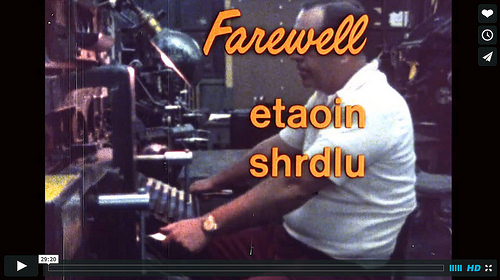
click to view ; Farewell - ETAOIN SHRDLU - 1978

“A film created by Carl Schlesinger and David Loeb Weiss documenting the last day of hot metal typesetting at The New York Times. This film shows the entire newspaper production process from hot-metal typesetting to creating stereo moulds to high-speed press operation. At the end of the film, the new typesetting and photographic production process is shown in contrast to the old ways.”

REPRISES/RESPONSES/REJOINDERS/RIPOSTES

  • Reader K. writes re: “Orthography”: “ha! That first limerick looks like most of my iMessages now that I’ve switched to using voice-to-text!”

  • Those clever poems also caught Reader O’s attention: “Wow! The second limerick finally makes sense to me! I would be ashamed, but instead I have chosen to be glad that I got it. :)”

  • “Cellfish” stirred up some comments on Twitter and this, from Reader A.: “Oh man, I love ”cellfish“ I am turning it into one of our UdG Daily Try activities. In looking for images, I found this collection of possible new katexic words (unless that’s where you got it from).” — I hadn’t seen that collection before, but there are some newsletter-worthy creations there!


I welcome comments, suggestions, thoughts, feedback and all manner of what-have-you. Just press ‘Reply’ or email to: clippings@katexic.com.

And please feel free to share anything here as far and wide as you want! If you want to give a shout-out, please link to: http://katexic.com/clippings/.

#238
August 20, 2015
Read more

|k| clippings: 2015-08-18 — of high-fins and such

Today’s WORK (it took me a shameful number of seconds to grok the 2nd limerick) via the always wonderful Futility Closet, which the whole Clamor should be reading.

Also: we have contest winners that will be announced in a special Saturday edition…so don’t unsubscribe before then.

WORK

There once was a ,cal fellow,
Who grew .ically mellow;
With a — he was gone
To the town of :
To write for a sheet that was yellow.

She was wooed by a handsome young Dr.,
Who one day in his arms tightly lr.;
But straightway he swore
He would do so no more,
Which the same, it was plain, greatly shr.

A boy at Sault Ste. Marie
Said, “To spell I will not agree
Till they learn to spell ‘Soo’
Without any u
Or an a or an l or a t.”

There was an old maid from Duquesne
Who the rigor of mortis did fuesne;
She came to with a shout,
Saying: “Please let me out;
This coffin will drive me insuesne.”

—from Limerick Lyrics (Stanton Vaughn, ed.)
—via Futility Closet

WORD(S)

cellfish (cell-fish) /SEL-fish/. adjective. Using a cell phone in a way that disregards others, such as loud-talking in a restaurant, in line while the cashier waits, &c. A portmanteau combining cell (phone) + selfish.

“Don’t be Cell-Fish” (Long Island Mass Transit Authority)

“When he started taking calls from telemarketers during intimate moments, I realized that he wasn’t that into me and was really quite cellfish.” (Verbotomy)

“With fools, there is no companionship. Rather than to live with men who are cellfish, vain, quarrelsome, and obstinate, let a man walk alone.” (Buddha)

WEB

  1. Snoop Dogg, the Jackson 5, the Ramones, Bryan Adams and many others meet Shakespeare. Just for the LOLs. → Pop Sonnets

  2. “Took the light rail from Tianjin City to Binhai for a walk-around on the last day of 2007. It was a pleasant day, though an odd one too, as we wandered through a landscape that seems to have no idea what is happening to it.” → Photographer Jim Gourley’s photos from Tianjin, in what is now the evacuation zone.

  3. I don’t go out of my way to watch—or avoid—most Spielberg films. But Bryan Cranston as Dalton Trumbo is intriguing. → ► Dalton Trumbo (trailer)

  4. The Scofield is an impressive new literary magazine, modeled on The Dial. The first issue centers around David Markson and the idea of “solitude.”

  5. Today in 1590, colonist Charles White returns from a (three year!) supply run to England and discovers the Roanoke Colony (which was actually the 2nd settlement there, the first had disappeared before White re-settled at the same location in 1587)—including his granddaughter Virginia Dare, the first English child born in the Americas—has vanished. The only clue: the word “CROATOAN” carved into a tree, likely meaning “Croatoan” (now Hatteras) Island. Though the settlement had been dismantled, indicating an intentional relocation, the Roanoke colonists were never found and their fate remains unknown.

WATCH/WITNESS

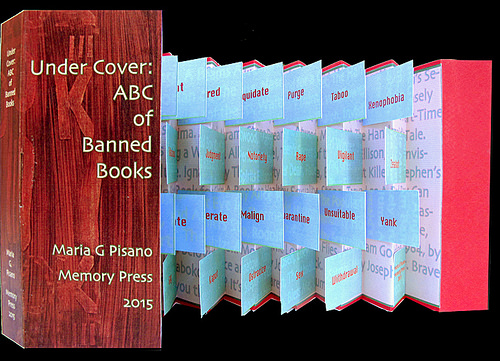
Under Cover: ABC of Banned Books (Maria G. Pisano)

Under Cover: ABC of Banned Books — “Books have been burned, challenged, banned, removed from schools and libraries and used as a rationale for death and destruction throughout history and across cultures. This flag book showcases examples of words and methods used in censoring works, as well as highlighting the continuation of these practices today.”

REPRISES/RESPONSES/REJOINDERS/RIPOSTES

  • Reader G. doesn’t like it: "Call me Ms Stick-in-the-Mud, but I don’t see how the ‘poem’ you shared is any such thing.’ — OK, Ms. Stick-in-the-Mud.

I welcome comments, suggestions, thoughts, feedback and all manner of what-have-you. Just press ‘Reply’ or email to: clippings@katexic.com.

And please feel free to share anything here as far and wide as you want! If you want to give a shout-out, please link to: http://katexic.com/clippings/.

#237
August 18, 2015
Read more

|k| clippings: 2015-08-13 — one or a dozen a day

WORK

You don’t have to keep going down to the river, you know. It’s not always a pleasant place. Bears were sighted there recently. The spring floods have uprooted so many trees. Don’t forget the strange man with a dog. He was soaking wet, the man. Was he talking to himself? You shouldn’t be running away like that. Personally, I think with all this rain, the ground is hurt. It’s doing things that won’t support us, falling away in places. You’re going to put your foot down one evening without looking and the ground won’t be there. Is this what you want? You’ll be tumbling down deep into a hole, asking yourself over and over, Well, Well?

—James Haug
—from “Three Poems”
—found in jubilat (No. 27)

WORD(S)

bibulous /BIB-yoo-ləs/. adjective. A heavy drinker; an alcoholic; related to, or resembling, drunkenness. More generally, an absorbent material. It feels like there should be a portmanteau in here somewhere about one who is drunk on books. See also: bibulously. From Latin bibulus (readily drinking), from bibĕre (to drink).

“‘The Star-Spangled Banner’ did not immediately become the national anthem; though it was written by Francis Scott Key during the Battle of Fort McHenry in 1814 (and set to the tune of ‘To Anacreon in Heaven,’ a British drinking song celebrating a bibulous Greek poet who is said to have choked to death on a grape)…” (Anne Fadiman)

“The hovel on Ferry stood, or, rather, leaned at a bibulous angle on a narrow street cut across at an oblique angle by another narrow street, all the old wooden homes like an upset cookie jar of broken gingerbread houses lurching this way and that way, and the shutters hanging off their hinges and windows stuffed with old newspapers, and the snagged picket fence and raised voices in unknown tongues and howling of dogs who, since puppyhood, had known of the world only the circumference of their chain.” (Angela Carter)

“The incumbent, the Professor at that time, was an old man bibulous by nature, who had been driven still further into his cups by the insubordination of his pupils.” (William Faulkner)

WEB

  1. The Cooper Hewitt Smithsonian Design Museum is on track to digitize everything in its collection (more than 215,000 objects) by late next year. As it goes it is exploring ways of sharing those collections through its online collection database. For example (via Reader M.), explore some of their bookpapers, book covers or many other types. Or by color. And many more. Oh, and geeks will enjoy the explorations and behind-the-scenes look in the Cooper Hewitt Lab blog.

  2. The Clamor knows I’m a list-buff and think everyone else should be too. The Wikipedia List of lists of lists will help a lot in that cause [via Reader C.].

  3. I’ll just leave this one right here for you to figure out → No one will ever read this but

  4. Typophiles and font-freaks will enjoy this gem from the Internet Archives, including “Type Design: A Homily” by Frederic Goudy and other interesting tidbits, each set in a new typeface. → Ars Typographica Vol 1, No 4 - An Occasional Miscellany

  5. Today in 1422 (according to some sources), William Caxton—the first English printer and the man who brought the printing press to England—is born. The first book he printed was Chaucer’s Canterbury Tales…two edition of which, from 1476 and 1483, can be viewed online. Naturally, Caxton was the first English retailer of printed books in London, producing and selling, among other titles, the first English translation of Ovid’s Metamorphoses.

WATCH/WITNESS

Thorazine Advertisement [show images; click for larger and more]

Just one of many classic advertisements for Thorazine. It’s for hyperactive kids, the nauseated, the senile, the excited, the anxious… For the love of all that’s holy to you, stay away from the rest of the WHALE site.

REPRISES/RESPONSES/REJOINDERS/RIPOSTES

  • Reader L. would know: “Old geeks might know about the earlier updated Devil’s Dictionary 2.0. And only geeks will get most of it.”

I welcome comments, suggestions, thoughts, feedback and all manner of what-have-you. Just press ‘Reply’ or email to: clippings@katexic.com.

And please feel free to share anything here as far and wide as you want! If you want to give a shout-out, please link to: http://katexic.com/clippings/.

#236
August 13, 2015
Read more

|k| clippings: 2015-08-11 — oh honey

Two nuclear-grade errors in the last issue. First, the WORK, which I accidentally left unattributed, was by Anne Fadiman from her wonderful book Ex Libris: Confessions of a Common Reader. I hope it was obvious that the writing was too fine to be my own…and I would never feature my own writing anyway! Second, it is Ambrose Bierce, not Pierce. I’m not sure how that happened.

And don’t forget you have until the end of the week to enter the (Cormac) McCarthyisms Contest. Two options, one for readers and one for writers.

WORK

“We need another and a wiser and perhaps a more mystical concept of animals. Remote from universal nature and living by complicated artifice, man in civilization surveys the creature through the glass of his knowledge and sees thereby a feather magnified and the whole image in distortion. We patronize them for their incompleteness, for their tragic fate for having taken form so far below ourselves. And therein do we err. For the animal shall not be measured by man. In a world older and more complete than ours, they move finished and complete, gifted with the extension of the senses we have lost or never attained, living by voices we shall never hear. They are not brethren, they are not underlings: they are other nations, caught with ourselves in the net of life and time, fellow prisoners of the splendour and travail of the earth.”

—Henry Beston
—from The Outermost House: A Year of Life On The Great Beach of Cape Cod

WORD(S)

melligenous (melligineous) /mə-LIJ-i-nəs/. adjective. Like honey; similar in form to honey; made of honey. Many know mellifluous–which shares the Latin root mel (honey)–in terms of pleasant, musical sound. But the earliest citations show “mellifluous” being used in both the literal and metaphorical senses (in Higdon’s Polychronicon) back in the mid 1300s. Thus, the honeyed tone of Johnny Hodges, etc.

“But, after the Queen has satisfied her appetite, what is she to do? Nothing, as long as she can, and then commence her melligenous meal again.” (Overland Monthly).

“…whilst the flowers of Banksia ornata, Lambertia formosa, and some other species are rich in melligenous sap.” (Rev. W. Woolls)

“He’ll never cure Rosalind Ferne! — Did you ever hear such a melligenous name?” (Emma C. Dowd)

“…man must have lost his wits with his tail, both being now exceedingly rudimentary. Having lost his tail, he could no longer swing in the ethereal blue; and then, losing his wits, grew a mental tail, and swung in the deep inane, devising the ideal of discomfort, wherein all pleasures should be considered as evil, and all pains as exceedingly good; chewing aloes he swore they were as melligenous as the sugar cane, called black white, white black, and this fair world the abode of his satanic majesty; beat his wife, swore at the ‘kids,’ and kicked the cat over the garden wall.” (J. F. Fuller)

WEB

  1. “A banknote from 1380 that threatens decapitation, a set of 17th-century prints so delicate they had never been opened, and 3000-year-old ‘oracle bones’…” → Oracle bones and unseen beauty: wonders of priceless Chinese collection now online. And, serendipitously via Reader B. comes a link to a story of something new from the other university on that side of the pond…the new Digital.Bodleian.

  2. And you thought TSA didn’t have a sense of humor? → 25 Odd Confiscations: TSA on Instagram

  3. Of interest to more than just librarians…anyone with an interest in technology, culture, preservation, copyright, etc. should check out this (sometimes quite funny) post/presentation → how to destroy special collections with social media

  4. “British Movietone is arguably the world’s greatest newsreel archive, spanning the period 1895 to 1986.” And now it’s all being loaded to YouTube so you can get lost for hours when you should be working → British Movietone

  5. Today in 1989, Vice President Dan Quayle enlightened CNN-watching America, noting, “Mars is essentially in the same orbit. … Mars is somewhat the same distance from the Sun, which is very important. We have seen pictures where there are canals, we believe, and water. If there is water, that means there is oxygen. If oxygen, that means we can breathe.” Sadly, there were no reports of Quayle-ites emigrating to the red planet; happily, Mars exploration continues, close-up.

WATCH/WITNESS

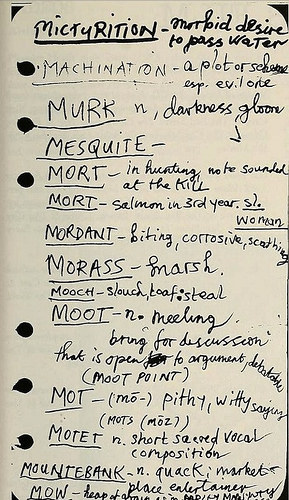
Page from Nick Cave's Handwritten Dictionary [enable images; click for more

A page from Nick Cave’s Handwritten Dictionary.

REPRISES/RESPONSES/REJOINDERS/RIPOSTES

  • Reader J. finds a followup: “You shared Infinite Lego last year. Guess what? A book is coming out! http://ktxc.to/infinite-lego-promo”

  • Reader D. is also an “active reader”: “Lovely post, Chris. I have never understood a book so well as when I have had a dialogue with it in the margins of the pages—in pencil.”

  • Reader S. wasn’t the first to note the B/Pierce error, but there’s more: “I suspect I won’t be the only one to point out the typo in the reference to Ambrose Bierce’s Devil’s Dictionary. I would add that much of my young adulthood was spent hunkered down in dark spaces with a candle reading and rereading Bierce’s hallucinatory stories of ghosts and Chinamen rising from beneath the floorboards to reclaim their pigtails. I probably won’t sleep much tonight.”


I welcome comments, suggestions, thoughts, feedback and all manner of what-have-you. Just press ‘Reply’ or email to: clippings@katexic.com.

And please feel free to share anything here as far and wide as you want! If you want to give a shout-out, please link to: http://katexic.com/clippings/.

#235
August 11, 2015
Read more

|k| clippings: 2015-08-07 — tentacular reading

WORK

During the next thirty years I came to realize that just as there is more than one way to love a person, so is there more than one way to love a book. The chambermaid believed in courtly love. A book’s physical self was sacrosanct to her, its form inseparable from its content; her duty as a lover was Platonic adoration, a noble but doomed attempt to conserve forever the state of perfect chastity in which it had left the bookseller. The Fadiman family believed in carnal love. To us, a book’s words were holy, but the paper, cloth, cardboard, glue, thread, and ink that contained them were a mere vessel, and it was no sacrilege to treat them as wantonly as desire and pragmatism dictated. Hard use was a sign not of disrespect but of intimacy.

Hilaire Belloc, a courtly lover, once wrote:

Child! do not throw this book about;
Refrain from the unholy pleasure
Of cutting all the pictures out!
Preserve it as your chiefest treasure.

What would Belloc have thought of my father, who, in order to reduce the weight of the paperbacks he read on airplanes, tore off the chapters he had completed and threw them in the trash? What would he have thought of my husband, who reads in the sauna, where heat-fissioned pages drop like petals in a storm? What would he have thought (here I am making a brazen attempt to upgrade my family by association) of Thomas Jefferson, who chopped up a priceless 1572 first edition of Plutarch’s works in Greek in order to interleave its pages with an English translation? Or of my old editor Byron Dobell, who, when he was researching an article on the Grand Tour, once stayed up all night reading six volumes of Boswell’s journals and, as he puts it, “sucked them like a giant mongoose”? Byron told me, “I didn’t give a damn about the condition of those volumes. In order to get where I had to go, I underlined them, wrote in them, shredded them, dropped them, tore them to pieces, and did things to them that we can’t discuss in public.”

WORD(S)

anthemion /an-THEE-me-ən/. noun. A flat floral motif in the shape of a honeysuckle or similar radiating cluster. Often found in ancient architecture and as a printer’s ornament. From Greek literal, diminutive of anthos (flower). See a nice example on the face of the Saint Nicholas Greek Orthodox Cathedral and more information than you’re ever likely to need on this palmette.

“It was a four-story establishment with a vermiculated facade, the oval windows surrounded by onyxlike anthemion friezes.” (Peter F. Hamilton)

“In the Foreword to the 1966 version of Speak, Memory, Nabokov says that in looking for a title for the first edition, he ‘toyed with The Anthemion which is the name of a honeysuckle ornament, consisting of elaborate interlacements and expanding clusters, but nobody liked it’; it would be a fitting, if precious, subtitle for Lolita (as well as for several other Nabokov works). A grand anthemion entwines H.H.’s narrative, like some vast authorial watermark, and its outlines are traced by the elegantly ordered networks of alliteration, ‘coincidences,’ narrative ‘inconsistencies,’ lepidopterological references, ‘cryptocolors,’ and shadows and glimpses of Quilty.” (Alfred Appel, Jr.)

“Greek artists were transported to Rome and placed in charge of the most important public works. Roman art is, consequently, but a development or adaptation of the Greek. It is noticeable, however, that it almost completely ignored the most characteristic and popular of the Greek forms—for example, the anthemion—and adapted those, such as the acanthus and the scroll, which had been considered of minor importance among the Greeks.” (Marie R. Garesche)

WEB

  1. This link is everywhere now (the hazards of not publishing daily), but it’s too awesome to not share → Cornell University—World’s largest natural sound archive now fully online

  2. Of course not on par with Ambrose Pierce’s classic, but still amusing → The New Devil’s Dictionary

  3. Charming Bookstores in Unexpected Places → What are some of your favorites?

  4. The One Grand pop-up bookstore “Favorite Books" series continues → first Tilda Swinton, then Carrie Brownstein and now: Ta-Nehisi Coates.

  5. Today in 1869, explorer (and astronomer) George Davidson deeply impresses hostile Chilkat Indians in Alaska with his prediction of an eclipse, ensuring the safety of his team which he feared would be attacked soon. A bit of the Englishman in the Tlingit Chief’s court.

WATCH/WITNESS

Isobel Varley (photo by Muir Vidler) [enable images; click for more]

Isobel Varley, who is listed in the Guinness Book of World Records as the “the world’s most tattooed senior woman.” This photo is one in a series of photos of aging rebels by Muir Vidler.

REPRISES/RESPONSES/REJOINDERS/RIPOSTES

  • Reader S. was the first to spot my error: “Time warp or did the last email take over a day to get to me?” — No, I sent the last issue out with the wrong date. It hurts me worse than it hurts you, believe me…

  • From Reader H. on the excerpt from Barthelme: “Barthelme’s 60 Stories (and his 40 Stories as well) are full of wonders.”

  • From Reader B. on the same: “That’s astonishing Barthelme. ¶ And you did a fine followup with the booze word.”


I welcome comments, suggestions, thoughts, feedback and all manner of what-have-you. Just press ‘Reply’ or email to: clippings@katexic.com.

And please feel free to share anything here as far and wide as you want! If you want to give a shout-out, please link to: http://katexic.com/clippings/.

#234
August 7, 2015
Read more

|k| clippings: 2015-08-04 — open heart, open head

WORK

“The snow is coming,” she said. “Soon it will be snow time. Together then as in other snow times. Drinking the busthead ’round the fire. Truth is a locked room that we knock the lock off from time to time, and then board up again. Tomorrow you will hurt me, and I will inform you that you have done so, and so on and so on. To hell with it. Come, viridian friend, come and sup with me.”

They sit down together. The pork with red cabbage steams before them. They speak quietly about the McKinley Administration, which is being revised by revisionist historians. The story ends. It was written or several reasons. Nine of them are secrets. The tenth is that one should never cease considering human love, which remains as grisly and golden as ever, no matter what it tattooed upon the warm tympanic page.

—Donald Barthelme
—from “Rebecca”
—found in Sixty Stories

WORD(S)

busthead (bust-head). noun. Cheap, strong liquor, usually of the illegal variety. Moonshine. Hooch. Poteen. Pop-skull. Bumblings. The origin is obvious to anyone who’s hit the busthead a little hard themselves.

“Appalachian connections to the beverage are both natural and cultural. Clear streams, deep valleys, dry corn, soft water, and industrious farmers come together in the production of whiskey, the almost magical mountain dew or white lightning. Those who know the drink call it corn squeezin’s, skull cracker, thump whiskey, happy Sally, stumper wine, blockade whiskey, tiger’s sweat, rotgut, or busthead.” (Mark F. Sohn)

“Their distillations?” asked Mr. Rand.
The old lady spoke up. “Busthead. Red-eye. Mountain dew. They’re brewing alcohol, Mr. Rand,” she informed him…
(Cherie Priest)

“Inside, the air was always thick with the smell of muscatel, smoke, cracklings, draft beer and busthead whiskey, expectorated snuff, pickled hogs’ feet, perfume, body powder, sweat, and home-grown reefer.” (James Lee Burke)

WEB

  1. More contranyms/antagonyms/Janus words [via Reader K.] → 25 Words That Are Their Own Opposites

  2. “Vladimir Nabokov’s opinions on various writers, culled from Strong Opinions.” → Nabokov’s Recommendations [Via Reader N. who notes: “This is a typically cranky and inconsistent list. I always enjoy things like this—or most of the time I do.”]

  3. “The question, now, is this: is the paragraph itself destined to die just as the mark that once delineated it has disappeared from sight?” → Keith Houston of Shady Characters on the imminent death of the paragraph

  4. The “backward index” is a thing…and one of beauty too. → Reverse Logic

  5. Today in 1858, the first transatlantic telegraph cable is completed, connecting Valentia Harbor in Ireland and Trinity Bay in Newfoundland. On August 16th, the first message was successfully sent: "“Glory to God in the highest, and on earth, peace, good will to men.” Unfortunately, God wasn’t regulating the voltage and the quickly deteriorating cable became unusable by mid-October. Previously: The Golden Age of Telegraph Literature and “U Tr?”: A Glossary of Abbreviations Used by Early–20th-Century Telegraph Operators.

WATCH/WITNESS

Cashew in the Real Raw [enable images; click for larger]

Kuriositas has a photo-laden and fascinating story about the cashew—Covert Cashew: The Secret Life of a Nut—from seed to tasty morsel with many intriguing steps in between. I knew the cashew was a strange “fruit” (basically akin to a peach!) but had no idea how labor intensive, initially poisonous, etc. it was.

REPRISES/RESPONSES/REJOINDERS/RIPOSTES

  • Reader C. writes in about seaweed paper: “Since just this year I have become enamored of seaweed and have collected it for food (which, by the way, requires a fishing license) I am thrilled to see that it can be used for papermaking (another interest of mine) as well.”

  • Reader P. liked last issue’s subject-line: “I love today’s subject line [monday’s dog-o-war] - the acknowledgement that Mon can be a mental struggle is comforting. ;-)”

  • Reader A., naturally, shared a compelling dog-related item: “For the dogs, after hearing an NPR story on the woman who trained the lead actor dogs, I ordered and was absorbed by the movie White God, where the unwanted, shunned mixed breed dogs of Budapest get their revenge. It was moving to say the least ¶ http://ktxc.to/white-god-trailer ¶ I’ve read people conjecture its a metaphor of racism, but in the extras the director makes it clear that it was his inspiration of visiting a dog pound, and the gazes he saw from the dogs in cages, looking at him as a looming powerful White God (it’s a nod he says as well to the earlier movie White Dog).”


I welcome comments, suggestions, thoughts, feedback and all manner of what-have-you. Just press ‘Reply’ or email to: clippings@katexic.com.

And please feel free to share anything here as far and wide as you want! If you want to give a shout-out, please link to: http://katexic.com/clippings/.

#233
August 5, 2015
Read more

|k| clippings: 2015-08-03 — monday's dog-o-war

Today’s WORK is a little more intense than Monday feels for me this morning, but not by much.

Here’s a way to beat the day’s doldrums: enter the (Cormac) McCarthyisms Contest…one prize for a lucky avid reader, another for he or she who dares to scribble.

WORK

“Last of all my turn will come after someone’s spear or sword has removed the life from these limbs; and my dogs, turned savage, tear me to pieces at the entrance to my palace. The very dogs I have fed at table and trained to watch my gate will lie in front of my doors, restlessly lapping their master’s blood. It looks well enough for a young man killed in battle to lie there mutilated by a sharp spear: death can find nothing to expose in him that is not beautiful. But when an old man’s dogs defile his grey head, his grey beard and his genitals, wretched mortals plumb the depths of human misery.”

—Homer
—from The Iliad (trans. by E.V. Rieu; edited by Peter Jones)

WORD(S)

facinorous (facinorious, facinerious) /fa-SIN-ə-rəs/. adjective. Seriously, jaw-droppingly wicked. From Latin facinorōsus (criminal, wicked), from facinus (deed, especially bad deed).

“Nay, ’tis strange, ’tis very strange, that is the
brief and the tedious of it; and he’s of a most
facinerious spirit that will not acknowledge it”
(William Shakespeare)

“I am conscious that in arguing against the ”more deadly than the male“ conception of the woman criminal I am perhaps doing my book no great service. It might work for its greater popularity if I argued the other way, making out that the subjects I have chosen were monsters of brutality, with arms up to the shoulders in blood, that they were prodigies of iniquity and cunning, without bowels, steeped in hypocrisy, facinorous to a degree never surpassed or even equalled by evil men.” (Victor MacClure)

“Thirdly, consider the utter arrogant and facinorious nature of what the socialists are saying. It is in essence, ‘you produce and we will distribute,’ or ‘you work and we will enjoy the result,’ or more bluntly, ‘we will take from you what you have made.’” (John Bowman)

WEB

  1. It’s not funny because it’s true… → Every Single Word Spoken by a Person of Color in [Mainstream Film Title]

  2. “Non-writers often believe ‘the muse’ is a friendly spirit who whispers ideas into warm, receptive minds. This is a charming misconception. The muse is a muscular, nude hermaphrodite with tentacles, wings, and the antlered head of a stag.” → The Fantastically Normal Life of a Writer

  3. Making Paper from Seaweed: Papermaking with Atlantic BioInvader Codium Fragile

  4. Eat Pigeon: An Introduction to M.F.K. Fisher, History’s Best Food Writer

  5. Today in 1527, the first known letter (in English) is sent from North America to King Henry VIII from John Rut who was on a mission for the King to find the Northwest Passage. This was about the time that Henry was deciding to annul his marriage to Catherine of Aragon, ultimately leading to the Reformation, so perhaps he was too busy to reply. At any rate, no further record of John Rut remains.

WATCH/WITNESS

Himalayan Pool photo by (David Kaszlikowski) [click for larger]

Photographer David Kaszlikowski located this Himalayan mountain pool using a drone and then photographed it using “a 30-second exposure shot with a Canon 5D Mark III on a tripod. While the shutter was open, he ‘painted’ the water and surrounding area with an LED, creating an eerie glow on the ice and sky. ” That should mean something to photographers in the Clamor. I just think it’s eerily pretty.

REPRISES/RESPONSES/REJOINDERS/RIPOSTES

  • Reader S. writes in regarding Dali’s ‘Gala Contemplating the Mediterranean Sea Which at Twenty Meters Becomes the Portrait of Abraham Lincoln (Homage to Rothko)’: “…that Dali you pointed to is my favourite of his. My first serious girlfriend’s Dad had a copy of it in his house which I’d stare at whilst laying in bed after, well, you know, and it was the perfect distance away from the bed, right at the tipping point between seeing the details and seeing the macro. Brought back nice memories.”

  • Reader G. keeps it simple. In response to Christine Baumgarthuber’s It Ought to be Called Vice Cream, she writes: “I love ice cream.”

  • Reader B. observes, about the same piece: “I liked the ice cream passage, but am madly in love with the name ‘Baumgarthuber’.”


I welcome comments, suggestions, thoughts, feedback and all manner of what-have-you. Just press ‘Reply’ or email to: clippings@katexic.com.

And please feel free to share anything here as far and wide as you want! If you want to give a shout-out, please link to: http://katexic.com/clippings/.

#232
August 3, 2015
Read more
  Newer archives Older archives  
Powered by Buttondown, the easiest way to start and grow your newsletter.