katexic clippings logo

katexic clippings

Archives
Subscribe

katexic clippings katexic clippings

Archive

|k| clippings: 2015-12-17 — missing the mind's eye

WORK

“Make a conscious choice. Decide to move your index finger. Too late! The electricity’s already halfway down your arm. Your body began to act a full half-second before your conscious self ‘chose’ to, for the self chose nothing; something else set your body in motion, sent an executive summary—almost an afterthought—to the homunculus behind your eyes. That little man, that arrogant subroutine that thinks of itself as the person, mistakes correlation for causality: it reads the summary and it sees the hand move, and it thinks that one drove the other. But it’s not in charge. You’re not in charge. If free will even exists, it doesn’t share living space with the likes of you.”

—Peter Watts
—from Firefall

WORD(S)

apophenia /a-pə-FEE-nee-ə/. noun. The human tendency to find patterns in random data. Last week’s pareidolia is a specific form of apophenia. For example, gamblers often see illusory patterns in rolls of dice and spins of roulette wheels. Numerology and fortune-telling use (and prey upon) this tendency. From German Apophänie (a coinage used to refer to delusional thinking).

“The same hardwired apophenia that made human beings see the hand of God in the empirical universe also made us hear Him in the electronic shrieking of our tribe.” (Jay Lake)

“Either games are considered to be games—how does chess reveal a narrative?—or else video games are seen as too primitive, perhaps too childish, to be capable of creating the space required for a convincing tale. Looking for storytelling in gaming makes too much of too little, an exercise in apophenia.” (Bryan Alexander)

“A few years ago a message from God was found in a tomato in Yorkshire. […] At least two explanations come to mind. One is that the Supreme Being sees fit to make Himself visible in produce no less than He does in whirlwind and quasar. Another is that those who saw the message experienced apophenia—the tendency to see meaningful patterns and connections where they are not in fact present. ¶ Whatever the truth of that tomato, it is certainly the case that human beings regularly see things which are not there.” (Caspar Henderson)

WEB

  1. Classic pulp/smut fiction meets librarians, books and readers in this inspired book cover series.

  2. “When tech culture only celebrates creation, it risks ignoring those who teach, criticize, and take care of others.” Hmmm. There are many problems with this article but it touches on something important I’ve yet to figure out how to articulate. » Why I Am Not a Maker

  3. The last list like this [The 12 Weirdest, Funniest, Smartest Twitter Bots] was one of the most popular links of the year. So I think you’ll enjoy The Best Twitter Bots of 2015…some ingenious minds at work.

  4. A Point of View: Is there still any point in collecting books?. Bonus: The author reads his essay. [Via Reader B.]

  5. Today in 1929, popular journalist, presidential speechwriter, and etymological columnist William Safire is born in New York City. Among many other accomplishments, Safire wrote the “On Language” column in the New York Times Magazine for nearly 30 years, evolving (some would say progressing) over that time from a confirmed prescriptivist and language purist to one more sympathetic to descriptivism and language changes. Whatever his position—and however much one has to hold one’s nose when it comes to his politics—Safire was a good writer who had a fine ear and a keen wit [seriously, “it’s not the teat, it’s the tumidity?”]. Another favorite: “The Yip Harburg rule of agreement: if you’re not near the antecedent you love, you use the antecedent you’re near.”

WATCH/WITNESS

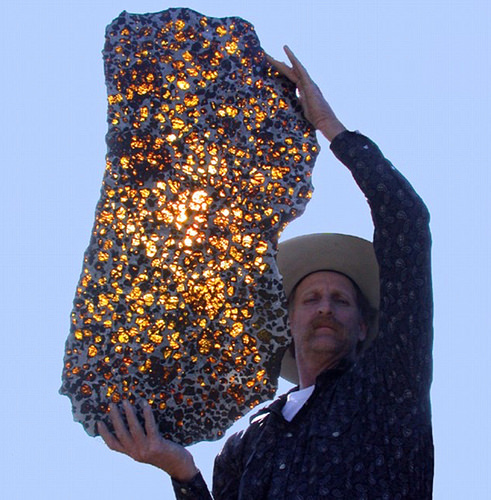
Out of this world, quite literally: The beautiful and mysterious Fukang meteorite

Out of this world, quite literally: The beautiful and mysterious Fukang meteorite

REPRISES/RESPONSES/REJOINDERS/RIPOSTES

  • Reader S. is in the club: “*makes the secret hand gesture of readers of Peter Watts’ fiction* ¶ Leslie Stevens also directed the wonderfully mad Fanfare for a Death Scene, which had Telly Savalas as the leader of the Golden Horde, Tina Louise as (IIRC) a Circassian princess, Burgess Meredith as an insane trumpet-playing scientist, and Al Hirt because why not?”

  • Reader G. remains grateful: “Gratitude might not make us live longer, but it will help us live better. I was also glad for the permission to be my regular grumpy self without fear it might shave a few years off the top…”

  • Reader T. finds a comment-section gem: “So, the Offerman video is great, but the comments, particularly the one that provides highlights by time, are truly sublime. I can’t wait to get home tonight and sip the hell out of a wee dram of Ardbeg (it doesn’t flaunt the peat!).”


I welcome comments, suggestions, thoughts, feedback and all manner of what-have-you. Just press ‘Reply’ or email to: clippings@katexic.com.

Enjoy the WORD(S) section? Check out my other little project: Concīs Magazine » http://concis.io/

And please feel free to share anything here as far and wide as you want! If you want to give a shout-out, please link to: http://katexic.com/clippings/.

#271
December 17, 2015
Read more

|k| clippings: 2015-12-15 — Homoj estas ridinda

WORK

LISTER: Rimmer, you’ve been doing Esperanto for eight years. How come you’re so utterly useless?

RIMMER: Oh, speaks! And how many books have you read in your entire life? The same number as champion the wonder horse: zero!

LISTER: I’ve read books.

RIMMER: Uh, Lister, we’re not talking about books where the main character is a dog called “Ben.”

LISTER: I went to Art College!

RIMMER: You?

LISTER: Yeah!

RIMMER: How did you get into Art College?

LISTER: The normal way you get into Art College. The same old, usual, normal, boring you get in. Failed me exams and applied. The snatched me up.

RIMMER: Ah, but you didn’t get a degree, did you?

LISTER: No, I dropped out. I wasn’t in long.

RIMMER: How long?

LISTER: 97 minutes. I thought it was going to be a good skive and all that, you know? But I took one look at the time table and just checked out, man. I mean, it was ridiculous. They had, they had lectures at, like, first thing, in the afternoon. We’re talking half-past twelve everyday. Who’s together by then? You can still taste the toothpaste.

—dialogue from “Kryten”
—Red Dwarf episode 2.1, September 6, 1988

WORD(S)

pareidolia /payr-it-DOHL-yə/. noun. The human tendency to find patterns where none exist, whether seeing images in random or ambiguous visual patterns or hearing intentional sounds in similarly random or ambiguous audio patterns. For example, seeing the face of Jesus in a tortilla or hearing words on a record being played in reverse. From German pareidolie (a coinage for a disorder known as “confusion of objects”), from Greek par- (abnormal) + eídōlon (image, reflection).

“There was supposed to be some rational explanation to justify the mumbo jumbo. Left-hemisphere pattern-matching subroutines amped beyond recognition; the buggy wetware that made you see faces in clouds or God’s wrath in thunderstorms, tweaked to walk some fine line between insight and pareidolia.” (Peter Watts)

“…Arcimboldo might either have experienced pareidolia or wanted to; in any case he arranged it ceaselessly for others—also faces in lichen, ice formations, rock forms, patterns of stars.” (Kim Stanley Robinson)

“Expectant attention and pareidolia have undoubtedly transformed sightings of birds, otters, logs, and waves into sightings of Nessie. Mirages have transformed more than one merganser into a monster.” (Rick Emmer)

WEB

  1. A History of Punctuation for the Internet Age

  2. “Taking the [terribly sexist, ignorant] words of Scott Adams and combining them with the art of Scott Adams.” → MRA Dilbert

  3. What Happens When You Can’t Talk to Yourself?

  4. The Science of Gratitude. Pair with: Happiness Doesn’t Help You Live Longer.

  5. Today is Zamenhof Day, a worldwide observance celebrating the birth of L.L. Zamenhof and the Esperanto language he created. Zamenhof, a Russian ophthalmologist, created the simple artificial language in hopes of furthering peace and harmony between people of different countries. A simple language with just 900 roots and a 28-character alphabet, studies have shown that learning Esperanto takes about 1/10 the time for the same amount of gain as studying English. In this TEDx talk, Tim Morley makes a good case for learning Esperanto. But Esperanto never took off the way Zamenhof hoped: there are an estimated 1000 native Esperantists and 100,000 active users among a total population estimated at between 1–2 million who have studied the language significantly. The lernu! site has Esperanto learning resources in dozens of languages, but I prefer learning Esperanto soap-opera style. And, of course, YouTube has plenty of Esperanto learning videos. But the one Esperanto link to rule them all: ► Incubus, the 1966 horror film—in Esperanto—starring William Shatner, written and directed by Leslie Stevens of The Outer Limits and Buck Rogers in the 25th Century.

WATCH/WITNESS

Nick Offerman Drinks Whiskey [enable images; click to view]

Tired of the same old holiday fireplace videos? How about 45 Straight Minutes of Nick Offerman Quietly Drinking Single Malt Scotch by the Fire?

REPRISES/RESPONSES/REJOINDERS/RIPOSTES

  • Reader T. goes down the rabbit hole: “…I opened my browser to ‘google’ something, but was pleasantly distracted by your email, links and all the wonderful things I learned by clicking on the article about using bigger words, and the Emily Dickinson! Thanks!”

  • Reader G. brings in some Kingly support: “As tempting as it is to beseech and implore, Stephen King in his book advising writers says to just use said. Because it’s not as distracting and irritating as beseeching and imploring and shouting and barking. What you say should convey how you say it.”


I welcome comments, suggestions, thoughts, feedback and all manner of what-have-you. Just press ‘Reply’ or email to: clippings@katexic.com.

Enjoy the WORD(S) section? Check out my other little project: Concīs Magazine » http://concis.io/

And please feel free to share anything here as far and wide as you want! If you want to give a shout-out, please link to: http://katexic.com/clippings/.

#270
December 15, 2015
Read more

|k| clippings: 2015-12-10 — scoops and spells

WORK

“Life is a spell so exquisite that everything conspires to break it.”

#269
December 10, 2015
Read more

|k| clippings: 2015-12-08 — I wonder, I say I wonder

Is thinking of doing sometimes enough?

WORK

“Salute”

Past is past, and if one
remembers what one meant
to do and never did, is
not to have thought to do
enough? Like that gather-
ing of one of each I
planned, to gather one
of each kind of clover,
daisy, paintbrush that
grew in that field
the cabin stood in and
study them one afternoon
before they wilted. Past
is past. I salute
that various field.

—James Schuyler
—from Freely Espousing

WORD(S)

battology /ba-TAH-lə-gee/. noun. Needless, tiresome repetition. Babbling. From Ancient Greek battologia (stammering speech), possibly named after Battos who, in Herodotus’s Histories, asked the Oracle at Delphi about his speech defect—he was prone to “long hymns consisting of many lines, full of tautologies”—and was given in answer a prophecy that he would become king.

“I cannot see how he will escape that heathenish battology of multiplying words, which Christ himself, that has the putting up of our prayers, told us would not be acceptable in heaven.” (John Milton)

“But see the battology here: ‘God of God, Light of Light, very God of very God.’ Why this repetition—which adds neither to the emphasis nor to the expressiveness of the document?” (Benjamin B. Warfield)

WEB

  1. A great MeFi thread on a practice everyone should be, ummm, practicing. » Commonplace Books: Notebooks for Magpies

  2. Death By Coconut: A Story Of Food Obsession Gone Too Far

  3. Drink me! “DNA molecules can be the basis for an archival storage system potentially capable of storing all of the world’s digital information in roughly nine liters of solution, about the amount of liquid in a case of wine. […] The new storage technology would also be capable of keeping immense amounts of information safely for a millennium or longer” » “Data Storage on DNA Can Keep It Safe for Centuries”

  4. What should we call ‘Grammar Nazis’?

  5. Today in 1980, John Lennon, singer, songwriter and founding member of the Beatles, is shot to death in front of the entrance to his New York City apartment building. I remember exactly where I was when the news came over the one radio station we could get in our tiny, freezing cabin in bush Alaska, and I have no more commentary now than I did as a bewildered 10-year-old. Instead, some links: Lennon’s final interview, Dec. 8, ► Lennon’s Poster, ► “Jealous Guy”, ► "Working Class Hero and—because I love it despite the overplay—► “Imagine”.

WATCH/WITNESS

A charming animated short by Åsa Lucander [click to view]

► “Lost Property”…a charming animated short film by Åsa Lucander.

REPRISES/RESPONSES/REJOINDERS/RIPOSTES

  • Reader C. is a trickster: “I can’t get enough of alternative and extra punctuation like the irony mark¡”

  • Reader F. asks: “Thanks for bringing Limetown Stories to my attention. What other podcasts do you listen to?” — Because I’m old and enfeebled and can’t multi-task well enough to do anything else while listening to podcasts, I don’t listen to many…and I’m often way behind. That said: Mystery Show, A Way With Words, WTF (just skip the self-indulgent intros), Memory Palace and The Allusionist continue to make the cut.


I welcome comments, suggestions, thoughts, feedback and all manner of what-have-you. Just press ‘Reply’ or email to: clippings@katexic.com.

And please feel free to share anything here as far and wide as you want! If you want to give a shout-out, please link to: http://katexic.com/clippings/.

#268
December 8, 2015
Read more

|k| clippings: 2015-12-03 — of rules and fools

“Culture is the rule, and art is the exception […] The rule is to want the death of the exception.” Bam!

WORK

“In a sense, fear is the daughter of God, redeemed on Good Friday. She is not beautiful, mocked, cursed or disowned by all. But don’t be mistaken, she watches over all mortal agony, she intercedes for mankind; for there is a rule and an exception. Culture is the rule, and art is the exception. Everybody speaks the rule; cigarette, computer, t-shirt, television, tourism, war. Nobody speaks the exception. It isn’t spoken, it is written; Flaubert, Dostoyevsky. It is composed; Gershwin, Mozart. It is painted; Cézanne, Vermeer. It is filmed; Antonioni, Vigo. Or it is lived, then it is the art of living; Srebrenica, Mostar, Sarajevo. The rule is to want the death of the exception. So the rule for cultural Europe is to organize the death of the art of living, which still flourishes.”

—Jean Luc Godard
—from Je Vous Salue, Sarajevo

WORD(S)

xystus /ZIS-təs/. noun. For ancient Greeks, a covered portico used for exercise. For ancient Romans, an open colonnade with trees designed for recreation and conversation. Also a Latinized form of the Roman name Sixtus. From Greek xystos (scraped, polished).

“Mentioned by Josephus as a place in Jerusalem surrounded by porticoes and used by gymnasts and for public assemblies; it was designed by Herod the Great.” (Oxford Dictionary of the Bible)

“Philosophers who aired their elegant doubts in the shady xystus.” (Frederic William Farrar)

“…she is standing on the Xystus with Agrippa, entreating the people not to injure themselves by resistance.” (George Eliot)

“…there were gates on that side above the Xystus, and a bridge that connected the upper city to the Temple. This bridge it was that lay between the tyrants and Caesar, and parted them…” (from The Great Events by Famous Historians)

WEB

  1. “Molaison’s testable intelligence remained normal; his basic personality seemed unchanged; and he could remember quite a lot of his past, but he was no longer able to form new memories. […] He could read the same magazine day after day without showing any sign that he had encountered it before. H.M. had become a stunningly pure case of anterograde amnesia.” » The Man Who Forgot Everything [Thanks, Reader C.]

  2. The deepest history (yet) of the Irony Mark (¡) (bonus, from the comments section, “why not use the analogous Spanish character ‘¿’ to indicate, say a rhetorical question¿”)

  3. An eery and delightful podcast, “Limetown follows journalist Lia Haddock as she investigates the infamous disappearance of a doomed research facility.” → Limetown Stories

  4. Don’t be put off by the title…some fascinating explorations here » Q’s perpetual and amazing quest for an algorithmic typography

  5. Today in 1930, French New Wave director, screenwriter and film critic Jean-Luc Godard is born in Paris. A revolutionary who seemed intent on breaking every rule, always to great effect, and who worked with disdain for the idea of “high” vs. “low” cinema, Godard is one of the most influential and stylish filmmakers ever. I have yet to go wrong with any of his films, but if you haven’t seen them yet Godard’s films from the 60s are must-sees, particularly Breathless (1960), Contempt (1963) and Alphaville (1965). Related reading: Jean-Luc Godard pronounces film dead.

WATCH/WITNESS

A bizarre underwater icicle (brinicle) [click to view]

Video: “Where the so-called ‘brinicle’ met the sea bed, a web of ice formed that froze everything it touched, including sea urchins and starfish. ¶ The unusual phenomenon was filmed for the first time by cameramen Hugh Miller and Doug Anderson…”

REPRISES/RESPONSES/REJOINDERS/RIPOSTES

  • Reader B. has some nature sounds for the Clamor: “…if you want the sound of the woods, how about this one? ► Francisco López — Wind [Patagonia]”

  • Reader A. sets me straight: “…the ‘first narrative film’? Not so fast, my friend. Georges Méliès’ Trip to the Moon is very certainly narrative, and dates from 1902. ¶ First narrative film in North America, maybe? ¶ More on Méliès, worthy of the Clamor, imho: Early hand-painted colors in a 1900 (narrative!) film, ► Georges Méliès: Jeanne d’Arc, and an eternal fan favorite, ► A Trip to the Moon - Viaje a la Luna - Le Voyage dans la lune - Georges Méliès 1902”


I welcome comments, suggestions, thoughts, feedback and all manner of what-have-you. Just press ‘Reply’ or email to: clippings@katexic.com.

And please feel free to share anything here as far and wide as you want! If you want to give a shout-out, please link to: http://katexic.com/clippings/.

#267
December 3, 2015
Read more

|k| clippings: 2015-12-01 — scumblebums in clown cars

WORK

"A skillful comedian could coax a laugh with tiny indicators such as a vocal tic (Bob Hope’s ‘But I wanna tell ya’) or even a slight body shift. Jack E. Leonard used to punctuate jokes by slapping his stomach with his hand. One night, watching him on The Tonight Show, I noticed that several of his punch lines had been unintelligible, and the audience had actually laughed at nothing but the cue of his hand slap.

These notions stayed with me for months, until they formed an idea that revolutionized my comic direction: What if there were no punch lines? What if there were no indicators? What if I created tension and never released it? What if I headed for a climax, but all I delivered was an anticlimax? What would the audience do with all that tension? Theoretically, it would have to come out sometime. But if I kept denying them the formality of a punch line, the audience would eventually pick their own place to laugh, essentially out of desperation. This type of laugh seemed stronger to me, as they would be laughing at something they chose, rather than being told exactly when to laugh."

—Steve Martin
—from Born Standing Up: A Comic’s Life

WORD(S)

scumble /SKUM-bəl/. verb or noun. To soften the colors of a painting or other work of art by applying a thin coat or layer of opaque or near-opaque color. The effect of this process. Scumble is a frequentative (a form expressing repetition) of the verb scum (in its older sense meaning to clear, to skim), whose origin is unknown.

“‘Eschew surplusage,’ snapped Twain, that anti-European, anti-Catholic pinchfist from the American midwest, with his unlovely spray of scentless botanicals. Blink the incidentals! Fract that chicken! Scumble that depth-of-field! Rip off that wainscotting! Slubber that gloss! Steam down those frills!” (Alexander Theroux)

“But this wasn’t that flat, affectless Pop thing, the Brillo box, the soup can. If anything, it was the opposite: a stop-sign whose unique scumble of urban grit—whose peeling green pole, textured upon the canvas, whose reflection of morning light near a river in summer—made William want to cry.” (Garth Hallberg)

“I felt secretly sure any other teacher would kill all that was strangest and most luminous in her playing. That scumbled virtuosity of the nonnative speaker wouldn’t survive her first real lesson.” (Richard Powers)

“In this preliminary report on infinite consciousness a certain scumbling of the essential outline is unavoidable. We have to discuss sight without being able to see.” (Vladimir Nabokov)

WEB

  1. It’s OK to just look at the phenomenal pictures. » Chronicling Depression With Photography

  2. I’ve thought about Stan Alcorn’s article on (not) viral audio for a long time. Now Digg is revisiting the piece and the conversation is (sometimes) fascinating. » Can Audio Go Viral? Sometimes!

  3. Speaking of immensely satisfying audio, the wonderful Frank Delaney is reading from and, with great insight, digging into Ulysses one 5-minute bite at a time » RE:JOYCE

  4. Or there’s always nature’s constant soundtrack… » Someone Put Giant Megaphones in the Woods So You Can Listen to the Forest

  5. Today in 1903 Edwin S. Porter, a former cameraman for Thomas Edison, releases ► The Great Train Robbery, the first narrative film. A western filmed mostly in New Jersey, the film pioneered many techniques including jump cuts, panning shots and even the first example of gunshots being used to force someone to dance. Just a bit over 11-minutes long, it’s hard to overstate The Great Train Robbery’s place in film history and its influence on every generation of film to come.

WATCH/WITNESS

1947 Film on Fore-Edge Painting [click to view]

A wonderful short film from 1947 on fore-edge and reverse fore-edge book painting that includes showing an artist painting them » Fore-edge Painting 1947 - Unusual Occupations Series.

REPRISES/RESPONSES/REJOINDERS/RIPOSTES

  • Reader T. makes my day: “Thank you for bringing Mr. Childers to my attention. Also the Cassini footage. Actually, all this stuff. An uberous dose of knowledge for sure.”

  • Reader W. has a tardigrade update: “Some of the clamor might be interested in this followup on the aliens in our midst: The tardigrade genome has been sequenced, and it has the most foreign DNA of any animal.”


I welcome comments, suggestions, thoughts, feedback and all manner of what-have-you. Just press ‘Reply’ or email to: clippings@katexic.com.

And please feel free to share anything here as far and wide as you want! If you want to give a shout-out, please link to: http://katexic.com/clippings/.

#266
December 1, 2015
Read more

|k| clippings: 2015-11-24 — filled to bursting

WORK

“Take a step forward, lads. It will be easier that way.”

—Erskine Childers (last words to the firing squad assembled before him)

WORD(S)

uberous /OO-bər-us/. adjective. Abundantly fruitful, copious, fertile. Originally referring specifically to supplying milk or food in abundance when referring to breasts or animals/crops respectively. From Latin ūber (abundant, rich). See also French ubéreux and the rare noun form uberty.

“I am rather proud of my brain. It is a sensitive, lucid, and uberous organ. It contains a prodigious store of information…” (Roald Dahl)

“Vienna’s Mater, its uberous mothering Venus—among the world’s oldest and most perfectly preserved fertility figures—is not to be found among all the Rubens and Bruegel and Roman and Greek and Egyptian antiquities at the Kunsthistorisches Museum, but rather just across the park, with the mammoth taxidermy and Diplodocus and tektites and diamonds and ores, at the Naturhistorisches Museum—as if the Venus hadn’t merely been dug from the Danubian loess, but had been created by it.” (Joshua Cohen)

“Generally therefore that were to be chosen, which passing silently through ponds and other receptacles, exposed to the sun and air, nearest approaching to that of rain, dropping from the uberous cloud, is certainly the most natural and nursing…” (John Evelyn)

WEB

  1. A powerful project, even in photographic form » The ‘Stone’ figures of Point Woronzof

  2. All but a few issues of the Guild of Book Worker’s Journal have been digitized and made available for free

  3. “Everyone states an interest in craft and skill and ‘creativity’, but what really seems to make a thing stand out on the contemporary internet is a striking blend of the eccentric and the skilful, the intangible qualities of the ‘viral object,’ as opposed to the quiet joy of individual discovery.” » No longer collecting for ourselves

  4. Meanwhile, Near Saturn…11 Years of Cassini Saturn Photos

  5. Today in 1922, while his appeal was still pending, Irish novelist and nationalist (Robert) Erskine Childers is executed by a firing squad in Dublin. Over the course of his life, Childers—whose novel The Riddle of the Sands: A Record of Secret Service was one of the earliest espionage novels—swung from avid supporter of the British empire to radical, gun-smuggling Irish nationalist…but his downfall was being caught with a single .32 calibre semi-automatic pistol (ironically a gift from his former friend Michael Collins, from whom he had split over the latter’s role in the Provisional Government of Ireland of Ireland) in his possession. In addition to shaking the hands of every member of the firing squad before his execution, Childers made his young son—who would later become the president of Ireland—promise to seek out and shake the hand of every person who had signed his death warrant.

WATCH/WITNESS

Walt Disney's Operation Wonderland [click to view]

Walt Disney’s Operation Wonderland » The video’s given description says enough: “Some weird man wants to find out how production on Alice In Wonderland is going. We see him enter the studio and given a tour by Walt Disney himself. Storyboards, music, line readings, Alice actress doing homework, live-action rehearsals, multiplane cameras, and Walt riding the Lilly Belle steam train all in one!” » Part 1 and Part 2

REPRISES/RESPONSES/REJOINDERS/RIPOSTES

  • Reader C. shares one good idea and one…no so good: “Please get Tom Hiddleston to read [Barbara Ganley’s] 'The Physics of Falling' for your next issue. ¶ And I never thought anyone could ruin the Gettysburg Address. I was wrong.

I welcome comments, suggestions, thoughts, feedback and all manner of what-have-you. Just press ‘Reply’ or email to: clippings@katexic.com.

And please feel free to share anything here as far and wide as you want! If you want to give a shout-out, please link to: http://katexic.com/clippings/.

#265
November 24, 2015
Read more

|k| clippings: 2015-11-19 — little notes of the world

WORK

She gave him a small kick, he gave her one back, she punched his shoulder, he grabbed her arm, she tripped him, he pulled her down, she landed on him face to face, they rolled and rolled and rolled until laughter in the deep loamy leaves until hugging until he brushed her marble-y breast until he kept his hand there and until what was this what was this but here he was here she was here they were and there his breath and here hers and there his hand and here hers rolling and rolling up there the trees waving at them and the sky beyond like that the surface and this the sea.

—Barbara Ganley
—from “The Physics of Falling”
—found in Sonora Review (Issue 68)

WORD(S)

marmoreal /mar-MOR-ee-əl/. adjective. Resembling or made of marble. Cold, hard and smooth. If I spun wax, I’d be DJ Marmoreal. From Latin marmor (marble).

"Eyes brimming o’er and brow bowed down with lovey
Marmoreal neck and bosom uberous…
(Robert Browning)

“And to my surprise, I was comforted. Somehow, the great Nobodaddy in the sky reached down a marmoreal hand and laid it on my burning brow and soothed me.” (John Banville)

“God, she looked huge. Her crimson, purple wings, in flight, obscured the roof-tree of the Imperial Circus. Yet those marmoreal, immense arms and legs of hers, as they made leisurely, swimming movements through the air, looked palely unconvincing, as if arbitrarily tacked on to the bird attire.” (Angela Carter)

WEB

  1. Dammit!

  2. Crass materialism at its finest…because 70 years of copyright protection isn’t enough? » Anne Frank’s Diary Gains ‘Co-Author’ in Copyright Move

  3. “Is marginalia, finally, truly marginal?” » Atlas of Interest: On the Hidden Life of Marginalia

  4. I might need to play with this in a letter or two » A “masked letter” from 1777

  5. Today in 1863, Abraham Lincoln delivers what has come to be seen—despite being just ten sentences long and initially receiving deeply partisan reactions—one of the most eloquent and influential political statements ever made: the Gettysburg Address. Now seems like one of those times politicians should take a few minutes to really read and think about Lincoln’s words, doesn’t it?

WATCH/WITNESS

Giang Dinh on TEDx [click to view and read more]

Giang Dinh’s work is instantly recognizable and his short (5 minute) TEDx talk is wonderful: A simple fold, a thousand words | Giang Dinh

REPRISES/RESPONSES/REJOINDERS/RIPOSTES

  • Reader B. writes in on a visionary: “Engelbart is one of the great, under sung heroes of our time.”

  • Reader J. catches me out on ‘enow’: "Well, first, I can’t believe you skipped the Rubaiyat (or: why am I the only one thinking of the Rubaiyat?)

A Book of Verses underneath the Bough,
A Jug of Wine, a Loaf of Bread — and Thou
Beside me singing in the Wilderness —
Oh, Wilderness were Paradise enow!"

  • and more: “And then, on the history of ‘sleep music,’ one of my favorite Townes van Zandt stories. He said a record company asked him to make an album of lullabies. But then (he said) he realized that if it was any good, no one would ever hear the B side.”

  • Reader S. had something to say about sleep music as well: “Your reference to Songs in the Key of Zzz reminded me of one of my favorite music compilations, Songs in the Key Of Z, an engrossing collection of outsider music. (Also a book by Irwin Chusid.) If you’ve never encountered the Shaggs, now’s your chance.”


I welcome comments, suggestions, thoughts, feedback and all manner of what-have-you. Just press ‘Reply’ or email to: clippings@katexic.com.

And please feel free to share anything here as far and wide as you want! If you want to give a shout-out, please link to: http://katexic.com/clippings/.

#264
November 19, 2015
Read more

|k| clippings: 2015-11-17 — of mice and milk & honey

WORK

“A wall covered in spines, shelved from floor to ceiling, recognises the correspondence between bricks and books. It is the point at which knowledge becomes embedded in structure and the appearance is of books holding up the ceiling. The implication is that enlightenment, the journey towards the sky or the sublime is available within these pages. It is a metaphor made clearer by the special pieces of furniture, the chairs and stools which ingeniously convert to become ladders or in the sliding steps which glide along the floor scanning the shelves. And just as bricks humanise the scale of even a vast wall by introducing an element of human scale—a solid unit designed to fit perfectly into the hand, so books define the space and give scale to even the largest the wall. They are endlessly reproduced and faked in a game of trompe l’oeil in which their symbolic role alone is invoked. There are bookish wallpapers, there are rows of fake books spines, there are hidden jib doors hidden amongst the bookshelves which open, just as do books themselves to reveal another world and there are dealers who specialise in slightly-worn, leather-spined books by the yard, not for reading but for recreating a country house effect, the impression of history and wisdom. Already in the 1st Century AD Seneca swore by a small library, for knowledge rather than vanity, not ‘endless bookshelves for the ignorant to decorate their dining rooms.’”

—Edwin Heathcote
—from “Books”

WORD(S)

enow /i-NOW/. adjective or adverb. Enough. In archaic usage, a plural for enough. In Scottish dialect: a moment ago, just now or presently. From Old English genog (enough).

“There are enow of zealots on both sides.” (David Hume)

“His mere looks threw darts enow t’impress Their pow’rs with trembling.” (Homer, translated by George Chapman)

“Away, Away, John Carrion Crow,
Your Master hath enow
Down in his Barley Mow.”
(Thomas Bewick, from The History of Little King Pippin With an Account of the Melancholy Death of Four Naughty Boys, Who were Devoured by Wild Beasts. And the Wonderful Delivery of Master Harry Harmless, by a Little White Horse.)

“I like thy spirit, I do in truth; but I do not admire thy judgment. Bone-rackings and bastings be plenty enow in this life, without going out of one’s way to invite them.” (Mark Twain)

WEB

  1. “English is not normal: No, English isn’t uniquely vibrant or mighty or adaptable. But it really is weirder than pretty much every other language”

  2. Songs in the Key of Zzz: The History of Sleep Music

  3. Lightweight but interesting nonetheless…I think I need to do a lot of personal investigation. » What Are the Defining Ingredients of a Culture’s Cuisine?

  4. I’ve gone all descriptivist but I can still laugh at the funnies by would-be grammar czars and punctuation police » 20+ Gifts For Friends Who Work For The Grammar Police

  5. Today in 1970, engineer and inventor Douglas Engelbart is granted a patent for an “X-Y Position Indicator for a Display System” or, as we all know and love/hate it, the computer mouse (see some pictures of the first mouse). Though Engelbart developed his idea independently, there were in fact both earlier versions of a mouse and a trackball, but both of these were part of secret military projects and thus not made public or patented. Engelbart’s invention was also referred to as “the bug,” but the mouse moniker became popular because the cord was thought to resemble a rodent’s tail. The 1981 Xerox Star workstation, officially called the Xerox 8010 was the first commercial workstation to ship with a mouse (and a graphical interface featuring folders, icons and many other now-standard features as well).

WATCH/WITNESS

Post Office Wrapped in Love Letters [click to view; read story]

“In 2001, Artist Ha Schult Wrapped a Former Berlin Post Office in Thousands of Oversized Love Letters Collected From the Public”.

REPRISES/RESPONSES/REJOINDERS/RIPOSTES

  • Reader C. on a funny find: “Re: The Onion for nerds – Here’s The Onion for designers.”

  • Reader M. on the insanity: “The Box of Crazy is what really introduced me to Reddit…How I wish I had never seen the Crazy.”

  • Another Reader M.: “I love your newsletter so much.” — A real lifeline coming from this particular reader.


I welcome comments, suggestions, thoughts, feedback and all manner of what-have-you. Just press ‘Reply’ or email to: clippings@katexic.com.

And please feel free to share anything here as far and wide as you want! If you want to give a shout-out, please link to: http://katexic.com/clippings/.

#263
November 17, 2015
Read more

|k| clippings: 2015-11-12 — the warp and weft of words

Today’s word via Errata, Wordnik’s “Wordie” blog, which every logophile should be reading.

WORK

“Boo, Forever”

Spinning like a ghost
on the bottom of a
      top,
I’m haunted by all
the space that I
will live without
      you.

—Richard Brautigan
—from The Pill vs. the Springhill Mine Disaster

WORD(S)

logolatry /lə-GAW-lə-tree/. noun. An unhealthy veneration or worship of words. Coined by Samuel Taylor Coleridge. From Greek logo- (speech, words) + -latry (worship of).

“What is the whole system from Philo to Plotinus, and thence to Proclus inclusively, but one fanciful process of hypostasizing logical conceptions and generic terms? In Proclus it is Logolatry run mad.” (Samuel Taylor Coleridge)

“What Mark scroggins calls the poet’s ‘logolatry’ includes not just an entrancing litany of polysyllabic and arcane words but also a fondness for utterances of humbler origin.” (Harryette Mullen)

But as “Protestant ‘logolatry’ supplant[ed] the idolatry of which the reformers accuse Catholicism,” Shakespeare’s stupid puritans point to what was potentially dangerous about the cult of the ear. (Robert Hornback)

WEB

  1. “Science news you won’t read anywhere else” AKA The Onion for nerds » The Allium [Thanks, Reader M.!]

  2. “Insomniacs Unite! The Podcast That Bores You to Sleep, on Purpose”

  3. “30 Gorgeous Tattoos Inspired By Great Books”

  4. “The Guggenheim Launches Its First Ever Online Exhibition”

  5. Today in 1954, Canadian singer-songwriter Neil Young is born. The “Godfather of Grunge” (see also: Sleeps with Angels) and twice-member of the Rock & Roll Hall of Fame, Young’s voice—both literally and in the form of his guitar playing and songwriting—is instantly recognizable and undoubtedly unique. Surprising fact: Neil Young is an an avid model train enthusiast who bought into (and helped revive) the Lionel model train company and who owns multiple patents on model train technologies of his own devising. A few great videos ►“Helpless” at Massey Hall, 1971, ►“Old Man”, early 70s, ►“The Needle and the Damage Done (unplugged), 2012” and ►“Southern Man”, last month.

WATCH/WITNESS

Map from the "Box of Crazy" [click to view images]

A man finds an old box by a dumpster. He opens it. The contents get mysteriously and continuously weirder. Pair with comments on the “Box of Crazy”.

REPRISES/RESPONSES/REJOINDERS/RIPOSTES

  • Reader D. enjoyed the Sesame Street trivia: “Thank you for the factoids about Sesame Street. I did not know there was a day when there was no guest star for Sesame Street. It seems such an integral part of the show. I do like the idea of the Cookie Monster liking everything wheel-shaped (cookies, included). ¶ The poem is very nice, too.”

  • As did Reader C.: “Loved the Sesame Street trivia. Thanks for sharing!”


I welcome comments, suggestions, thoughts, feedback and all manner of what-have-you. Just press ‘Reply’ or email to: clippings@katexic.com.

And please feel free to share anything here as far and wide as you want! If you want to give a shout-out, please link to: http://katexic.com/clippings/.

#262
November 12, 2015
Read more

|k| clippings: 2015-11-10 — everything's A-OK

WORK

    It looks nice in the snow

            getting lost
                        where I used to get lost

—Larry Eigner
—from Things Stirring Together or Far Away

WORD(S)

nyctography /nik-TAH-grə-fee/. noun. A form of shorthand invented by Lewis Carroll using a system of dots and strokes. Frustrated with waking and trying to capture ideas in the dark—or go through the cumbersome lamp-lighting process only to have to extinguish it a few moments later—Carroll invented this shorthand for use with a 16-square gridded card he called the Nyctograph. Maybe it’s just me, but couldn’t Carroll just use regular letters inside the squares? Test your nyctographic reading skills with the book Alice’s Adventures in Wonderland: An edition printed in the Nyctographic Square Alphabet devised by Lewis Carroll. From Greek nycto- (relating to night) + graph (related to writing).

“Any one who has tried, as I have often done, the process of getting out of bed at 2 a.m. in a winter night, lighting a candle, and recording some happy thought which would probably be otherwise forgotten, will agree with me it entails much discomfort. All I have now to do, if I wake and think of something I wish to record, is to draw from under the pillow a small memorandum book containing my Nyctograph, write a few lines, or even a few pages, without even putting the hands outside the bed-clothes, replace the book, and go to sleep again. … I tried rows of square holes, each to hold one letter (quarter of an inch square I found a very convenient size), and this proved a much better plan than the former; but the letters were still apt to be illegible. Then I said to myself ‘Why not invent a square alphabet, using only dots at the corners, and lines along the sides?’ I soon found that, to make the writing easy to read, it was necessary to know where each square began. This I secured by the rule that every square-letter should contain a large black dot in the N.W. corner. … [I] succeeded in getting 23 of [the square-letters] to have a distinct resemblance to the letters they were to represent.” (Lewis Carroll)

WEB

  1. Some of these are astounding…from micropoetry and “linguistic serendipity” to imaginary moths. Don’t let the fact that Twitter is the platform for the experiments keep you from checking them out. » The 12 Weirdest, Funniest, Smartest Twitter Bots

  2. Web Poets’ Society: New Breed Succeeds in Taking Verse Viral

  3. The UCSB Cylinder Audio Archive contains digitized recording of more than 10,000 wax cylinders (dating back to 1893!) including vaudeville, Broadway, opera, famous speeches and the fascinating Recorded Incanabula. And there are thousands more awaiting your adoption.

  4. Like his music, his life was sad and beautiful. » The Sad and Beautiful World of Sparklehorse’s Mark Linkous

  5. Today in 1969, Sesame Street—the program that taught me, and I suspect many others, to read—debuts on PBS. It has run there without interruption until sometime in the next month or so when it will move to HBO (with episodes appearing on PBS after HBO’s 9-month exclusive). The product of a grant worth more than $50 million in today’s dollars and the first show to be constructed based on educational research, Sesame Street debuted to high ratings and intense controversy about the effects of television on children. I don’t know about that, I just know I was addicted…and for many years was convinced Luis was my biological father. Even though I was 13 at the time, I still watched the show sometimes and cried when Mr. Hooper died (“we all feel sad”). Some trivia: Snuffleupagus was, for 15+ years, invisible to adults…whenever Big Bird tried to introduce him the adults couldn’t see him. This was changed because producers worried that the portrayal would discourage children from reporting abuse. Oscar the Grouch was originally orange (and in a now banned episode fell in love with the Wicked Witch of the West). Cookie Monster was created by Jim Henson for a commercial—he was then ►the “Wheel Stealer” AKA the Cracker Monster, I guess—years before the show. Ernie’s song ►“Rubber Duckie” reached #16 on the Billboard charts. The Count was born on October 9, 1,830,653 B.C. Big Bird is 8’ 2". James Earl Jones was the show’s first guest star…he ►recited the alphabet in 1979.

WATCH/WITNESS

Poetry of Perception [click to view]

The Poetry of Perception is “an eight-part video series [~20 min total] on representations of perception and sensation” featuring animations and work by Whitman, Dickinson and Williams. — Only 6 parts are available so far.

REPRISES/RESPONSES/REJOINDERS/RIPOSTES

  • Reader P. is a confirmed Clamorer: "Ha! Just stumbled across sehnsucht and immediately knew it was a katexic type of word. Indeed, referenced Sept 29th! — And you can see sehnsucht in Logocopia.

  • Reader J. on phatic and, um, “interruption phenomena”: “Roman Jakobson designated as one of his six functions of any speech act one ‘oriented towards contact,’ and he called it the phatic function. He, too, liked the example of various ‘empty’ greetings, but also ‘interruption phenomena,’ like ‘uh,’ ‘um,’ etc.—those gap-fillers in our utterances that make listeners aware that we’re not finished speaking. My teacher Al Cook used to extend it also to the holiday phone call in which we merely make contact with a string of uncles and aunts and cousins who are eating over at grandma’s house. An interesting phenomenon: when I explain vocal gap-fillers to my class by pointing them out in my own speech, I get caught in a loop where I can’t stop noting them (or, more exactly, where I have to rip myself away from attending to them as distinct from the actual content of what I’m talking about).”


I welcome comments, suggestions, thoughts, feedback and all manner of what-have-you. Just press ‘Reply’ or email to: clippings@katexic.com.

And please feel free to share anything here as far and wide as you want! If you want to give a shout-out, please link to: http://katexic.com/clippings/.

#261
November 10, 2015
Read more

|k| clippings: 2015-11-07 — so rad!

In a manner so delightful it almost makes me forgive myself, Reader B. called me out with the following clever note after the last issue: “Letheans 6.9:14?” It took me a few minutes to figure it out: I used demonym as a WORD before…on June 9 of last year! Not only did I repeat it in the last issue, I repeated some of the exact same examples. Le sigh. So, an increasingly rare 3rd issue this week.

And I wonder what Gardiner (below) would make of email?

WORK

“In the great sense letter-writing is no doubt a lost art. It was killed by the penny post and modern hurry. When Madame de Sevigny, Cowper, Horace Walpole, Byron, Lamb, and the Carlyles wrote their immortal letters the world was a leisurely place where there was time to indulge in the luxury of writing to your friends. And the cost of franking a letter made that letter a serious affair. If you could only send a letter once in a month or six months, and then at heavy expense, it became a matter of first-rate consequence. The poor, of course, couldn’t enjoy the luxury of letter-writing at all. De Quincey tells us how the dalesmen of Lakeland a century ago used to dodge the postal charges. The letter that came by stage coach was received at the door by the poor mother, who glanced at the superscription, saw from a certain agreed sign on it that Tom or Jim was well, and handed it back to the carrier unopened. In those days a letter was an event.”

“Now when you can send a letter half round the globe for a penny, and when the postman calls half a dozen times a day, few of us take letter-writing seriously. Carlyle saw that the advent of the penny post would kill the letter by making it cheap. ‘I shall send a penny letter next time,’ he wrote to his mother when the cheap postage was about to come in, and he foretold that people would not bother to write good letters when they could send them for next to nothing. He was right, and the telegraph, the telephone, and the postcard have completed the destruction of the art of letter-writing. It is the difficulty or the scarcity of a thing that makes it treasured. If diamonds were as plentiful as pebbles we shouldn’t stoop to pick them up.”

—A. G. Gardiner
—from “On Letter Writing” (1916!)

WORD(S)

phatic /FA-dik/. adjective. Speech or speech sounds that are intended to communicate emotions or affirm a social connection rather than convey information. For instance, the standard “How are you?” greeting for which no reply is necessary or expected. Trivial or purely formal speech. From Greek phatos (spoken).

“The doctor’s long speeches—customarily phatic and ceremonially polite—say little but sing much.” (William H. Gass)

“Every night, the 10-Port cabin steward, Petra, when she turns down your bed, leaves on your pillow—along with the day’s last mint and Celebrity’s printed card wishing you sweet dreams in six languages—the next day’s Nadir Daily, a phatic little four-page ersatz newspaper printed on white vellum in a navy-blue font.” (David Foster Wallace)

“Who is the enemy? We fully trained soldiers asked ourselves in Vietnam. The corrupt Diem family? Francophobes among the Chinese? The lieutenant’s West Point professors? The phatic orators in Congress?” (Barry Lopez)

“It was he who wanted to talk! The driver was content to dispense with phatic thanks and chatter.” (Samuel R. Delaney)

WEB

  1. Dumb Cuneiform will take your tweets and convert them to clay tablets. Really.

  2. “Here is the story of Maureen ‘Mo’ O’Neill. She spent her days mainly alone. She didn’t have many friends, she was getting older, she didn’t know who she was. After work she could never summon up the inspiration it took to get off the couch and leave the house. But that’s when she discovered the solution that opened up the world to her, competitive air guitar.”

  3. Arkadiusz Podniesiński’s amazing photo essay on Fukushima, living and abandoned

  4. Brian Lehrer talks with Roman Krznaric about his Empathy Museum.

  5. Today in 1867, physicist and chemist Marie Skłodowska Curie is born in Warsaw. Curie, famous for her work on radioactivity (her exposure to it would ultimately kill her; in fact, her papers remain so radioactive today that they are stored in lead-lined boxes and those who wish to consult them must wear protective gear) and x-rays, was the first woman to win a Nobel Prize, the first person to win a 2nd Nobel and remains the only person to win that highest honor in multiple sciences (physics and chemistry). Curie’s work was epic scientifically and socially…but throughout the remained modest and charitable: paying back her her early scholarships, donating most of her Nobel money and refusing to patent her work in order that further research not be hindered. Many institutions—scientific and cultural—have been named after Curie, as have various elements and minerals—and her likeness has appeared on all kinds of art and currency. Upon her death, Curie became the first woman to be entombed in the Panthéon based on her own work. Another way Curie’s legacy lived on: in 1935 her daughter, Irène, also won the Nobel prize. Good watching: ►Marie Curie: Great Minds.

WATCH/WITNESS

Sir David Attenborough narrates Adele's Hello [click to view video]

“The lesser-spotted Adele is about to be everywhere, again…” » Sir David Attenborough narrates Adele’s “Hello”.

REPRISES/RESPONSES/REJOINDERS/RIPOSTES

  • Reader T. writes in demonymically: “Used to be a Tokite (Toker?), but I’m happy to be a new New Mexican—although getting older every day—and a proud, if gringo, Burqueno.”

  • Reader D. asks: “Was the ‘call’-ing in your subject line intentional? Because, you know, Marian Call?” — Yep.


I welcome comments, suggestions, thoughts, feedback and all manner of what-have-you. Just press ‘Reply’ or email to: clippings@katexic.com.

And please feel free to share anything here as far and wide as you want! If you want to give a shout-out, please link to: http://katexic.com/clippings/.

#260
November 7, 2015
Read more

|k| clippings: 2015-11-05 — calling Katexicans of the Clamorite

WORK

“Autumn”

I walk outside the stone wall
Looking into the park at night
As armed trees frisk a windfall
Down paths that lampposts light

—Samuel Menashe
—from Samuel Menashe: New and Selected Poems

WORD(S)

demonym /DEM-ə-nim/. noun. A word that identifies people from a particular place, e.g. American, Liverpudlian or Seattlite. Coined by Paul Dickson, of Merriam-Webster, in 1997 as a back-formation of demonymic. From Greek demos (populace) + -onym (suffix for name). See also domunym and gentilic.

Some interesting demonyms: Accidentals (Accident, Maryland), Munchers (Munich), Tangerines (Tangiers), Hatters (Medicine Hat, Alberta), Jovian (Jupiter), Cretans (Crete…come on, it’s a little funny), Abba-Zabbas (Albania, preferred over Albinos) and Nutmegger (Connecticut, funny history there).

“His designation ‘Chaldean’ no doubt points to the astrological thought of his time, as opposed to being a demonym for Babylonian natives.” (Francesca Rochberg)

“Let’s find out if you can tell the difference between a Cestrian (a resident of Chester, England) and a Cytherean (a hypothetical inhabitant of the planet Venus). Test your familiarity with demonyms…” (Richard Nordquist)

WEB

  1. Continuing last issue’s moving-images theme: Moving Movie Posters. Clever.

  2. Marian Call, favorite of Katexic and the Clamor, is issuing Yippee Ki Yay, her awesome (and unique) holiday album, on CD (and the usual digital). And she’s on tour (South, East and Far North USA). But anyone, anywhere can purchase “custom voicemail carols for the holiday season, deliverable on Solstice, on Christmas Eve, or on New Year’s Eve.” See Marian’s site for details.

  3. Dakota Death Trip is compiling, from archival sources, “Tales of the tragic, harsh, strange, and amazing lives of those brave enough to claim the Northern Plains as home.”

  4. Chaz Hutton’s post-it note illustrations/graphs/comics. Pairs well with Jessica Hagy’s classic Indexed work.

  5. Today in 1639, the first post office is established in the American colonies. Located in the home of Richard Fairbanks and established by the General Court of Massachusetts: “For preventing the miscarriage of letters, it is ordered, that notice be given that Richard Fairbanks’s house in Boston is the place appointed for all letters which are brought from beyond the seas, or are to be sent thither,’ to be brought unto; and he is to take care that they be delivered or sent according to their directions; and he is allowed for every such letter one penny, and must answer all miscarriages through his own neglect in this kind; provided that no man shall be compelled to bring his letters thither, except he please.” When you think about it (well, when I think about it, anyway), the U.S. Postal Service remains a rather amazing accomplishment. It’s too bad that, despite making a profit of over 300-million dollars in the last quarter, politically-motivated myths about its unprofitability and unviability continue to proliferate. It will be a sad day if the service is finally shuttered.

WATCH/WITNESS

Twain's first typewritten letter [click to view story]

“…O NE CHIEFLY NEEDS SWIFTNESS IN BANGING THE KEYS. THE MACHINE COSTS 125 DOLLARS. THE MACHINE HAS SEVERAL VIRTUES I BELIEVE IT WILL PRINT FASTER THAN I CAN WRITE. ONE MAY LEAN BACK IN HIS CHAIR & WORK IT. IT PILES AN AWFUL STACK OF WORDS ON ONE PAGE. IT DONT MUSS THINGS OR SCATTER INK BLOTS AROUND.” → Read more about Mark Twain’s first typewritten letter at the always fab Letters of Note.

REPRISES/RESPONSES/REJOINDERS/RIPOSTES

  • Reader F. on memorizing poems: “I can’t say enough about how much richness memorizing poems has brought to my life in ways both obvious and much-less so. Thanks for sharing Dahlia Lithwick’s article.”

  • On Twitter, Reader A. dives: “The internet rabbit hole gobbles me up—that clip on Props leads me to Raging Cinema tumblr.”


I welcome comments, suggestions, thoughts, feedback and all manner of what-have-you. Just press ‘Reply’ or email to: clippings@katexic.com.

And please feel free to share anything here as far and wide as you want! If you want to give a shout-out, please link to: http://katexic.com/clippings/.

#259
November 5, 2015
Read more

|k| clippings: 2015-11-03 — jam packed cold cuts

WORK

“Too few people understand a really good sandwich.”

—James Beard
—from Beard on Bread

“Enjoy every sandwich.”

—Warren Zevon
—from an interview with David Letterman, February 2008

WORD(S)

futhark (futhorc, futhork) /FOO-thork/. noun. The runic (ancient Scandinavian) alphabet, named after the initial phonemes of the first six runes: F, U, Th, A, R and K. The futhorc is the name of the Anglo-Saxon variant, representing sound changes in Old English for the same six letters.

“Elder Futhark inscriptions were rare, with very few active literati, in relation to the total population, at any time, so that knowledge of the runes was probably an actual ‘secret’ throughout the Migration period.” (World Heritage Encyclopedia)

“Fairchild tipped the shot to his life and relaxed the craving. The man sitting next to him did the same for himself and waited with his hands in front him on the bar, the black penitentiary futharks on them blurred by trembling.” (Denis Johnson)

“In the Middle Ages, runes were used for divination and casting spells. As is shown in the Anglo-Saxon poem, the H´vam´l of the Elder Edda, it was a basic requirement of a rune master to know how to perform ‘the Sending’. Rune casting was fiercely condemned by the medieval Church as witchcraft and was poorly documented. So we have little knowledge about which futhark (or alphabet) was used by medieval rune readers in Britain or the interpretation they put upon the castings.” (Karen Maitland)

WEB

  1. The Wellcome Library Internet Archive already contains thousands of scanned volumes including collections on Sexology and Forensics, with plans to put 15 million more pages into its 19th century medical books archive over the next two years. Absolutely fascinating browsing.

  2. Earliest Known Draft of King James Bible Is Found. Pair with the inimitable Christopher Hitchens’ Blessed Are the Phrasemakers, on the making of the King James Bible.

  3. Dahlia Lithwick on why you should memorize poems. I can’t agree with her characterization that doing so is “kale for the soul,” but I can relate to those moments where “I have stumbled backward into a memory of a stanza or a phrase that suddenly made the moment briefly beautiful, and connected, and deep.”

  4. I Love TV Intros collects just what the title says (serious, too-much-time-in-front-of–70s-tv nostalgia alert).

  5. Today is National Sandwich Day, celebrating the supposed eponymous invention of John Montagu, the 4th Earl of Sandwich. Montagu is said to have invented the sandwich as a convenient means of sustenance while he spent 24 straight hours at the gambling tables (the original sandwich, thus, was roast on toast). I’m willing to believe the story and further believe this should be an internationally recognized day. But I’m also hungry. Or maybe it has to do with the fact that Americans consume more than 300 million sandwiches every day. Linkage: Wikipedia’s List of Notable Sandwiches; the world’s longest sandwich (over 2400 feet long); classic ► Mr. Bean making a sandwich.

WATCH/WITNESS

Why Props Matter [click to view]

“A look at the hidden power of film props…”

REPRISES/RESPONSES/REJOINDERS/RIPOSTES

  • Reader C. writes: “Is it just me or do we live in an era of increasing numbers of increasingly bad portmanteau words? Libtards, Chrislam, Cuckservatives?” — Sturgeon’s law applies, I think.

I welcome comments, suggestions, thoughts, feedback and all manner of what-have-you. Just press ‘Reply’ or email to: clippings@katexic.com.

And please feel free to share anything here as far and wide as you want! If you want to give a shout-out, please link to: http://katexic.com/clippings/.

#258
November 3, 2015
Read more

|k| clippings: 2015-10-29 — everything is up in the air

WORK

“Hen”

The hen is the best example of what living constantly with humans leads to. She has completely lost the lightness and grace of a bird. Her tail sticks up over her protruding rump like a too large hat in bad taste. Her rare moments of ecstasy, when she stands on one leg and glues up her round eyes with filmy eyelids, are stunningly disgusting. And in addition, that parody of song, throat-slashed supplications over a thing unutterably comic: a round, white, maculated egg.

The hen brings to mind certain poets.

—Zbigniew Herbert (translated by Czeslaw Milosz and Peter Dale Scott)
—from The Collected Poems: 156–1998

WORD(S)

futilitarian /fyoo-til-ə-TAIR-ee-ən/. noun or adjective. One who is devoted to futile pursuits or believes in the futility of aspiration. A portmanteau of futile + utilitarian; coined by Robert Southey.

“If the Utilitarians would reason and write like you, they would no longer deserve to be called Futilitarians.” (Robert Southey)

“Born helpless, nude and unable to provide for himself, Lore Sjöberg eventually overcame these handicaps to become a futurist, a futurologist and a futilitarian.” (Lore Sjöberg)

“Better an ‘Old Futilitarian of the dead American left’ than a surf-rider on the Wave of the Future.” (Irving Howe)

“They are infinite, I am thinking, all these hungry, grasping people chasing after the new and improved, the super and imperishable, and I stand alone against them—but that’s the kind of thinking that led me astray all those years ago. Better not to think. Better not to act. Just wave the futilitarian banner and bury your nose in a glass of sake.” (T.C. Boyle)

WEB

  1. The George Eastman House photo collection is a great place to spend some time. The albums are a good starting point. I particularly enjoyed the Autochromes featuring color photography from the 1910s, and the Lincoln Conspiracy albums.

  2. An exceptionally well-written story that could have gone wrong in so many ways. Good stuff. → American Horror Story: The Cecil Hotel

  3. “I am simply a Native American artist and writer whose creative mantra in best summed up with a word from my tribe’s own language as: ‘taʔčaʔx̣ʷéʔtəŋ’, which means ‘get into trouble’.” → Jeffrey Veregge Art, Design and Mischief

  4. An interview with Peter Mendelsun, book cover designer extraordinaire (and some of his best designs) [Thanks, Reader B.!]

  5. Today in 1924, poet, essayist and playwright Zbigniew Herbert is born in Lwów, Poland. Herbert’s poetry is plainspoken and often, thanks to the prominence of World War II and its aftermath in his life—a time in which he saw his hometown destroyed and replaced, essentially, with a concentration camp and he became active in the resistance—tragicomic. In Herbert’s work the extremes of beauty, even rapture, and despair are plain…as is the tragic and comedic circumstance of humanity as we are constantly ground between them. I’ve featured Herbert’s poems and prose here multiple times and heartily recommend his Collected Poems as a must-have for any poetry reader (the cover photo is awesome too).

WATCH/WITNESS

Contact Juggling [click to view video]

I’d never heard of it until now but ► contact juggling is mesmerizing. Sometimes it looks like the juggler has three hands, other moments seem impossible without CGI (which I don’t think is being used).

REPRISES/RESPONSES/REJOINDERS/RIPOSTES

  • Reader W. on a poetry coincidence: “Not sure if you know that Sylvia Plath and Dylan Thomas share a birthday.” — I realized that when I was preparing the last newsletter. Serendipitously, the owner of a ‘daily’ poems list I belong to shared this inspired pairing: ‘The force that through the green fuse drives the flower’ and ‘Poppies in October’. Bonus: listen to ► Sylvia Plath reading her poem and listen to ► Dylan Thomas reading his accompanied by a creepy animation.

I welcome comments, suggestions, thoughts, feedback and all manner of what-have-you. Just press ‘Reply’ or email to: clippings@katexic.com.

And please feel free to share anything here as far and wide as you want! If you want to give a shout-out, please link to: http://katexic.com/clippings/.

#257
October 29, 2015
Read more

|k| clippings: 2015-10-27 — mad goodness

WORK

“There is a sort of sweet madness about you and me, a sort of mad bewilderment and astonishment oblivious to the Nasties and the Meanies; you’re the only person, of course your’re the only person from here to Aldebaran and back, with whom I’m free entirely; and I think it’s because you’re as innocent as me. Oh I know we’re not saints or virgins or lunatics; we know all the lust and lavatory jokes, and most of the dirty people; we can catch buses and count our change and cross the road and talk real sentences. But our innocence goes awfully deep, and our discreditable secret is that we don’t know anything at all, and our horrid inner secret is that we don’t care that we don’t.”

—Dylan Thomas
—from a letter to Caitlin McNamara, 1936
—found in The Collected Letters (edited by Paul Ferris)

WORD(S)

agathist /A-gə-thist/. noun. One who believes things naturally tend toward the good. A systemic optimist. An adherent to the doctrine of agathism, a doctrine of optimism and a life devoted to the good. From Greek agath (good).

“From the agathist point of view, religion at its best is self-conscious, disciplined pursuit of knowledge of the good plus devotion to it. Such a life may or may not involve belief in a personal, transcendent God.” (Richard E. Creel)

“The existence of evil compels Dr. Miller to substitute the moderate title of ‘Agathist’ for that of ‘Optimist.’ Pawns, therefore, must fall, and bishops; but he will in part indemnify us by pointing out the reason.” (The Edinburgh Review)

WEB

  1. 99% Invisible visits the USPS Dead Letter Office. The results are intriguing and disappointing; so much more should have been done, so many more stories produced.

  2. ‘NPR Voice’ Has Taken Over the Airwaves. Pairs well with: An Example. Of. The NPR Podcast. Voice. And Why It’s. So Annoying.

  3. I love the close attention Medium pays to typography and design. Their latest, on getting quotation marks right, is a typographical primer replete with info for type geeks. As was their piece on crafting link underlines. And pilcrows. They even have a typographical pod at their office…

  4. Worth checking out just for the few photos of these remarkable books » A magical glimpse into the Tudor imagination: Lost library of John Dee to be revealed

  5. Today in 1914, poet Dylan Thomas is born in Swansea. Thomas’s dazzling linguistic gifts have been obscured by the stories (and myths) of his destructive, alcoholic behavior and early demise as well as the curious and paradoxical diminishing that accompanies continuous inclusion in anthologies and references in popular culture. But give even his most anthologized poems such as “The force that through the green fuse drives the flower” or “And Death Shall Have No Dominion” (both written when Thomas was a teenager) or “Do not go gentle into that good night” some slow, attentive reading time and be amazed anew at one of the greatest English wordsmiths.

WATCH/WITNESS

Starlings Take Off at 200 Frames Per Second [enable images; click to watch]

►Starlings Take Off at 200 Frames Per Second. Awesome.

REPRISES/RESPONSES/REJOINDERS/RIPOSTES

  • Reader B. on Lorca: “It’s fascinating how different is Lorca’s Wall Street from our own. ¶ ”herds of men who cannot count past three, herds more who cannot get past six, scorn for pure science" ¶ now Wall Street contains tons of quants, and thrives on science. The parts about gold and death still hold, though.

I welcome comments, suggestions, thoughts, feedback and all manner of what-have-you. Just press ‘Reply’ or email to: clippings@katexic.com.

And please feel free to share anything here as far and wide as you want! If you want to give a shout-out, please link to: http://katexic.com/clippings/.

#256
October 27, 2015
Read more

|k| clippings: 2015-10-22 — the poultriest differences

WORK

"The truly savage and frenetic part of New York…the terrible, cold, cruel part, is Wall Street.

Rivers of gold flow there from all over the earth, and death comes with it. There, as nowhere else, you feel a total absence of the spirit: herds of men who cannot count past three, herds more who cannot get past six, scorn for pure science and demoniacal respect for the present. And the terrible thing is that the crowd that fills this street believes that the world will always be the same, that it is their duty to keep that huge machine running, day and night, forever. This is what comes of a Protestant morality that I as a (thank God) typical Spaniard found unnerving.

I was lucky enough to see with my own eyes the recent stock-market crash, where they lost several million dollars, a rabble of dead money that went sliding off into the sea. Never as then, amid suicides, hysteria, and groups of fainting people, have I felt the sensation of real death, death without hope, death that is nothing but rottenness, for the spectacle was terrifying but devoid of greatness. And I, who come from a country where, as the great father Unamuno said, ‘at night the earth climbs to the sky,’ I felt something like a divine urge to bombard that whole canyon of shadow, where ambulances collected suicides whose hands were full of rings."

—Federico García Lorca (translated by Christopher Maurer)
—from Poet in New York

WORD(S)

cackle-bladder (cacklebladder) /KA-kəl BLA-dər/. noun. A tiny bag, or in modern times a capsule, of fake blood held in the mouth and used to counterfeit coughing up blood in order to fix a boxing match, participate in a con or play a part on stage or screen (or is that just another form of confidence game?). Originally filled with chicken blood, making the etymology obvious…

“Liddell shrugged. ‘It came off the shirt of an old-time con man. I’ve got a sneaking hunch it was a cackle-bladder. Cool off.’” (Frank Kane)

“Had him running around the country and took him for twenty-thousand dollars, then we blew him off with a cackle bladder in Buffalo, New York.” (Michael Kurland)

"It tells you how they work on the mark’s own larcenous cravings for a killing, how they build him up to betting his entire stake—and then ‘put the chill on’—via the ‘cackle bladder’ routine." (Billboard, June 16, 1951)

WEB

  1. Feast and Phrase | Gastronomy in the world of words

  2. “We asked renowned neuroscientists, physicists, psychologists, technology theorists and hallucinogen researchers if we can ever tell whether the ‘reality’ we are experiencing is ‘real’ or not. Don’t worry. You’re going to be ok.” (I’m not so sure) » Is the world real, or is it just an illusion or hallucination?.

  3. Issues #1–49 (1987–1999) of ETCetera, the magazines of the Early Typewriter Collectors Assocation, are online (free)

  4. Digging Up The Bones Of Billy The Kid

  5. Happy Fechner Day. Today in 1850, German philosopher, physicist and experimental psychologist, Gustav Fechner wakes from a dream with an inspiration on how to study the mind and perception: instead of asking people to think about their perceptions, Fechner had the idea to vary an external stimulus (like the brightness of a light) and ask people when they could detect a difference. In this way Fechner, building on the work of Ernst Weber, developed a scale that related changes in physical intensity to changes in perceptual intensity: Fechner’s Scale/Law (turns out the relationship is logarithmic). Fechner’s work was the start of the new and continually fascinating field of psychophysics.

WATCH/WITNESS

Sunbathing on Top of Wind Tower [enable images; click to view]

“A drone pilot taking a look at a giant wind turbine was startled to find a man sunbathing on the top of it. Kevin Miller flew the drone all the way up the 200ft turbine to find the mystery man flat on his back catching some rays…”

REPRISES/RESPONSES/REJOINDERS/RIPOSTES

  • Reader B. exclaims: “LONG LIVE THE WATERBEARS.”

  • Reader F. on the ‘the rise, and rise, of literary annotation’: “Annotation might be on the rise in all kinds of new forms (I’m looking at you Hypothes.is) but is any of it any good (I’m looking at you Genius)?”


I welcome comments, suggestions, thoughts, feedback and all manner of what-have-you. Just press ‘Reply’ or email to: clippings@katexic.com.

And please feel free to share anything here as far and wide as you want! If you want to give a shout-out, please link to: http://katexic.com/clippings/.

#255
October 22, 2015
Read more

|k| clippings: 2015-10-20 — everyone's a critic

WORK

"If and when humans do establish a greater and more durable presence in space we may have the Waterbear, also called the Tardigrade, to thank. In an experiment in 2007, helpfully labelled ‘Tardigrades in Space’, numbers of this tiny animal spent ten days in orbit without any protection and lived. They withstood the almost complete vacuum and temperatures ranging from of –272.8°C (which is very close to absolute zero) up to +151°C. They survived a dose of cosmic rays one thousand times as high as would kill a human and shrugged it off. When exposed to direct solar radiation in addition to the cosmic rays, a large proportion of the test subjects bit the dust (in as far as there is any in the near vacuum of space) but, still, many survived. No other multicellular animal looks to be remotely capable of this. Perhaps, in the long term, the characteristics that enabled them to endure will be of use to humans…or our successors.

A typical Waterbear is about the size of the full stop at the end of this sentence. Under a microscope it looks something like a roly-poly teddy bear—if a teddy bear were to have claws, red eyes and two extra pairs of legs. The phylum has been around, little changed, since at least the Cretaceous and perhaps the Cambrian, and is more closely related to velvet worms and arthropods than anything else. (In appearance, Waterbears are more like Velvet worms; in ubiquity, more like arthropods.) There are about 750 different species of Waterbear on Earth today, living in almost every conceivable habitat from ice shelves to hot springs, from the tropics to the polar regions, and from more than 6,000 metres up in the Himalaya range to marine sediments in the abyssal zone more than 4,000 metres below sea level. In the laboratory they can withstand pressure six times as great as that felt at the bottom of the deepest ocean. This animal is what they call a polyextremophile, happy in many different extreme environments."

—Caspar Henderson
—from The Book of Barely Imagined Beings: a 21st Century Bestiary

WORD(S)

zoilus /ZOH-i-ləs/. noun. A bitter, envious, even malignant critic given to unjust faultfinding. Coined after the Ancient Greek critic of the same name who was famous for his criticism of Homer, leading to his nickname Homeromastix (scourge of Homer) and his place in the proverb that “every poet has his Zoilus.” None of Zoilus’s writing has survived.

“I am unable to prevent my own Zoilus from imitating a bright and saucy schoolboy, but really he should not tell me how to spell the plural of ‘automaton’ which has two endings, both correct. And what business does he have to rebuke me for preferring Theocritus to Virgil and to insinuate that I have read neither?” (Vladimir Nabokov)

“As Homer had a Zoilus, so Mr. Rowe had sometimes his; for there were not wanting malevolent people, and pretenders to poetry too, that would now and then bark at his best performances…” (Samuel Johnson)

“Nay, should great Homer lift his awful head,
Zoilus again would start up from the dead.
Envy will Merit as its shade pursue,
But like a shadow proves the substance true…”
(Alexander Pope)

WEB

  1. More Titillated Than Thou: How the Amish conquered the evangelical romance market

  2. Absolutely fascinating…and well-written enough for non-scientists like myself (even if the subtitle of the piece is a sophisticated kind of clickbait) → How Big Can Schrödinger’s Kittens Get?

  3. “American history is told through the use of surnames from gravestones…” → Place. See also the artist/author’s previous Stonecipher: A Book of Seasons

  4. On “the rise, and rise, of literary annotation”

  5. Today in 1977, the plane chartered by the band Lynyrd Skynyrd crashes while attempting an emergency landing in Gillsburg, Mississippi, killing lead singer Ronnie Van Zant, guitarist Steve Gaines and backup vocalist Cassie Gaines along with a manager and both pilot and co-pilot. The remaining band members reunited just once in early 1979 to perform an instrumental version of their famous song “Free Bird” (with the Charlie Daniels Band). Many other versions of the band have followed but none have approached the chemistry of the original lineup. Here’s the last time “Free Bird” was played and professionally recorded just a few weeks before the crash. And, arguably, one of their best complete concerts (it really is a great song despite being overplayed). Incidentally: the band’s name was an homage, of sorts, to gym teacher Leonard Skinner, who taught (and objected to the long hair of) several of the band members. Skinner would later become friends with the band and one of their albums featured a photo of his realty business sign inside.

WATCH/WITNESS

Tardigrade on Moss [enable images; click to view larger]

“…a millimeter-long tardigrade crawls on moss.”

REPRISES/RESPONSES/REJOINDERS/RIPOSTES

  • Reader F. writes in about last issue’s WORK and WORD: "Well, Calvino has about covered it! I am going to rearrange my bookshelves. ¶ And ‘finical’ made me think for some obtuse reason of ‘pernickety,’ which looks totally wrong without the ‘s’ that everyone puts in front of the ‘nickety.’ ¶ Actually, ‘finical’ sounds more architectural, while ‘pernickety’ seems more person-based.

  • Reader J. sends me (and perhaps you) in search of a unique book: “When I discovered Calvino I went on an absolute Calvino bender, from the early Path to the Nest of Spiders through the books you mention. But my favorite of all–especially if you want to luxuriate in a metatextual mud-/mod-bath, is the matched double novella, The Invisible Knight and The Cloven Viscount. His image of horsemen charging upon each others’ lances and being sproinged over the heads of the groundlings will be with me forever. (And by the way, if you can get your hands on, and can swing the price of, the original Castle of Crossed Destinies with its full-color plates of the tarot deck that maps the narrative, grab it.)”


I welcome comments, suggestions, thoughts, feedback and all manner of what-have-you. Just press ‘Reply’ or email to: clippings@katexic.com.

And please feel free to share anything here as far and wide as you want! If you want to give a shout-out, please link to: http://katexic.com/clippings/.

#254
October 20, 2015
Read more

|k| clippings: 2015-10-15 — book 'em calvino

A longer WORK today (maybe the longest ever). But if there’s one thing I’m sure of, it’s that the Clamor is full of bookworms who will appreciate Calvino’s rumination on the infinite reading list.

WORK

In the shop window you have promptly identified the cover with the title you were looking for. Following this visual trail, you have forced your way through the shop past the thick barricade of Books You Haven’t Read, which were frowning at you from the tables and shelves, trying to cow you. But you know you must never allow yourself to be awed, that among them there extend for acres and acres the Books You Needn’t Read, the Books Made For Purposes Other Than Reading, Books Read Even Before You Open Them Since They Belong To The Category Of Books Read Before Being Written. And thus you pass the outer girdle of ramparts, but then you are attacked by the infantry of the Books That If You Had More Than One Life You Would Certainly Also Read But Unfortunately Your Days Are Numbered. With a rapid maneuver you bypass them and move into the phalanxes of the Books You Mean To Read But There Are Others You Must Read First, the Books Too Expensive Now And You’ll Wait Till They’re Remaindered, the Books ditto When They Come Out In Paperback, Books You Can Borrow From Somebody, Books That Everybody’s Read So It’s As If You Had Read Them, Too. Eluding these assaults, you come up beneath the towers of the fortress, where other troops are holding out:

  • the Books You’ve Been Planning To Read For Ages,
  • the Books You’ve Been Hunting For Years Without Success,
  • the Books Dealing With Something You’re Working On At The Moment,
  • the Books You Want To Own So They’ll Be Handy Just In Case,
  • the Books You Could Put Aside Maybe To Read This Summer,
  • the Books You Need To Go With Other Books On Your Shelves,
  • the Books That Fill You With Sudden, Inexplicable Curiosity, Not Easily Justified.

Now you have been able to reduce the countless embattled troops to an array that is, to be sure, very large but still calculable in a finite number; but this relative relief is then undermined by the ambush of the Books Read Long Ago Which It’s Now Time To Reread and the Books You’ve Always Pretended To Have Read And Now It’s Time To Sit Down And Really Read Them.

With a zigzag dash you shake them off and leap straight into the citadel of the New Books Whose Author Or Subject Appeals To You. Even inside this stronghold you can make some breaches in the ranks of the defenders, dividing them into New Books By Authors Or On Subjects Not New (for you or in general) and New Books By Authors Or On Subjects Completely Unknown (at least to you), and defining the attraction they have for you on the basis of your desires and needs for the new and the not new (for the new you seek in the not new and for the not new you seek in the new).

—Italo Calvino
—from If on a winter’s night a traveler

WORD(S)

finical /FIN-ə-kəl/ adjective. Overly particular; excessively fastidious. In architecture: inordinately delicate and detailed. Likely derived from fine, possibly from Dutch fijnkens (accurately, neatly). See also: foppish, finicky and perjink.

“While he ate, which he did with the finical niceness of an aged and dyspeptic gourmet on the umpteenth course of an imperial banquet, he would glance up at me now and then with a speculative and, so it seemed, drily amused expression.” (John Banville)

“Time was when I was thought entitled to respect. But now, debauched by this Frenchified rascal, they call me rude, surly, a tyrant! It is true that I cannot talk in finical phrases, flatter people with hypocritical praise, or suppress the real feelings of my mind. The scoundrel knows his pitiful advantages, and insults me upon them without ceasing.” (William Godwin)

“Now, the wry Rosenbloom is dead
And his finical carriers tread”
(Wallace Stevens)

“Scrupulous to the last, finical to a fault, that’s Malone, all over.” (Samuel Beckett)

“Now, mark you, I was devilish sharp set. I was in no mood to quibble about trifles: I was not, shall we say, in a finical mood.” (Philip Larkin)

WEB

  1. “There are thieves in the archives and we don’t even know it.” → The Unseen Theft of America’s Literary History [Thanks, Reader B.] And this reminded me of the great Criminal podcast episode “Ex Libris”

  2. These Are Words Scholars Should No Longer Use to Describe Slavery and the Civil War

  3. Keith Houston (you have read Shady Characters, right?) strikes again, this time with the counter-intuitive history of the “%” sign. Hint: it has nothing to do with the digit zero. → Miscellany № 59: the percent sign

  4. Because there just aren’t enough covers of songs using the stuff of the songs themselves → [“99 Red Balloons” played with red balloons]

  5. Today in 1923, journalist, novelist and short story author Italo Calvino is born in Cuba. Calvino’s range was vast, but he leaned toward the challenging end of the spectrum. Even his most traditional stories have a touch of the fantastic about them, as you would expect from pioneer in metafictions that are sometimes as much puzzle as narrative (this was, after all, the man who said, “most of the books I have written and those I intend to write originate from the thought that it will be impossible for me to write a book of that kind: when I have convinced myself that such a book is completely beyond my capacities of temperament or skill, I sit down and start writing it”). If the names Borges, Beckett and Carroll arouse your interest, Calvino’s work will too. If you’re new to Calvino I recommend (in this order): The Baron in the Trees, Cosmicomics and If on a winter’s night a traveler. And if you haven’t read it yet, the Paris Review “collage” or “oblique interview” is required Calvino-related reading.

WATCH/WITNESS

Cardboard Lexus [enable images; click to view and read story]

The “origami inspired” cardboard Lexus that took a team of five designers more than three months to assemble out of 1700+ laser-cut pieces.

REPRISES/RESPONSES/REJOINDERS/RIPOSTES

  • Reader H. on last issue’s WORD: “I could tell you how much I love paraprosdokians, but if I did I’d have to kill you.”

  • Reader W. noticed: “Logocopia! Why have you been hiding this!?” — I keep thinking I’ll find time to fill in all 220+ historical words first…

  • Reader F. shares a follow-up: “The Oregon Shakespeare Festival has responded to the controversy over its ‘translations.’”


I welcome comments, suggestions, thoughts, feedback and all manner of what-have-you. Just press ‘Reply’ or email to: clippings@katexic.com.

And please feel free to share anything here as far and wide as you want! If you want to give a shout-out, please link to: http://katexic.com/clippings/.

#253
October 15, 2015
Read more

|k| clippings: 2015-10-13 — the unspeakable in pursuit

WORK

“We were excited about getting jobs; we hardly went anywhere without filling out an application. But once we were hired—as furniture sanders—we could not believe this was really what people did all day. Everything we had thought of as The World was actually the result of someone’s job. Each line on the sidewalk, each saltine. Everyone had a rotting carpet and a door to pay for. Aghast, we quit. There had to be a more dignified way to live. We needed time to consider ourselves, to come up with a theory about who we were and set it to music.”

—Miranda July
—from “Something That Needs Nothing”
—found in No One Belongs Here More Than You

WORD(S)

paraprosdokian /pair-ə-prohs-DOH-kee-ən/ noun. A figure of speech featuring a surprise turn or ending. A common rhetorical device in comedy exemplified by the one-liners of Steven Wright, Mitch Hedberg and Woody Allen. From Ancient Greek pará (against) + prosdokía (expectation). Some examples of paraprodoskians:

“I haven’t slept for ten days…because that would be too long.” (Mitch Hedberg)

“If all the girls at Vassar were laid end-to-end…I wouldn’t be surprised.” (Dorothy Parker)

“There but for the grace of God—goes God.” (Winston Churchill)

“It’s not that I’m afraid to die, I just don’t want to be there when it happens.” (Woody Allen)

“If I could just say a few words…I’d be a better public speaker.” (Homer Simpson)

“The last thing I want to do is hurt you—but it’s still on the list.” (Steven Wright)

WEB

  1. Did you know Benjamin Franklin proposed a reformed alphabet for English? A brief paper by Nicola Twilley provides a lot of great information on Franklin’s creation, among others. And the optimistic, “has the time finally come?” conclusion—thanks to the Palm Pilot and digital fonts—is priceless.

  2. Decoding the Range: The Secret Language of Cattle Branding

  3. American Science & Surplus (I like the ampersand in the name; I'd like it even better in their company acronym) sells all kinds of—well—“incredible” stuff you don’t know you need. Yet.

  4. There’s A Public Typewriter Booth In Tompkins Square Park

  5. Today in 1915 Charles Hamilton Sorley—despite his youth one of the most important of the World War I poets—is shot and killed by a German sniper in Loos, France. Most of Sorley’s poems were recovered from his kit, though his body never was. The poems, such as ► “When You See Millions of the Mouthless Dead” (read by Tom O'Bedlam) and “Such, Such is Death” speak for themselves. Thanks to the Internet Archive, you can also read Sorley’s letters (includes a useful biography).

WATCH/WITNESS

El Caminito Del Ray: The World's Most Dangerous Walkway

El Caminito Del Ray: The World’s Most Dangerous Walkway has re-opened (click through for more photos and nausea-inducing video). No thanks.

REPRISES/RESPONSES/REJOINDERS/RIPOSTES

  • Reader D. is spot-on, particularly in the last two sentences: “That’s an interesting piece about the Oregon Shakespeare Festival. I wonder, too, about what happens to Shakespeare’s language when they do that. Shakespeare’s plots were never much (copies of other people’s plays): it was the language and the wordplay that made them standout. I think of operas–I once realized while telling someone the plot of Tosca that it sounded silly. It was hard to convey why I liked it so much. It was the music, not the plot that carried the meaning and emotion. Shakespeare’s language is his music. Without it, the plays seem rather silly and overdramatic (maybe like our own lives at times?). Its his language that makes them transcend the plot into the spiritual, reminding us that it is the soul that really matters. I just don’t know about tinkering with his music.”

  • My thanks to all in The Clamor who brought the typo in the very first line of the last issue to my attention. It’s not that they don’t happen occasionally, but in the very first line? [le sigh]


I welcome comments, suggestions, thoughts, feedback and all manner of what-have-you. Just press ‘Reply’ or email to: clippings@katexic.com.

And please feel free to share anything here as far and wide as you want! If you want to give a shout-out, please link to: http://katexic.com/clippings/.

#252
October 13, 2015
Read more
  Newer archives Older archives  
Powered by Buttondown, the easiest way to start and grow your newsletter.