katexic clippings logo

katexic clippings

Archives
Subscribe

katexic clippings katexic clippings

Archive

|k| clippings: 2016-03-10 — admeyeringly

WORK

“Admire as much as you can, most people don’t admire enough.”

—Vincent van Gogh
—from The Letters of Vincent van Gogh (translated by Arnold Pomerans)

WORD(S)

aperçu /a-per-SYOO/. noun. A summary. A revelatory glimpse. An intuitive, immediate insight. A borrowing from French; past participle of apercevoir (to perceive).

“Although the letters are full of shrewd observations and crisply formulated images, Van Gogh was no coiner of the aperçu. The expressive force of his prose lies more in the accumulation of arguments…” (Ronald de Leeww)

“Inside the front cover, above his name and the date inscribed in blue ink, was a single penciled notation in his 1949 script, a freshman aperçu that read, ‘Metaphysical poets pass easily from trivial to sublime.’” (Philip Roth)

“If you go to a classic definition you know what a true classic is, and similarly a ‘true romantic.’ But if you go to both, you have an algebraic formula, x = x, a cancellation, an aperçu, and hence satisfying…” (Charles Ives)

“I had not the heart to tell her that my Big Book on Bonnard—it sounds like something one might shy coconuts at—has got no farther than half of a putative first chapter and a notebook filled with derivative and half-baked would-be aperçus.” (John Banville)

WEB

  1. Rare Walt Whitman letter, written for a dying soldier, found in National Archives

  2. “The artistically eclectic author talks about his fiction, the importance of a visual imagination, and how hard it is to get decent artwork on a book jacket” → Sci-Fi Hero Samuel Delany’s Outsider Art [Thanks, Reader B.!]

  3. Death apps promise to help people curate their afterlives

  4. An animated chart of 42 North American butterflies [Thanks, Reader D.!]

  5. Today in 1926, Sylvia Townsend Warner’s Lolly Willowes, or The Loving Huntsman, the first “Book-of-the-Month Club” volume, is published. While the Club would grow from 4,000 to more than 500,000 members in just 20 years—and remains in operation, if not a literary force, today—the more interesting part of the story is the author of that first release. Warner, openly gay and a member of the “Bright young things”, would go on to author a half-dozen more novels, many books of poetry and nearly 150 stories and biographical sketches for The New Yorker. See also: a review of I’ll Stand By You: Selected Letters of Sylvia Townsend Warner and Valentine Ackland.

WATCH/WITNESS

Solar Eclipse at 35K feet [click to view video]

The still image might not look like much, but watching the solar eclipse from 35,000 feet with excited, geeky commentary approaching “double rainbow” territory is awesome! Not only was this flight and deviation from the flight path planned for a year…but the passengers were on the way to Hawaii, not Anchorage.

REPRISES/RESPONSES/REJOINDERS/RIPOSTES

  • Reader M. says we might have been had: “BoingBoing is reporting the covert scan of museum’s Nefertiti bust appears to be hoax. But a hoax of a sort where the hoax is actually the real thing.”

I welcome comments, suggestions, thoughts, feedback and all manner of what-have-you. Just press ‘Reply’ or email to: clippings@katexic.com.

Enjoy the WORD(S) section? Check out my other little project: concīs » http://concis.io/

And please feel free to share anything here as far and wide as you want! If you want to give a shout-out, please link to: http://katexic.com/clippings/.

#291
March 10, 2016
Read more

|k| clippings: 2016-03-08 — eternally returning mail

WORK

/ the ache / toská: No single word in English renders all the shades of toska. At its deepest and most painful, it is a sensation of great spiritual anguish, often without any specific cause. At less morbid levels it is a dull ache of the soul, a longing with nothing to long for, a sick pining, a vague restlessness, mental throes, yearning. In particular cases it may be the desire for somebody of something specific, nostalgia, love-sickness. At the lowest level it grades into ennui, boredom, skuka.

—Vladimir Nabokov
—from Eugene Onegin: Commentary and Index

WORD(S)

dysthymia /dis-THIY-me-ə/. noun. Morbid anxiety. Despondency. Chronic depression. AKA “blunted affect.” See also: the adjective form dysthymic. From Greek dys- (hard, bad, unlucky) + thymos (spirit, mind, courage).

“The shrink they sent her to diagnosed her more specifically with dysthymia, which he defined as an inability to enjoy things that she should be enjoying. Which she recognized the justice of, since she enjoyed nothing, though there was a world of space inside that ‘should’ that a dysthymic semiotician could have argued with, if she had had the energy.” (Lev Grossman)

“We’re social animals, basically, but the group is more versatile if you have maybe a couple of hyperthymic types for cheerleaders, some dysthymics to sit home and mumble, and the one guy—let’s say, you—who edges away from the crowd, who sits up when everybody else is asleep, who basically keeps the watches of the night. The one who sees the lions coming.” (Robert Charles Wilson)

“But Jules couldn’t do much for Dennis except eat meals with him, rent movies from Blockbuster with him, lie in bed with him, and listen to him talk about the intractability of his dysthymic state.” (Meg Wolitzer)

WEB

  1. Look upon me/we/it/us and despair… → 15+ Funniest Face Swaps From The Most Terrifying Snapchat Update Ever

  2. “We wrote a program to analyze hundreds of works by authors with and without creative-writing degrees. The results were disappointing.” → How Has the MFA Changed the Contemporary Novel? [Thanks, Reader K.!]

  3. “English isn’t uniquely vibrant or mighty or adaptable. But it really is weirder than pretty much every other language.” → English is not normal

  4. The Hemingwrite (mentioned here last year) is now the Freewrite, the “world’s first smart typewriter.” I’m intrigued by the device, skeptical of the price.

  5. Today is International Women’s Day. Established in 1911 in Copenhagen, IWD is “a global day celebrating the social, economic, cultural and political achievements of women.” This year’s campaign theme is “Planet 50–50 by 2030: Step It Up for Gender Equality” or, as a hashtag, #PledgeForParity. Linkage: 15 Books To Read This International Women’s Day and VIDA’s 33 Life-Changing Books.

WATCH/WITNESS

Drawing by Mark Powell [click for more]

Mark Powell uses old maps, used envelopes and magazine covers, among other found materials, as a base for his incredible drawings.

REPRISES/RESPONSES/REJOINDERS/RIPOSTES

  • Reader G.: “Thank you for [the Raymond Carver poem] ‘Interview’ – it rang true.”

  • Reader C.: “That Carver poem was a punch in the gut. I forgot how much I loved, now make that ‘love’, his poetry.”

  • Reader B.: “Sitkin is very Cronenbergian. Nice.”


I welcome comments, suggestions, thoughts, feedback and all manner of what-have-you. Just press ‘Reply’ or email to: clippings@katexic.com.

Enjoy the WORD(S) section? Check out my other little project: concīs » http://concis.io/

And please feel free to share anything here as far and wide as you want! If you want to give a shout-out, please link to: http://katexic.com/clippings/.

#290
March 8, 2016
Read more

|k| clippings: 2016-03-03 — don't you look comfy

WORK

“Interview”

Talking about myself all day
brought back
something I thought over and
done with. What I’d felt
for Maryann—Anna, she calls
herself now—all those years.

I went to draw a glass of water.
Stood at the window for a time.
When I came back
we passed easily to the next thing.
Went on with my life. But
that memory entering like a spike.

—Raymond Carver
—from The Maverick Poets: An Anthology

WORD(S)

asteism /ASTEE-izm/. noun. A backhanded compliment. Pleasant mockery; genteel, refined or polite irony or insult. Asteisms of the first sort include statements like “that dress makes you look so thin.” The second includes the work of many wits, such as Winston Churchill’s comment about Stafford Cripps that “he has all of the virtues I dislike and none of the vices I admire.” From Greek asteismos (wit or witticism), from asteios (of a city, rather than the country).

“The garrulous brother of the taciturn Holy Roman Emperor Charles V once tried to cajole Charles into dinner conversation. Charles used asteism when he replied, ‘What need that brother, since you have words enough for us both.’” (Bryan Garner)

“‘Asteism?’ Love questioned. ¶ ‘A more delicate form of sarcasm—sarcasm sharpened to its most exquisite and impalpable point.’” (Inez Hayes Irwin)

WEB

  1. These Squiggly Signatures Are Actually Shakespeare’s Sonnets [Thanks, Reader C.!]

  2. More than 6000 handwritten, sketched and typed objects revealed… → Bob Dylan’s Secret Archive

  3. Sarah Sitkin’s organic body-based art weirds me out. I can’t get her hyperrealistic human ear iPhone case out of my head.

  4. One artist has exclusive rights (for use in “the field of art”) to the vaunted Vantablack. → Anish Kapoor Gets Exclusive Rights to the World’s Darkest Material

  5. Today in 1873, the United States Congress passes an “Act for the Suppression of Trade in, and Circulation of, Obscene Literature and Articles of Immoral Use” A.K.A. the “Comstock Law,” criminalizing the sending of “obscene, lewd, or lascivious” material using the United States Postal Service. The law was informally named after crusader Anthony Comstock (from whom were derived the related terms comstockery and comstockism) who’d waged an intense war against, essentially, the burgeoning Free Love movement, and what he considered indecent, including not just erotica and sex toys but also, crucially, contraceptives and any materials referring to them. Parts of the law stood until as late as the 1960s, though the parts of the law regarding birth control had been struck down through the actions of Margaret Sanger, whose legacy also includes founding the organizations that would become Planned Parenthood.

WATCH/WITNESS

The Wintergatan Marble Machine [click to view/listen]

3000 parts, 2000 marbles, all kinds of music: meet the Wintergatan Marble Machine

REPRISES/RESPONSES/REJOINDERS/RIPOSTES

  • Reader B. explored further: “So I clicked on the URL [for The Diagram Prize] and read, among other things, ‘and a photography book showcasing the beautiful architecture of bus stops in the former Soviet Union’. I couldn’t let this go. A quick search and voila! You should take a peek at this: http://herwigphoto.com/project/soviet-bus-stops/” — I’m intrigued!

  • A different Reader B. on slower writing: “Typing with one hand sounds as bad as severing it from my blood-spouting wrist.”


I welcome comments, suggestions, thoughts, feedback and all manner of what-have-you. Just press ‘Reply’ or email to: clippings@katexic.com.

Enjoy the WORD(S) section? Check out my other little project: concīs » http://concis.io/

And please feel free to share anything here as far and wide as you want! If you want to give a shout-out, please link to: http://katexic.com/clippings/.

#289
March 4, 2016
Read more

|k| clippings: 2016-02-29 — ode to the OED

WORK

“The problem with the alphabet is that it bears no relation to anything at all, and when words are arranged alphabetically they are uselessly separated. In the OED, for example, aardvarks are 19 volumes away from the zoo, yachts are 18 volumes from the beach, and wine is 17 volumes from the nearest corkscrew.”

—Mark Forsyth
—from The Horologicon: A Day’s Jaunt Through the Lost Words of the English Language

WORD(S)

sough /SOW/. noun or verb. The sighing sound of wind or water; a murmuring or humming. To make such a sound, to draw a deep breath. Also, to preach or pray in a hypocritical manner. Or to whine. Or even a drain or sewer. From Old English onomatopoeic verb swōgan (to resound; to rustle), related to swēgnjan (sigh).

“We laughed happily, and for a moment all the harbour noises stopped at once, so that we heard the sough and lap of the green water against the quay steps.” (Malcolm Lowry)

“As winds pass through leaves, deep and visible undulations of felicity passed through those who lay in the grass. We could hear the sough of dreamers who did not sleep.” (Nick Tosches)

“I have heard nothing but the sough of the sea
And wide upon the open sea my friend
The sea-wind crying, out of its cave to roam
No more, no more … until my memory
Swung you back like a lock…”
(John Berryman)

“When the racket was lost a moment, only a cosmic sigh; they heard the sough of time and space, the wave poised over everything.” (Nadine Gordimer)

WEB

  1. “Participants in the study who typed with only one hand produced higher quality essays…” — perhaps we need Harrison Bergeron style creative constraints (people certainly seem to be happier and happier when I write less and less)? → People Who Write Well Do This One Simple Thing, Psych Study Finds

  2. Reading From Behind: A Cultural History of the Anus is a book title I will never be able to unsee. → The Diagram Prize: Oddest Book Titles of the Year battle it out [Thanks, Reader B.]

  3. “Technology-inspired technology gives us incremental improvements. Art-inspired technology gives us brand new ideas.” → Art and Math and Science, Oh My!

  4. “On a more general level, however, the OED’s new frequency data confronts us with an interesting question. Namely, its disclosure that around 82% of English words are not commonly used or known asks us to reconsider what defines a natural language.” → If I May Use Some of It

  5. Today in 1884, the first fascicle of the Oxford English Dictionary is published, more than 20 years after the project’s inauguration. That first 352-page installment covered A to Ant. The full dictionary wouldn’t be complete until 1928…but it is neither the longest in form nor the longest in the making; that honor belongs to the Dutch dictionary Woordenboek der Nederlandsche Taal, which took twice as long to complete. What would become the OED was a project begun by a London philological society that wasn’t connected to Oxford University or its press. It would take four editors and thousands of volunteers (early crowdsourcing) to complete the first volume…and the first complete set would arrive 60 years past the initial projection of a decade (incidentally, the word ‘set’ has the lengthiest entry with 430 senses explained in just under 60,000 words). Among the most diligent and prolific finders of illustrative quotations was W.C. Minor, the eponymous madman in Simon Garfield’s entertaining history of the OED, The Professor and the Madman.

WATCH/WITNESS

About 'A E S T H E T I C' [click to view]

What is ~A E S T H E T I C~ Experience? — “‘Aesthetics’ is defined as a set of principles concerned with the nature and appreciation of beauty, especially in art. However, A E S T H E T I C has recently taken on a meaning of its own within internet culture.”

REPRISES/RESPONSES/REJOINDERS/RIPOSTES

A few members of the Clamor were moved to find their birthday words:

  • Reader B.: “1967? I can live with Mockney. But I was so close to computernik!”

  • Another Reader B.: “‘Blast-off’ Boy, does that feel good. I’m very happy with my birthday word. Thanks!”

And on other topics:

  • Reader M: “I love the grammar club article. Totes cray-cray for lingo jingo, yo.”

  • Reader P.: “Reader T. [who eloquently told the haters they could ‘bite his Clamorite butt’] took the words right out of my mouth! Rude folks deserve all that and more!”

  • Reader L. on 29 Lit Mags You Should be Reading: “I agree with you, most of these are well known. How about featuring some newer ones, like yours?”


I welcome comments, suggestions, thoughts, feedback and all manner of what-have-you. Just press ‘Reply’ or email to: clippings@katexic.com.

Enjoy the WORD(S) section? Check out my other little project: concīs » http://concis.io/

And please feel free to share anything here as far and wide as you want! If you want to give a shout-out, please link to: http://katexic.com/clippings/.

#288
March 1, 2016
Read more

|k| clippings: 2016-02-25 — stick your frammis up

Joseph Hutchison let me know that the title of his poem featured in my last issue should have been “Belief” (not “Belife”). I duplicated the typo—what I took at the time to be an intentional play on words—from his site. It’s a good excuse to go and read more of Hutchison’s wonderful poems.

WORK

“There is something in us, as storytellers and as listeners to stories, that demands the redemptive act, that demands that what falls at least be offered the chance to be restored. The reader of today looks for this motion, and rightly so, but what he has forgotten is the cost of it. His sense of evil is diluted or lacking altogether, and so he has forgotten the price of restoration. When he reads a novel, he wants either his sense tormented or his spirits raised. He wants to be transported, instantly, either to mock damnation or a mock innocence.”

—Flannery O’Connor
—from Mystery and Manners: Occasional Prose

WORD(S)

frammis /FRAM-əs/. noun. A generic term for a thing that someone can’t name, similar to thingamabob or gizmo. A common invented surname in comics and invented company name in technical writing. More generally, nonsense or jargon, commotion or confusion. Origin unknown, perhaps derived from a family name.

“It [the comic strip ‘Silly Milly’] has its pet vocabulary—all names are Frammis, laughter is Yuk Yuk, and the language of animals is Coo.” (M. Farber)

“I could not write most science-fiction films, especially the kind where there is all that lunatic ‘Captain, the frammis on the right engine is flummaging’–type dialogue.” (William Goldman)

“We didn’t have a flangella voltometer with us. Very important during electrical work, otherwise you can fry the frammistat.” (Tom Piccirilli)

“The kook really meant it. He wanted to go find that uppity creepy cemetery where Ginny’s blue-blood parents had stuck her body, and blow trumpet for the dead. It was all at once laughable and pitiable and creepy. Like a double-talker giving you the business with the frammis on the fortestan, and you standing there wondering what the hell is happening.” (Harlan Ellison)

WEB

  1. Some good entries…but I think the Clamor could come up with a much better list. → 29 Amazing Literary Magazines You Need To Be Reading.

  2. The first rule of grammar club: there are and aren’t rules. → The totes amazesh way millennials are changing the English language

  3. Another great entry in the “Every Frame a Painting” series. → Joel & Ethan Coen - Shot | Reverse Shot

  4. I have 17 birth month words including control freak, mind-blow, pigging and two more that are destined to be future WORD entries. How about you? → How to find your birthday word

  5. Today in 1981, a 9-year-old later (inevitably) dubbed “Billy the Kid” robs a Rockefeller Center bank with a cap gun. Three days later, having spent most of his $118 haul on “hamburgers, a movie, and a wrist watch that plays music,” the 4’–5" surrendered himself to police. I can find no record of the verdict in his case or what the young entrepreneur did in his later life. Presumably he ended up working on Wall Street.

WATCH/WITNESS

3d-printed tardigrade (water bear) [click for more]

Another entry in my growing tardigrade (AKA water bear) obsession: a 3D printed model “in Full Color Sandstone: Fully colored material with a coarse finish and a delicate feel.” Also available as a wireframe, a stainless steel bottle opener and more. Thanks, Reader J.!

REPRISES/RESPONSES/REJOINDERS/RIPOSTES

  • Regardless of the title, Reader T. enjoyed Hutchison’s poem: “Great poem! Found many more on his site, all leading to a slightly lighter wallet. Thanks. I think.”

  • Reader B. on ‘Ten Great Writers Nobody Reads Anymore’ and the earlier ‘Ten Great Writers Nobody Reads’: “Those two Lithub pieces are heartbreaking: because of undeserved obscurity, and my sense of seeing the amount of books I can read before death or brain collapse dwindling each year. ¶ I did, and do, love reading Olaf Stapledon, though.”

  • Reader T. responds to the unhappy unsubscribers: “I get that Katexic might be too much, too erudite, too time-consuming, too whatever. But to flame you on the way out the door? They can bite my Clamorite Butt.”


I welcome comments, suggestions, thoughts, feedback and all manner of what-have-you. Just press ‘Reply’ or email to: clippings@katexic.com.

Enjoy the WORD(S) section? Check out my other little project: concīs » http://concis.io/

And please feel free to share anything here as far and wide as you want! If you want to give a shout-out, please link to: http://katexic.com/clippings/.

#287
February 25, 2016
Read more

|k| clippings: 2016-02-23 — busted

WORK

“Belife”

–for James Wright

The lake is a dark
wound in the earth: you
lean forward, kneeling,
to bathe your hand.

—Joseph Hutchison
—from The Undersides of Leaves

WORD(S)

gobbledygook (gobbledegook) /GOB-əl-di-gook or GOB-əl-di-guuk/. noun. “The overinvolved, pompous talk of officialdom.” Pretentious verbiage. Unintelligible jargon. The first recorded use was in 1944 by U.S. Representative Maury Maverick who banned “gobbledygook language” — in a government memo. Maverick later noted he’d coined the word because it was onomatopoeic…it sounded like a turkey. See also: bafflegab.

“If a Super-Power wanted to contact man, it seems unlikely to me that it’d be all wrapped up in a lot of complicated gobbledegook. It would all be very clear indeed.” (Dallas McCord Reynolds)

“‘I am not at liberty to tell you what is wrong.’ It can’t be much fun having to parrot such gobbledygook. But who would want to work for a service where you earn promotion not for the number of people you let through but for the number you turn back?” (J.M. Coetzee)

“A spider, a spiral, a one-eyed man”? What is that? A shopping list? A dance track? A line from a sodding haiku?”
“Crispin, if I knew, I’d tell you, I swear.”
“Then it may just be random gobbledegook.” (David Mitchell)

WEB

  1. At Lithub, 10 More Writers Nobody Reads. Pair with the earlier Ten Great Writers Nobody Reads.

  2. Cancer cons, phoney accidents and fake deaths: meet the internet hoax buster [Fascinating. Thanks, Reader B.!]

  3. Our very own Reader G. testified before the House Committee on Natural Resources. He still has to compete with my mom for position of #1 Katexic fan.

  4. An unexpectedly fine essay → On Shit: Profanity as Weltanschauung

  5. Today is the Church of Scientology’s “Celebrity Day,” a celebration of the church’s “Celebrity Centers” around the globe. The first and primary center is the Château Élysée in Hollywood (naturally), known as the Church of Scientology Celebrity Centre International, which boasts 39 hotel rooms for visitors that have included many of the most famous film and music stars, and (based on the Yelp and Google reviews) a coffee shop that serves a mean cappuccino and a $12 Sunday Brunch. Now that is a miracle.

WATCH/WITNESS

3D printed bust of Nefertiti [click for story]

A 3D printed bust of Nefertiti created using clandestine scans from the Neues Museum in Berlin. Read more and see other images in the full story.

REPRISES/RESPONSES/REJOINDERS/RIPOSTES

  • Reader G. sends kudos (not the candy kind): “…another issue of Katexic stuffed with mind-stimulating links and information. Keep up the good work.”

  • Reader S. sends…something else: “A friend recommended your newsletter. It’s a bunch of pretentious gobbldygook [sic]. Thanks for wasting my time.”

  • Reader C. might be related: “I’m done with your email cluttering my up my inbox. Its [sic] not the 90’s [sic]. Get a site.”


I welcome comments, suggestions, thoughts, feedback and all manner of what-have-you. Just press ‘Reply’ or email to: clippings@katexic.com.

Enjoy the WORD(S) section? Check out my other little project: concīs » http://concis.io/

And please feel free to share anything here as far and wide as you want! If you want to give a shout-out, please link to: http://katexic.com/clippings/.

#286
February 23, 2016
Read more

|k| clippings: 2016-02-17 — jibes & gambols

WORK

“He allowed himself to be swayed by his conviction that human beings are not born once and for all on the day their mothers give birth to them, but that life obliges them over and over again to give birth to themselves.”

—Gabriel Garcia Marquez
—from Love in the Time of Cholera

WORD(S)

fleer /fleer/. verb or noun. To grin or grimace; to sneer or jeer; to jibe…or the look of one doing so. A mocking speech. Unknown origin, possibly related to Norwegian and Swedish flira, Danish flire (to grin, to laugh inappropriately).

“What, dares the slave
Come hither, cover’d with an antic face,
To fleer and scorn at our solemnity?”
(William Shakespeare)

“The gas-lights hissed with a faint, malicious susurration, and except for their infinitesimal mechanical vivacity, that jetted fleeringly from obscenely open small slits, all life was extinguished.” (Hermann Broch)

“Nat wore the look he got when he was listening to something amazing that was new to him. A fleer of analysis, like he was startled to learn that he could have missed this before, given that he knew everything about anything worth knowing.” (Michael Chabon)

“I have always seen her critical, scornful and fleering; but now it is with genuine ill nature that she tears those she calls her friends to pieces.” (Simone De Beauvoir)

WEB

  1. Useless Press is “a publishing collective that creates eclectic Internet things.” For example, the forthcoming PCKWCK, a real-time, serialized, re-imagining of Dickens’ The Pickwick Papers.

  2. “On the evolution of a word that feels eminently like itself…” → A History of Horny

  3. Reader C. shares a link to some visualizations of punctuation in novels inspired by some punctuation posters shared here earlier.

  4. A Short History of the Index Card

  5. Today in 1930, Clyde Tombaugh discovers the (now) dwarf planet Pluto. Using a ►blink comparator, Tombaugh was systematically searching for the unknown Planet X that had been predicted by famed astronomer Percival Percival Lowell. Pluto got its name from the suggestion of then 11-year old Venetia Burney (who lived ong enough to see Pluto’s demotion from planet to dwarf planet), a suggestion Tombaugh liked because it started with the Lowell’s initials.

WATCH/WITNESS

GM Maurice Ashley v. chess hustler [click to view]

Watch Grandmaster Maurice Ashley play trash talking chess hustler in Washington Square Park. Related: Magnus Carlsen (and Liv Tyler!?) do the same.

REPRISES/RESPONSES/REJOINDERS/RIPOSTES

  • Reader B. makes two notes: “‘dilemma telegraph’ [from Peter Conners’ prose poem ‘The Babies of Winter’] is a phrase I will now try out wherever possible. ¶ [E.M. Forster’s] ‘The Machine Stops’ is indeed amazing.” — For the Clamor: the full story online.

I welcome comments, suggestions, thoughts, feedback and all manner of what-have-you. Just press ‘Reply’ or email to: clippings@katexic.com.

Enjoy the WORD(S) section? Check out my other little project: concīs » http://concis.io/

And please feel free to share anything here as far and wide as you want! If you want to give a shout-out, please link to: http://katexic.com/clippings/.

#285
February 18, 2016
Read more

|k| clippings: 2016-02-16 — dumdrum

WORK

“The Babies of Winter”

It’s not just the chill, but the sounds. Information spent on thin wires of air. Upstairs, the window has been blown open; a dilemma telegraph beating itself against walls that will need to be painted before the baby arrives. Not a figurative baby, a literal one: minuscule mitten and woolen hats with chin straps. The cobwebs will need to be dusted from Whitman’s old toys. The seasons hold us tight: the storms have betrayed our trust but they must be forgiven. Dusted, put to use. They did the best they could. They are one hundred years old, and the babies of winter must always be forgiven.

—Peter Conners
—from of Whiskey and Winter

WORD(S)

humstrum /HUM-STRUM/. noun. A musical instrument of crude or primitive construction. A hurdy-gurdy. Sometimes, music played equally badly. Obviously a portmanteau of hum + strum, favored for the pleasing repetition of sound even describing something displeasing.

“Bonnell Thornton had just published a burlesque Ode on St. Cecilia’s day, adapted to the ancient British musick, viz. the salt-box, the Jew’s-harp, the marrow-bones and cleaver, the humstrum or hurdy-gurdy, &c. Johnson praised its humour, and seemed much diverted with it.” (James Boswell)

“A musical instrument made of a mopstick, a bladder, and some packthread, thence also called a bladder and string, and hurdy gurdy; it is played on like a violin, which is sometimes ludicrously called a humstrum…” (Francis Grose)

“I went the other evening to the concert, and spent the time there much to my heart’s content in cursing Mr. Hague, who played on the violin most piggishly, and a Miss (I forget her name)—Miss Humstrum, who sung most sowishly.” (Samuel Taylor Coleridge)

WEB

  1. “The goal of Editions At Play is to allow writers to create ‘books that cannot be printed’. Books that are written to change dynamically on your phone or tablet using the internet.” → See the story in pictures. Distinctly related: pBooks, eBooks, & dBooks: why we are hooked on books and bookness.

  2. It wasn’t just that one Sears catalog… → A Crudely Drawn Penis Almost Derailed Huckleberry Finn

  3. The secret “anti-languages” you’re not supposed to know [Thanks Reader B.!]

  4. Copy, paste and play with the N+7 Machine.

  5. Today in 1923, British Egyptologist Howard Carter opens King Tutankhamun’s tomb, aka KV62, leading to the discovery of some of the world’s most famous Egyptian artifacts, such as Tutankhamun’s funerary mask, gold sarcophagus and mummy. There has been much speculation about King Tutankhman’s early death (at approximately 19, after ruling for 10 years), but the consensus is that he died of an infection of a broken leg and that the relatively small size of his burial chamber is due to hurriedly adapting a tomb intended for someone of lesser status rather than political intrigue.

WATCH/WITNESS

Folio Society's collector's edition of Lolita [click to view image; learn more]

Oh. My. The Folio Society’s collector’s edition of Lolita looks incredible. See the link for the details of this fine press edition and a peek at a few more of the illustrations by Federico Infante.

REPRISES/RESPONSES/REJOINDERS/RIPOSTES

Reader A. on a book that scares her: “The Machine Stops E.M. Forester. ¶ Because it’s a post apocalyptic vision of a world controlled by electronic devices. ¶ Written in 1909 ¶ If I could use a size thousand font for ‘1909’ I would.”

Reader B. asks: “What’s the source of that nearly Lovecraftian McCarthy quote?” — Blood Meridian, from which I could cull 100 WORKs!


I welcome comments, suggestions, thoughts, feedback and all manner of what-have-you. Just press ‘Reply’ or email to: clippings@katexic.com.

Enjoy the WORD(S) section? Check out my other little project: concīs » http://concis.io/

And please feel free to share anything here as far and wide as you want! If you want to give a shout-out, please link to: http://katexic.com/clippings/.

#284
February 16, 2016
Read more

|k| clippings: 2016-02-11 — scurfing safari

WORK

“Clown Baby’s Loneliness”

Clown Baby has no troupe of toddler clowns to call his own—such a company awaits him in the future. Still, there is much to practice. See how he sets up his stuffed animals: the top-hatted Teddy Bear prepped to dance, a frowning lion ready for smile lessons. When friends come over, he tries desperately to make them laugh; if this fails, he calls them all together, pointing with spitty fingers, to see how many of them he can fit in a pram.

—Gerry LaFemina
—from The Book of Clown Baby

WORD(S)

scurf /skərf/. noun. Scaly dry flakes of skin. Any encrustation or flaky, scaly deposit on a surface. The “foul” remains when something adhesive is removed. Rarely: a contemptible person. Also: a sea trout. Probably derived from Old English sceorfan (to gnaw) and scearfian (to cut into shreds).

“Guy offered up his delicate and increasingly emotional nostrils to a familiar experience: the scurfy smell of old money.” (Martin Amis)

“Here I sit, naked under my prison garb, wads of pallid flesh trussed and bagged like badly packaged meat. I get up and walk around on my hind legs, a belted animal, shedding an invisible snow of scurf everywhere I move.” (John Banville)

“I have no heart to be left behind, not even
if Zeus himself would swear to scrape away
the scurf of age and make me young again…”
(Homer, translated by Robert Fagles)

“They were young men, subalterns, well set-up, their metal ashine and their black unmaculated by hairs, scurf or food-droppings.” (Anthony Burgess)

“In the distance before him a fire burned on the prairie, a solitary flame frayed by the wind that freshened and faded and shed scattered sparks down the storm like hot scurf blown from some unreckonable forge howling in the waste.” (Cormac McCarthy)

WEB

  1. I mentioned Jana Dambragio’s Letter Locking site before. Now I’ve discovered her Letter Locking YouTube channel and it’s chock full o’ goodness including how to fold and lock letters in all kinds of ways (including one used by John Donne), but also how to create and use invisible ink, message eggs and more.

  2. “It’s not just your imagination. Horror films are much more scary than they were in the past. Here’s how they do it.” → Neurothriller

  3. Alyson Provax - Time Wasting Experiment [Thanks, Reader M.]

  4. A fantastic article about Beverly “Guitar” Watkins…76 years old and going strong. As the article says, she’s probably the best blues guitarist you’ve never heard of. Don’t believe me? Listen to Watkins play “Back in Business” or “Right String, Wrong Yo-Yo”…or jam at the Avignon Blues Festival.

  5. Today in 1929, with the signing of the Lateran Accords by Cardinal Pietro Gasparri, the Secretary of State under Pope Pius XI, and Benito Mussolini, Vatican City—covering an area of just .17 square miles (.44 square kilometers) with well under 1000 citizens—officially becomes the world’s smallest independent state. This is small…you can walk around the entire city under 45 minutes. Central Park in New York City is eight times larger. Vatican City has its own postal system and stamps, radio and unique Euro design. St. Peter’s Basilica, inside Vatican City, can hold 60,000 people; the Vatican City museums’ nine miles of exhibits receive an average of 25,000 visitors every day. Because crime statistics don’t take the tourist population into account, Vatican City is home to the highest crime rate in the world, more than 1.5 per person. Interesting viewing: National Geographic’s ►Inside the Vatican.

WATCH/WITNESS

History of Japan [click to view]

After seeing it recommended approximately 1,623 times, I finally gave in and watched ►Bill Wurtz’s “History of Japan” video. And you know what? It’s fun! Warning, some NSFW language.

REPRISES/RESPONSES/REJOINDERS/RIPOSTES

  • Reader G.: “The Pale King scares me. I’m afraid of it as a novel. I’m afraid I’ll be disappointed. I’m afraid of how I’ll feel having finished the last new sentence of David Foster Wallace I’ll ever encounter.”

  • Reader C.: “Every other book of contemporary poetry fills me with fear, for poetry and for myself.”


I welcome comments, suggestions, thoughts, feedback and all manner of what-have-you. Just press ‘Reply’ or email to: clippings@katexic.com.

Enjoy the WORD(S) section? Check out my other little project: concīs » http://concis.io/

And please feel free to share anything here as far and wide as you want! If you want to give a shout-out, please link to: http://katexic.com/clippings/.

#283
February 11, 2016
Read more

|k| clippings: 2016-02-09 — a grunted medley

WORK

“…you had a point about language. When you get right down to it, it’s a workaround. Like trying to describe dreams with smoke signals. It’s noble, it’s maybe the most noble thing a body can do, but you can’t turn a sunset into a string of grunts without losing something.”

—Peter Watts
—from Blindsight

WORD(S)

shivaree (charivari) /SHIV-ə-ree/. noun. Originally, a mock serenade using pots, pans and whatever was at hand to disapprove of a marriage or wedding. More generally, a cacophany of sound, a din, a discordant medley. Shivaree is a corruption of the French charivari, from Greek karebaria (headache), derived from kare (head) + barys (heavy).

“She turned on all the horrors of the ‘Battle of Prague’, that venerable shivaree, and waded chin deep in the blood of the slain.” (Mark Twain)

“The staple figure in novels is the man of aplomb, who sits, among the young aspirants and desperates, quite sure and compact, and, never sharing their affections or debilities, hurls his word like a bullet when occasion requires, knows his way and carries his points. […] But we for the most part are all drawn into the charivari; we chide, lament, cavil and recriminate.” (Ralph Waldo Emerson)

“So it went: the succession of film fragments on the tube, the progressive removal of clothing that seemed to bring her no nearer nudity, the boozing, the tireless shivaree of voices and guitars from out by the pool.” (Thomas Pynchon)

“How can a body be made from the word?–language, a
shivaree of transparence-jigsaw-glass immensity”
(Robin Blaser)

WEB

  1. SEEING THINGS: On what, and why, we visualize when we read

  2. The Museum of Broken Relationships

  3. “I think there’s a lot to clear up regarding the overwhelmingly negative feedback I received for my short story ‘Creative-Writing Beatdown,’ about a guy who beats up the other students in his creative-writing class after they are overly critical of his work.” → A Letter to my Creative Writing Class

  4. The strange tale of the man who was shot point-blank for mispronouncing ‘Newfoundland’—in the Old West

  5. Today is the Christian Feast Day of Saint Apollonia. Because Apollonia’s torture included having her teeth ripped out and shattered, she is now considered the patron saint of dentistry and toothaches. In ancient art she is commonly depicted with pincers holding a tooth. While browsing I found this description of ancient “dentistry” that shows how far we’ve come: “…wealthy people saved up their toothaches till the day came round for one of the great annual fairs or markets, and then had their decayed stumps harvested, amid a blare of trumpets, by artists in gorgeous costumes. On such occasions the victim would be further enheartened by a large and interested concourse of spectators.” Actually, I’m not sure that wouldn’t be better than my visits to some dentists. Not to be confused with the other Apollonia.

WATCH/WITNESS

The New Sound of Music BBC documentary [click to view]

►The New Sound of Music is “a fascinating BBC historical documentary from the year 1979. It charts the development of recorded music from the first barrel organs, pianolas, the phonograph, the magnetic tape recorder and onto the concepts of musique concrete and electronic music development.” And it really is! It doesn’t hurt that the narrator has a little bit of an Alan Partridge thing going on.

REPRISES/RESPONSES/REJOINDERS/RIPOSTES

  • Reader C. on my question, “what book scares you?”: “House of Leaves wasn’t really scary, but it was definitely haunting…”

  • Reader B. adds: “What scares me to read…embarrassingly, the Mahabharata. It’s so long, and I feel inadequate to its referential world.”

  • And Reader T.: “Not meant flippantly at all: the Bible.”

  • Reader K. follows up on Infinite Jest at 20: “Fans in the Clamor might enjoy the readers’ responses to the Infinite Jest anniversary article. My own feelings are—mixed.”


I welcome comments, suggestions, thoughts, feedback and all manner of what-have-you. Just press ‘Reply’ or email to: clippings@katexic.com.

Enjoy the WORD(S) section? Check out my other little project: Concīs Magazine » http://concis.io/

And please feel free to share anything here as far and wide as you want! If you want to give a shout-out, please link to: http://katexic.com/clippings/.

#282
February 10, 2016
Read more

|k| clippings: 2016-02-04 — at the dark root of things

One of my personal reading challenge goals this year is to read “a book that scares me.” Robert Burton’s Anatomy of Melancholy might be it…except I’m not sure it’s a book that can be read in the general sense of the term. What book scares you?

WORK

“The last and greatest cause of this malady, is our own conscience, sense of our sins, and God’s anger justly deserved, a guilty conscience for some foul offence formerly committed […] ‘A good conscience is a continual feast,’ but a galled conscience is as great a torment as can possibly happen, a still baking oven, (so Pierius in his Hieroglyph, compares it) another hell. Our conscience, which is a great ledger book, wherein are written all our offences, a register to lay them up, (which those Egyptians in their hieroglyphics expressed by a mill, as well for the continuance, as for the torture of it) grinds our souls with the remembrance of some precedent sins, makes us reflect upon, accuse and condemn our own selves.”

—Robert Burton
—from The Anatomy of Melancholy

WORD(S)

cullion /KUL-yən/. noun. A vile fellow; a despicable rascal. Also, a testicle. Derived from Latin cōleus, culleus (bag, testicle). See also (if you must): colho, cojon and coglione.

“Away, base cullions!” (William Shakespeare)

“That’s a fine thing that cullion of a son of yours is after doing now.” (Benjamin Black)

“If you think me a whore, where are the gifts I have received from my lovers? All the gifts I have are given me by my husband, the whoreson foul-mouthed cullion who tries to buy my goodwill for his own lusts because the priests have made him half a eunuch!” (Marion Zimmer Bradley)

“Do you see nothing? clodpatel Huguenot! varlet! cullion! What brought you here into my studio?” (Honoré de Balzac)

“Their wives and loveliest daughters constuprated by every base cullion, as Sejanus’ daughter was by the hangman in public, before their fathers and husbands’ faces.” (Robert Burton)

"But by the croys which that Seint Eleyne fond,
I wolde I hadde thy coillons in myn hond
In stide of relikes or of seintuarie.
(Chaucer)

WEB

  1. Letter of Recommendation is a great NYT feature with “celebrations of objects and experiences that have been overlooked or underappreciated.” Related: Here’s How To Get Around the Paywalls of the New York Times, Wall Street Journal and More.

  2. Gorilla Youngsters Seen Dismantling Poachers’ Traps—A First

  3. Shakespeare Documented is “the largest and most authoritative collection of primary-source materials documenting the life of William Shakespeare, bringing together all known manuscript and print references to Shakespeare, his works, and additional references to his family, in his lifetime and shortly thereafter.” All online!

  4. Not really political, just interesting: @TrumpRetweeps simply tweets the bios of everyone retweeted by Donald Trump.

  5. Today in 1600, Johannes Kepler meets Tycho Brahe for the first time. Following this meeting in Prague, Brahe would hire the younger Kepler, who would work as his assistant until Brahe’s untimely death not much more than a year later. Both were fascinating characters. Brahe was a lynchpin in the scientific revolution who modified and built new instruments and applied himself assiduously to astronomical observations. He was also a strong believer in astrology and possessed, among other models, an artificial nose made of solid gold, replacing the real one he lost in a duel wit a fellow student over who was the better mathematician. After his death, Kepler made no secret that he used Brahe’s measurements to, among other things, develop the famous Three Laws of Planetary Motion. There has been much speculation as to whether Kepler, in fact, murdered Brahe, who (upon only recent examinations revealed) died of mercury poisoning. While plausible—perhaps for personal gain (Kepler would ascend to the coveted seat of Royal Astronomer that Brahe sought), perhaps at the behest of the King, with whom Brahe was rumored to have had an affair—there’s no solid evidence to support or disprove the theory.

WATCH/WITNESS

CRAIGSLIST by Briana Forney [click to view]

“CRAIGLIST” by Briana Forney. One of many great pieces in Found Poetry Review #8.

REPRISES/RESPONSES/REJOINDERS/RIPOSTES

  • Reader B. makes my day: “More riches! ¶ How do you do it, man?” — I don’t know what I’m doing or how I do it!

  • Reader M. makes a great point: “The best part about the Byrne article is completely overlooked in the article itself: the animated gifs that reveal the meaning of the textual proofs, without needing to know how to read a mathematical proof at all. A beautiful addition to an already beautiful book!”

  • Reader C. has a WORD sighting for the Clamor: “Don’t forget Eliot’s use of haruspicate in The Dry Salvages, V…” — In fact, I didn’t! See it in the expanded references accompanying the Logocopia entry."

  • Reader D. has a request: “I wonder if you could also give us the names of the texts the quotations come from for the word of the day. (I’m often curious, but I forget to ask.) I would like to know what kind of book today’s word appears in. :) (I really like the word and never knew there was a special word for those seers.)” — I used to do this, then stopped after multiple requests that I do so in order that people could have the fun of looking them up themselves. That’s not too hard with Google Books and the like. I’m now leaning toward incorporating the references on the Logocopia site but leaving them out of the email. But I often fall behind in maintaining the site!


I welcome comments, suggestions, thoughts, feedback and all manner of what-have-you. Just press ‘Reply’ or email to: clippings@katexic.com.

Enjoy the WORD(S) section? Check out my other little project: Concīs Magazine » http://concis.io/

And please feel free to share anything here as far and wide as you want! If you want to give a shout-out, please link to: http://katexic.com/clippings/.

#281
February 4, 2016
Read more

|k| clippings: 2016-02-02 — auspices and auguries

WORK

“Then at three or four in the morning my eyelids snap open like faulty window blinds and I find myself in a state of lucid alertness the equal of which I never seem to achieve in daytime. The darkness at that hour is of a special variety too, more than merely the absence of light but a medium to itself, a kind of motionless black glair in which I am held fast, a felled beast prowled about by the jackals of doubt and worry and mortal dread. Above me there is no ceiling, only a yielding, depthless void into which at any moment I might be pitched headlong. I listen to the muffled labourings of my heart and try in vain not to think of death, of failure, of the loss of all that is dear, the world with its things and creatures.”

—John Banville
—from The Blue Guitar

WORD(S)

(h)aruspex /(h)ə-RU-speks/. noun. Ancient Roman soothsayers who made predictions based on an inspection of the entrails of sacrificial animals. Plural: haruspices. See also haruspical/haruspicate (belonging to, or having the function of, a haruspex). From Sanskrit hirâ (entrails) + Latin spic (beholding, inspecting).

“‘Am I to be frightened’, he said, in answer to some report of the haruspices, ‘because a sheep is without a heart?’” (J.A. Froude)

“He sat with his stricken gaze still turned to the window and the day’s bright tumult outside. I looked at our plates, haruspicating the leavings of our lunch. They did not bode well, as how should they?” (John Banville)

“Never forget that you can put your clothes back on and leave the institution before the doctor arrives to read your future in your organs, the modern haruspicy that exorbitant insurance barely covers.” (Ben Lerner)

“I part you like a crossroads and fear the god of eloquence and thieves. When you kissed me, my heart was in my mouth, you tore it out to read it, haruspex you.” (Jeanette Winterson)

WEB

  1. A very well written, compact essay → Everything About Everything: David Foster Wallace’s Infinite Jest at 20

  2. Barns Are Painted Red Because of the Physics of Dying Stars

  3. “Early on I decided to punctuate my own aphoristic ars poetica with quotes from books I happened to be reading at the time or quotes I’d collected here and there. In that way, my blog also became my commonplace book.” → ursprache turns 10 [and it’s a regular stop for myself and many others who occasionally get word drunk]

  4. Math becomes art in Byrne’s 1847 colourful Euclid

  5. Today in 1887, the first Groundhog Day is celebrated at Gobbler’s Knob in Punxsutawney, Pennsylvania. According to folklore, this is the day in which the sacred groundhog peeks from his burrow and, if it’s cloudy, spring will arrive early, but if it’s sunny and the groundhog sees its own shadow, winter will last for six more weeks. According to the US National Climatic Data Center, the groundhog is “on average, inaccurate” and, adding insult to injury, goes on to say, “[t]he groundhog has shown no talent for predicting the arrival of spring, especially in recent years.” I’m sure of one thing: we have significantly more than 6 weeks of winter left up here!

WATCH/WITNESS

Criswell on composition and storytelling in film [click to view]

Just one of a passel of fantastic videos and video essays about film ranging from broad topics like this and the French New Wave to specific films and directors.

REPRISES/RESPONSES/REJOINDERS/RIPOSTES

  • Reader L. is disappointed: “I really hoped the ‘Diet of Worms’ would be—something else.”

  • As was Reader F., in their own way: “The origin of ‘dicker’ [last issue’s WORD] was much more prosaic than I imagined.”


I welcome comments, suggestions, thoughts, feedback and all manner of what-have-you. Just press ‘Reply’ or email to: clippings@katexic.com.

Enjoy the WORD(S) section? Check out my other little project: Concīs Magazine » http://concis.io/

And please feel free to share anything here as far and wide as you want! If you want to give a shout-out, please link to: http://katexic.com/clippings/.

#280
February 2, 2016
Read more

|k| clippings: 2016-01-28 — my god, it's full of stars

WORK

“Don’t talk to me about the stars, about how cold and indifferent they are, about the unimaginable distances. There are millions of stars within us that are just as far, and people like me sometimes burn up a whole life trying to reach them.”

—Ted Kooser
—from The Wheeling Year

WORD(S)

dicker /DIK-ər/. verb or noun. To bargain or haggle. More generally to vacillate. As a noun, in an obsolete usage: a quantity of 10, usually furs or hides. Occasionally: many or a lot. From Latin decuria (a bundle of 10) and Middle English dyker and Middle Low German dēker (quantity of 10).

“Behold, said Pas, a whole dicker of wit…” (Sir Philip Sidney)

“He did not believe in giving the dealer a large profit. In the midst of a dicker he would turn his terrific eyes full upon his visitor and exclaim: I have heard enough. I’ll take this at the price you paid plus fifteen per cent.” (Virginia Woolf)

“Do you really think you can go down there and dicker with some greaser pimp that buys and sells people outright like you was goin down to the courthouse lawn to trade knives?” (Cormac McCarthy)

“My word on’t, Bertrand, I struck no bargain with Lord Baltimore, nor dickered and haggled any quid pro quos, I’m no more Papist this morning than I was last week…” (John Barth)

WEB

  1. The Dora Lee Club of Chicago was a snail mail based social network and dating service in the 50s with a funny and fascinating “List of Women” looking for suitors.

  2. Epistolary film fame could be yours. Or something… → The Eduardo Munez Letter Project

  3. Some very clever little creations here → If Great Scientists Had Logos. This is just a portion of Kapil Bhagat’s “mostly minimalist” work. Thanks, Reader S.!

  4. The Martin Luther Insult Generator Thanks, Reader G.!

  5. Today in 1521, an imperial council—a diet—is convened in Worms, Germany to decide the fate of Martin Luther. Luther appeared before the Diet of Worms to respond to charges of heresy. When asked to repudiate his works, Luther refused, stating that he would only do so if convinced by scripture or reason and saying to the assembled, “Here I stand; I can do no other.” A turning-point in the growing Reformation, Luther would later go into hiding and the diet would issue the Edict of Worms, declaring Luther an outlaw who was to be captured and punished as a heretic…an act that would hound Luther for the rest of his life.

WATCH/WITNESS

still from "Most Detailed Universe Map" video [click to view]

An ►awe-inspiring video about the most detailed map of our universe yet made. More than 500 million light-years across, containing more than 100,000 galaxies.

REPRISES/RESPONSES/REJOINDERS/RIPOSTES

  • Reader W. asks: “Surely you meant your subject line to read ‘DEFiant buRSTs’, right?”

  • Reader F. calls me out: “a whole segment for we ‘amperfans’” ???? Who committed this egregious error? Not “us,” surely! — Busted.

  • Reader B. finds a 5-letter literordinym: “There is a street in Oslo: HeieRSTUVeien.” — I suspect other languages, or our representation of them, might allow for even longer examples…


I welcome comments, suggestions, thoughts, feedback and all manner of what-have-you. Just press ‘Reply’ or email to: clippings@katexic.com.

Enjoy the WORD(S) section? Check out my other little project: Concīs Magazine » http://concis.io/

And please feel free to share anything here as far and wide as you want! If you want to give a shout-out, please link to: http://katexic.com/clippings/.

#279
January 28, 2016
Read more

|k| clippings: 2016-01-26 — defiant bursts

There are just five days left in Eclectica Magazine’s 20th Anniversary Anthology Editions Kickstarter campaign and they are two-thirds of the way there. If you invest a few dollars in just one literary venture this year, consider this one. Tom and his team have been publishing great work on the web for 20 years…that’s at least a century in internet years! I really want to see those anthologies and I hope you do too.

Now, back to our regular programming.

WORK

I just came to the realization, to the sudden, illuminating, simple realization, upon receipt of a letter from my true friend, Fr. W., a man most inclined to friendship (he writes with unbelievable verve on one of the finest typewriters) that to write a good letter can only mean to write it such that the recipient be able, while reading it, to hear the letter writer speaking loudly and most emphatically to him, as though seated right there at his side! To be able to completely reconcile in a letter this difference between the one who silently writes and the one who speaks out loud, that’s true letter writing skill! Everything else is literary rubbish crowned with laurels à la pig’s head. Temperament, incivilities, peculiarities, impertinences, tomfooleries, everything must come roaring out, roaring, roaring; or else it’s a contrived, mendacious and, therefore, boring, business! Letter-instant-photography!

—Peter Altenberg (translated by Peter Wortsman)
—from Telegrams of the Soul

WORD(S)

literordinym /lit-ər-OR-də-nim/. noun. A word that contains consecutive alphabetical letters, such as HIJack and aFGHan. Some sequences are quite common in English, such as DEF. I can find only two sequences of four or more: RSTU, as in undeRSTUdy and MNOP, as in the very uncommon gyMNOPhobia (fear of nudity). Can you find others?

WEB

  1. Short fictions composed entirely of example sentences from various dictionaries » Dictionary Stories

  2. Stickin’ it to the man » UK film censors forced to watch a 2-day long movie of paint drying

  3. Shady Characters Miscellanea #68 (just subscribe to the blog already!) has good stuff, including a whole segment for we “amperfans” with links including one to Sophie Elinor’s ongoing series The Amperclan & a fantastic little piece from Jonathan Hoefler about ampersands and why one is his company’s Middle Name.

  4. Charles Dickens (Channeling Jorge Luis Borges) Created a Fake Library, with 37 Witty Invented Book Titles

  5. Today in 1945, Jacqueline Mary du Pré is born in Oxford, England. Though multiple sclerosis would force her to stop performing at just 26—and take her life at just 43—du Pré is considered one of the most talented cellists of the 20th century. The performance that cemented her reputation was her interpretation of ►Elgar’s Cello Concerto in E Minor, Op. 85. If you prefer to hear du Pré solo, enjoy her performance of the cello standards, ►Bach’s Suites for Solo Cello No. 1 & 2.

WATCH/WITNESS

from Valerie Hugo's "ALPHABET" series [click to see more]

From Valerie Hugo’s ALPHABET series, combining typography, illustration and nature. See the rest of the series.

REPRISES/RESPONSES/REJOINDERS/RIPOSTES

  • Reader P. takes the bad with the good: “Thank you so much for ‘Paper is Not Dead’! I have shared it with everyone I can think of—we are not luddites, but I still write with a fountain pen (so does my DH). We prefer paper books and what’s left of our local newspaper (3 days a week—pretty slim pickings), and we still go through lots of paper sticky notes. Needless to say, I enjoyed the Watch/Witness segment on making the book from scratch. ¶ I have to vehemently disagree about ‘Ask Me Another’. I cannot stand the host Ephira (?) and her screechy voice, but even more so, the stuff of the show is juvenile and dumb. I don’t get what people like about it. […] ¶ Thanks for keeping me entertained—I love Clippings!”

I welcome comments, suggestions, thoughts, feedback and all manner of what-have-you. Just press ‘Reply’ or email to: clippings@katexic.com.

Enjoy the WORD(S) section? Check out my other little project: Concīs Magazine » http://concis.io/

And please feel free to share anything here as far and wide as you want! If you want to give a shout-out, please link to: http://katexic.com/clippings/.

#278
January 26, 2016
Read more

|k| clippings: 2016-01-21 — a nip and a quaff

WORK

“So You Say”

It is all in the mind, you say, and has
nothing to do with happiness. The coming of cold,
the coming of heat, the mind has all the time in the world.
You take my arm and say something will happen,
something unusual for which we were always prepared,
like the sun arriving after a day in Asia,
like the moon departing after a night with us.

—Mark Strand
—from New Selected Poems

WORD(S)

nipperkin /NIP-ər-kin/. noun. A small cup or other vessel for alcoholic spirits or a measure using the same. Now commonly abbreviated as nip. From Low Dutch nippen (sip).

“…for you must know, I have set a nipperkin of toddy by me, just by way of spell, to keep away the meikle horned deil, or any of his subaltern imps who may be on their nightly rounds.” (Robert Burns)

“Here’s a health to the barley-mow! The ocean, the river, the well, the pipe, the hogshead, the half-hogshead, the anker, the half-anker, the gallon, the half-gallon, the pottle, the quart, the pint, the half a pint, the quarter-pint, the nipperkin, and the jolly brown bowl!” (Traditional Cornish drinking song)

WEB

  1. Books without words (but not the kind you think).

  2. The Ask Me Another podcast/audio show [Thanks, maybe-a-reader R.] is a hoot. Past guests include Patrick Stewart, Peter Sarsgaard, David Cross, John Darnelle, and the cast of Wet Hot American Summer.

  3. Good for a little laugh → ►Paper is not dead

  4. A Grandfather’s Postcards

  5. Today in 1968, the Battle of Khe Sanh begins. One of the longest sieges in the Vietnam War, the battle would end 77 days (and more than 12,000 casualties) later. Also on this day, in 1977, on his first day in office, President Jimmy Carter grants unconditional pardons to more than 100,000 “draft dodgers”.

WATCH/WITNESS

How to Make a Book from Scratch [click to view]

Andy George examines 5000 years of writing history and attempts to follow ancient methods and new practices to ►make a book entirely from scratch. [And they mean entirely: vellum, paper, glue, ink, brush, etc.]

REPRISES/RESPONSES/REJOINDERS/RIPOSTES

  • Reader M.: “Reader S. ‘drops their mic’? I see what you did there.”

  • Reader B.: “Guy Davenport! Please, sir, may I have some more?”


I welcome comments, suggestions, thoughts, feedback and all manner of what-have-you. Just press ‘Reply’ or email to: clippings@katexic.com.

Enjoy the WORD(S) section? Check out my other little project: Concīs Magazine » http://concis.io/

And please feel free to share anything here as far and wide as you want! If you want to give a shout-out, please link to: http://katexic.com/clippings/.

#277
January 22, 2016
Read more

|k| clippings: 2016-01-19 — the not-so-secret chord

WORK

“The whole world, he [Charles Fourier] said, is a correspondence. And everything comes in a chord. The chord contains eight items. The center of the chord is the pivot. At one end of the chord is the avant-garde, and at the other end is the arrière-garde. In a fruit chord, let’s say, you have at one end the ripest golden pear, and at the other end is the quince, which never ripens. It remains as hard as a rock. And all of these corresponded with personalities (I’ve known plenty of quinces).”

—Guy Davenport
—from Paris Review, “The Art of Fiction No. 174”

WORD(S)

doublure /Də-bloor/. noun. An ornamental lining inside a book’s cover, usually of leather, vellum or brocade. From Middle French doubler (to line, double).

“When the doublure is finished, the covers of the books should be closed, and the book should be put away for about half an hour to dry.” (Edith Diehl)

“The intricate blind-tooling of the doublure shadowed forth the blind fate which left us in ignorance of our future and our past, or even what the day itself might bring forth.” (Charles Waddell Chesnutt)

“The book was bound in ruby red Levant morocco with gilt frames containing the hair of Mary and Percy Shelley inserted in the front doublure. In the end doublure was an urn-shaped frame containing a fragment of Shelley’s skull.” (Judith Pascoe)

WEB

  1. Lighting…and its survivors. → The Body Electric

  2. A site I know will be handy this election year…and any year in which Facebook is still a thing. → Snopes’ Field Guide to Fake News Sites and Hoax Purveyors

  3. Finally, an App for Transcribing Medieval Manuscripts

  4. “…while procrastination is a vice for productivity, I’ve learned—against my natural inclinations—that it’s a virtue for creativity.” → Why I Taught Myself to Procrastinate

  5. Today in 1903, Guglielmo Marconi sends and receives the first two-way, transatlantic wireless message. Theodore Roosevelt took “advantage of the wonderful triumph of scientific research and ingenuity” to send his greetings to King Edward VII, who replied in kind. Less than a decade later, wireless messages from the ill-fated Titanic would save more than 700 lives. And a decade after that, the first commercial transatlantic radio services would debut. And then, well...the world.

WATCH/WITNESS

Semantron Trance from Syria [click to view]

►Semantron Trance in Syria. See also Michael Gordon’s Timber and Mantra: Post-Minimalist Percussion In Aisle 12.

REPRISES/RESPONSES/REJOINDERS/RIPOSTES

  • The fabulous Reader M. makes me smile: “you send us the best stuff.”

  • Reader A. will take her answer online: "Coincidentally just got Wind-up Bird Chronicle via Amazon used books when your letter arrives with the quote. I read Patti Smith’s M Train, Patti talks about Murakami. ¶ I love reading a book with references to other books and then I read those books. ¶ Ishiguro’s The Buried Giant, thoughts? — I haven’t read it yet! You? Anyone else in the Clamor?

  • Reader S. drops their own mic: “’Bout damn time. ‘Mike’ never made sense to me.”


I welcome comments, suggestions, thoughts, feedback and all manner of what-have-you. Just press ‘Reply’ or email to: clippings@katexic.com.

Enjoy the WORD(S) section? Check out my other little project: Concīs Magazine » http://concis.io/

And please feel free to share anything here as far and wide as you want! If you want to give a shout-out, please link to: http://katexic.com/clippings/.

#276
January 19, 2016
Read more

|k| clippings: 2016-01-14 — words in the world

In today’s WORK, C. D. Wright isn’t talking about (just) poetry or even (just) words, but our presence in—and our part as maker of—the world. RIP.

WORK

“I believe in a hardheaded art, an unremitting, unrepentant practice of one’s own faith in the word in one’s own obstinate terms. I believe the word was made good from the start; it remains so to this second. I believe words are golden as goodness is golden. Even the humble word brush gives off a scratch of light. There is not much poetry from which I feel barred, whether it is arcane or open in the extreme. I attempt to run the gamut because I am pulled by the extremes. I believe the word used wrongly distorts the world. I hold to hard distinctions of right and wrong. Also I think that antithetical poetries can and should coexist without crippling one another. They not only serve to define their other to a much more exacting degree than would be possible in the absence of the one or the other; they insure the persistence of heterogeneous (albeit discouragingly small) constituencies.”

—C. D. Wright
—from Cooling Time

WORD(S)

imbrue (embrue) /im-BROO/. verb. To stain or drench, particularly with blood. When speaking of a weapon, to thrust or plunge. From Old French embreuver (moisten, soak [in], dye, imbue).

“These barbarous wretches, who have imbrued their hands in so much innocent blood.” (Oliver Cromwell)

“A highly popular murder had been committed, and Mr. Wopsle was imbrued in blood to the eyebrows.” (Charles Dickens)

“I used to stand on the balcony and watch the setting sun imbrue the sky with its puce and blue-indigo stains and then fall down” (Mark Leyner)

“…it has been a sort of balm to my spirit to sit up with the King, night after night, imbrued in the royal gore, breathing it into my lungs, sopping it up with my flesh…” (Neal Stephenson)

“What! shall we have incision? shall we imbrue?
Then death rock me asleep, abridge my doleful days!”
(William Shakespeare)

WEB

  1. A fascinating article that brings into focus—in a compelling way—the eternal debate about sociology, subjectivity and the problems of being a writer both inside and outside of a community → The Trials of Alice Goffman

  2. Shakespeare’s Plays 4-Part Venn. Combine vigorously with: all the Shakespearean deaths in a pie chart and A Visual Crash Course in All the Deaths in Shakespeare’s Tragedies.

  3. More big (for some nerds anyway) grammar and style news following on the heels of the singular “they.” Admitted curmudgeon Bill Walsh’s sadness is delightful. → The Post drops the ‘mike’ — and the hyphen in ‘e-mail’

  4. How Disney manifests its evilness through Mickey’s copyright. Not news to some readers, but the story and visuals are very good.

  5. Today in 1956 (according to some sources; hey, it’s a slow day), Little Richard releases his influential—even rock-and-roll-revolutionary—hit single “Tutti Frutti”. In addition to dropping at just the right moment to shock the new, mostly white rock-and-roll scene, Little Richard’s unabashed flamboyance and suggestive dancing were a perfect match for the song…whose original lyrics were: “A wop bop a loo mop a good goddam, Tutti Frutti, good booty, if it don’t fit, don’t force it, you can grease it, make it easy.”

WATCH/WITNESS

click to listen; Alan Rickman reads Shakespeare's Sonnet 130

RIP Alan Rickman. Listen to Rickman read “Sonnet 130” (My mistress’s eyes are nothing like the sun…). And, at the other end of the gamut, Rickman and helium combine for a good laugh.

REPRISES/RESPONSES/REJOINDERS/RIPOSTES

  • Reader B. on Murakami and Sterne: “That Murakami quote reminds me of Sterne’s hobby-horse bit from Tristram Shandy. ¶ ‘When a man gives himself up to the government of a ruling passion,—or, in other words, when his Hobby-Horse grows headstrong,—farewell cool reason and fair discretion!’”

  • Reader G. keeps it simple: “best katexic [1/12/16 issue] ever!”

  • Another Reader B.: “Have just read this: ‘One woman mentions in a memoir that her grandmother carried calling cards into the 1940s.’ I wanted you to know that I still use calling cards.”


I welcome comments, suggestions, thoughts, feedback and all manner of what-have-you. Just press ‘Reply’ or email to: clippings@katexic.com.

Enjoy the WORD(S) section? Check out my other little project: Concīs Magazine » http://concis.io/

And please feel free to share anything here as far and wide as you want! If you want to give a shout-out, please link to: http://katexic.com/clippings/.

#275
January 14, 2016
Read more

|k| clippings: 2016-01-11 — the freakiest show

RIP, David Bowie. Whatever one thinks of his music (I was a fan but not a fanatic), he set an amazing example of tireless creativity and productivity until the very end. See also: A 20-year-old David Bowie responds to his first fan letter.

WORK

“Here’s what I think, Mr. Wind-Up Bird,” said May Kasahara. “Everybody’s born with some different thing at the core of their existence. And that thing, whatever it is, becomes like a heat source that runs each person from the inside. I have one too, of course. Like everybody else. But sometimes it gets out of hand. It swells or shrinks inside me, and it shakes me up. What I’d really like to do is find a way to communicate that feeling to another person. But I can’t seem to do it. They just don’t get it. Of course, the problem could be that I’m not explaining it very well, but I think it’s because they’re not listening very well. They pretend to be listening, but they’re not, really. So I get worked up sometimes, and I do some crazy things.”

—Haruki Murakami
—from The Wind-Up Bird Chronicle

WORD(S)

adversaria /ad-vər-SAIR-ee-ə/. noun. Commentaries or notes on a text or document. A miscellaneous collection of notes and quotes. AKA: a commonplace book. Borrowed from Latin adversāria (notes, observations, things written on one side of a page).

“Collect all your Adversaria and give them to the World in some shape or other.” (Thomas Percy)

“A correspondent, who in a number of Adversaria ingeniously traced ‘bombast’ to the inflated Doctor Paracelsus Bombast, considers that ‘humbug’ may, in like manner, be derived from Homberg, the distinguished chemist of the court of the Duke of Orleans…” (John Camden Hotten)

“It is compiled out of an Adversaria, or commonplace book, in which he had jotted down everything of unusual interest that he heard in conversation or read in books…” (Encyclopaedia Britannica)

WEB

  1. Before Facebook there were risqué Victorian calling cards.

  2. Electric Literature reprints David Bowie’s 100 Favorite Books. Also, via Reader K., Bowie demonstrates his “cut-up” technique for writing lyrics.

  3. Some roundups of 2015’s best book covers from The New York Times Book Review, BuzzFeed, Huffington Post, Book Page and The Casual Optimist.

  4. A Harvard Poetry Professor Reviewed Haiku I Got Sent on Tinder. H/T Reader C.

  5. Today in 1949, writer and translator Haruki Murakami is born in Kyoto, Japan (incidentally, he is not—nor is he related to—fellow surrealish novelist Ryū Murakami; save yourself some confusing grief there). At once mournful, surreal and deeply informed by the classical Western canon, Murakami has to be reckoned as one of the greatest contemporary authors in any language. His work is experimental but not at the expense of its (sometimes dark) heart. I recommend starting with The Wind-Up Bird Chronicle and Hard-Boiled Wonderland and the End of the World. Linkage: Paris Review “Art of Fiction” interview; The Fierce Imagination of Haruki Murakami; Haruki Murakami’s Advertorial Short Stories: Rare Short-Short Fiction from the 1980s; ► Haruki MURAKAMI: In SEARCH of this elusive WRITER (DOCUMENTARY); A pie chart of Murkami’s themes (obsessions).

WATCH/WITNESS

Bowie's "Life on Mars" by the Ukelele Orchestra of Great Britain

► David Bowie’s “Life on Mars” performed by The Ukulele Orchestra of Great Britain

REPRISES/RESPONSES/REJOINDERS/RIPOSTES

  • Reader D. on the pulp librarian book cover series: “I showed my husband (a public librarian) the book cover series on Professional Literature for Librarians, and he thought they were hilarious (and quite pertinent to his experience). The only problem I find with them is that they are notably sexist, which I hope is due only to the source material and not due to outmoded notions about the gender of librarians. (In other words, I would have liked to have seen more covers that represented ”hot“ male librarians (after all, there are a few–I married one).”

  • Reader B. isn’t buying the used bookstore comeback: "That WaPo story about used bookshops is too much puffery. ¶ In mentioning the (relatively) high profit margin for individual book sales, the piece ignores that volume is usually low, which is one reason 99% of used bookshops have barely survived, before Amazon. ¶ Note, too, buried down in the piece how some (no mention of #s?) stores use Amazon to boost sales. ¶ Moreover, that detail about opening shops in the right neighborhoods…such locations are very, very rare. Rarer still as American society increasingly sorts itself out by economic class.

  • A different Reader B. answers a question: "I am reading the 2015–08–07 issue […] ‘Charming Bookstores in Unexpected Places → What are some of your favorites?’ Okay, I will answer that. In the May 2014 issue of Snakeskin, I wrote about the charms of used bookstores.


I welcome comments, suggestions, thoughts, feedback and all manner of what-have-you. Just press ‘Reply’ or email to: clippings@katexic.com.

Enjoy the WORD(S) section? Check out my other little project: Concīs Magazine » http://concis.io/

And please feel free to share anything here as far and wide as you want! If you want to give a shout-out, please link to: http://katexic.com/clippings/.

#274
January 12, 2016
Read more

|k| clippings: 2015-12-29 — zzing!

Happy holidays and a happy new year to the Clamor. I appreciate your continued attention.

Katexic Clippings will resume a regular publication schedule on January 12. Until then, you get what you get (or don’t)!

WORK

“If it is not beautiful for someone, it does not exist…”

—William Gaddis
—from The Recognitions

WORD(S)

pizzle /PI-zəl/. noun. An animal penis, most often a bull’s, or a whip made from the same. Likely from German pesel or Flemish pezel (sinew, bowstring).

“…as he entered and walked over toward the bull’s stall. —There! he said, swinging round, and the lantern with him, —There’s a masterful pizzle for you!” (William Gaddis)

“Oh you are an angel! You may sit, Dick. (Pause.) In a word, REDUCE the pressure instead of increasing it. (Lyrical.) Caress, fount of resipescence! (Calmer.) Dick, if you would. (Swish and thud of pizzle on flesh. Faint cry from FOX.) Careful, Miss.” (Samuel Beckett)

“The Vandiemenlander stood in the street opposite with his pizzle in one hand and the revolver in the other.” (Cormac McCarthy)

“You gutless popinjay! My dog has more valor in its pizzle than you possess in your entire body!” (Jasper Fforde)

WEB

  1. Addicted to Distraction. Complete the set with: Should the net be regulated like drugs or casinos?.

  2. Another twofer: Google Tour of the American Bookbinders Museum and the classic A manual of the art of bookbinding. Even if you’re not into bookbinding or book art, all readers and collectors (or accumulators) of books should enjoy some of the “Hints to Book Collectors” (p. 292).

  3. This story left me gobsmacked: The Strange Case of Anna Stubblefield

  4. Don’t call it a comeback? In the age of Amazon, used bookstores are making an unlikely comeback

  5. Today in 1922, novelist William Gaddis is born. A two-time National Book Award winner, Gaddis’s work—particularly The Recognitions—are important as early postmodern novels and on their own dark, sardonic, erudite merits. Like Pynchon and DeLillo (Gaddis’s writing enough like the former that there was some speculation he and Pynchon were in fact the same person), Gaddis is an author whose success depends on significant attention and his readers’ willingness to swim—and sometimes sink—in a multi-layered ocean of allusion. Clamorites might further enjoy ► Gaddis in Conversation with Malcolm Bradbury.

WATCH/WITNESS

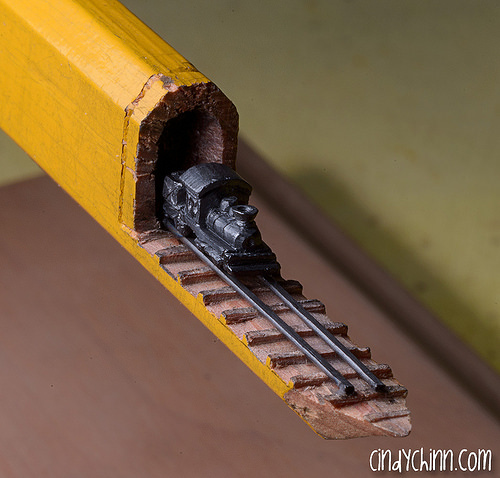
Cindy Chinn's intricate pencil carvings

The rest of Cindy Chinn’s pencil carving includes more cars and a trestle bridge. Amazing..

REPRISES/RESPONSES/REJOINDERS/RIPOSTES

Rebecca Solnit’s two pieces—Men Explain Lolita to Me and 80 Books No Woman Should Read—inspired and provoked reactions across the gamut, with people I greatly admire popping up from one end to the other. Personally, I think both ends of the spectrum protest too much. A sampling:

  • “That ‘80 Books’ piece was fun, and harsh… I keep running into women who really, really hate Henry Miller. I’d like to research this and find out why, but am so deeply sick of the gender wars now, and I like Miller’s writing so much, that I resist the desire. Ah, I like Solnit very much, but these two pieces rankled.”

  • “I can already hear the outpouring of offended men trying to explain Solnit’s articles to me and how they are wrong despite my living the experiences she describes. Please don’t.”

  • “Rebecca Solnit femsplains every negative male stereotype ever posited with a venom indicative of a fully closed and cynical mind. Pullleeez, no more.”

  • “I’m tired of articles like this [Solnit’s Lolita article]. I’m even more weary that the experiences she describes remain true and make such articles necessary. I’m exhausted in advance by those who complain that such opinions are unfair and one-sided and don’t take into account their support of women. Sure. And #alllivesmatter.”

  • “Oh, yay. Oh, yaaaaaaaaaaaaaaawn.”

  • “Solnit’s right. I doubt many will read closely enough to understand why or even that she’s making a nuanced argument. Whether from ignorance or weariness, I won’t hazard to guess.”

  • “Why do so many men get so upset when someone describes the behaviors of some men to them? If they aren’t part of the group being described, why do they feel so personally attacked? Solnit takes pains to show she isn’t talking about all men and that there has been progress in the world she lives in and observes.”


I welcome comments, suggestions, thoughts, feedback and all manner of what-have-you. Just press ‘Reply’ or email to: clippings@katexic.com.

Enjoy the WORK? Check out my other little project: Concīs Magazine » http://concis.io/

And please feel free to share anything here as far and wide as you want! If you want to give a shout-out, please link to: http://katexic.com/clippings/.

#273
December 29, 2015
Read more

|k| clippings: 2015-12-22 — the now and the knowing

RIP, Wendy Battin. A fine poet. A fine soul. A scientist in mind and poet of the heart who understood something about the quantum lattice of both. Wendy asked, not too long ago, why we called death “peace.” I have no idea, but I hope for Wendy that beyond this now comes that knowing.

WORK

“Geometry 1”

Courage: the heart times time.

Silence:

Reason: a program

Spring: a recoil, a coil, a

Helix: one body climbing a staircase

Matter: is dark, or light, or

Weightless: the thing that escapes when the earth lets go

Frogs shrill as April high in the trees.

Soon the sky will fall and I will be here to catch it.

—Wendy Battin
—from On Barcelona

WORD(S)

vernissage /vər-nə-SAZH/. noun. A private viewing of art or paintings before a public exhibition. From French vernir (varnish), and originally meaning the day before an opening, during which exhibitors could retouch and varnish their work.

“For the artists of Paris, the most important date in the social calendar always fell a day or two before the Salon opened to the public. Le jour du Vernissage, or Varnishing Day, saw hundreds of painters descend on the Palais des Champs-Élysées to put the finishing touches on their works, filling the exhibition hall with the scraping of ladders and the penetrating stink of varnishes, turpentine and drying oils.” (Ross King)

“He handed the girl a jar of ointment, happy to be present at a vernissage no larger than the skin area of a typist.” (J. G. Ballard)

“It matters very much that he chose her at his vernissage, that his work was what was being held up to where the light could get at it that night. ” (Andrew Hood)

WEB

  1. Men Explain Lolita to Me. A fine pairing: 80 Books No Woman Should Read

  2. NPR’s “Songs We Love” — 2015 edition. Nice interactive features and some good music.

  3. For a Shakespeare Anniversary, an Online Re-Creation of a 1796 Show

  4. 51 of the Most Beautiful Sentences in Literature. What are some of yours?

  5. Today is winter solstice—the shortest day and, obviously, the longest night—in the northern hemisphere. The word solstice is from the Latin for “the sun stands still” because of the way in which it appears to both rise (barely) and set (too quickly) in the same place for many days. Winter solstice is the occasion of natural celebration here in the Northern latitudes, but it has been the basis of festivities since ancient times when the myth was that if people didn’t celebrate the sun might not decide to return. At this time of year, I understand the fear. Just as Stonehenge was created to commemorate the summer solstice, Ireland’s Newgrange commemorates the winter solstice, the one time of year that the light shines through and illuminates the underground “triple spiral.”

WATCH/WITNESS

The History of Typography, in Stop-Motion Animation [click to view]

The History of Typography, in Stop-Motion Animation

REPRISES/RESPONSES/REJOINDERS/RIPOSTES

  • Reader B. on Peter Watts, author of last issue’s WORD(S): “Peter Watts is one fiercely fine writer.”

  • Reader J. expands on Peter Watts WORD(S) on free will: “…about the illusion of free will. Perception and motor control are actually more complex than that. Postdiction is the psychological term that addresses the illusion of backward causation. Benjamin Libet’s experiments tell us less about free will than they do about the difference between objective time and neural time.”


I welcome comments, suggestions, thoughts, feedback and all manner of what-have-you. Just press ‘Reply’ or email to: clippings@katexic.com.

Enjoy the WORD(S) section? Check out my other little project: Concīs Magazine » http://concis.io/

And please feel free to share anything here as far and wide as you want! If you want to give a shout-out, please link to: http://katexic.com/clippings/.

#272
December 22, 2015
Read more
  Newer archives Older archives  
Powered by Buttondown, the easiest way to start and grow your newsletter.