Stuff logo

Stuff

Archives
Subscribe

Stuff Stuff

Archive

Xanthan Gum

I have not forgotten — I simply had a couple early calls this morning, and that, in combination with a somewhat discombobulated week, has led to this edition’s going out a bit later than I’d prefer.

I beg your forgiveness for the businesslike quality of what follows — entering the twelfth hour of wakefulness, I feel my wit flagging.

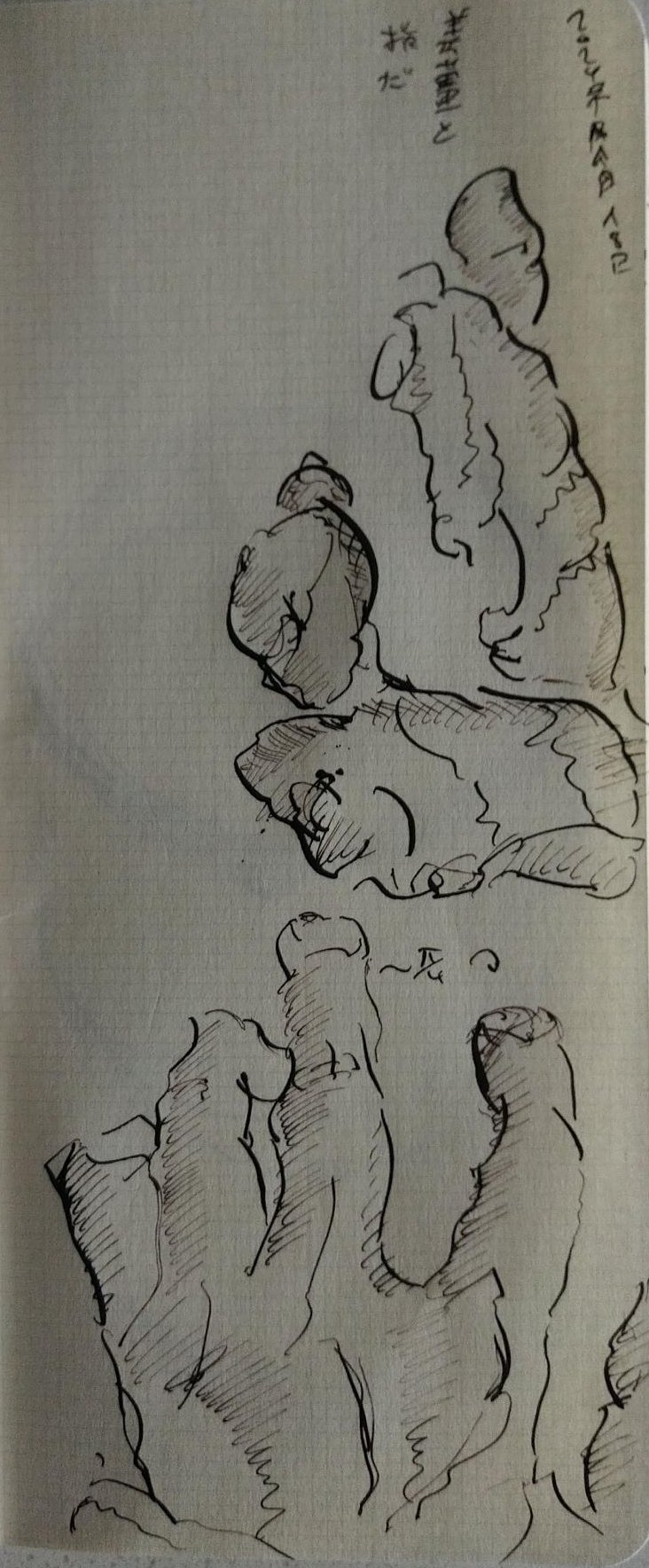
This week, casting about for new themes, I rediscovered hands.

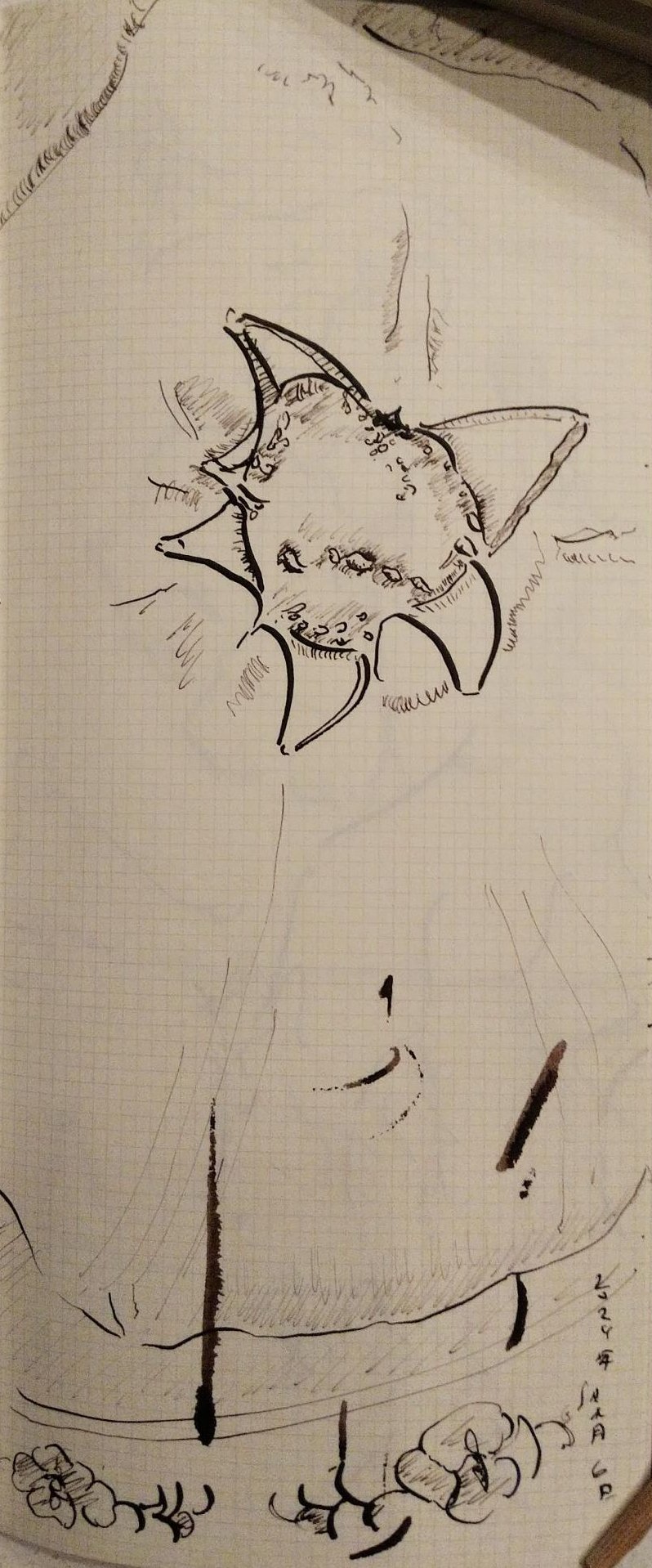
Hand and ginger
#42
November 23, 2024
Read more

Patina

… or, Mortal Decay

A strange thing happened this week, which is that I realized the book, if a book it be, I thought I’d started is in fact a different book. This came about when I observed that so many of my examples from the fragmentary passage I’ve shared, over the past couple weeks, on “how things acquire meaning,” come from the domain of taste. But this is not new — the first two examples, sriracha and broccoli, come from something I dashed off ten or eleven months ago, by way of preface to an experiment I’d had lying in the proverbial drawer since 2019 and which was now, improbably, to appear in a singular and largely forgotten journal known as Res. The third example from the Res preface concerned the furniture of George Nakashima, and this too is apposite, for it turns out the theme I thought I’d set aside but which has been lying in wait is patina. So today I’m going to offer a new opening, one that frames the three numbered sections from the past two editions as the way into an investigation of patina, plus a new section. At length this will knit up with markmaking, though how, precisely, remains to be seen.

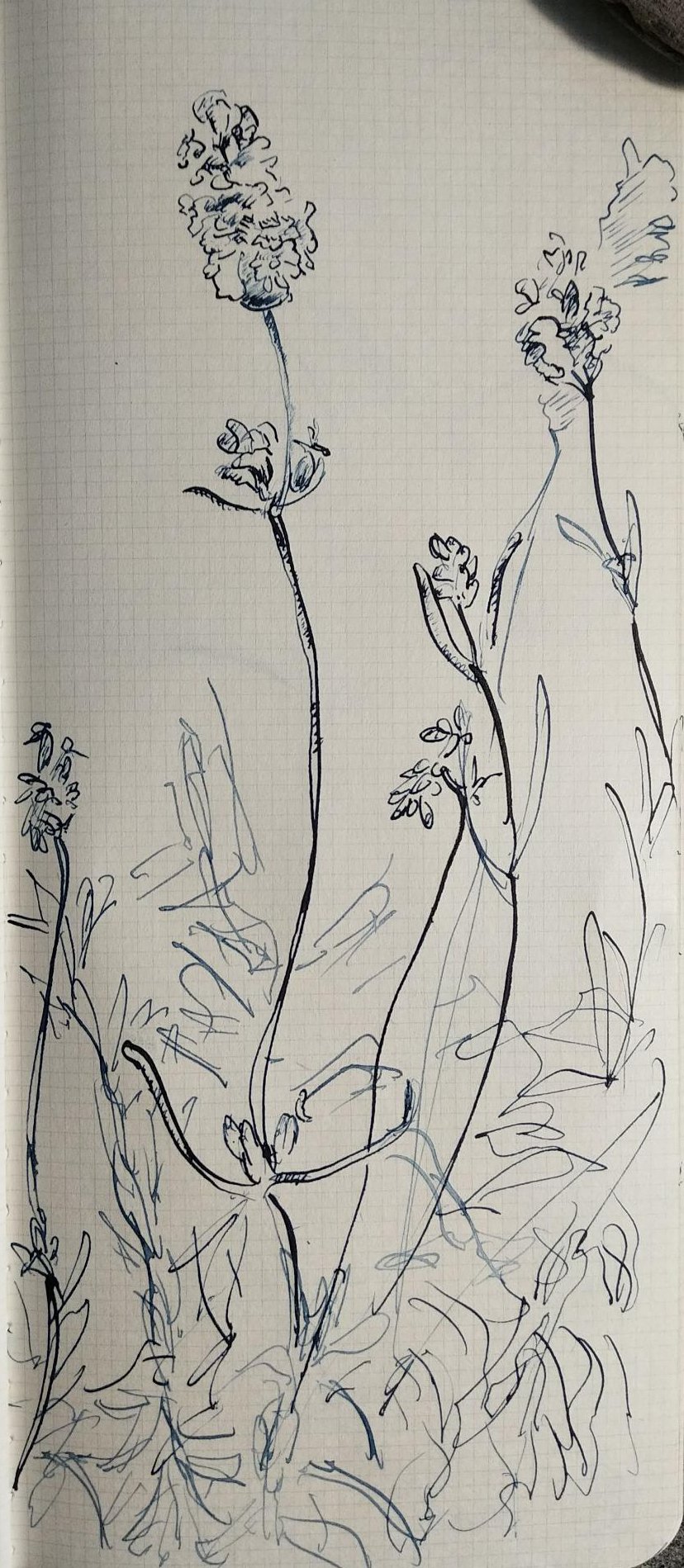
But first! It’s been a desultory week for markmaking. It’s not that I’ve neglected it, it’s just that, since last week, when we had the dog, I’ve found myself unable to return to things that hold still, or at least, plants. A lot of what I’ve been doing with the Zebra G this week has come down to experiments in technique — refining my control of line variation, learning (rather, failing) to render assorted shapes and textures faithfully, understanding the limits of the G, not to say pigment-based ink more generally. Chiefly these come down to limited possibilities for conveying translucency, the layered occlusion of materials that admit some light but not all, etc. Of course it’s eminently possible to dilute pigment ink and use it diluted on the nib, and this I’ve done with the other ink you’ve seen me using here, from Kakimori. But somehow, over the past month, since I started working with the Dominant Industry ink, I’ve got out of the habit of setting out a glass of lukewarm water when I work — maybe it’s just seemed like too much fuss, or maybe I’ve simply wanted to minimize the number of things that, in my clumsiness, I might knock over.

The upshot of all this is that I have fewer drawings to share this week, and what I have is not terribly interesting. But here you go.

#41
November 15, 2024
Read more

Infantile Egoism

Believe it or not, my plan for today was simply to pick up where I left off last week, but of course intervening events call out for commentary. But first, flex nib studies!

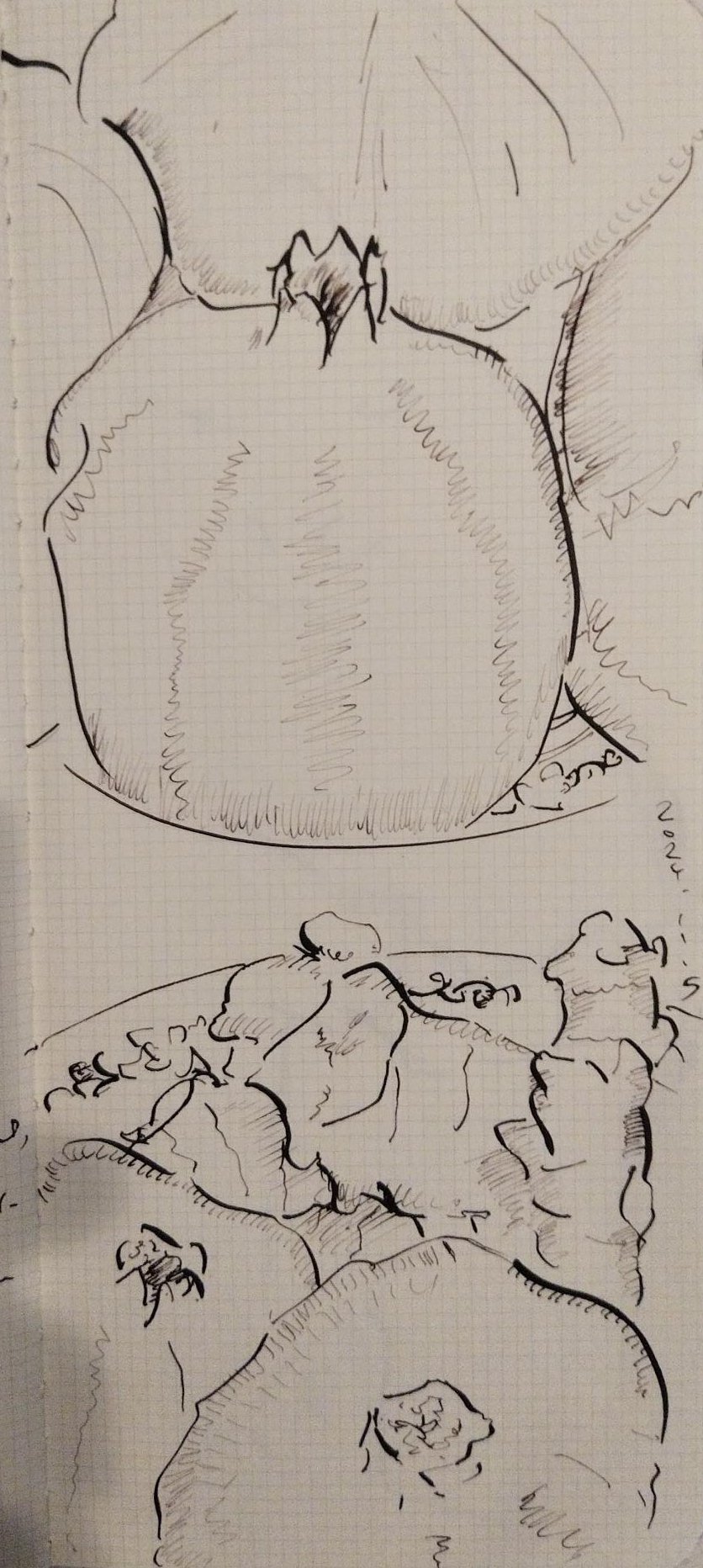
Pomegranates, ginger. Ginger continues to give me trouble.

Since I arrived in the mountains pomegranates have figured prominently in my visual field. The above is from Tuesday.

Dehiscence
#40
November 8, 2024
Read more

Being in One Place

It’s been weeks, five, in fact, since I last wrote, for which you have my apologies. Suffice it to say I’ve been in transit, from Berlin to Salt Lake City via Amsterdam, London, and New York, and circumstances have, if not conspired against my commitment to keeping this public notebook, then passively frustrated that commitment.

I can say, though, somewhat to my surprise, they did not frustrate my practice to continue making marks, so today, in lieu of a proper edition, I bring you a series of sketches from the past five weeks. You’ll observe I’ve changed format and ink — on the Zebra G we’ve got Dominant Industry’s Winter Wood (I’ve tended to be chary of warm colors, and I thought a morose compost brown would be a way to ease into the reds and yellows, but it turns out it’s a great color for drawing dying-back ferns too). At either end of the series you’ll see those old Sailor finger nail nibs — the first is the 21k no. 3 (circa 1971?), the second a 1967 14k no. 2 that I’m still getting the hang of — it has a very precise sweet spot, and if you try to use it with the nib at an orientation other than what it likes, it comes over scratchy … which is a useful experience in itself. The 1967 Sailor is loaded with Shikiori Miruai, a black-green that’s become my favorite cartridge ink. The paper is Yamamoto Ro-biki in their oddball vertical format … the plains are on backorder, so enjoy the meshwork-of-the-peeled-back-reality vibes of the 2mm graph. Scrub to the end for a special bonus.

#39
November 1, 2024
Read more

Manuports

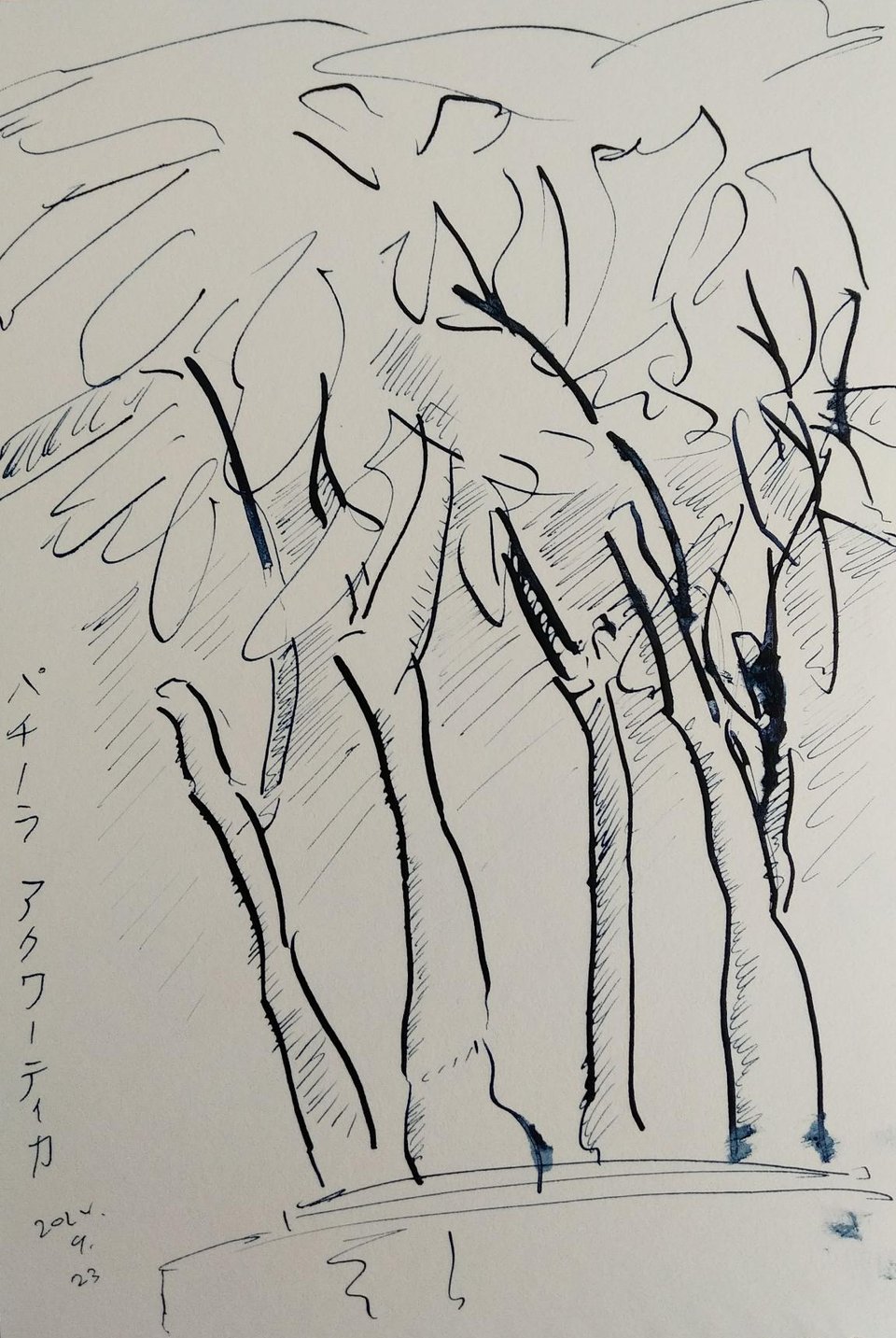
Pen and ink drawing of a Pachira aquatica
P. aquatica in a storm. This tree lives indoors — the storm was of the inner sort.

I promised there’d be more today on silica gravel and its significance for markmaking, so let’s not waste time. Consider this image, from a 2021 paper entitled “Self-care tooling innovation in a disabled kea (Nestor notabilis),” by Amalia Bastos and colleagues at the University of Auckland. Now consider Figure 6 (apologies, direct link is wonky) from a 2015 paper entitled “New Archaeological Evidence for an Early Human Presence at Monte Verde, Chile” by archaeologist Tom Dillehay and colleagues — Dillehay’s history with the site in question, which lies outside Puerto Montt in the Los Lagos region of Chile, goes back fifty years. While you’re at it, consider this correction to the Dillehay paper, which highlights a pair of accompanying figures. The format — stone artifacts knolled out[*] — is common in the archaeological literature, less so (perhaps unknown?) in avian ethology.

In the case of Bruce, a kea who was discovered having lost his maxilla or upper bill, the artifacts in question are pebbles from the floor of Bruce’s enclosure that the parrot used to preen himself for want of a bill (he appears to look for pebbles with a suitable wedge or conic shape, secures the broad end between the inferior side of his tongue and his lower bill, and uses the tip in lieu of a bill tip to comb his coat for nits and debris).

#38
September 27, 2024
Read more

Breaking in

Pen and ink drawing of a potted Pachira acquatica.
Pachira aquatica. I sense it’s got bigger in the five days since I made this.

So it appears the Zebra G does in fact break in, i.e., it gets more flexible (the tines spread more under equivalent pressure), not to say more elastic (rate of relaxation under release from pressure) the more you use it, at least to a point. Our Pachira aquatica has no doubt reaped the gains. In the sketch above, I was seated on the floor such that my eyes were about 40cm below the lip of the vessel, and if you’re familiar with P. aquatica you might spot the foreshortening this yielded: the canopy appears modestly compressed — admittedly, could be partly an effect of the edge of the paper — while the stems and especially the pot appear elongated, the latter evoking a dramatic volume it lacks in life despite my having left it incomplete.

I was going to open by saying I don’t know why I take such pleasure drawing this particular plant — rather, this particular kind of plant — but in fact I think I do. It’s not that it’s easier than other kinds of vegetation — the ovoid leaves are perhaps a bit more legible than those of its neighbor the poor dying-back sedum, or the dense herbaceous stems of the lavender visible, if you’re sitting at the foot of the P. aquatica, by turning your head in the other direction, through the window that gives on the balcony.

#37
September 20, 2024
Read more

Marks

Container garden: Zebra G, Kakimori Toppuri
Much to my chagrin, I have yet to identify this plant.

I had high hopes for this week’s edition, but we’re going start slow, and in lieu of anything approaching meaningful commentary I offer you these undeveloped efforts with a Zebra G Manga nib and Kakimori Toppuri ink (the paper is Traveler’s watercolor, simply because it was handy — for a sense of scale, the above comes from a B6 notebook).

Pigment inks lack the delicate shading you get with better dye inks, but they’re preferable for working with dip nibs as the greater viscosity lends itself to relying on the surface of the nib itself to serve in lieu of an ink reservoir. I must say, I’ve found myself nonplussed by the Zebra G, which has a reputation for flexibility — to my hand it feels a touch stiff, though it’s possible it’ll break in with use.

#36
September 13, 2024
Read more

Return

Greetings from a rainy south-facing coast. From where I stand at the kitchen counter I can see the sea. Over the past two months I’ve spent more time drawing than writing, and I sense this marks the point of departure for a new project, perhaps two. So today, by way of a new departure, I offer three poorly photographed drawings.*

With luck you’ll hear from me again next Friday and regularly thereafter. If this note gave you any solace, please share it with others.

———

* Pen: Sailor “long-short,” c.1971, no. 2 or 3 nib in 21k. Ink: Sailor Shikiori Kasasagi (鵲、“Magpies”) — the blue sheen does not show up in these photos. Markers: Copic Sketch BG78 and BG72, from the “Sea & Sky” pack.

#35
September 6, 2024
Read more

Hiatus

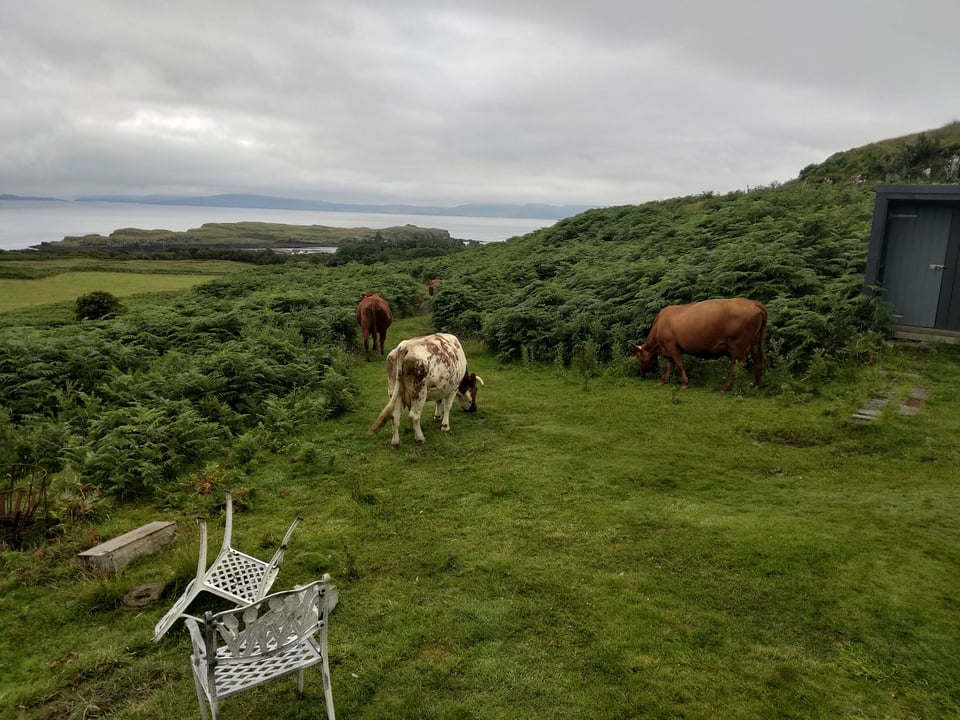
Forgive the abruptness of this announcement. STUFF will be going on hiatus for a while, that I might recover a bit from the cumulative strain of six years’ continuous application of pressure. Six years? That feels absurd, but it is about that long since I last had a week when I felt nothing hanging over me. That was on the Isle of Eigg, in the Hebrides, and Eigg remains among the most moving places I have ever been. So I offer you, in token of my thanks for your reading this nonsense the past ten months, a photo of the cows departing from our garden, our last morning on Eigg, July 21, 2018.

IMG_20180721_065408.jpg

With luck you’ll hear from me again in a matter of months. Many thanks to you all.

#34
July 6, 2024
Read more

Plate, bottle, net

Without boring you with the details, in the not quite three weeks since I returned from a four-day trip to New York(•) I have been beset in body and spirit, so in lieu of an edition of STUFF I offer you the following lines of Masaoka Shiki’s (1867–1902). Masaoka — Shiki was his style or pen name — contracted tuberculosis in his early twenties and spent much of his life in bed, convalescing. His work is full of sounds overheard, out of view: dusk chorus, people returning from a New Year’s party, a baseball game.(°)

ibiki ari
sara mo tokuri mo
kaya no soto

there is snoring
plate, sake bottle
outside the mosquito net(°°)

(Summer 1893)

#33
June 22, 2024
Read more

Buttons

Today, alas, I must be brief, with a desultory promise to bore you at length as we get into summer and the responsibilities associated with the final month of my tenure at the Wissenschaftskolleg ebb. As some of you know, the past year I’ve been going through a Trouser Emergency®. I am pleased to report it’s under control, thanks to the acquisition of a lovely pair of used 3sixteens in a 12oz Kuroki Mills left-hand twill, courtesy another of the anonymous kind souls on the far side of the planet who send me things. Alas, my relief was marred by the discovery, when they arrived, that the fly buttons are of horn, which, in view of other things I’ve said, would be off brand.

Naturally I turned to the best trim shop on the planet, only to find that they do not — yet? — stock fasteners. How can this be? Thread, fusing, binding, elastic, even surplus size tags of rPET — but no buttons. This turned out to be another blessing in disguise, else how should I have discovered there’s a thriving trade in vintage tagua nut buttons on Etsy? In the past I’ve used this forum to disparage archive fetishism in fashion, but faced with the choice of purchasing buttons machined last week in Hong Kong and buttons manufactured in Edwardian England, I was quick to see the appeal of wearing pants with fly fasteners from a time of gutta percha–insulated telegraph cables and strategic maneuvering over guano reserves (read Lord Jim). Perhaps it helped that last week, fighting jet lag on a brief trip to New York, I found myself flipping through Mrs Dalloway. This truly was the Golden Age of STUFF, save, as we’ve discussed, when it comes to writing instruments, when the Golden Age of STUFF was the early 1970s.

My frustration was not yet at an end, for it turned out I was unable to purchase the c.1900 tagua nut buttons for delivery to Germany, which has lately implemented a packaging waste reduction law that requires vendors to take responsibility for the final disposition of any packaging used to send stuff through the mail. A good idea in principle, but in practice burdensome to small vendors unprepared to deal with the regulatory overhead, including registration with a bespoke packaging registry, LUCID. From the LUCID Registration Frequently Asked Questions:

#32
June 8, 2024
Read more

Saturation

I thought this week I would turn away from material things, and then I heard splint (the soul of wood), new out with the Brisbane-based ambient label Room 40. splint is perhaps the final recording from Steve Roden, the Los Angeles–based painter, sculptor, and musician known for the genre of music he called “lowercase”, who died last year at fifty-nine, having been diagnosed, six years earlier, with Alzheimer’s disease. He described his method on splint thus:

every sound on this recording was generated by rubbing, bowing, plucking, and scratching a 1943 moulded plywood leg splint designed by charles eames. some of the sounds were recorded directly to tape, others were manipulated and processed electronically. … i used my hands, mallets, brushes, and a violin bow.

The splint in question is one of these. It was intended, I imagine, to facilitate the evacuation of soldiers with fractures of the femur. I was unaware of the Eames splint until I heard Roden’s performance with it. When I then looked it up I made the following note:

to imagine a time when medical appliances were made of mahogany plywood … when you’d want them to be objects of beauty, when the designer gave thought (perhaps I’m projecting) to how the appearance or feel of it would enter into the mindset of a wounded soldier … Look at the chirality of it

#31
May 25, 2024
Read more

Commodities, recontextualized, become objects of veneration

My notes to myself for this newsletter advise me to write it off the top of your head, but as I’ve just finished polishing a book, the top of my head is something of a waste sensu “broad and empty expanse” — which is kind of great from the inside, but perhaps not so interesting for readers. This book was a particular slog. For most of four years I’d been in the habit of starting over every five weeks or so, convinced that this time I’d found the way in. In January I decided it was ride or die. February, March, and April were, let’s say, pressured, so it was something of a surprise to find, rereading what I’d come up with, that perhaps it works. And I do sense I’ve freed whatever blockage (to continue the hydraulic metaphor) I’d been facing. Already I have a next book in view, on which more anon.

But first! To cheap behaviorist props aka rewards for grinding diligence, and what better reward for completing a writing project than … a pen! I’d promised myself a new pen (or new to me, it need not be newly made) when I completed this thing, and having got through the first polish with no sense it’d be better consigned to the filter bag of bad life choices I’ve felt a mounting pressure to make good on this promise. The problem, of course, is that this promise runs headlong into my well-advertised abhorrence of STUFF and particularly the acquisition of STUFF, so the past few weeks have had me in a state of fixation that has tested the patience of my long-suffering, overly charitable partner, as I’ve lost more hours than we really need to reckon on r/fountainpens, pen YouTube, and pen eBay, weighing the cons of acquiring a tube of machined acrylic produced in Hiroshima sometime around 1970 with a sectioned cone of 21-karat gold affixed to the end. High-karat pocket pens manufactured in quantity and marketed to school children fifty-plus years ago for a cool ¥1,500 have become the object of a strange … I don’t want to call it fetishism, because the appeal of these pens lies in the fact that they were in fact remarkably well made, and the Sailors in particular are loved for the way the nib tips are tuned — with an edge rather than rounded, so you get a pencil-like feedback. So really it’s the promise of that feedback, that tactile experience, that has me curious. Every now and then you’ll find a Sailor from that era with a nib content as high as 23k — not on their posh presentation pens, on pocket pens of the sort you imagine being packaged in cellophane with a paperboard insert and displayed on spinners in neighborhood stationery stores (though in fact, it’s possible that one, though similar in form factor to the cheap pocket pens, was sold in a satin-lined leatherette box (background).

If my mind were not a broad and empty expanse there are many directions we could take this: the way pedestrian commodities, recontextualized, become objects of veneration, the lock-in that obliges Sailor to continue manufacturing cartridges that fit the feeds on pens made fifty years ago. But I’ll leave these for another day.

At this point I should probably spare myself the agony of acquiring something that will stick around and simply get myself some tea.

#30
May 11, 2024
Read more

Interval timer

Monday I finished a book — finished it modulo light polishing, finished what has to be the final structural draft — so I spent the balance of the week absent in spirit, if not consistently in body. I thought I would use my spiritual absence to catch up on reading, not least a stack of papers on senescence in non-avian reptiles. The weather was cold, the news dismal, and it was a relief to sit around drinking tea and nudging forward various Time Kitchen–related nonsense. Alas, I got less reading done than I’d hoped, for I got sucked into a search for a new interval timer.

A while back I gave a workshop for the design team at a maker of posh loudspeakers. I had them all make one-minute recordings on their phones and then we sat around their studio on a rainy afternoon at the start of autumn when they were fresh off a product launch and exhausted and listening to their recordings on an eighteen-driver sound bar, which— as a monaural hearer, my grasp of “soundstage”, as audiophiles use the term, is limited, but I had never encountered a PA with the detail in the imaging that this thing had. Of course we were limited by the source material, which, again, they’d recorded with their phones—but most if not all of them were using Apple phones, which come with pretty good ADCs and microphones onboard, so these recordings of the automated announcements on the municipal transit bus, a neighborhood street fair, the rain outside a kitchen window, and so on had an uncanny popout quality to them. That evening at dinner we got to talking about the implications of the kind of work they did for the design of products that deal but peripherally with sound—washers, for instance. If you’re investing in a high-end washer (because maybe you want to wash your c.2016 Evan Kinori lounge shirt at home), you’d like to think that whoever designed and manufactured the thing gave thought to how it sounds—not just the “audio display”, the signals to indicate that the selected cycle has begun or completed, that the door’s been left open, etc, but the way the drum sounds when it’s churning. This example carries special significance for me, for two years ago I went through a period of weeks when, for reasons still unclear, the systole in (I suspect) one of my carotid arteries was audible to me in the evenings and mornings—and the first time I heard it I assumed it was because my partner was running the washer in the next room.

And yet, sometimes we acquiesce in sounds whose principle design considerations seem to have been ease of manufacturing rather than sonic properties. Don’t get me wrong—ease of manufacturing is a serious design consideration, and it can lend itself to remarkably elegant solutions. In the auditory display category, perhaps the best example is the Casio F-91W—or any Casio wristwatch from before the advent of the kinds of driver miniaturization we take for granted today. The Casio F-91W has no driver per se. Rather, the piezoelectric crystal is soldered directly to the steel backplate, which is secured to the resin housing at the corners but not across the surface. The backplate is thin enough that under the acoustic stimulus of the piezo it resonates like the head of a drum, producing a characteristic chirping timbre. By varying the frequency of the piezo vibration, you can, in fact, generate a range of pitches from the F-91W, and if you start writing complications for the F-91W module upgrade SensorWatch you can play with this, as the SensorWatch API includes affordances for audio signals at a range of pitches (of course, if you’ve installed the replacement module, you’ll have to solder the backplate to the new onboard piezo if you want to get any sound out of the thing … I kind of like the idea of a watch that makes no sound and gives signals in the visual channel, and as the SensorWatch features not one but two LEDs, one red, one green, you can actually do quite a bit more in the luminous channel than with Casio’s stock Module 593). (Full disclosure: I wrote the first alarm complication for SensorWatch — it’s since been bumped from the repo by a better one.)

These days, between tinnitus (~10,000 Hz, varying in quality but consistent in fundamental frequency) in my hearing ear and a notch in my hearing at round 5,000 Hz, I can barely hear the F-91W, especially if I’ve managed to roll over onto my hearing ear in my sleep. Occasionally I’ll hear it if the backplate is set on a stiff surface, which serves as a further amplifier.

#29
April 27, 2024
Read more

Porousness

There are not many of you: still, I feel a responsibility, and it pains me when two weeks have gone by — this morning it is 15 days — and I have not written. The trouble is, I’ve been finishing a book that, while it will end up being on the short side — to its credit — has been abusing me, in one fashion or another, for the better part of four years. We’re in the final weeks, modulo polishing — it was only mid March when I understood, finally, what it wanted to be about — and that’s absorbing whatever verbal capacities I might otherwise bring to bear on STUFF. Not to say the beautiful weather: the overcast this morning makes me long for a monsoon and, more particularly, for an excuse to lie on a cool floor making up the sleep I missed the previous night for the damp heat and insects coming in a tear in the screen. It strikes me, not for the first time, how much of my writing life consists in an effort to evoke the character and logic of hypnopompic states, states of coming-to. This character is not oneiric, exactly, but it shares with oneiric and hypnogogic states a loosening of the constraints on bodily behavior and the causal dispositions of matter more broadly that we infer from waking experience. It’s a state of porousness, receptivity, and no doubt it is a fool’s game to try to evoke it in words — but on screen! I think of Hirokazu Kore-eda’s Still Walking (歩いても歩いても), with its scenes of domestic tension blanketed by the heat of Obon, or Mo Scarpelli’s El Father como sí mismo, which, if you have not seen, what have you been doing with your time? Go watch it, now, today, so we can discuss it. I think too of Tsai Ming-liang’s Days(日子), or really of Tsai’s entire œuvre, since even when his protagonist Hsiao Kang, the indomitable Lee Kang-sheng, is not contending with flooded holes or selling real estate in the monsoon, he exudes a certain just-out-of-bed dazedness — save, of course, in the Walker films, where his slowness acquires the aspect of full realization. But Days in particular has a monsoon languidity to it, far more than Stray Dogs, though the latter unfolds over the course of a monsoon, and the protagonists’ search for shelter is a key motif.

Anyway, I was planning to write about Khruangbin’s new LP, A la Sala, and to observe that they’ve made an acid cumbia record without the organ and bandoneón, which, I don’t know about you, but the plangent harmonics of the organ and accordion have always grated on me. They’re a hair’s breadth from acid surf, which, I suppose, is where they started fourteen years ago, and I hope their next move is an EP with Gustavo Yashimura.

#28
April 14, 2024
Read more

Splicing of Tape

I’m overdue for this edition, but the “something coming on” I alluded to two weeks ago turned out to be a prostrating fatigue–type bug of epic proportions. Yesterday was the first day in ten I felt confident enough to walk to the store without packing a hammock, bug bivy, and space blanket lest I feel the need to stop en route for a nap, and while today, thus far, I’ve been more or less vertical in body, my mind has decided to take the week ahead off. Among the tasks I’d set myself this morning was the repair of noragi-type jacket (ok, it was a Kinori, but from 2016 or so, pre–Field Shirt–palooza, purchased used from one of the many pseudonymous kind souls whose help I require to get dressed). It is, I must say, well-made, with French seams and all the rest, though marred by the fact that the patch pockets are insufficiently broad to accommodate a Midori A6 notebook — then again, the material, a c.300gsm linen plain weave, lacks the structure to accommodate a Midori A6, so perhaps it’s just as well. Anyway, I’d been looking for something to wear over a t-shirt in overcast 19-degree weather of the sort we have today in Berlin, and it fits the bill perfectly save that, like every entrant in the hybrid noragi category, it has tape closures that serve no purpose other than to get in your way. I have yet to see a designer solve the noragi closure problem. Hiroki Nakamura at Visvim solves it by declining to include closures at all. Takuji Suzuki solves it with ingenious asymmetric inside-outside paired tapes that kind of work but feel fussy. Oil & Lumber opts for traditional mid-placket tapes … Prospective Flow, who knows, though if you’re not yet watching their boroboro handstitch videos, my god, what have you been doing with your time?

Anyway. Kinori’s solution is by far the strangest: bathrobe (‘dressing gown’)–style tapes sewn into the side seams. I had no idea what to do with these and resolved to take them off. This, with the help of my partner’s seam ripper and modest guidance, I proceeded to do — in the process, creating a gap in the exterior face of the aforementioned French seam on one side. The jacket looks much better without the tapes, and the seam is hardly in danger of coming undone. Still, this morning I thought I’d repair the damage. This should be a one-minute job. Instead, owing either to my aforementioned clumsiness or the shadow of prostrating fatigue (I feel something coming on …) it took some 20 minutes. But I was reminded how good it feels to draw a needle through fabric.

I will share that I improved my prostration reading an oral history of the San Francisco Tape Music Center and was consoled to learn that many of the early innovators in sample-based procedural music felt they had no facility with the actual splicing of tape, so perhaps there’s hope.

#27
March 31, 2024
Read more

Clumsiness

I had wanted to offer a follow-up to my note of last week — my thought was to start with the image of RiffRaff, the galah outside Brisbane who gets CBD oil by way of palliative care for pancreative cancer, taking the eyedropper in her beak and use that as point of entry into tooling, the relationship we enter into with a prosthesis via ongoing contact, so that the tool serves to create an altered interface between body and world. See, I am putting this poorly — I can feel my powers at an ebb on this undeservedly mild late-winter morning, and I am simply not feeling, as the anthropologist Dell Hymes put it many years ago, the “breakthrough into performance” that characterizes oral narrative, including something written to be heard as if it had been spoken.

(One man who is feeling the breakthrough into performance this morning is Bill Callahan, whose 2022 LP YTI⅃AƎЯ I’m listening to at the moment—

I feel something coming on
A disease or a song

In my case it’s definitely not a song, though in view of the weather we’ve been having there’d be no excuse for its being a disease. Anyway, I urge you to give YTI⅃AƎЯ a listen at your earliest convenience.)

#26
March 17, 2024
Read more

The Second Law

This edition is overdue, but I must confess I’m feeling a bit stumped for a theme. Spring has come early to Berlin — rather, we kind of skipped the second half of winter and went to spring sometime in the last week of January, and while everyone’s been holding their breath, waiting for the hammer to fall, I must say, I’m convinced we’re going to get off without more cold weather. For the first time in I don’t know how long, this week finds me free of late-winter depletion. Even in Los Angeles, the second week of March 2019, I recall feeling shot, not just by virtue of professional exertion but from the weather. When I’d arrived, the previous August, southern California was in the seventh year of a drought, and mature pines that had survived a number of yearslong droughts could be seen lodging, their roots lifted out of the dry earth. But that winter brought heavy rain — I recall driving I-10, the Santa Monica Freeway, east from the 110 junction to meet a friend in Culver City in a typhoon that all but idled drivers accustomed to desert weather.

And this brings me back to RiffRaff, the forty-eight-year-old galah who takes CBD oil for late-stage pancreatic cancer. Here, for the uninitiated, is RiffRaff at medicine time. RiffRaff’s caretaker, Leah Jigalin, interprets RiffRaff’s foot tapping as an expression of joy, and this seems reasonable. Birds of the order Psittaciformes — parrots and cockatoos — exhibit a tendency to rhythmic entrainment to a beat similar to our own, and, as in our own case, when birds groove it seems to represent both an expression and a source of pleasure. Grooving, in turn, appears to coöccur with a constellation of superficially unrelated tendencies: altriciality, for one, the tendency, common to humans and cockatoos, to experience a prolonged postgestational period of development — to be physically immature, and unable to take care of themselves, at birth. Other elements of the complex include object play, social play, and tool use.

Playfulness could figure in the development pathway for tool use by encouraging object exploration and the acquisition of a repertoire of flexible motor sequences adaptable to the different kinds of objects — proto-stuff, in the technical usage of this newsletter — that come to hand. As for why grooving should coöccur with an elongated developmental pathway tuned for the acquisition of tool-using skills, there we must be more speculative. But there’s no question that in humans grooving functions as a kind of episodic social glue, facilitating joint attention and coordinate action, as in the acoustic “taskscapes” that musicologist Gary Tomlinson, building on the work of evolutionary anthropologist Clive Gamble, has imagined for scenes of hominin butchery and tool making c. 1 Ma (million years ago). In an elegant study of ten years ago, my colleague Melissa Ellamil asked which factors, in a dance club setting, conduced to social grooving in a dance club setting. This was just one study, of course, and there’s a reason — multiple reasons — you don’t see more efforts at “cognitive ethology”, taking the methods of functional imaging science out of the scanner and into the world: it is difficult to do it well. But for what it’s worth: Melissa found that the strongest predictor of “group synchrony” was how well known the track was (her proxy for track reputation was number of scrobbles on Last.fm). And the strongest signal of group synchrony was reciprocating movement through the z-axis (i.e., forward and backward along a fixed sagittal plane).

Of course, a hundred twelve years ago Émile Durkheim, in The Elementary Forms of Religious Life, proposed that spontaneous social grooving — “collective effervescence”, as he put it — served more than an episodic function: that it was the basis for a longer-lived sense of group membership. But back to RiffRaff, and late-winter depletion.

#25
March 9, 2024
Read more

Field Shirt Arbitrage

The past two weeks, I’ve had two things on my mind, or two things that warrant comment. I ask your forgiveness, for both come from the New York Times. The first is RiffRaff, a forty-eight-year-old galah or rose-breasted cockatoo who lives near Brisbane, has been diagnosed with pancreatic cancer, and takes CBD oil to mitigate the cancer’s inflammatory effects. Perhaps you’ve seen the video of RiffRaff tapping rhythmically with her right leg when she sees the syringe approaching. Part of what holds my attention about RiffRaff’s display is how it drives home the relationship between play and the kind of exploratory manipulation of objects—stuff, in the technical sense of this newsletter—that gives rise, over developmental and perhaps evolutionary horizons, to tool use.

The relationship between play and tooling is something I want to come back to, but it’ll have to wait, because today we have more pressing business, namely, investment banker cum speculative urbanist Jan Sramek’s Evan Kinori field shirt, and omfg would you look at this bro walking the tracks in his $800 kakishibu-dyed lambswool-and-cashmere “field shirt” and, erm, maybe a pair of 501s and some kind of nubuck boot (Viberg Waxy Commander, perhaps? looks like he bought the whole Starter Pack).

Just get a load of my homeboy, with his steely thousand-mile gaze! This photo was made in December 2023 or January 2024 by one Aaron Wojack on the occasion of one of Mr Sramek’s recurring visits to Rio Vista, in Solano County, California, where, since 2016 or 2017, he’s been assiduously buying up farms and ranches with the intent of securing a zoning conversion and developing a city for 400,000, at one fell stroke solving the Bay Area’s housing crisis and providing a place to live for all the service personnel Sramek and his buds would prefer not live in the Bay Area per se. Of course he’s had help: early investors in Flannery Associates, the special-purpose vehicle spun up to manage the land acquisition phase of the adventure, not to say the bullying of holdouts, have included Marc Andreesen, Reid Hoffman, and the Collison Bros®. There is so much we could say about this, but this month we probably won’t get past Sramek’s Evan Kinori field shirt, and to explain why, let’s go to Thomas Pynchon’s 1990 novel Vineland, named for a fictitious Lost Coast county that sits somewhere between Humboldt and Del Norte.

#24
February 24, 2024
Read more

The touch of the real

Today, because I’ve been at the end of my tether and this note is eight days overdue, once more we’re going to try something new. I’m writing this off the top of my head, and if it proves undeserving of your attention I’d be grateful for feedback to that effect.

I’ve been at the end of my tether not just the past week but the past eight months, with periodic reprieves. The causes need not detain us today. Suffice it to say I’ve been more than a bit disgusted with myself and my working life, such as it is.

Amid this disgust I’ve sought refuge, like so many, in shopping for Frivolous Stuff®, and while my widely rehearsed horror of stuff (if you have not yet got round to a second or third reading of my 2021 The Human Scaffold, what are you waiting for?) makes it borderline impossible for me to take pleasure in acquiring new things save consumables like tea, woodcase pencils, notebooks, and 6/1 botanical-dyed needlework thread yall,(°) I seem to have created a loophole for old stuff, so long as it is not so old or in such good condition as to be really exciting — it has to have a certain junk quality to get past my Stuff-Induced Self-Hatred® filters. Toward the end of calendar 2023, staring down a pair of books that had been leering at me for too long, I decided that the path to absolution ran through better writing implements.

#23
February 11, 2024
Read more
Older archives  
Powered by Buttondown, the easiest way to start and grow your newsletter.