Stuff logo

Stuff

Archives
Subscribe

Stuff Stuff

Archive

One morning early in our acquantaince

One morning early in our acquaintance I came out to find Taslan Poplar in t-shirt and drawstring trousers, practicing a kata in the clearing in front of the house, moving with a fluidity I would not have expected. I squatted down with my tea to watch. After about twenty minutes he mounted the engawa and squatted down beside me. We talked about how good it was to be there: the quiet, the cool, clean air, how humbling it was—this was Taslan’s word—they’d been able to regrow the forest, or grow a new one, since in the old days you’d never find cypress and gum in the same place, something about mycorrhizal diversity, and how it was essential, at this stage, to bring everyone together in a place like this. I asked him was this place his and he said no, just a place he borrowed from time to time.

We went in to find the others getting up: making coffee, negotiating an unfamiliar space with unfamiliar bodies. We were there that weekend to plan a raise for an early-stage venture Taslan was backing in lab-grown regenerative skin care. The first thing we did, that morning, when everyone had seen to their needs, for stimulants or spinal twists or quiet time watching the day fill in, was watch a film of sea slugs regrowing their bodies from the head, the founder narrating excitedly over the music—oddly jaunty, like some unreleased cut from the Synergetic Voice Orchestra—pointing out how the heart lay on the far side of the breakage plane from the head, as did the digestive system, explaining how, by tying the neck with a loop of nylon thread, you could induce the slug to jettison its body. We watched in time-lapse as the tissue surrounding the nylon loop decomposed, turning cloudy, like spun sugar. At twenty-two hours, he said, jumping up and gesturing at the wall where we’d projected the image, the head separates from the body. We watched the head drag itself off, a tremor in the antenna-like rhinophores.

Takes about a day for the wound to heal, he continued, another week for the heart and parapodia to start coming back. Nine days post-intervention you could see the new heart beating. The image dissolved. We saw a half-slug, just the head and neck, capped off, at the rear, by a small loop of parapodium edged in black. At the anterior end the rhinophores were intact, the orange tips offering a pleasing contrast to the desaturated green of the head, and at first I thought it was using them to get around, but no: it was dragging itself forward by the mouth and ventral surface, same as any other of its kind. The body was covered in the dark flecks, not chlorophyll but some kind of autologous pigmentation, characteristic of its kind. It did not appear to be in distress.

At seventeen days, regeneration was more or less complete. The film ended with a still of an intact specimen of Elysia viridis. Our hero stood in the projector beam, so that the slug’s body was projected partly on his body, partly on the wall, calling our attention to the green speckling that marked the presence of chloroplasts in the tubule cells of the digestive epithelium, distributed, in this species, over the whole of the body, from the tips of the rhinophores to the edges of the parapodia. The slugs were said to be solar-powered, because it seemed, though the evidence was inconsistent, they could subsist, for a time, on energy generated by photosynthesis in plastids extracted from the algae they ate. It’s more prominent, he said, stroking his handlebar mustaches, in the fed state. The image dissolved into a panel of three stills, side by side, E. viridis, E. marginata, E. chlorotica, the lasta vibrant green. We listened, rapt, as he explained what made it so remarkable that the plastids should survive in the cells of the new host, in some species for weeks, much less that they should continue to function. Endosymbiosis, he said, is not like swapping a battery, the chloroplast genome has long since lost many of the genes essential to its own upkeep, including some of those implicated in photosynthesis itself. These are encoded in the nucleus of the endosymbiotic host—the alga—their expression mediated by signals from the plastid. In fact, signaling between plastid and host is bidirectional, the maintenance of plastid structure and its acclimation to changes in photoenvironment a product of ongoing coordination between the two. Selection, he added, operates on the plastid–host ensemble. We nodded thoughtfully.

#22
January 27, 2024
Read more

Spec course description, part 2

How Many Kinds of Persons Are There? This course, convened via seminar and intended for students who have had at least one previous course in anthropology, the history of medicine, or the philosophy of mind, introduces a theme foundational to all three: personhood. As it turns out, the answer to the question, How many kinds of persons are there? varies depending on whom you ask, when, and in what context. In some times and places it has been unremarkable to treat animals—or certain animals—as beings possessed of an interiority not unlike our own. In our own day, we have come to see it as unremarkable to ascribe personhood to corporations—in the United States, corporations have a legally sanctioned right of free speech. Should we treat automata that lack interiority—a something-it-is-like-ness—but exhibit qualities of speech similar to our own (e.g., large language models) as persons? What about biological chimerae? Should we ascribe personhood to rivers, as courts in Aotearoa New Zealand, in acknowledgment of Māori legal tradition, have done? To mountains? We’ll devote special attention to the challenge of bridging the hermeneutic gap between our own theories of personhood and those of some of the communities we’ll be discussing. Does it make it less difficult to imagine that Thunder, say, could be a person when we think about how we (some of us, anyway) talk to our favorite shirts? How should we interpret grammatical evidence that our working theory of personhood is not as tidy as we sometimes imagine—e.g., in 「車がいる。」, does the use of the animate verb show that we’re treating the (moving) car as a metonym for its driver? Or are we ascribing animacy to the car itself?

「車がいる。」kuruma ga iru, ‘There’s a car [moving].’

Again, it all sounds so easy.


#21
December 30, 2023
Read more

Spec course description

Spec course description, January 2022:

Eating, Drinking, and Smoking: The Anthropology of Food and Medicine. Ingestion—the introduction of foreign matter into the body cavity via the mouth—is among the most intimate things we do as animals, yet we do it all the time. It is also evolutionarily deep—internal digestion appears early on in the history of the Metazoa, and there are no clades where it subsequently disappeared. In this course, convened via a combination of lectures and discussions, we take these observations as starting points for a wide-ranging discussion of the history and anthropology of food and medicine. The fact that taking things into the body is both intimate and ordinary makes it a good starting point for considering how culture mediates our experience of our bodies and the other-than-self world—thus, this course represents, among other things, an introduction to anthropology as a discipline for interested students with no prior exposure to it. Case studies will be drawn from across the histories of food and medicine, with an emphasis on making the familiar strange and the strange familiar via comparisons between historical cases and the habits of eating and drug-taking familiar from our own lives. We will devote special attention to the ingestion of mind-altering substances, including sugar, caffeine, alcohol, and tobacco, along with more specialized substances such as pituri and ayahuasca. Working as individuals or in pairs students will be expected to formulate a manageable field-based research project of their own—Tokyo is perhaps the best city in the world for street food, not to say coffee, and opportunities to observe people consuming food and drugs “in the wild” abound. This project, together with participation in discussions, will serve as the basis for evaluation.

It all sounds so easy.

#20
December 23, 2023
Read more

Resembling our own

In July 2022 I gave a seminar on the theme “ignorance as a political strategy”—topical enough. Among the things we read was Yōko Tawada’s novel The Emissary, because it is short and accessible and because I had not liked it when I’d read it previously and wanted to see how others found it. The Emissary (2014; English translation 2018) describes life in a near-future Tokyo where the young are feeble while older people, those seventy and above, say, are no longer subject to bodily decline—some seem to grow more vital as they age. There has been some kind of environmental catastrophe, the nature of which has not been made clear to the people of Japan. The government seems to know more than it is letting on: those who vocally question official policy find themselves menaced. But then, it is not clear that the government is still the government—administrative functions appear to have been privatized. Japan has reverted to a state of sakoku, closure to the outside world—the protagonist, Yoshirō, laments the loss of the plush foreign towels, now banned, that he used to use—but withdrawal, apparently, is the condition everywhere, whence the need for emissaries, chosen from among the young.

I chose the book, as I said, for how it thematizes the cultivation of ignorance as a political strategy, be it one of control (keeping the populace in the dark) or resistance (separating one’s life from the public drama). But in the discussion, what drew our attention was how Tawada evokes her characters’ inability to imagine a future. Yoshirō, observed one of the participants, may be immortal. His great grandson and ward Mumei (“No name”) shows promise as an emissary but could die before he gets to go overseas. Neither of them seems able to form a picture of the world as it will be more than ten years out. In this respect, their situation resembles our own.

#19
December 16, 2023
Read more

The having just one

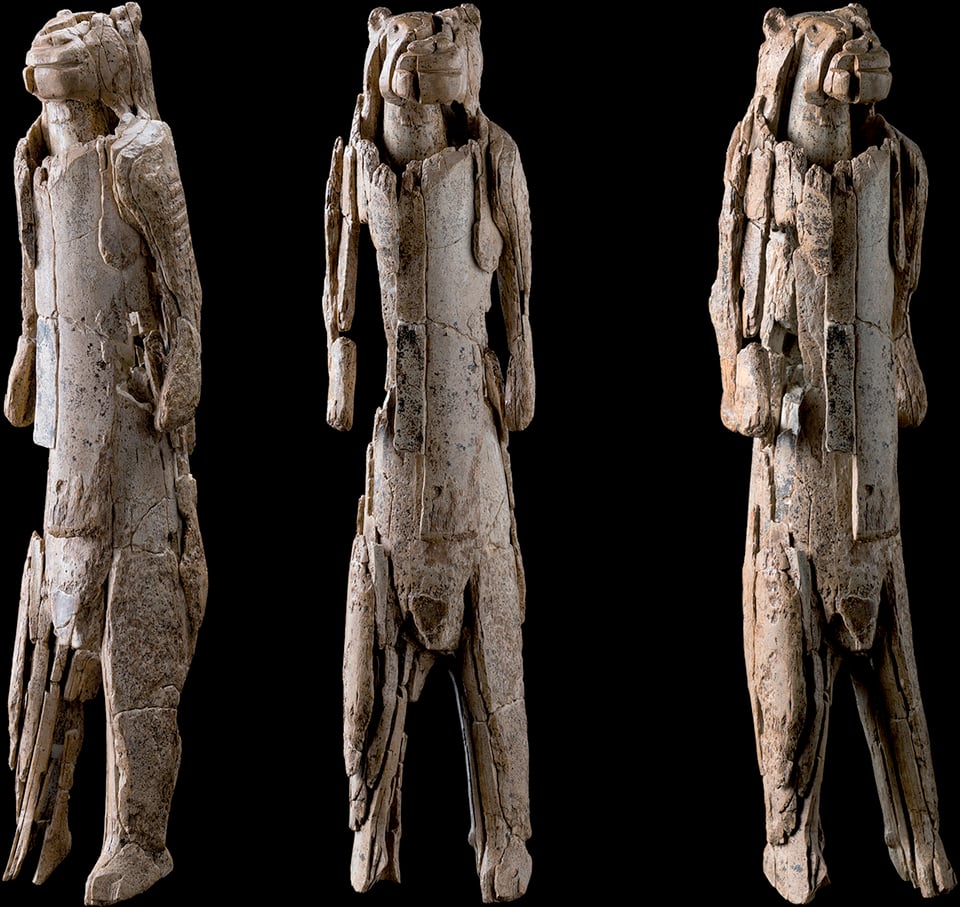
The uncanny allure of therianthropes, as the Hohlenstein–Stadel Löwenmensch (Lion-person), discovered in some two hundred fragments in a limestone cave in the Hohlenstein cliffs of Bade-Wurtemberg, southwest Germany. Unearthed in 1939, it was not until 1969 that they were found to form a figure. A restoration was undertaken in 1987; systematic excavation between 2008 and 2013 uncovered additional fragments, and a second restoration was undertaken. The figure was carved from the tusk of a mammoth and stands 296mm tall. It has been dated to 40–39 ka.

The Löwenmensch is unmistakably jaunty in posture and expression: standing arms akimbo, as if the hands were searching for trouser pockets, a relaxed grin spreading across their face.

Perhaps what gets us is not the having a body but the having just one.

Löwenmensch composite view (right quarter, ventral, left quarter)
#18
December 10, 2023
Read more

Made to patina

In 2015 I purchased a pair of pants, cut with a five-pocket dungaree-style pattern in the upper block, close-fitting, made of a texturized high-tenacity polyamide knit with elastane. I’ve worn them at least a thousand days. The elastane has lone since blown out, and they fit so loosely now I’ve had to get them rehemmed. For years the material refused to develop signs of age, then, quickly, it started wearing through. These days I treat them as track pants—they are good for running, in cold weather, and for wearing around the house in the evenings. Barring fire or innovation in fabric recycling, the stuff they’re made of is eternal. This fabric will remain intact long after the fabric of my body has been redistributed through the bodies of other living things. The best I can hope for is to cut it up and use it to patch other garments. When I do this, the thread I use will likely be five-gram (no. 25 1/6) cotton sashiko thread, perhaps dyed with chestnut skin for the contrast with the grayish blue of the nylon. The seam will fail long before the patch.

When I think about how I’ve invoked empirical findings in this text—about evolutionary transitions in individuality, neural crest development in jawless vertebrates, central pattern generation, gravity sensing in vascular plants, etc—I feel a similar mix of fondness and concern to what I feel when I imagine patching squares of fabric cut from the nylon dungarees into some other thing. On the one hand, this material is familiar to me, and the thought of carrying it around a bit longer, finding new uses for it, etc, gives me pleasure. On the other hand, the patched-in material feels out of place.

Of course there is a difference between, say, McShea’s comments on evolutionary transitions in individuality and the nylon fabric, which is that empirical findings, at least in principle, degrade gracefully over time. They are superseded by new findings or come under new scrutiny when implicit assumptions are made explicit. (Some findings prove dismayingly durable. So much of The Meat Question and The Human Scaffold consists in trying to persuade readers to look critically on assumptions common in the literature on nutrition physiology, the dynamics of social learning etc.)

Habits of thought, like clothing, houses, and kitchen furnishings, should be made to patina with use and, at length, return to the earth.

#17
November 29, 2023
Read more

Coloring us in

just as, in the experience of gravity, range of motion, the contractile activity of the heart and gut, and the distensive pressure of ingesta on the gut wall, we enter into a tactile relationship with the body.

Contrast this earlier passage:

… appeals to the conceit that when it comes to our explorations of the world our body is something we have a privileged relationship with. The body represents, as it were, well-surveyed country. This is a view I do not share.

Was I wrong earlier? Is the body known country?

#16
November 23, 2023
Read more

Killing it, pt 5

“But you’re not really ascribing interiority to a shirt or a bottle of vinegar—these are interactional gambits” —say, in the case of the shirt, a compliment that skirts the potential awkwardness of a more direct approach. Often characterization does serve a deflective role—it introduces a buffer between the “animator” of an assertion, request, etc and its recipients. In Nozawa’s survey, characters play an advisory role, raising the salience and softening the imperative force of notices, warnings, and injunctions—announcing disruptions to public transit, exhorting viewers to conserve energy (a lightbulb with closed eyelids).

My own view is that while often characterization represents an interactional gambit, this is not all it does. Characters are not simply puppets. Within the circle of conversation, just for a moment, they have a perspective, they look out on the world. They are present.

In characterizing things, in representing them as present to themselves, we make them more present, perceptually and conceptually, to ourselves and our interlocutors.

Consider the salience of verbs of contact in the foregoing. I want to say: to make something present is to enter into a kind of tactile relationship with it—just as, in the experience of gravity, range of motion, the contractile activity of the heart and gut, and the distensive pressure of ingesta on the gut wall, you enter into a tactile relationship with your body.

#15
November 16, 2023
Read more

Killing it, pt 4

22. (a)  I was delayed by the rain.
    (b)  I was made late by the rain.
    (c)  We were delayed by the rain.

23. (a)  The village was destroyed by the fire.
    (b)  The village was destroyed by fire.

With the arguments swapped, the light verb (22b) comes to sound a bit marked, to me anyway. Is this because the light verb invites an intentional interpretation, and when we defer the agent to a complement—by the rain—we confound this invitation? Strangely, even the lexical version, (22a), feels a bit marked in a side-by-side comparison with the plural patient. Somehow we sounds more apt as the patient of rain delay than I.

In (23) the difference is even subtler. In a sense there’s no comparison to be made, because the choice of (23a) or (b) is wholly determined by whether the fire in question was previously introduced as a topic of discourse. If it was, you’d have to go with (23a), if not with (23b). Even so, with the arguments swapped, (23a) tugs at me just a bit: if you’ve gone so far as to attribute agency to the fire, if you’ve issued the invitation to an intentional interpretation, why confound that invitation by swapping the arguments?

#14
November 9, 2023
Read more

Killing it, pt 3

Part of what makes (1c) and (5c) interesting is how characterization serves as an invitation to play. The speaker is practically obliging their interlocutor to participate in the ascription of interiority (to the shirt, to the bottle of rice vinegar). Consider again

   5. (a)  Where do you live?
      (b)  That pardalotte out back—where do they live?
      (c)  Where does the rice vinegar live?

In (1) we observed predicates of action. In (5), by contrast, we observe predicates of experiencing—specifically, the experience of dwelling.

(5c) is distinguished by a mismatch between our semantic template for experiencers of dwelling and the semantic profile of a bottle of rice vinegar. But we would hardly call this expression awkward, unless, perhaps, the speaker were new to our shared language and we suspected they lacked the resources to formulate the question in a more conventional way, e.g.,

#13
October 30, 2023
Read more

Killing it, pt 2

Let us call what we’re doing in (1c) above (see “Killing it, pt 1”) characterization—here I am borrowing from the linguistic anthropologist Shunsuke Nozawa. (1a) has a touch of it: in English, where lexical causatives are common, it is difficult not to hear light verb causatives as conveying intention, or at least this is how I hear them (compare the use of make as a coercive auxiliary, as in They made us line up to have our photo taken). Perhaps even (1b) is tinged with characterization, depending on your history with the verb destroy. And perhaps part of why the force of characterization feels so much stronger in (1c) than in (1a–b) has to do not with the semantics of the verbs in question but with those of the agents: rain and fire, even when made denumerable with the definite article the, feel topologically less apt for characterization than that shirt. Both shirtness and the demonstrative that contribute to the sense that we are dealing here with a particular individual. Compare:

   3. (a)  That rain made me late.
      (b)  That fire destroyed the village.

Here the use of the demonstrative that imbues the agent with greater individuality, and the sense of characterization is correspondingly stronger—at least to my ear.

Further examples of characterization:

#12
October 25, 2023
Read more

Killing it, pt 1

Consider the following:

    1. (a)  The rain made me late.
       (b)  The fire destroyed the village.
       (c)  That shirt is just killing it.

The expressions in (1) are causatives in the sense outlined earlier. At least, (a) and (b) are causatives. (c) is a bit trickier—but whether or not we’d call that shirt an agonist in Talmy’s sense, we can recognize it as an agent: the shirt is doing something.

The three expressions differ in verb semantics. (a) is a transitive light verb causative, the verb formed of a generic action (*make*) plus an adverb in a fixed position (following the object, preceding any complements, as in You’ll make me late for my call) and with a sense fixed by convention. (b) is a transitive lexical causative—the morph destroy conveys, on its own, the sense that the agent, the fire, has effected change in the world through its action on a patient, the village. (c) represents what functional syntacticists call an unergative construction: though that shirt is clearly an agent, there is no corresponding patient, nothing—at least, on the surface—that the shirt is acting on in virtue of killing it. The it is either an expletive object in the same sense that the it in It rained yesterday is an expletive subject—or perhaps you could construe the it as part of the verb and posit a distinct entry in our lexicon for kill it.

#11
October 21, 2023
Read more

Standing, squatting

Conversation with the editor of Waking Paralysis in the comments on what was to be the final pre-copyedit draft: he suggests I consider cutting a line that describes roadside sellers of grilled maize as “squatt[ing]”. “[I]f the corn is grilled near the ground, perhaps it’s accurate”—even so it might strike some readers as pejorative.

I try to make life easy for editors. But in this instance—perhaps it was the end of a long day—my response was a bit combative.

I’ve given this thought, and I’d like to keep squatted. To change it would be to whitewash the scene. In much of the world, squatting remains the modal posture of static wakefulness. When I was teaching in Shanghai, in 2018, one day I had the students working in small groups and I was circulating. At one point I squatted down next to one of the groups. One of my students expressed surprise that I could hold a squatted posture. She associated an inability to squat with whiteness. This was an educated urban 20-year-old. Anyone who takes offense at the suggestion that people squat needs to ask themselves why they consider it derogatory.

Forms of the verb squat appear, I see, twenty-two times in the 79,000-word text.

#10
October 17, 2023
Read more

Empty boxes

Almost anything was possible except, of course, the actual.

Murnane again, from “Land Deal” (1978).

[W]e had always clearly distinguished between the possible and the actual. Almost anything was possible. Any god might reside behind the thundercloud or the waterfall, any faery race inhabit the land below the ocean’s edge; any new day might bring us such a miracle as an axe of steel or a blanket of wool. The almost boundless scope of the possible was limited only by the occurrence of the actual. And it went without saying that what existed in the one sense could never exist in the other. Almost anything was possible except, of course, the actual.

Forty-four years later, FTX founder Sam Bankman-Fried, in an interview with Bloomberg’s podcast series Odd Lots, described crypto yield farming in remarkably similar terms:

#9
October 7, 2023
Read more

Sugar gyoza

Fragment of a note to a friend, late 2022, after we’d been speaking about the future of breakfast cereal—this was for a proposed project for one of the major cereal vendors. I had been describing the amateur YouTuber “SassESnacks”, whose carefully-mic’d recordings of herself eating chocolate cake, spicy salmon role, mochi, pizza, noodles, and a variety of “healthy snacks” have millions of views. Years after her death, in 2019, of pancreatic cancer, viewers continued to address SassE in the comments, telling her how much they missed her, how much her videos had helped them.

In this case I suspect watching and listening to someone eat has become a proxy for sharing food with them—perhaps being fed by them. In some of her posts a lot of the action consists in her preparing the meal first—this enhances my sense that what at least some devotees are getting from meokbang [Korean: “eating show”] is an experience of being cared for, of being securely held. Most of those who find their way into this scene, I suspect, have a pronounced ASMR [autonomous sensory meridian response]—they experience an evoked rheotactic sensation up the cervical spine and caudorostrally over the occiput in response to quiet reciprocating impulsive sounds (crackling, crunching, mixers, washers, muffled heartbeats). Whether you think this is a vestigial reward for crunching through charred long bones to get at the marrow or simply an epiphenomenon of neural crest ontogenesis and the evolutionary history of rheotactic mechanosensing inherited from teleosts, the effect is to feel as if someone were stroking you up the back of the neck while you watch them prepare something (for you?) to eat. That meets a deep need, especially if you’ve just come home at the end of a long day of building slide decks in a cubicle CAFO …

Of course the obverse of ASMR is misophonia. Do you really want to live in a world where you’re constantly surrounded by the sounds of people crunching cereal? Does cereal become a food of intimacy, a test of trust? The first time you eat cereal in front of someone without worrying about how they’re going to respond to the sound of your crunching—that’s a test.

In a sensory ecology of ubiquitous anosmia and declining taste buds, mouthfeel moves to the center of the pleasure of eating. The future is crunchy.

I wish I could say I’d punched up the diction to satirical effect. Alas, this is how I talk when no one is listening.


#8
October 2, 2023
Read more

Scrubbing a pan

A month before the thing with my hands I had an unusual experience sitting one morning:

2020-5-21

Awakening to not being awake … sitting, I feel myself pushing against something plastic. Like scrubbing copper that has oxidized or blackened—a vessel, say … what you see when you first start to scrub is not the original state of the copper, but the difference is stark enough to recall to mind what it looked like in its original state, the way it gleamed … is this an image that came to me sitting, or did I see it in a dream, or drifting off to sleep last night?

It’s not clear from this entry, but the experience I’m describing was one in which I felt as if my face were being erased. This is a rough approximation. It would be more exact, though perhaps less useful to the reader, to say that a cooking vessel, a saucepan say, had assumed the place of my face, and what I felt was that vessel being scrubbed, a layer of carbonization being removed.

The experience recurs twice in my journal from that year:

#7
September 27, 2023
Read more

Familiar, unfamiliar

I’m not kidding, each of them looked like they had 10 or 20 parent-hours in them. They looked like architectural models. Without exception, they looked exactly like the houses that were already in this suburb, except they had a chicken coop, a solar cell and an electric vehicle. And I took a lot away from that. It was absolutely, abundantly clear that they wanted a green future, but they wanted that green future to be very familiar.

Thus decarbonization consultant Saul Griffith, describing an exercise in speculative architecture he observed in Wollongong, New South Wales, in 2021, when his son’s year 6 (eleven-year-olds) class was asked to design a “sustainable” home. The they who wanted a green future but wanted it to be familiar is the parents.

Is it fair to say they wanted a green future that was familiar? Or simply that they were unable to imagine a green future—perhaps any future—that was unfamiliar? Is this a question of desire or of a limit to the speculative impulse?

I would go further than Griffith and say that what many people desire—certainly the inhabitants of an affluent place such as Wollongong—is timelessness. Or perhaps desire is too strong, for what I have in mind is not a reflexively articulated desire but an inclination, a basin of attraction. We (“we”) value continuity in our habits, above all in our habits of relating to others. Of course we value novelty too. But the desire for novelty tends to be satisfied with novelties of a superficial character—styles of dress and adornment, music, the flavors and textures of the condiments we use to vary our food—whereas the inclination toward continuity demands continuities of a more abiding kind: of relationships, perhaps of ways of getting a living.

#6
September 22, 2023
Read more

I looked down to find my hands

One evening early on in this project I looked down to find my hands were no longer attached to my body. From my journal:

2020-6-23

Yesterday evening around 9, sitting at the counter after eating, my hands resting on my stacked ankles, regarding them, the unaccustomed veinedness of the backs of the hands—an impression they were not part of me. Mild but clear, and unbidden: these were alien features of the world. It is not that I experienced revulsion for them or a desire to have them removed or destroyed … just a neutral dissociation. Looking at them now, on the keyboard, I can summon it again, even as they move under my command. An abiding awareness of the distinction between self and milieu …

The experience continued for a period of weeks. It came and went. At times, as I recall—though I do not see a record of this in my journal—it extended to encompass the entirety of the arms, the right arm in particular. At no point was it disturbing—often, in fact, it was distinctly pleasurable. It was less a tactile or proprioceptive experience than a visual one. Looking at my hands I experienced a recurrent alternation in the visual impression they made: now my hands appeared parts of a whole that I identified as my self, now they appeared separate. Soon I could flip my perspective at will and, again, there was something distinctly pleasurable in this. It was the same kind of pleasure as that of autonomous sensory meridian response, the tingling up the back of the skull some people experience when they hear certain impulsive sounds—crackling, crunching, the stridulation of orthopterans. It has since abated: looking down at my hands, once again on the keyboard, I can summon the dissociative sensation but faintly. But the memory of how pleasurable it was remains, as does the insight, if the term is warranted, that even the most settled-seeming of relationships, such as that of one’s hands to one’s body, is something that is continually being remade, with greater or lesser success.

(The experience I’ve described could be construed as a mild form of somatoparaphrenia. Reports of a sensation of limbs or extremities “floating free” are uncommon, though this may be mainly because experiences of this sort do not cause the distress and practical difficulties that lead sufferers of typical forms of hemispatial neglect to seek help. It is notable that the experience, in my case, was distinctly bilateral.)

#5
September 18, 2023
Read more

Thigmotropes

When I lived in Los Angeles I often went running on the ridge above our neighborhood, and my route included a fire trail that faced west toward the sea. Some of the trees I used to pass on the fire trail came to feel like friends.

My thoughts turn often to those trees and others I used to see in LA. Lately I have come to feel that friend does not do justice to the relationship I had with them. The word that surfaces in my mind when I recall reaching up to touch the limb of a bishop pine as I went past, or smelling the peppery-sweet scent of gum oil and looking up to see a spotted gum looming above, is familiar. These trees were my familiars.


Perhaps one thing I mean by familiar is that, in regarding the gum at the western end of Sea View Lane Trail in Mount Washington, Los Angeles—it is possible I have transposed this gum, in memory, from some other location—I understood the two of us as playing coordinate roles in some common undertaking. I understood us as being parts of something.

#4
September 13, 2023
Read more

The idea for this book

The idea for this book came to me at the end of August 2017, halfway through an artist’s residency at Shiro Oni Studio, Onishi, Gunma prefecture. The monsoon had come late, and the heat and humidity militated against vigorous activity of any sort. I spent much of my time lying on the cool tatami floor of my room, trying to recapture the sleep that had eluded me the night before. In the late afternoons I’d go around the corner to my studio, where I’d listen to a processed field recording I’d made in the local elementary school. I’d procedurally split the recording into overlapping 500ms segments that I then resequenced according to their spectral features and concatenated to make something new. The outcome was repetitive, shot through with the school attention chime that sounded halfway through the recording — the effect was like a cross between kulintang drumming and the stridulation of the kirigirisu or long-horned katydids that sang in the grass all night. I seemed to have stepped out of the timeline of my ordinary life and into an oppressively humid waking dream.


The foregoing (“The idea for this book ...”) is something I wrote as publicity copy for a different book, Waking Paralysis. But it could apply equally to this one. That makes three books to have come, in one fashion or another, from that six-week residency: The Human Scaffold (2021), Waking Paralysis, and this. If you pressed me for an account of what this one is “about” I might say: Sound, posture, time. Dissociation. Touch.

Those are things this book could be said to be about in the sense that they are things I have in mind as I work on it. But there’s a second kind of aboutness that attaches to made things, an aboutness of process. If you pressed me for an account of what this book is about in this second sense I might say:

#3
September 8, 2023
Read more
  Newer archives Older archives  
Powered by Buttondown, the easiest way to start and grow your newsletter.