
❤️🔥 man vs. bear
consent and the spectrum of desire
If I had a nickel for every time I was influenced to watch a horror movie by cultural analyses on TikTok, I’d have two nickels, which isn’t a lot, but it’s weird that it happened twice. The first was The Substance (2024), and the second was Obsession (2026). I hate horror movies, but in both cases I was so intrigued by TikTok breakdowns of themes and motifs that I finally relented (read: watched on small screens at low volume with the lights on). The brilliance of Obsession having a director that’s barely old enough to rent a car (26-year-old Curry Barker) is not only a fresh perspective, but that you have other Gen Z talent sharing their processes on TikTok—I loved Blair James’ breakdowns of the costuming.
But several videos I watched talked about the “real” horror of Obsession—that is, not Nikki’s unpredictable behavior but Bear’s selfishness. Everything from his negligence toward his cat to the way he dresses betrays a selfish personality; he isn’t in love with Nikki, but wants to be with her because it validates him as a person. According to Barker this was partly intentional—modern dating culture has made men paralyzed by the fear of saying or doing the wrong thing. But “Nice Guy horror,” a genre “in which the horror element is not supernatural but the casual dehumanization committed by men who see themselves as heroes,” is something only women can truly relate to, because of fundamental sexual dynamics at play—here “Nice Guy” is not a compliment but an indictment of men whose actions are decent but intentions are not.
Other films that, to me, fall into the “Nice Guy” horror canon:
The Stepford Wives (1975) and the remake (2004)
Ex Machina (2014)
Don’t Worry Darling (2022)
Blink Twice (2024)
Companion (2025)
At the time of its release, Ex Machina was mostly read as a film about the existential threat of AI and the ethical limits of consciousness, but more recently it’s been reevaluated as Nice Guy horror—a critique of the myth of genius and a warning about the consequences of allowing men to believe that they are masters of the universe and that their needs and desires supersede those of the people around them. I’m thinking specifically of the Asian female robot who doesn’t speak, is stripped naked for Nathan’s amusement, and then dances on command. Do we think Equinox stole their latest dumbass campaign idea from Alex Garland (techno-Orientalism has fascinated me for years, and in fact I wrote a whole slide about it in my Mad Max: Fury Road project four years ago)?
But I wanted to write about what I refer to as the “razor’s edge of consent,” the idea that the line between romance and horror rests on consent in the relationship (I use the example of the “Dobler-Dahmer Theory” from How I Met Your Mother). It’s something Nice Guys love to complain about—good-looking guys can get away with treating women poorly just because they’re good-looking! But the truth is that women are so constantly exhausted and traumatized by men violating them that the hottest fantasy is just genuine (i.e. not performative) decency and respect. The bar is truly in hell. I’ve heard some women call being nice “the free space on a bingo card.” It’s the very least you can do.
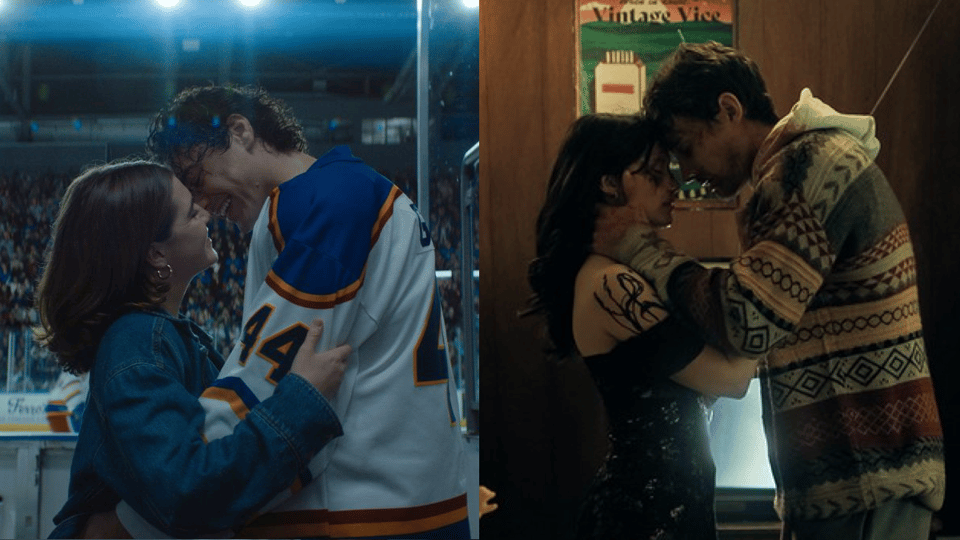
I had a longer word limit for this piece but I still had a lot of thoughts about this, so here are the the outtakes and extras:
🧾 scrap thoughts
In the original draft, I mention wedding cake-smashing as an example of normalized violence against women, and almost every article about its origins cites an article from The Knot, which claims it goes back to an ancient Roman tradition of a groom breaking a cake of wheat or barley over a bride’s head as a symbol of “fertility and dominance”—except that the source is literally just ONE (1) 24-year-old bakery owner with no apparent background in history! I found one actual text that confirms the Roman tradition, but it only notes that it symbolized good fortune, not dominance, so everything else seems to be retrofitted to the reconsideration of cake-smashing as misogynistic
As Princess Weekes points out, the Stepford Wives (2004) remake fails as a satire because it essentially blames the women for daring to be successful: “...the only reason for your anger, your resentment, your rage is really very simple,” the Men’s Association leader says to Joanna. “While you were trying to become men, we decided to become gods.” Which makes me think of one of the best lines in Crazy Rich Asians (2018), delivered by Astrid Young Teo: “It was never my job to make you feel like a man. I can’t make you something you’re not.”
Cat Person by Kristen Roupenian in The New Yorker remains a singularly stellar and deadly accurate example of the complexities of modern sexual politics; it’s less about the inherent moral goodness of either person and more about the the layers of social context that inform sexual interactions (which is why the playing field will never be truly equal)
“The way my mother always explained it, the traditional man wants a woman to be subservient, but he never falls in love with subservient women. He’s attracted to independent women. “He’s like an exotic bird collector,” she said. “He only wants a woman who is free because his dream is to put her in a cage.”” (Born a Crime: Stories from a South African Childhood by Trevor Noah)
In a post-screening Q&A panel, lead actors Michael Johnston (Bear) and Inde Navarrette (Nikki), recount their first interaction at a chemistry read, in which they awkwardly failed to connect in a handshake, which ended up being a perfect dynamic for the ill-fated pair—Johnston describes it as “brother-sister” and Barker jokes that “their lack of chemistry is what got them the role,” but there’s a kernel of truth there: there is no indication that Bear and Nikki are compatible or equally interested; the audience only sees Bear’s desperation to be with her
Many people have pointed out the Bear’s name coincides with the “man vs. bear” debate (a viral debate incited by a TikTok of interviewers asking women if they would rather be trapped in the forest with a man or a bear, which yielded some truly chilling comments: “no one will ask what I was wearing when a bear attacked me,” “nobody will say I liked the bear attack,” “the bear didn’t pretend to be my friend for months beforehand,” “if I survive the bear attack, I won’t have to see the bear at family reunions”) but Curry Barker confirmed it was unintentional
Against a backdrop of “ambient surveillance,” bodily autonomy is one of the last frontiers of power, which is why abortion bans under the guise of protecting children are so disgusting—you cannot take blood or organs from a corpse without the individuals’s explicit permission, yet in 2025, Adriana Smith was declared brain-dead but kept on life support by doctors against her family’s wishes, to essentially serve as an incubator for a nine-week-old fetus under Georgia’s LIFE Act, which restricts abortion once a fetal heartbeat is detected (as early as six weeks)
A lot of the deconstruction of the “Nice Guy” archetype is based warping audience expectations with casting, which we’ve seen before in Get Out where Allison Williams plays fresh-faced psychopath killer Rose, and in Promising Young Woman, a movie explicitly about the blurry lines of participation in sexual violence that weaponizes the nice-guy personas of the actors who had been heartthrobs and comedy darlings in the two decades prior: Christopher Lowell, Adam Brody, Max Greenfield, Christopher Mintz-Plasse, and Bo Burnham
You can read the full piece on the Playgirl website here.
💖 jenny
Thanks for reading Constellation Theory ✨! Subscribe to receive new posts and first access to projects.
to the stars 🚀This newsletter will always be free. But if you’d like to support the publishing fees or just show some love and appreciation, you can buy me a coffee (or boba) here! 🧋
