Your Feet Have Been Keeping Notes 📋
To the one whose feet have been filing daily reports she has never quite read,
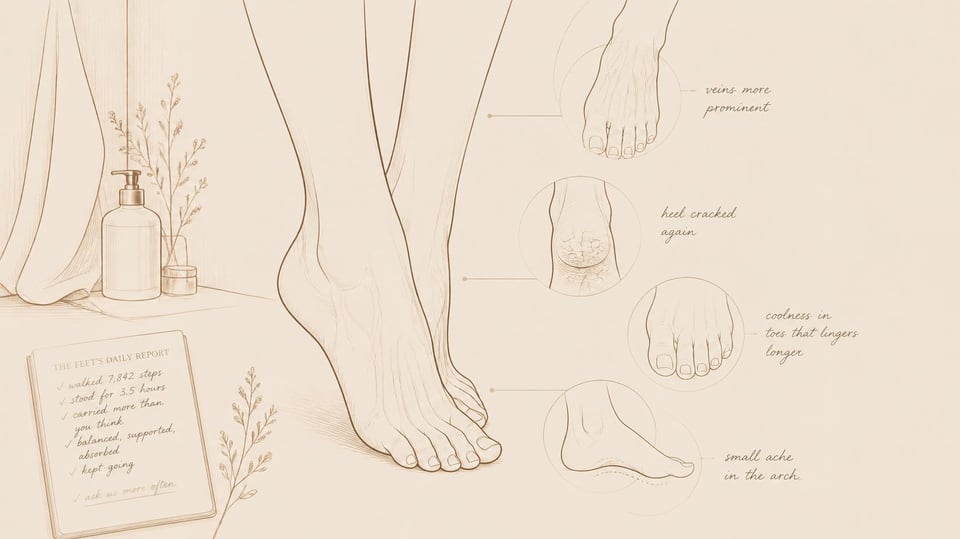
There is a particular moment, usually after a shower, when a woman glances down at her feet and thinks something noncommittal. That the veins on the top of the left foot have become more prominent. That the heel has cracked again. That there is a coolness in the toes that lingers longer than it used to, or a small ache in the arch that was not there last summer. She notes it, absently, and reaches for a moisturizer.
The feet, it turns out, have been keeping records. Meticulous ones. And Ms. Whitmore would like to gently suggest that they may be the most reliable correspondents in the entire body, precisely because no one has thought to ask them anything for years.
Every foot is a small dispatch from the systems upstream.
The feet sit at the end of your circulatory system's longest journey. Blood must travel down against gravity and, more impressively, back up against it, through a network of veins whose one-way valves have been quietly working since your girlhood. When those valves begin to weaken, which they do gradually in a large proportion of women by midlife, the first visible signs appear at the feet and ankles. Spider veins fanning out near the outer ankle. A slight puffiness at the end of the day that leaves the imprint of a sock. A faint aching after a long stand.
None of these are cosmetic details. They are early letters from the venous system, mentioning, in polite terms, that the valves would appreciate slightly less standing, slightly more elevation, and perhaps a walk. Research on chronic venous insufficiency suggests that somewhere between a quarter and a third of adult women show measurable signs of valve weakness by their fifties, often long before it registers as a medical concern.
The arteries, for their part, file their own reports. A foot that runs consistently cold, a nail bed that takes an unusually long time to pinken after being pressed, a strange absence of hair on the toes, or a small wound that heals more slowly than the same wound would have healed a decade ago, are all quiet messages about peripheral arterial flow. They are not, in themselves, cause for alarm. But they are, taken together, worth mentioning to a physician who knows how to listen.
Balance keeps its records here too.
The sole of the foot is, from a neurological standpoint, one of the most densely instrumented surfaces on the body. Its mechanoreceptors report continuously to the brain about weight, pressure, texture, and micro-shifts in position, and this stream of information is a substantial portion of what allows a woman to stand upright in a moving world without thinking about it. When these receptors are dulled, whether by decades of stiff shoes, thick socks, cold feet, or simply the gradual proprioceptive quieting that comes with age, balance grows subtly less confident.
A 2022 study led by Araújo and colleagues, published in the British Journal of Sports Medicine, looked at more than sixteen hundred adults between fifty-one and seventy-five and asked them to stand on one leg for ten seconds. Those who could not do it were nearly twice as likely to die within the following seven years than those who could. The study made no claim that balance itself was the reason. But balance, they suggested, is a remarkably efficient summary of many other systems at once, and the feet are where that summary gets written.
The joints of the foot are also reporting on how kindly they have been treated. The ball of the foot loses some of its natural fat pad cushioning in midlife, which is why walking barefoot on hard floors begins to feel less pleasant than it once did.
The arches, particularly in women, are more prone to gradual flattening in the years around menopause, in part because estrogen supports the elasticity of the ligaments that hold them up. When the arches lower, the alignment of every joint above them, from the knees to the hips to the lower back, is quietly renegotiated.
The report has been arriving. The question is only whether you have been reading it.
The remedies, as always, are quiet ones. The first is to spend a moment, once a week or so, actually looking at your feet in a good light. Not to inspect them for flaws, but to notice their news. A new prominent vein. A patch of skin that is drier than usual. A toenail that has grown differently. This is not vigilance. It is correspondence.
The second is to give the mechanoreceptors on the sole of the foot something to report on. Barefoot walking on varied indoor surfaces for a few minutes a day, or a short session of standing on a folded towel while brushing your teeth, gently reawakens the proprioceptive circuits. The feet learn best by being asked.
The third is to elevate your legs above your heart for ten or fifteen minutes at the end of a long day of standing. This is not a beauty treatment. It is a small courtesy to the venous valves, giving them a pause from the work of pushing blood uphill against gravity. Many phlebologists consider it one of the most underused interventions in vein health.
The fourth is to consider, when you can, shoes that permit the foot to move as an intelligent structure rather than as a passive one. A shoe with some flexibility at the toe and a heel no higher than the ball of the foot allows the small muscles inside the foot to remain in practice. Those small muscles are what will keep you steady on stairs in your seventies.
What Clara would like you to carry from this letter is the recognition that your feet have not been aging in silence. They have been writing to you every morning, in a small and modest hand, about the systems that carry you. The invitation is only to sit down, occasionally, and read what they have sent.
Ever on the side of the smallest correspondents, who write the most honest letters,
Ms. Clara Whitmore